
A VAT return is a mandatory tax form submitted to HM Revenue and Customs (HMRC) calculating the Value Added Tax a business owes or reclaims. Most VAT-registered UK businesses submit this digital return every three months, alongside matching tax payments, under Making Tax Digital rules.
Every VAT-registered entity in the United Kingdom tracks two distinct tax figures across each accounting period. Output tax represents the VAT charged to customers on taxable sales of goods and services. Input tax represents the VAT paid to suppliers on eligible business purchases and operational expenses. Subtracting input tax from output tax determines the net liability payable to HMRC or the refund owed to the company.
UK tax law requires all VAT-registered businesses to file returns digitally using Making Tax Digital (MTD) compatible accounting software. Paper submissions remain restricted to businesses holding specific HMRC digital exemptions. Accurate record-keeping prevents compliance audits, late payment interest charges, and statutory penalty points from accumulating against your company registration number.
What Does a UK VAT Return Measure and Report to HMRC?
A UK VAT return reports nine specific financial figures to HMRC, covering total sales, total purchases, output tax charged, and input tax reclaimed. This structured summary calculates the exact net VAT balance payable to the government or refundable to your business.
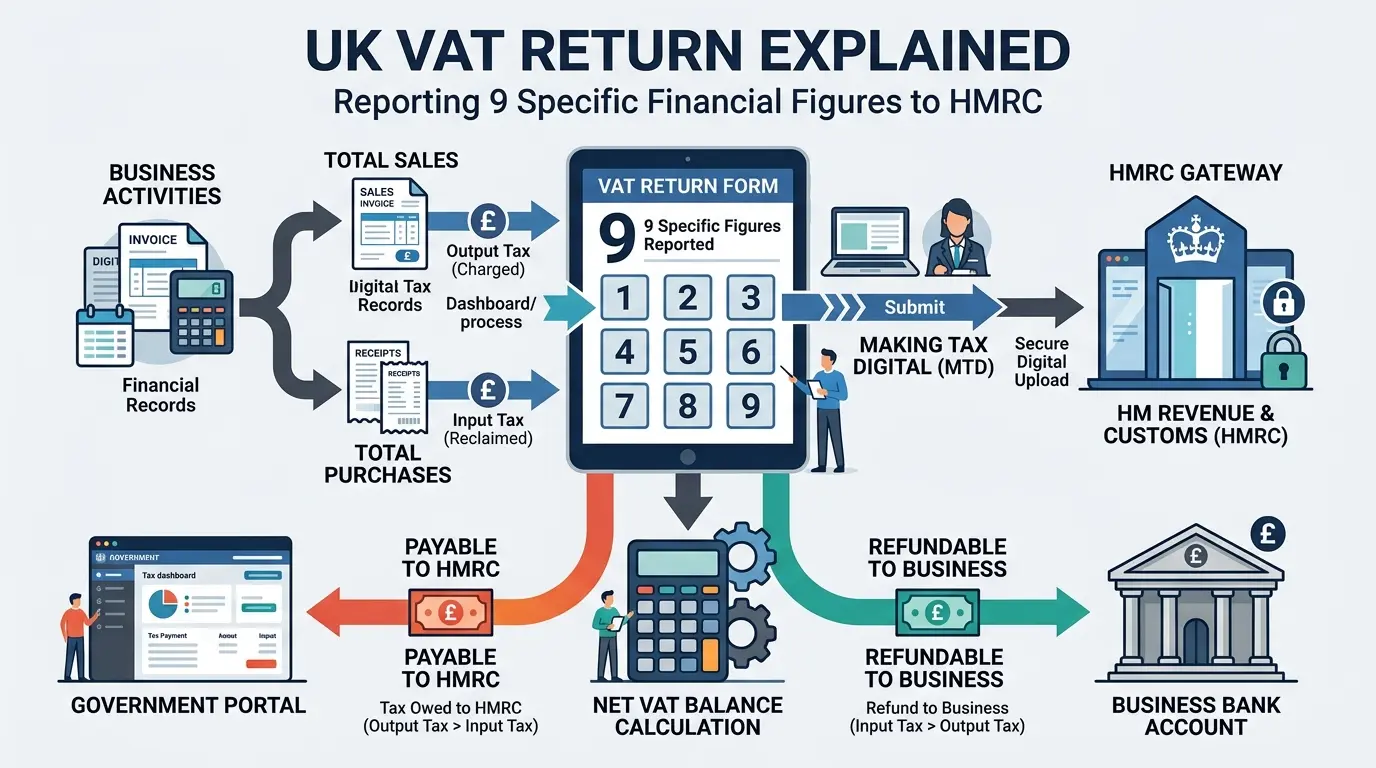
HMRC divides the standard MTD VAT return into nine numbered boxes to standardize financial reporting across all UK industries. Box 1 records the total VAT charged on sales and other outputs during the accounting period. Box 2 captures VAT due on acquisitions of goods from European Union member states into Northern Ireland. Box 3 automatically sums Box 1 and Box 2 to establish total gross VAT due.
Box 4 details the total input VAT reclaimed on business purchases, operational overheads, and qualifying capital assets. Box 5 subtracts Box 4 from Box 3 to establish the final net VAT payable or reclaimable. Boxes 6 and 7 record the net values of total sales and total purchases excluding VAT. Boxes 8 and 9 track the total value of goods supplied to and acquired from EU countries via Northern Ireland.
How Often Must UK Businesses Submit VAT Returns?
Most UK VAT-registered businesses submit VAT returns on a quarterly basis, equating to four submissions every twelve months. However, HMRC assigns monthly accounting periods for regular repayment businesses and offers an Annual Accounting Scheme for companies below specific turnover thresholds.
Quarterly filing aligns VAT reporting with standard three-month corporate accounting cycles. HMRC assigns each newly registered business to one of three stagger groups when issuing the VAT registration certificate. Stagger Group 1 covers periods ending in March, June, September, and December. Stagger Group 2 covers periods ending in January, April, July, and October, while Stagger Group 3 covers February, May, August, and November.
Businesses that regularly reclaim more VAT than they charge apply for monthly returns to accelerate cash refunds from HMRC. Construction firms, zero-rated food exporters, and early-stage companies incurring heavy capital expenditure frequently utilize monthly schedules. Conversely, businesses with estimated taxable turnover under £1.35 million qualify for the Annual Accounting Scheme. This scheme requires one annual VAT return alongside nine monthly or three quarterly advance payments based on previous tax liabilities.
When Are the Official HMRC Deadlines for Filing and Paying VAT?
The statutory deadline for submitting a quarterly VAT return and paying the balance due is one calendar month and seven days after the accounting period ends. Both the digital submission and cleared funds must reach HMRC by this exact date.
For a quarterly accounting period ending on 31 March, the submission and payment deadline falls on 7 May. Businesses using the Annual Accounting Scheme submit their single return within two months of the twelve-month accounting period end date. Electronic payment processing times vary depending on the chosen banking method, requiring careful treasury scheduling to avoid late settlement.
Direct Debit remains the most reliable payment method because HMRC automatically collects the declared liability three working days after the filing deadline. Faster Payments clear on the same day or the following day, including weekends and bank holidays. CHAPS transfers clear on the same working day if initiated before the bank cut-off time. Utilizing professional VAT Registration Assistance ensures your initial stagger group and Direct Debit mandates align correctly from day one.
Which UK Businesses Are Legally Required to Register for VAT?
Any UK business whose VAT-taxable turnover exceeds £90,000 within any rolling twelve-month period must legally register for VAT with HMRC. Businesses below this statutory threshold also choose voluntary registration to reclaim input tax on startup costs and supplier invoices.
The £90,000 threshold applies to a rolling twelve-month window rather than a fixed calendar or financial year. Business owners monitor cumulative taxable sales at the end of every month to detect threshold breaches immediately. Once turnover crosses £90,000, the business notifies HMRC within 30 days of the end of that month. Registration takes effect from the first day of the second month after exceeding the limit.
A business also registers immediately if it expects taxable turnover to exceed £90,000 within the next 30 days alone. Failing to register on time triggers a Failure to Notify penalty calculated as a percentage of the unpaid VAT owed from the effective registration date. Securing expert VAT Registration Assistance eliminates calculation errors during rolling turnover reviews and prevents retrospective tax assessments.
How Does Making Tax Digital (MTD) Impact VAT Return Submissions?
Making Tax Digital requires all UK VAT-registered businesses to maintain digital tax records and submit VAT returns directly to HMRC via compatible software. Manual typing into the old HMRC online portal is permanently closed for standard VAT-registered entities.
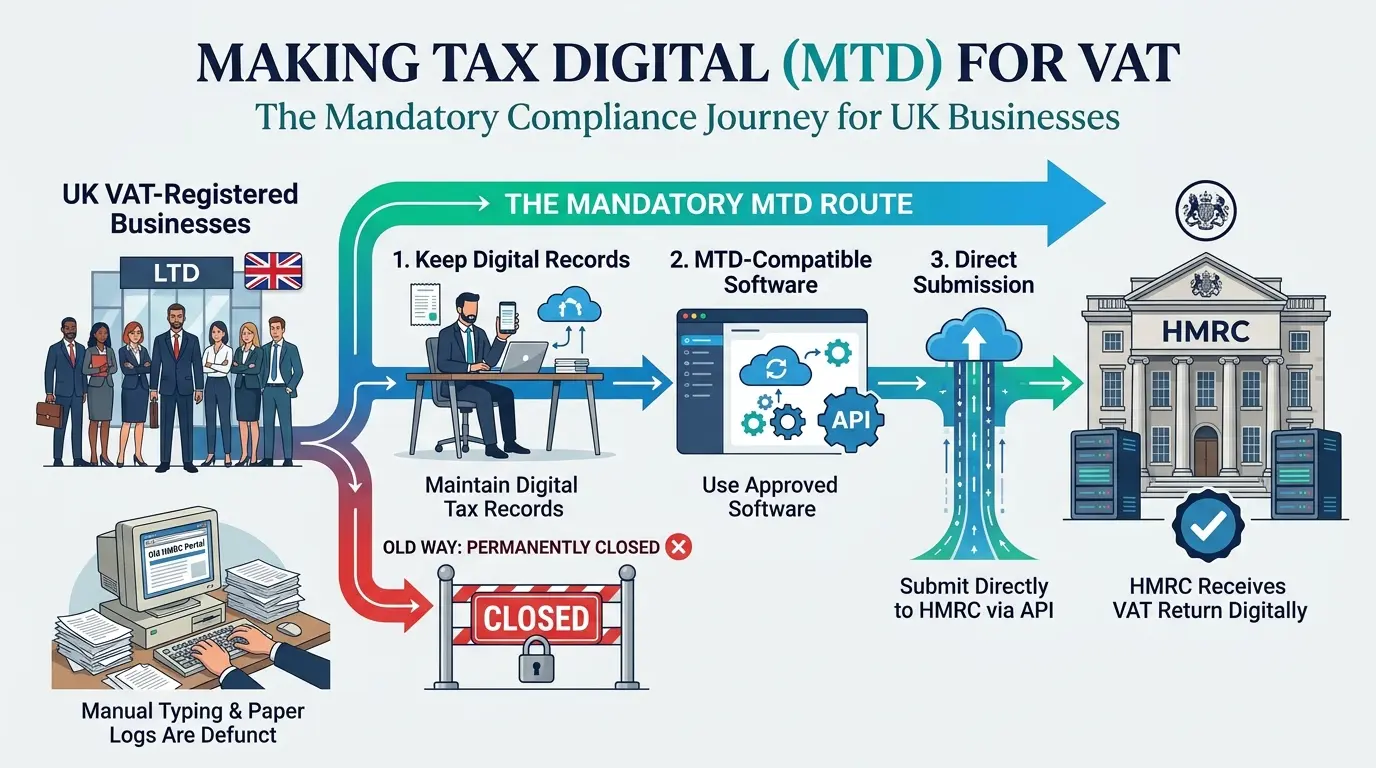
Under MTD regulations, businesses store core transaction data electronically, including business name, principal address, VAT registration number, and applicable accounting schemes. For every supply made and received, digital records capture the time of supply, net value, and the specific VAT rate applied. Standard-rated items carry a 20% VAT charge, reduced-rate items carry 5%, and zero-rated items carry 0%.
Digital links must connect all software programs used to compile, adjust, and submit VAT figures to HMRC. Copying and pasting figures manually between separate spreadsheets violates HMRC digital link mandates. Approved bridging software connects legacy Excel spreadsheets to HMRC APIs without breaking the required digital audit trail. Evaluating your accounting architecture through Tailored Tax Solutions: How Form My Company Evaluates Your Business Turnover for VAT confirms full compliance with MTD API standards.
What Penalties Apply for Late VAT Returns and Late Payments?
HMRC enforces a points-based penalty system for late VAT submissions alongside tiered financial charges and daily interest for overdue tax payments. Accumulating four penalty points on a quarterly schedule triggers an automatic £200 fine for every subsequent late filing.
Each missed filing deadline adds one penalty point to your HMRC compliance account. Monthly filers hit the £200 penalty threshold at five points, while annual filers hit the threshold at two points. Penalty points expire after 24 months only if the business remains below the threshold. Once a business hits the threshold, points reset to zero only after completing a period of full compliance and submitting all overdue returns from the previous 24 months.
Late VAT payments incur separate financial penalties starting 16 days after the due date. Payments made between 16 and 30 days late attract a first penalty equal to 2% of the unpaid VAT balance. Payments overdue by 31 days or more incur an additional 2% charge, bringing the total penalty to 4% of the outstanding tax. From day 31 onward, HMRC also applies a second penalty accruing daily at an annual rate of 4% until the balance clears in full.
How Can Businesses Prepare Accurately for Each VAT Accounting Period?
Accurate VAT preparation requires reconciling bank feeds weekly, validating supplier VAT invoices, and separating taxable sales from exempt income before the quarter closes. Maintaining dedicated tax reserve accounts prevents cash flow shortfalls when quarterly liabilities fall due.
Valid supplier invoices must display the supplier’s nine-digit VAT registration number, invoice date, tax point, net amount, and VAT rate charged. Reclaiming input tax without a valid VAT invoice results in disallowed claims and accuracy penalties during HMRC inspections. Businesses also exclude non-deductible expenses such as client entertainment and personal motoring costs from Box 4 calculations.
Setting aside 20% of gross customer receipts in a separate business savings account protects working capital against sudden tax bills. Reviewing How to Manage Cash Flow Challenges When Paying Quarterly VAT Bills provides structured treasury strategies for balancing supplier payments with HMRC deadlines. Implementing these disciplined bookkeeping routines alongside reliable VAT Registration Assistance keeps your reporting accurate across every tax cycle.
Submitting accurate UK VAT returns on schedule protects your business from HMRC penalty points, late payment interest, and compliance investigations. Understanding the nine reporting boxes, rolling £90,000 registration thresholds, and Making Tax Digital software rules establishes a predictable tax routine for growing companies. Form My Company delivers structured VAT Registration Assistance to verify your turnover thresholds, configure your HMRC stagger group, and align your digital reporting obligations from registration onward.
Explore More VAT Registration Assistance Guide,
Get Fast Certified Formation Documents From Form My Company
Skip the Solicitor Visit With Certified Documents From Form My Company
Frequently Asked Questions
When do UK businesses need to register for VAT?
UK businesses must register for VAT with HM Revenue and Customs (HMRC) once their VAT-taxable turnover exceeds £90,000 within any rolling 12-month period, or if they expect to surpass this threshold within the next 30 days alone. Form My Company monitors rolling monthly revenues and manages the application process through its VAT Registration Assistance service to ensure timely registration without incurring statutory late-notification penalties.
How long does it take to get a UK VAT registration number from HMRC?
HMRC typically processes standard online VAT registration applications and issues a nine-digit VAT registration number within 14 to 30 working days, though applications requiring additional identity or trade verification can take longer. Utilizing professional VAT Registration Assistance from Form My Company ensures all supporting business documentation, bank details, and director credentials are accurately submitted upfront to prevent processing delays.
Can a UK business register for VAT voluntarily below the £90,000 threshold?
Yes, UK companies with taxable turnover below £90,000 can apply for voluntary VAT registration at any time, provided they make or intend to make VAT-taxable supplies. Form My Company evaluates your supplier expenses and client base via its VAT Registration Assistance service to help you reclaim input tax on business purchases and enhance commercial credibility with B2B clients.
What documents are required for UK VAT registration?
To complete an HMRC VAT application, a business must provide its Companies House incorporation number, Unique Taxpayer Reference (UTR), UK business bank account details, principal place of business address, and accurate turnover figures. Form My Company streamlines this compliance stage through dedicated VAT Registration Assistance, verifying your Standard Industrial Classification (SIC) codes and transaction records before submission.
What happens if a business misses the HMRC VAT registration deadline?
If a company fails to notify HMRC within 30 days of the end of the month in which its turnover exceeded £90,000, HMRC backdates the registration effective date and charges VAT on all taxable sales made since that date. Engaging Form My Company for prompt VAT Registration Assistance minimizes the risk of Failure to Notify penalties—which can reach up to 30% of the unpaid VAT—and establishes compliant Making Tax Digital (MTD) reporting from day one.