
Businesses manage quarterly VAT cash flow by separating collected VAT into a dedicated reserve account, forecasting liabilities weekly, and selecting cash-aligned accounting schemes. Implementing HMRC Time to Pay arrangements and matching supplier payment terms prevents sudden liquidity shortages during quarterly tax deadlines.
Quarterly Value Added Tax obligations create predictable liquidity bottlenecks for growing enterprises across the United Kingdom. When companies collect 20% VAT on customer invoices, that capital temporarily inflates operating bank balances. Spending this tax revenue on daily operational expenses causes severe working capital deficits every 90 days.
Effective treasury management separates operational revenue from tax liabilities immediately upon invoice settlement. Finance teams track net cash positions rather than gross bank balances to avoid accidental overspending. Structuring internal accounting workflows around HMRC submission cycles eliminates last-minute borrowing and statutory late payment penalties.
Why Do Quarterly VAT Bills Create Cash Flow Bottlenecks?
Quarterly VAT bills create cash flow bottlenecks because businesses collect tax over three months while paying expenses on shorter cycles. Unsegregated bank accounts disguise actual working capital, leading companies to spend HMRC funds on payroll, inventory, or overhead before the deadline.
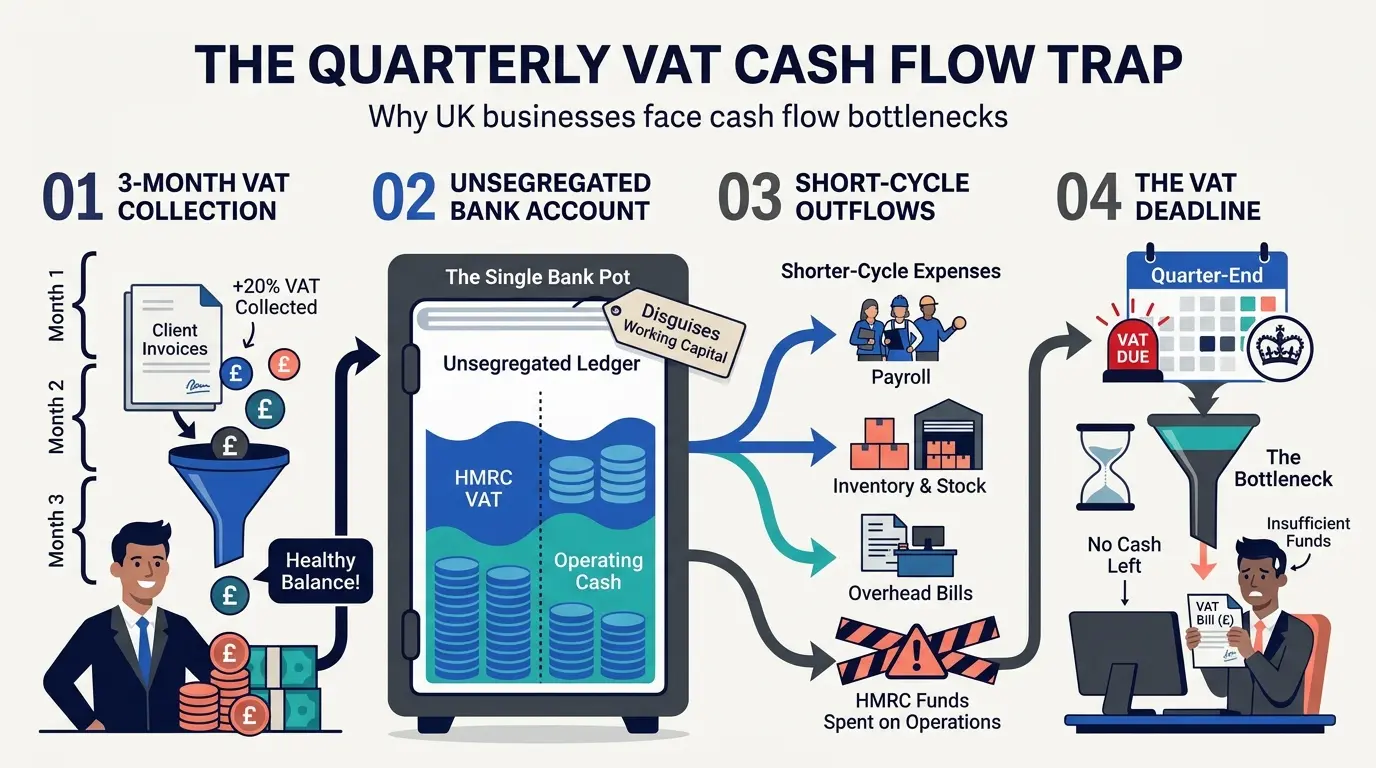
Standard VAT accounting requires businesses to report and remit tax based on invoice issue dates rather than payment receipt dates. If a company issues a £50,000 invoice with £10,000 VAT in month one, HMRC demands that £10,000 at quarter-end. When clients take 60 to 90 days to settle invoices, the business funds the tax liability out of existing cash reserves.
Operational commingling compounds this timing mismatch across 64% of UK small and medium enterprises. Keeping VAT receipts inside primary current accounts creates an illusion of surplus liquidity during months one and two. Directors allocate those funds toward stock replenishment or marketing campaigns, leaving insufficient capital when the quarterly return falls due.
Three primary operational triggers accelerate these quarterly deficits:
Accumulate unpaid customer receivables beyond standard 30-day credit terms
Purchase zero-rated inventory that generates zero reclaimable input VAT
Experience seasonal revenue spikes immediately preceding a quarterly VAT cutoff date
Understanding these baseline mechanics begins with reviewing What Is a VAT Return and How Often Must UK Businesses Submit It? to map exact reporting windows. Aligning internal billing cycles with statutory HMRC deadlines prevents unexpected capital outflows.
How Does Segregating VAT Funds Protect Working Capital?
Segregating VAT funds protects working capital by transferring the 20% tax portion of every paid invoice into a separate high-interest deposit account. This isolation prevents accidental spending on operational overheads and generates modest interest returns before the quarterly HMRC transfer.
Opening a dedicated business savings account solely for tax reserves establishes an immediate firewall around HMRC liabilities. Modern cloud accounting platforms calculate the exact VAT component on every incoming transaction automatically. Finance teams transfer that exact percentage weekly, ensuring the reserve balance always matches the accumulating VAT control account.
Keeping tax funds outside the main operating account forces leadership to make spending decisions using true net revenue. If an operating account holds £40,000 instead of £48,000, managers adjust discretionary purchasing to match genuine liquidity. This discipline eliminates emergency overdraft usage and preserves credit lines for strategic growth initiatives.
Automated banking rules streamline this segregation process without increasing administrative workloads. Many UK business bank accounts allow sub-accounts or automated percentage sweeps upon deposit clearance. Setting a 20% automated sweep on standard-rated sales guarantees full liquidity on the seventh day of the second month following quarter-end.
Which HMRC VAT Accounting Schemes Improve Business Liquidity?
Three HMRC accounting schemes improve liquidity: the Cash Accounting Scheme, the Annual Accounting Scheme, and the Flat Rate Scheme. Cash Accounting aligns tax payments with actual customer receipts, while Annual Accounting spreads liabilities across nine predictable monthly instalments.
Choosing the optimal accounting framework directly alters when tax liabilities crystallize on the balance sheet. Businesses with annual taxable turnover below £1.35 million qualify for specialized HMRC schemes designed to smooth cash flow volatility. Evaluating each scheme against current customer payment behaviors prevents premature tax outflows.
Cash Accounting Scheme
The Cash Accounting Scheme shifts the tax point from the invoice date to the date payment clears the bank. Companies never remit VAT to HMRC until customers actually settle their outstanding invoices. This mechanism provides automatic bad debt relief because unpaid invoices never trigger a tax liability.
Businesses offering 60-day or 90-day credit terms gain immediate liquidity protection under this framework. However, companies cannot reclaim input VAT on supplier purchases until they pay those supplier bills. Businesses that buy inventory on long credit terms while selling to retail customers for immediate cash lose liquidity under this scheme.
Annual Accounting Scheme
The Annual Accounting Scheme replaces four quarterly returns with one annual submission and nine interim payments. Businesses pay 10% of their estimated annual VAT bill each month from month four through month twelve. A final balancing payment settles any remaining liability two months after the accounting year ends.
Predictable monthly outflows eliminate the shock of large lump-sum quarterly tax bills. Finance directors budget exact monthly tax expenses alongside fixed payroll and rent commitments. If turnover drops significantly during the year, companies apply to HMRC to reduce the remaining monthly instalments immediately.
Flat Rate Scheme
The Flat Rate Scheme simplifies administration and retains a percentage of gross turnover for businesses turning over less than £150,000. Companies charge customers the standard 20% VAT rate but remit a lower fixed sector percentage to HMRC. Service-based businesses with minimal vatable expenses retain the difference between collected VAT and the flat rate payment.
Retaining 3% to 5% of gross turnover creates a built-in cash buffer every quarter. Companies lose the ability to reclaim input VAT on routine purchases, except for single capital asset purchases exceeding £2,000. Evaluating threshold eligibility through VAT Registration Assistance ensures businesses select the exact scheme matching their margin profile.
How Can Finance Teams Forecast Quarterly VAT Liabilities Accurately?
Finance teams forecast quarterly VAT liabilities accurately by maintaining rolling 13-week cash flow models that track output tax against reclaimable input tax. Updating ledger reconciliations weekly exposes upcoming tax deficits at least six weeks before the HMRC payment deadline.
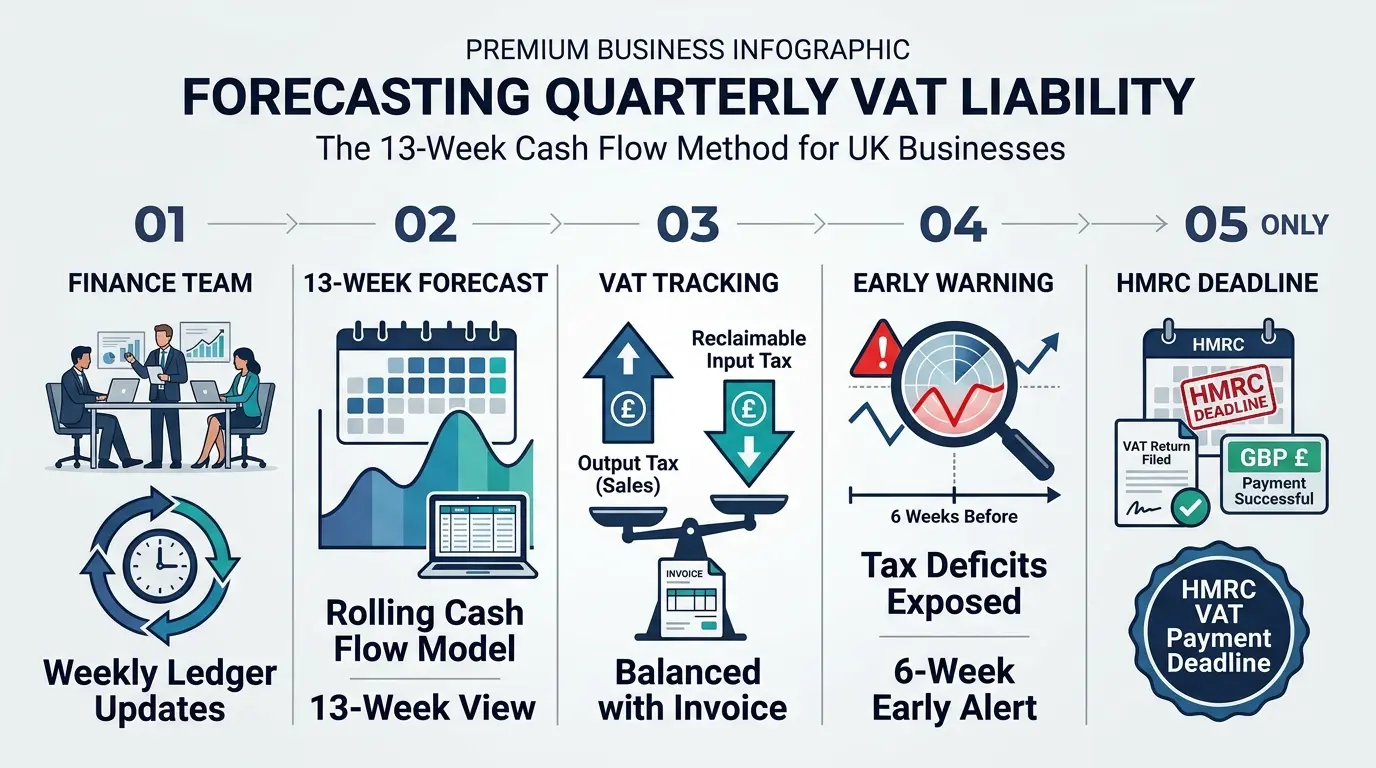
Static quarterly spreadsheets fail because transaction volumes and input tax credits fluctuate weekly. A rolling 13-week cash flow forecast incorporates real-time accounts receivable aging reports and scheduled supplier payment runs. Integrating live bank feeds into accounting software updates net VAT positions daily without manual data entry.
Accurate forecasting separates standard-rated, zero-rated, and exempt transactions at the point of entry. Misclassifying zero-rated sales as standard-rated overstates expected liabilities, whereas missing valid supplier VAT receipts understates reclaimable input credits. Finance teams review purchase ledgers every Friday to verify that valid VAT invoices support every claimed expense.
Three forecasting adjustments increase projection accuracy across volatile trading periods:
Deduct confirmed bad debts older than six months from quarterly output tax projections
Factor scheduled capital expenditure purchases into the exact quarter the supplier issues the tax invoice
Model worst-case collection scenarios by delaying expected customer receipts by 14 days
When turnover approaches mandatory thresholds or fluctuates across multiple tax rates, expert review prevents costly miscalculations. Exploring Tailored Tax Solutions: How Form My Company Evaluates Your Business Turnover for VAT demonstrates how structured turnover audits stabilize long-term tax forecasting.
What Steps Should Businesses Take When Facing a Short-Term VAT Shortfall?
Businesses facing a short-term VAT shortfall must contact HMRC before the payment deadline to negotiate a Time to Pay arrangement. Submitting the VAT return on time avoids late submission penalty points while spreading the unpaid tax balance across manageable monthly instalments.
Ignoring an impending liquidity gap triggers HMRC’s points-based penalty regime and daily statutory interest charges. HMRC charges late payment interest at the Bank of England base rate plus 2.5% from the first day past the due date. Submitting the digital VAT return on time proves compliance intent and preserves eligibility for structured repayment plans.
Securing an HMRC Time to Pay Arrangement
HMRC permits businesses to set up online Time to Pay plans automatically if the VAT debt is £20,000 or less. Companies qualify when they submit the latest return, owe no other tax debts, and propose clearing the balance within six months. Setting up this plan online takes less than 15 minutes and halts immediate enforcement action.
For liabilities exceeding £20,000, directors contact the HMRC Business Payment Support Service directly before the deadline. HMRC officers review cash flow forecasts, income statements, and expenditure budgets to determine affordable monthly repayments. Presenting realistic financial projections demonstrates operational control and secures longer repayment windows of up to 12 months.
Optimizing Accounts Receivable and Payable Timing
Accelerating customer collections by 10 days injects immediate liquidity before the seventh-day HMRC direct debit clears. Finance teams issue automated payment reminders seven days before invoice due dates and offer 1.5% early settlement discounts to high-value clients. Collecting £30,000 in overdue receivables releases £5,000 in previously funded VAT capital.
Delaying non-essential supplier payments until the new VAT quarter shifts input tax recovery forward by 90 days. Conversely, paying vatable supplier invoices before the current quarter closes increases reclaimable input VAT and reduces the immediate HMRC bill. Timing major asset purchases during the final week of a VAT quarter maximizes immediate tax relief.
Managing quarterly VAT cash flow requires strict capital segregation, accurate 13-week forecasting, and strategic selection of HMRC accounting schemes. Separating collected tax into dedicated reserve accounts prevents operational overspending, while Cash Accounting and Annual Accounting schemes align tax outflows with genuine business liquidity. Form My Company delivers structured compliance frameworks and turnover evaluations that keep UK businesses solvent and fully compliant across every quarterly tax cycle.
Explore More VAT Registration Assistance Guide,
How to Handle Import and Export VAT Obligations Following Recent Trade Rules
How to Prepare Your First VAT Return for HMRC Without Making Common Errors
Frequently Asked Questions
When is a UK business legally required to register for VAT?
A UK business must register for VAT with HMRC when its VAT-taxable turnover exceeds £90,000 over any rolling 12-month period, or if it expects to exceed £90,000 within the next 30 days alone. Form My Company provides VAT Registration Assistance to monitor rolling turnover figures and submit applications within the mandatory 30-day HMRC deadline.
Can a business register for VAT voluntarily below the £90,000 threshold?
Yes, UK businesses with a taxable turnover below £90,000 can apply for voluntary VAT registration at any time to reclaim input VAT paid on business purchases and equipment. Using Form My Company’s VAT Registration Assistance ensures your business evaluates whether voluntary registration improves cash flow and B2B credibility before committing to quarterly Making Tax Digital filings.
What documents and information are required for a UK VAT registration application?
To register for VAT with HMRC, businesses must provide their Company Registration Number or Unique Taxpayer Reference (UTR), director identification details, UK business bank account information, and accurate taxable turnover records. Form My Company streamlines this compliance process through dedicated VAT Registration Assistance, verifying your Standard Industrial Classification (SIC) codes and supporting evidence to prevent HMRC processing delays.
How long does it take to receive a UK VAT registration number from HMRC?
HMRC typically processes online VAT registration applications and issues a nine-digit VAT registration number within 14 to 40 working days, depending on security checks and application accuracy. Engaging Form My Company for VAT Registration Assistance minimizes verification queries and guides you on how to account for VAT on invoices issued while awaiting your official certificate.
What are the penalties for missing the UK VAT registration deadline?
Failing to register for VAT within 30 days of exceeding the £90,000 threshold makes a business liable for all unpaid VAT from the effective registration date, alongside a late notification penalty of up to 30% of the net VAT owed. Form My Company’s VAT Registration Assistance helps businesses establish accurate effective registration dates and maintain full HMRC compliance to avoid statutory fines and interest charges.