
Digital record keeping under Making Tax Digital (MTD) for VAT requires VAT-registered businesses to store specific tax records electronically using functional compatible software. HMRC mandates this digital storage alongside automated digital links to submit VAT returns directly via an Application Programming Interface (API).
HM Revenue and Customs (HMRC) introduced Making Tax Digital to eliminate manual data entry errors across the UK tax system. Since April 2022, every VAT-registered business in the United Kingdom must comply with these electronic record-keeping standards regardless of annual taxable turnover. Paper ledgers and manual copy-pasting between software programs no longer satisfy statutory tax compliance rules.
Electronic tax records serve as the foundation for every quarterly or monthly VAT return submitted to HMRC. Businesses capture transaction data digitally at the point of sale or purchase. Functional compatible software then calculates VAT liabilities and transmits the final summary figures directly to government servers.
Which Businesses Must Comply with MTD Digital Record Keeping Rules?
All VAT-registered businesses in the United Kingdom must maintain digital records under Making Tax Digital rules, regardless of their annual turnover. This statutory mandate applies to over 2.1 million UK businesses, including sole traders, partnerships, limited companies, and overseas entities registered for UK VAT.
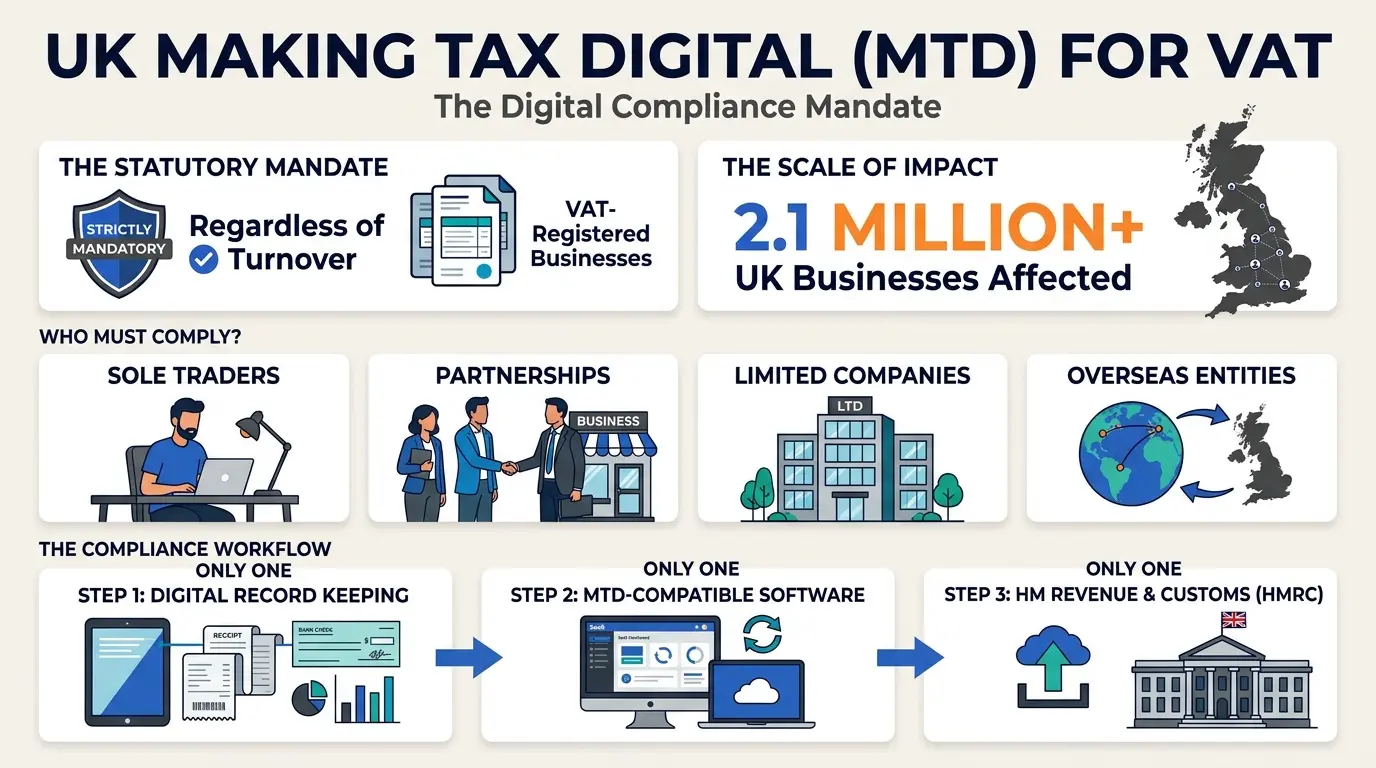
Prior to April 2022, only businesses exceeding the £85,000 VAT registration threshold faced mandatory MTD compliance. HMRC removed that turnover exemption to bring 100% of the VAT register into the digital tax ecosystem. Voluntary VAT registrants trading below the current £90,000 registration threshold also follow identical electronic record rules.
Exemptions apply only to a tiny fraction of taxpayers who demonstrate genuine digital exclusion. HMRC grants exemptions when religious beliefs prevent computer usage or when age, disability, or remote location makes internet access impossible. Businesses applying for exemption submit formal evidence to HMRC and receive written confirmation before using alternative filing methods.
Newly formed companies registering for VAT enter the MTD regime automatically upon receiving their nine-digit VAT registration number. Utilizing professional VAT Registration Assistance ensures your corporate entity establishes compliant digital workflows from day one. Proper initial setup prevents late-filing penalties and administrative backlogs during your first accounting period.
What Specific Information Must Businesses Record Digitally?
Businesses must digitally record three core data categories: designatory business details, supply transaction values, and VAT account summary figures. Each transaction entry requires the tax point date, the net value excluding VAT, and the specific VAT rate applied to the supply.
Designatory data identifies the taxable entity within the compatible software environment. Businesses record their legal business name, principal place of business address, nine-digit VAT registration number, and any specific VAT accounting schemes used. Examples of four common accounting schemes include the Flat Rate Scheme, Cash Accounting Scheme, Annual Accounting Scheme, and Margin Schemes.
For every supply made, the digital record captures the time of supply, known as the tax point. The record also stores the value of the supply excluding VAT and the exact rate of VAT charged. When an invoice contains multiple items taxed at different rates, the software records separate entries for each VAT rate.
For every supply received, businesses record the tax point date, the net value of the purchase, and the amount of input tax claimed. If a business uses the Flat Rate Scheme, it only records supplies received that qualify as capital expenditure goods costing £2,000 or more including VAT.
The digital VAT account forms the audit trail linking underlying transactions to the nine boxes of the VAT return. This digital account tracks output tax payable on sales, input tax recoverable on purchases, and any statutory adjustments. Adjustments include fuel scale charges, bad debt relief claims, and partial exemption calculations.
What Does Functional Compatible Software Mean Under HMRC Rules?
Functional compatible software is a software program or set of connected programs that records digital transactions, preserves records in electronic form, and connects to HMRC via an API. HMRC does not provide free proprietary accounting software, requiring businesses to select approved commercial tools.
Compatible software performs two primary compliance functions for VAT-registered entities. First, the software stores all mandatory designatory and transactional data in a structured electronic format. Second, the software communicates directly with HMRC systems to submit VAT returns and retrieve payment status updates.
Businesses choose between two main software architectures to satisfy HMRC standards:
Adopt all-in-one cloud accounting platforms such as Xero, QuickBooks, or Sage to manage invoicing, bookkeeping, and direct API submissions within a single application.
Connect existing spreadsheet ledgers to HMRC servers using approved bridging software that extracts final VAT summary cells via digital links.
Spreadsheets remain legally acceptable under MTD rules when paired with compliant bridging software. However, the spreadsheet itself must contain all mandatory transaction-level data rather than simple summary totals. Businesses retain digital records for a minimum statutory period of six years, or ten years if operating under the VAT One Stop Shop scheme.
How Do Digital Links Work Between Software Programs?
A digital link is an electronic transfer or exchange of data between software programs, products, or applications without manual intervention. HMRC strictly prohibits copying and pasting figures or manually retyping transaction totals between spreadsheets and accounting software.
Every transfer of data from the initial digital record to the final VAT return submission requires an unbroken digital audit trail. Once transaction data enters the accounting system, all subsequent calculations, summaries, and transfers occur electronically. Breaking this chain invalidates MTD compliance and exposes the business to HMRC default surcharges and record-keeping penalties.
HMRC recognizes five standard methods as valid digital links:
Link cells across different worksheet tabs using automated spreadsheet formulas such as SUM or VLOOKUP.
Transfer accounting files via email to a tax agent who imports the data directly into filing software.
Save transaction exports onto portable storage devices such as USB drives for direct import into compatible tools.
Use XML or CSV file imports and exports to move batch data between point-of-sale tills and accounting ledgers.
Connect separate software platforms through automated API integrations that synchronize invoice data continuously.
Complex corporate structures often operate multiple subsidiary ledgers across different accounting software packages. When consolidating figures across multiple entities, companies must maintain automated digital links between every subsidiary ledger and the group reporting tool. Reviewing guides on How to Register a VAT Group for Multiple Connected Corporate Entities clarifies how connected companies structure group-wide VAT reporting.
What Are the Exceptions to Transaction-Level Digital Record Keeping?
HMRC grants specific record-keeping relaxations for retail businesses, petty cash transactions, and supplier statements to prevent disproportionate administrative burdens. Retailers record daily gross takings instead of individual till receipts, while petty cash exceptions cover small purchases under £50.
Retail businesses process thousands of low-value consumer transactions daily, making individual invoice entry impractical. Under HMRC Notice 700/22, retailers record a single daily gross takings figure for each point-of-sale terminal. This daily digital entry captures total cash and card receipts separated by applicable VAT rates.
Petty cash transactions represent minor incidental expenses paid out of physical cash tins. Businesses record multiple petty cash purchases as a single combined digital entry rather than logging every individual receipt. Each individual transaction within the batch must cost less than £50 including VAT, and the combined batch total cannot exceed £500 including VAT.
Supplier statements summarize multiple invoices issued by a single vendor over a monthly billing cycle. Businesses record the summary totals from the supplier statement digitally if all underlying invoices fall within the same VAT return period. The digital entry must clearly show the total net value and total VAT charged across the statement.
Employee expense claims managed through third-party payroll or expense apps also qualify for batch recording. Businesses import a single summary figure per employee expense claim into their core accounting ledger, provided the underlying digital system retains individual receipt images and VAT breakdowns.
What Penalties Apply for Failing to Maintain Digital Records?
HMRC enforces a points-based penalty system alongside financial fines of up to £400 per return for failing to file via MTD-compatible software. Businesses that fail to maintain mandatory digital records or digital links face daily penalties ranging from £5 to £15.
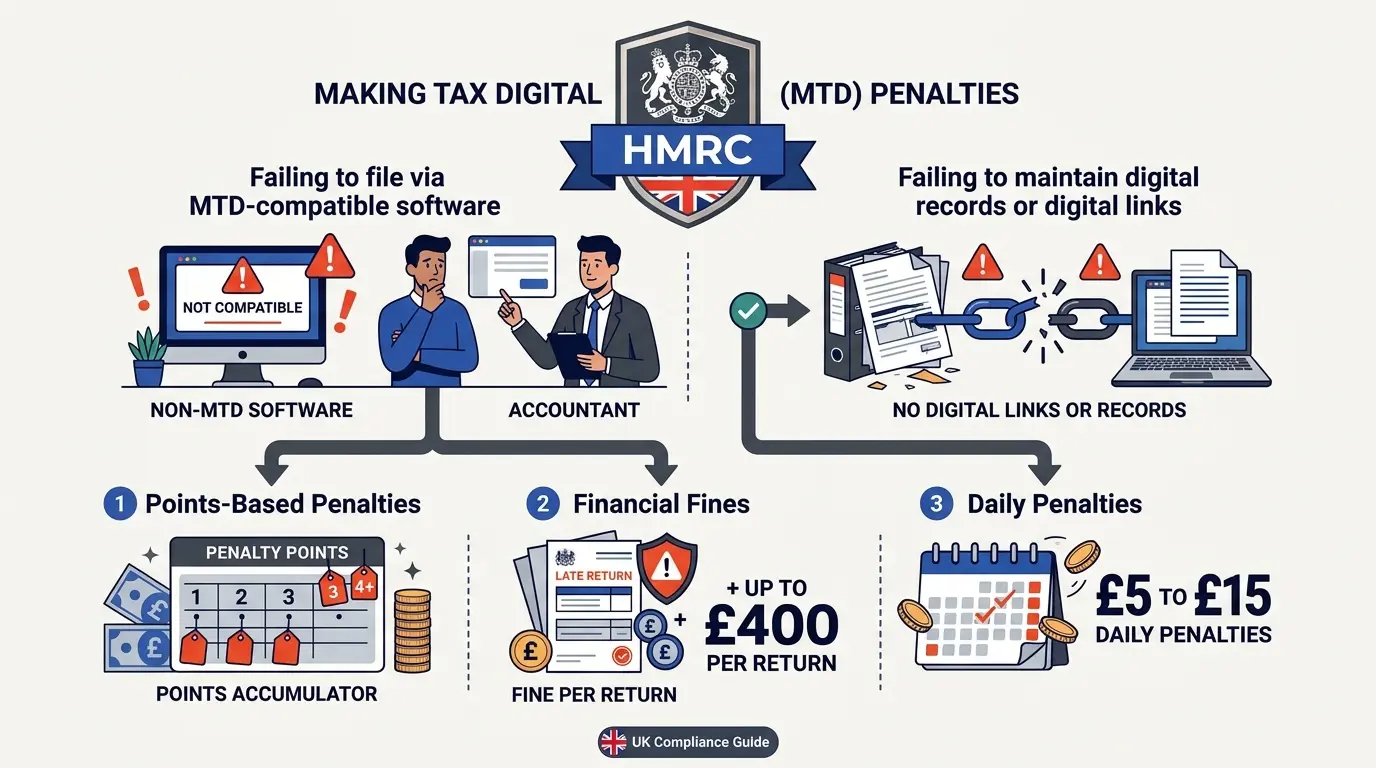
HMRC replaced the old default surcharge regime with a points-based system for late submissions and non-compliance. Every late VAT return earns one penalty point, and reaching the statutory threshold triggers an automatic £200 financial penalty. Quarterly filers hit the penalty threshold at four points, whereas monthly filers reach the threshold at five points.
Submitting a VAT return without using functional compatible software attracts an immediate £400 fine per non-compliant filing. HMRC officers inspect digital audit trails during routine VAT compliance checks to verify unbroken digital links. If an officer discovers manual copy-pasting between spreadsheets, HMRC issues formal warning notices followed by daily financial penalties until the business restores digital compliance.
Accurate record keeping also prevents late payment interest charges and inaccuracy penalties. Late payment interest accrues daily from the first day a VAT payment passes its due date, calculated at the Bank of England base rate plus 2.5%. Maintaining real-time digital records ensures accurate liability calculations and timely direct debit collections.
How Can Businesses Transition Smoothly to MTD Digital Record Keeping?
Businesses transition smoothly to MTD compliance by auditing existing bookkeeping workflows, selecting HMRC-recognised software, and mapping automated digital links before their first VAT period. Early preparation eliminates manual spreadsheet bottlenecks and ensures accurate API submissions from the initial registration date.
Auditing existing financial records identifies any manual data entry points that violate HMRC digital link rules. Businesses review how sales invoices, purchase bills, and bank feeds enter their accounting system. Replacing manual CSV retyping with automated bank feeds and optical character recognition (OCR) receipt capture eliminates human error.
Selecting appropriate accounting software depends on transaction volume and corporate structure. Single-entity service businesses operate efficiently on entry-level cloud accounting subscriptions. Multi-entity corporations or high-volume retailers require enterprise resource planning (ERP) systems with custom API connectors.
Navigating HMRC registration portals, scheme elections, and software authorisation steps demands technical precision. Choosing Complete Peace of Mind: Let Form My Company Handle Your Complex VAT Application Forms removes administrative friction during initial registration and MTD enrollment.
Digital record keeping under Making Tax Digital for VAT requires UK businesses to capture mandatory designatory and transactional data electronically, maintain unbroken digital links, and submit returns via HMRC-approved API software. Adhering to these structured electronic standards eliminates manual calculation errors, secures audit trails for six years, and protects companies against points-based fines and daily HMRC penalties. Form My Company delivers specialized VAT Registration Assistance to help UK businesses establish compliant VAT registrations, select appropriate accounting schemes, and integrate seamless digital workflows from day one.
Explore More VAT Registration Assistance Guide,
What Is a VAT Return and How Often Must UK Businesses Submit It?
What Is the Difference Between Standard, Reduced, and Zero-Rated VAT Supplies?
Frequently Asked Questions
When do you legally need to register for VAT in the UK?
UK businesses must register for VAT with HMRC if their taxable turnover exceeds £90,000 over any rolling 12-month period or if they expect to cross that threshold within the next 30 days alone. Overseas businesses without a fixed UK establishment must register before making their first taxable supply in the UK, regardless of turnover. Using Form My Company’s VAT Registration Assistance ensures your application is submitted within the statutory 30-day window to prevent late-registration penalties.
How long does HMRC take to process a VAT registration application?
HMRC typically processes online VAT registration applications within 10 to 40 working days, though complex corporate structures or incomplete forms often trigger extended security checks. Submitting inaccurate business descriptions, mismatched director details, or unverified bank records can reset the processing timeline entirely. Form My Company prepares and audits your submission through our VAT Registration Assistance service to minimize HMRC follow-up queries and delays.
What documents and information are required for UK VAT registration?
To register for VAT, you must provide your Company Registration Number, Unique Taxpayer Reference (UTR), director identification details, business bank account information, and accurate taxable turnover figures. HMRC also requires a specific description of your trading activities and supporting evidence such as contracts, invoices, or business plans for voluntary applications. Form My Company’s VAT Registration Assistance compiles and verifies all required documentation before filing with HMRC.
Can a business register for VAT voluntarily below the £90,000 threshold?
Yes, UK businesses trading below the £90,000 threshold can apply for voluntary VAT registration at any time to reclaim input VAT on business purchases and enhance commercial credibility with B2B clients. Voluntary applicants must demonstrate genuine trading activity and comply with Making Tax Digital (MTD) electronic record-keeping rules from their effective registration date. Form My Company helps evaluate whether early registration benefits your cash flow through tailored VAT Registration Assistance.
How do I choose the right VAT accounting scheme during registration?
Selecting between the Standard VAT Accounting Scheme, Flat Rate Scheme, Cash Accounting Scheme, or Annual Accounting Scheme depends on your annual turnover, client base, and expense structure. Choosing an unsuitable scheme during initial registration can restrict input tax recovery or create unnecessary administrative overhead. Form My Company assesses your company’s financial profile as part of our VAT Registration Assistance to align your HMRC registration with the most tax-efficient accounting scheme.