
Margin Scheme VAT taxes the difference between what a business pays for an eligible item and what it sells it for, rather than the full selling price. UK dealers in second-hand goods, works of art, antiques, and collectors’ items use this scheme to avoid double taxation.
Standard Value Added Tax applies to the entire final sale price of a product. When a VAT-registered retailer buys a used item from a private individual, no input VAT is charged on that initial purchase. Charging 20% VAT on the full resale value creates an unfair tax burden that erodes profit margins.
HM Revenue and Customs (HMRC) established the VAT Margin Scheme under Notice 718 to solve this double taxation issue. Dealers account for output tax solely on the gross profit margin achieved during the transaction. This mechanism keeps second-hand retailers competitive alongside private sellers in the UK market.
How Does the VAT Margin Scheme Work in Practice?
The VAT Margin Scheme works by calculating output tax strictly on the gross profit margin of a qualifying sale. Dealers pay VAT at a flat rate of 16.67% (one-sixth) of the positive margin, while zero VAT applies if the item sells at a loss.
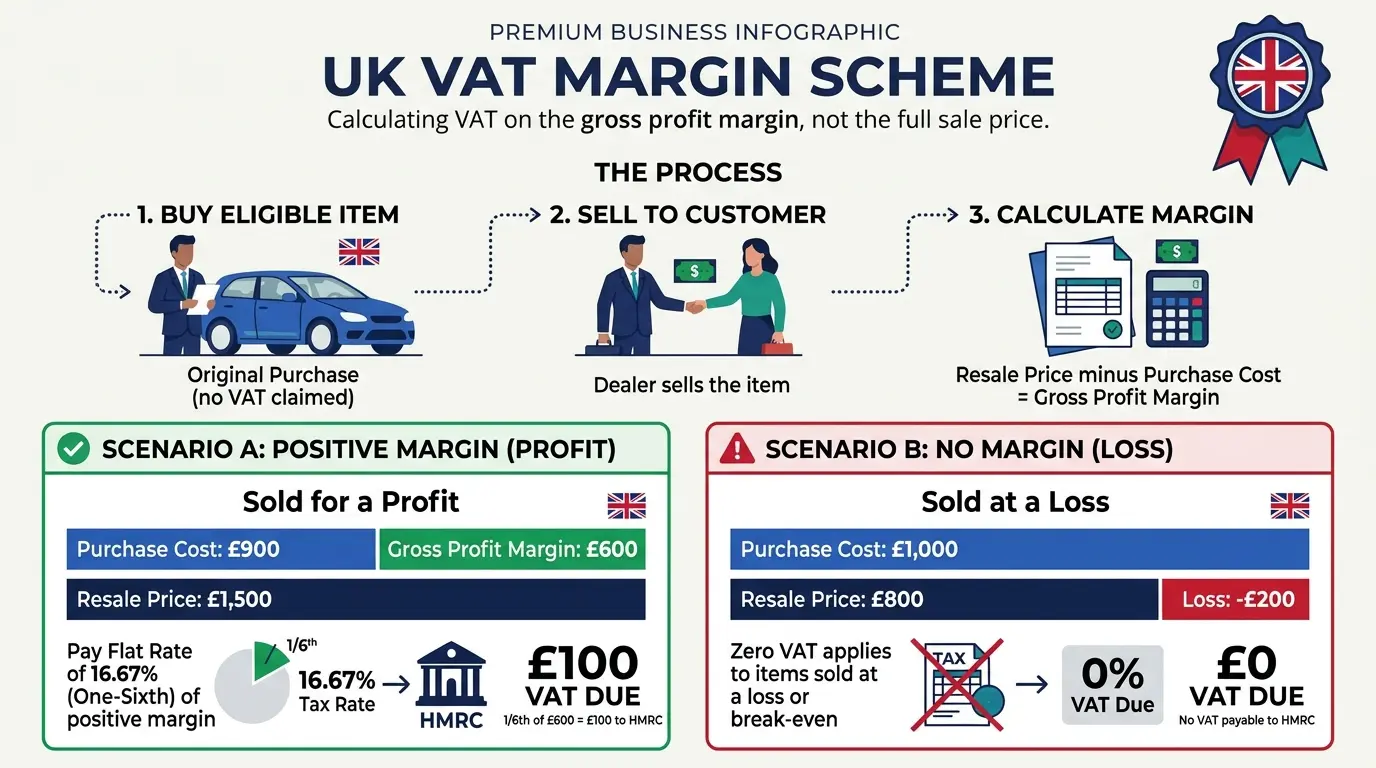
The calculation formula subtracts the original purchase price from the final selling price to isolate the value added by the dealer. Under standard VAT rules, a seller adds 20% onto the net price. Under the margin scheme, the VAT sits inside the gross profit margin itself.
Dividing the profit margin by six extracts the exact one-sixth (16.67%) tax liability owed to HMRC. Consider a dealer who buys a vintage watch for £1,000 and sells it for £1,600. The gross profit margin equals £600, resulting in a £100 VAT liability rather than £266.67 under standard accounting.
Retailers cannot deduct repair, restoration, or overhead expenses when determining the purchase price for margin calculations. The purchase price reflects only the exact amount paid to acquire the asset. However, dealers reclaim input VAT separately on business overheads, tools, and repair parts through their regular VAT return.
When an item sells for less than its acquisition cost, the profit margin equals zero. HMRC does not refund VAT on loss-making margin scheme sales, nor can dealers offset losses against profitable sales. Each transaction stands alone unless the business qualifies for the Global Accounting simplification.
Who Can Use the VAT Margin Scheme for Second-Hand Goods?
VAT-registered businesses that buy and sell eligible second-hand goods, works of art, antiques, or collectors’ items qualify for the scheme. The business must acquire these goods without reclaimable VAT from private individuals, charities, or other margin scheme dealers.
Eligibility depends entirely on the tax status of the supplier and the nature of the goods. A dealer qualifies only when the previous owner did not charge standard VAT on the sale invoice. Four primary supplier categories meet this strict HMRC requirement: private individuals, non-VAT registered businesses, charities, and other VAT-registered dealers selling under the margin scheme.
Businesses spanning diverse retail sectors rely on this accounting method daily. Common UK adopters include used car dealerships, vintage clothing boutiques, independent bookshops, fine art galleries, and refurbished electronics resellers. Establishing correct tax accounting from day one requires structured VAT Registration Assistance to align business operations with HMRC compliance frameworks.
Companies cannot use the scheme if they buy goods on a standard VAT invoice showing separate tax amounts. Reclaiming input VAT on an acquisition permanently disqualifies that specific item from margin scheme treatment. Dealers hold the flexibility to apply the scheme selectively on individual items while using standard VAT for new stock.
Which Items Are Eligible and Excluded Under HMRC Rules?
Eligible items include tangible second-hand goods, works of art, antiques over 100 years old, and rare collectors’ items suitable for further use. HMRC strictly excludes precious metals, investment gold, precious stones, and any item purchased with reclaimable VAT.
HMRC defines second-hand goods as movable property suitable for further use either in its current state or after repair. Works of art encompass original paintings, sculptures, hand-woven tapestries, and limited-edition signed prints. Antiques must exceed 100 years of age, while collectors’ items cover philatelic stamps and numismatic coins of historical interest.
Specific high-value commodities face strict statutory exclusions to prevent tax avoidance in bullion and gem markets. Three excluded asset classes highlight these boundaries: investment gold bars, unmounted diamonds, and scrap platinum. Because these materials retain intrinsic commodity value rather than artistic or utility value, standard VAT rules govern their trade.
What Are the Rules for Second-Hand Motor Vehicles?
Second-hand motor vehicles qualify for the Margin Scheme only when acquired without reclaimable VAT from private owners or non-registered entities. Dealers must record vehicle identification numbers, registration marks, and purchase dates in a dedicated stock book.
Motor dealers frequently handle part-exchange vehicles alongside fleet acquisitions. When a dealership takes a car in part-exchange from a private motorist, the vehicle qualifies for the margin scheme. If the dealership buys an ex-lease vehicle from a finance company charging 20% VAT, the car enters standard VAT stock.
Special rules govern vehicles bought in Northern Ireland versus Great Britain due to the Windsor Framework. Dealers moving used cars from Great Britain to Northern Ireland for resale face specific restrictions on margin scheme eligibility. Accurate tracking of vehicle provenance prevents costly retrospective tax assessments during HMRC inspections.
What Record-Keeping and Invoicing Rules Apply to Margin Scheme Dealers?
Margin scheme dealers must maintain a detailed stock book tracking every item’s purchase and sale details, alongside issuing compliant margin invoices. Invoices must never display a separate VAT amount, because doing so disqualifies the transaction from the scheme.
HMRC enforces rigorous documentation standards under VAT Notice 718 to verify profit margin calculations. Missing paperwork invalidates the margin claim, forcing the dealer to pay 20% standard VAT on the full selling price. Dealers must retain all margin scheme records for at least six years.
Every qualifying purchase requires a purchase invoice containing specific statutory data points. When buying from a private seller, the dealer creates a self-billed purchase invoice signed by the seller. This document records the seller’s name, address, item description, purchase date, and total price paid.
What Must Appear on a Margin Scheme Sales Invoice?
A margin scheme sales invoice must display the seller’s VAT number, invoice date, item description, total price, and a mandatory HMRC margin declaration. Showing any separate VAT figure violates HMRC rules and voids margin scheme protection.
Standard VAT invoices break down net price, VAT rate, and gross total. Margin scheme invoices show only the single gross selling price. Including a separate VAT line allows the buyer to falsely reclaim input tax, triggering immediate penalties from HMRC.
To satisfy statutory audit requirements, every sales invoice must feature one of three approved HMRC declarations:
Apply the phrase “Margin scheme – second-hand goods” for general used retail items.
Insert the statement “Margin scheme – works of art” for qualifying fine art sales.
Include the notice “Margin scheme – collectors’ items and antiques” for eligible collectibles.
Maintaining an up-to-date stock book links every purchase invoice directly to its corresponding sales invoice. The stock book lists sequential stock numbers, acquisition dates, purchase prices, disposal dates, selling prices, and exact profit margins. Modern cloud accounting platforms automate these ledgers to eliminate manual entry errors.
What Is the Global Accounting Simplified Margin Scheme?
Global Accounting is a simplified version of the VAT Margin Scheme designed for dealers who buy and sell high volumes of low-value items. Instead of tracking individual items, businesses calculate VAT on the total bulk margin at the end of each VAT period.
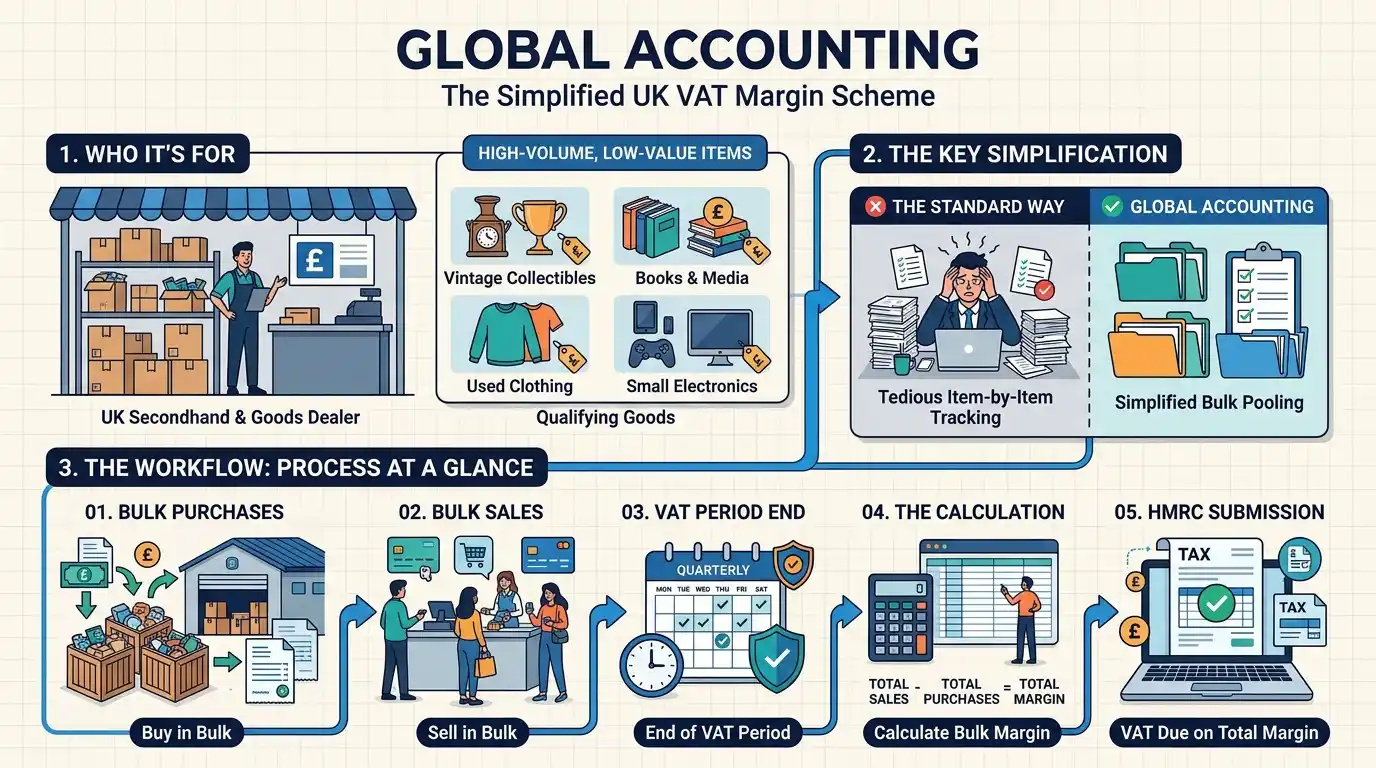
Tracking individual profit margins becomes administratively impossible for businesses selling thousands of inexpensive items. Charity shops, record stores, and secondhand book dealers handle vast inventories where individual items cost under £500. Global Accounting resolves this bottleneck by pooling all eligible purchases and sales together.
Under Global Accounting, a dealer subtracts total eligible purchases from total eligible sales during a three-month VAT quarter. If total sales exceed total purchases, the dealer pays 16.67% VAT on the aggregate net difference. When purchases exceed sales in a quiet quarter, the negative balance carries forward to offset future profits.
HMRC imposes a strict £500 individual item cap on Global Accounting inventories. Any single item bought or sold for more than £500 cannot enter the Global Accounting pool. Dealers must track items exceeding £500 individually within a standard margin scheme stock book.
Exclusions also apply to specific asset categories regardless of their individual monetary value. Aircraft, boats, caravans, horses, and motor vehicles never qualify for Global Accounting. If a dealer makes clerical errors while reconciling bulk margins, reviewing How to Correct Minor VAT Mistakes on Past Returns Using HMRC Adjustment Rules ensures accurate reporting without triggering compliance flags.
When Should a Business Avoid Using the VAT Margin Scheme?
A business must avoid the VAT Margin Scheme when selling goods to other VAT-registered businesses that want to reclaim input VAT. Because margin invoices hide the VAT element, B2B buyers lose the ability to recover tax on their purchases.
Business-to-business (B2B) transactions operate differently from business-to-consumer (B2C) retail sales. When a VAT-registered company buys equipment or stock, it expects a standard VAT invoice to reclaim the 20% tax from HMRC. Because a margin scheme invoice contains zero reclaimable VAT, B2B buyers face a higher net cost.
If a dealer sells an item under the margin scheme to a corporate buyer, that buyer cannot recover the 16.67% tax paid by the dealer. Conversely, using standard VAT allows the B2B buyer to reclaim the entire 20% VAT charge, reducing their true expense. Smart dealers evaluate their customer base before choosing an accounting method for each sale.
High-volume exporters also encounter distinct rules when shipping second-hand goods outside the UK. Exports of eligible second-hand goods to overseas buyers generally qualify for zero-rated VAT, provided the dealer holds valid proof of export within three months. Applying the margin scheme to zero-rated exports unnecessarily sacrifices profit margin to domestic tax.
New enterprises entering the second-hand retail market benefit from professional tax structuring before submitting their initial HMRC applications. Exploring Fast-Track Your Tax Setup: Why Growing Businesses Rely on Form My Company for VAT Assistance demonstrates how early compliance planning protects retail cash flow. Securing accurate VAT Registration Assistance prevents costly administrative restructuring as inventory volumes scale.
The VAT Margin Scheme protects UK second-hand retailers from double taxation by restricting output VAT to the 16.67% profit margin rather than the full resale price. Success under HMRC Notice 718 requires strict adherence to item eligibility criteria, meticulous stock book record-keeping, and compliant invoicing without separate VAT breakdowns.
Form My Company supports UK retailers and resellers by delivering streamlined VAT Registration Assistance tailored to specialized HMRC accounting schemes. By establishing compliant tax structures and accurate reporting frameworks from incorporation, Form My Company enables growing businesses to manage second-hand inventories with full regulatory certainty.
Explore More VAT Registration Assistance Guide,
What Is Digital Record Keeping Under Making Tax Digital (MTD) for VAT?
What Is a VAT Return and How Often Must UK Businesses Submit It?
Frequently Asked Questions
When is a UK business legally required to register for VAT?
A UK business must register for VAT with HMRC if its taxable turnover exceeds £90,000 over any rolling 12-month period, or if it expects to surpass that threshold within the next 30 days alone. Overseas businesses selling goods or services into the UK have no threshold and must register before making their first taxable UK sale. Form My Company monitors these statutory deadlines through our VAT Registration Assistance service to help businesses submit compliant applications within HMRC’s 30-day notification window.
How long does it take to get a UK VAT registration number from HMRC?
HMRC typically processes standard online VAT applications within 30 to 40 working days, though applications requiring manual identity or trading checks can take longer. Submitting inaccurate business descriptions or mismatched company records often triggers compliance queries that reset the processing timeline. Using Form My Company’s VAT Registration Assistance ensures all company data, turnover figures, and supporting evidence are verified before submission to prevent avoidable HMRC delays.
What documents and information are required to register a company for VAT?
To register a limited company for VAT, HMRC requires your Companies House registration number, Unique Taxpayer Reference (UTR), UK business bank account details, and a clear description of your taxable business activities. Applicants must also provide accurate actual or projected turnover figures alongside director identification details. Form My Company streamlines this preparation by compiling and validating your corporate records as part of our end-to-end VAT Registration Assistance.
Can a small business register for VAT voluntarily below the £90,000 threshold?
Yes, UK businesses with taxable turnover below £90,000 can apply for voluntary VAT registration at any time. Registering early allows companies to reclaim input VAT on start-up equipment, software, and supplier invoices while projecting greater credibility to VAT-registered B2B clients. Through our VAT Registration Assistance, Form My Company helps founders select the right effective registration date and evaluate suitable schemes like Flat Rate or Cash Accounting.
Can a business trade and charge VAT while waiting for its VAT number?
Businesses can continue trading during the HMRC processing period, and must account for VAT from their official effective date of registration even before receiving their VAT number. During this interim period, companies adjust prices to cover the VAT liability and issue standard VAT invoices retrospectively once HMRC confirms their registration number. Form My Company guides new registrants through these interim invoicing rules as part of our comprehensive VAT Registration Assistance to ensure full Making Tax Digital (MTD) compliance.