

An LLP needs at least two members, including at least two designated members who are responsible for key filing and compliance duties. If you’re working out how to register an LLP in the UK, first agree who will join, how the LLP will operate and what each member’s responsibilities will be. Then register the LLP with Companies House.
The registration form is only part of the process. An LLP agreement, also called a partnership deed, can explain how profits will be shared and how members can join or leave, helping everyone understand the arrangement from the outset.
This guide covers the LLP structure and limited liability, designated members’ responsibilities, what to include in an agreement and the details needed for registration. It also explains how a formation service can help with the application.
Key Takeaways
- Plan for at least two LLP members, with at least two designated members to handle key filing and compliance responsibilities.
- Agree the LLP’s rules in a written agreement, including how profits are shared and how members can join or leave.
- Prepare the LLP’s registration details, including its members, registered office and business activity, before applying to Companies House.
- Understand how the LLP structure separates the business from its members, and what tax reporting responsibilities members may have.
- Consider a registered office address service if you want a suitable public address for the LLP’s official records.
Designated members and their responsibilities
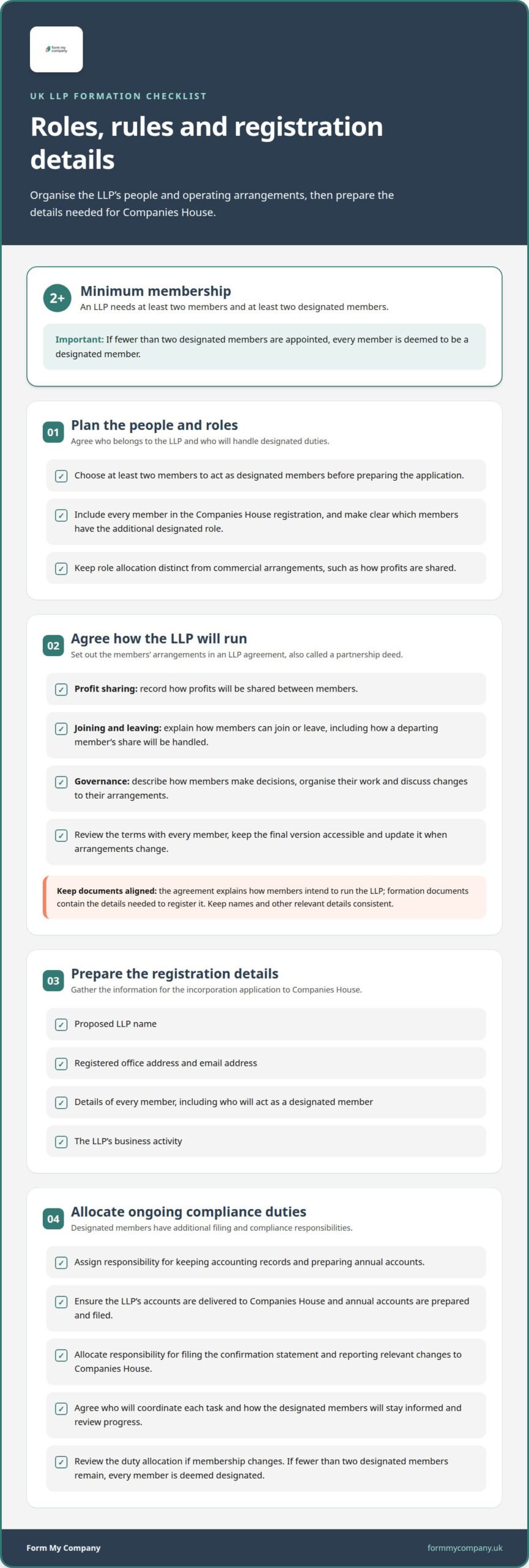
Plan the LLP’s member roles before incorporation. A UK LLP needs at least two designated members, who take on additional filing and compliance responsibilities.
How a formation provider checks designated-member requirements
Choose at least two members to act as designated members before preparing the LLP application. If an LLP has fewer than two designated members, every member is deemed to be a designated member.
Confirm who will take each role and include every member in the Companies House registration. For example, an LLP with two members cannot leave the designated roles unassigned, because both members would be deemed designated members.
- Distinguish the designated role from ordinary membership when recording responsibilities. All members belong to the LLP, but designated members have additional filing and compliance duties. Make the distinction clear in the information prepared for registration, then document practical arrangements internally so each person understands what they are expected to handle.
Keep role allocation separate from commercial arrangements such as how profits are shared. Those terms belong in the LLP agreement. If the members also need to organise details about people with significant control, keep those records aligned with the PSC register.
Set out designated-member responsibilities
Assign responsibility for the LLP’s accounting records, annual accounts and Companies House filings. Designated members must deliver the LLP’s accounts to Companies House, prepare and file annual accounts, file the confirmation statement and report relevant changes.
The Limited Liability Partnerships Regulations 2001 are relevant to designated members’ duties. Record who coordinates each task and how the other designated members will stay informed, rather than assuming an ordinary member will automatically manage a filing.
- Set up a clear process for keeping accounting records and preparing annual accounts. Designated members carry these responsibilities, so decide how records will be collected and who will coordinate the accounts before filing dates approach. Clear ownership helps prevent tasks being overlooked as members divide their day-to-day work.
For example, one designated member can coordinate the records while another tracks Companies House submissions. The LLP remains responsible for its filings, so agree how both designated members will review progress and resolve gaps in the information.
- Include membership and other LLP changes in the compliance process. Designated members must report relevant changes to Companies House and file the confirmation statement. Record who will identify a change, prepare the required information and oversee its submission.
Review the allocation of duties when the LLP’s membership changes. If fewer than two designated members remain, every member is deemed designated. Reviewing roles promptly helps everyone understand who has filing responsibilities and keeps compliance tasks organised.
What does the deed of partnership cover?
Prepare an LLP agreement, also called a partnership deed, to set out how members will run the LLP. Agree its practical terms alongside the formation details.
How a provider can help prepare an LLP agreement
Gather the members’ proposed arrangements before drafting the agreement. Include how profits will be shared and how members can join or leave, as these are central terms of an LLP agreement.
Use specific examples to resolve differences early. For instance, agree how a departing member’s share will be handled rather than leaving the situation unclear. Ensure the terms reflect the members’ intended working relationship.
Set out governance in the agreement
Describe how the LLP will operate, including how members will make decisions and manage their work together. The agreement should reflect the actual partnership, rather than rely on assumptions that may not suit its members.
Clarify how members will discuss changes to their arrangements and record decisions. For example, if they plan to divide responsibilities, describe that arrangement clearly. Avoid wording that leaves members unsure how to make operational decisions.
Relate the agreement to formation documents
Keep the agreement’s operating terms separate from the information prepared for company formation. The agreement explains how members intend to run the LLP; formation documents provide the details needed to register it.
Keep names and other relevant details consistent across documents. If the agreement identifies the members, for example, use the same names in the registration information. The agreement does not replace Companies House registration or the confirmation statement.
- Review the agreement with every member before relying on it. Check that profit-sharing terms, joining and leaving arrangements, and governance provisions reflect what everyone has agreed. A review together can uncover different expectations, such as whether a new member shares profits immediately or only after an agreed point.
Keep the final version accessible to the members and update it when their arrangements change. Without a deed of partnership, the Limited Liability Partnerships Act 2000 governs members’ position. If you’re arranging registration as well, LLP formation support can help align the formation process with the details you provide.
Registering with Companies House
To understand how to register an LLP in the UK, prepare its details and submit an incorporation application to Companies House. The application records the LLP’s members, registered office and business activity.
Information and documents to provide for an LLP application
Gather the proposed LLP name, registered office address, email address, member details and business activity. Include every member, identify the designated members and select at least one SIC code. The application allows up to four SIC codes.
Use a physical registered office address in the UK and in the country where the LLP is registered. The registered office and member details appear on the public record. Nationality and country fields use a standard list, so enter details in the available format.
If you’re asking how to register an LLP in the UK, prepare its name and addresses, member and designated-member details, and SIC code selection. Keep the entries consistent with the members’ agreed arrangements.
How a formation provider submits the Companies House application
Submit the application once the LLP’s registration details are complete. A formation provider can use the information you supply to prepare and submit the incorporation application to Companies House. Incorporation establishes the LLP as a separate entity; it does not replace the members’ internal agreement.
Choose an application route and provide the required information. For a postal application, include the completed form and relevant details. Continuation pages are optional and can provide additional information when needed.
After incorporation, Companies House provides the LLP with a company registration number and certificate. Keep these documents with the LLP’s formation records.
Understand application processing and acceptance
Allow time for Companies House to process the application. Companies House normally processes UK LLP incorporation applications within 24 hours, although complex applications can take longer. Online LLP registration may take 3 to 4 hours, while postal registration takes around two weeks.
Companies House decides whether to accept an application and how long processing takes. An estimate is not confirmation of incorporation. If your plans depend on the LLP’s legal status, wait until the application has been accepted rather than treating submission as approval.
Check registration costs and timing
Choose an application route with its cost and timing in mind. According to Companies House, registering a UK LLP by post costs £124. Postal registration takes around two weeks, while online LLP registration may take 3 to 4 hours.
Companies House normally processes applications within 24 hours, though complex applications can take longer. These estimates describe different stages, so distinguish the online registration estimate from the usual processing period. Companies House controls the final acceptance and timing.
Once incorporated, the LLP must send annual accounts and a confirmation statement to Companies House. Members also have partnership tax-reporting responsibilities, including Self Assessment where applicable.
What is a Limited Liability Partnership (LLP)?
- Choose an LLP if the business needs partnership-style management within a separate legal entity. An LLP has members, not directors and shareholders, and does not issue share capital or share certificates. The LLP itself is generally not liable for Corporation Tax; members are responsible for tax on their own income or gains.
An LLP is intended for profit-making businesses, not not-for-profit organisations. Before choosing this structure and a business name, consider whether members want to manage the business together and share its profits.
- Plan for at least two members throughout the LLP’s life. Members can be individuals or corporate members, so a business can include people, companies, or a combination of both. Eligibility requirements may apply to individuals who want to become LLP members.
Keep member details consistent across the LLP’s formation documents. Every member must be registered with Companies House, and the registration information, including member details, becomes public. If a corporate entity joins, record it as a member rather than as an individual.
- Choose a suitable registered office before setting up the LLP. It must be a physical address in the UK and in the country where the LLP is registered. The address is publicly available, including when the LLP uses a member’s home address, so consider the privacy implications before choosing it.
A Royal Mail PO Box cannot be used as the registered office. Keep the LLP’s official registered office separate from members’ contact details in internal records. The official correspondence address does not change who the members are or how they share profits.
- Set up tax responsibilities for each member from the start. Individual members generally pay tax on their share of the LLP’s profits through Self Assessment, and each must register separately for Self Assessment with HMRC. The LLP also has partnership tax-reporting obligations.
Identify the nominated partner, who must complete a Self Assessment tax return for the partnership each year. This partnership return is separate from each individual member’s own Self Assessment return. A corporate member may have a Corporation Tax liability, so distinguish its tax position from an individual member’s.
- Keep member responsibilities clear as the LLP operates. Members participate in the partnership, while the LLP remains a separate entity. For example, an individual member reports their share of profits through Self Assessment, while a corporate member considers its own Corporation Tax position.
Record membership changes and keep Companies House information aligned with the LLP’s current structure. When a member leaves or a new individual or corporate member joins, update the LLP’s records and consider the effects on profit-sharing arrangements and partnership tax reporting.
LLP structure and limited liability
- Assess whether a limited liability partnership suits the way your business will operate. An LLP is a separate legal entity that combines partnership-style management with limited liability for its members. Members can run the business together, rather than using a limited company’s director-and-shareholder model.
Keep the distinction clear: the LLP conducts the business, while its members participate in the partnership. Business obligations belong to the LLP, not automatically to each member personally. This separation is central to understanding what limited liability does and does not mean.
- Understand which party is responsible if the LLP cannot pay a business debt. The LLP itself is responsible for its business debts, rather than its individual members. Members are not personally liable for debts the LLP cannot pay.
This distinction can help members assess the structure’s protections when planning the business. It does not make the LLP’s debts disappear: the LLP remains responsible for them. Keep business decisions and records in the LLP’s name to distinguish the entity’s obligations from members’ personal affairs.
- Identify any personal guarantee before relying on limited liability. A member may become personally responsible for a business loan if they personally guarantee it. For example, if a lender requires a member’s guarantee, that commitment is separate from the LLP’s general responsibility for its debts.
Read the terms of any proposed guarantee carefully and identify which member would give it. The LLP structure does not remove a personal commitment made by an individual member. The key question is whether that member has personally guaranteed the particular business loan.
- Use the LLP agreement to connect the legal structure with the members’ working arrangements. Set out how members will manage the partnership and share profits, so the internal rules match the business they intend to run. For example, document how responsibilities are divided.
Clear roles support organised decision-making, but they do not change the LLP’s separate status. A member’s internal role concerns how the partnership operates, while the LLP remains responsible for its own business debts.
- A formation agent can help put the intended LLP structure into the incorporation process. The member details and formation information should reflect who is joining the entity and how it will be organised. This matters when members need to distinguish the LLP’s obligations from personal guarantees.
Choose the structure with both its protections and its limits in view. The LLP is responsible for its business debts, but a member’s personal guarantee for a business loan remains relevant. Plan your LLP formation with those responsibilities in mind.
Form My Company: Registered Office Address Service
Form My Company offers a Registered Office Address Service for LLPs that need an appropriate address for official records. The registered office is public, so this option may suit members who prefer not to use a home address. The address must meet the LLP’s registration requirements, including being in the UK and the country where the LLP is registered.
Use the service when planning the LLP’s formation, alongside the member details and agreement. Form My Company also offers Digital, Digital & Print, and Entrepreneurs Choice packages for company formation.
Contact Form My Company to discuss a registered office address for your LLP.
Set your LLP up for the next stage
Registration is the starting point, not the whole plan. As the partnership develops, review whether members’ expectations still match how the business operates. Keeping a clear record of agreed decisions can help maintain practical working arrangements as priorities change.
A useful next step in learning how to register an LLP in the UK is to organise formation support around your needs. Form My Company offers Digital, Digital & Print, and Entrepreneurs Choice packages, alongside LLP formation support. Choose the option that suits how you want to handle setup, while keeping the members’ agreed arrangements in view.
If you’re ready to move forward, contact Form My Company for help. Take the next step with a clear plan for your LLP.
Frequently Asked Questions
How many members does an LLP need?
An LLP needs at least two members at all times. Members may be individuals or corporate entities, so the LLP could have two people, two companies or one of each. Keep the minimum in mind when planning a departure: if a member leaves, the LLP still needs enough members to meet the requirement. Designated-member duties are separate from ordinary membership.
Are there any rules on LLP names?
Yes. A UK LLP’s registered name must end with “Limited Liability Partnership” or “LLP”. Choose the complete name before registration and use it consistently in the application and the LLP’s records. For example, if the proposed name ends in “LLP”, don’t omit that suffix in formation documents. The registered name is distinct from any informal trading name members may use.
Does an LLP differ from a Limited Company?
Yes. An LLP is a separate legal entity with members and partnership-style management. A limited company instead has directors and shareholders. This distinction affects how the business is structured and how participants relate to it: people joining an LLP become members, not shareholders. Consider how the owners want to organise management and share profits when choosing between these structures.
Does an LLP have directors, shareholders or shares?
No. An LLP has members rather than directors and shareholders, and it does not issue share capital or share certificates. Members’ financial arrangements are set out in the LLP agreement, rather than through company shares. For example, members can document how profits are divided. This makes it important to distinguish membership rights and agreed profit-sharing from shareholding.
How are LLP profits taxed?
Individual members generally pay tax on their share of the LLP’s profits through Self Assessment. Each individual member registers separately with HMRC, while the nominated partner completes a partnership tax return each year. A corporate member may have a Corporation Tax liability. An LLP with both individual and corporate members should account for their different tax positions, rather than treating all members as individuals.
What ongoing filings does an LLP have?
An LLP must send annual accounts and a confirmation statement to Companies House. It must also report relevant changes to its information, and designated members handle these filing responsibilities. Set up a process for gathering information and preparing submissions so changes are not overlooked. For instance, a change in membership should prompt a review of the LLP’s Companies House information and internal records.
Who can register a new LLP?
Individuals and corporate entities can be LLP members, and a formation provider can handle the registration process. Every member must be included in the Companies House registration. If you want professional support, an LLP formation service can prepare and submit the application using the information you provide. Members still need to agree how their partnership will operate, including the arrangements in their LLP agreement.
What are the eligibility requirements to form a UK LLP?
A UK LLP needs at least two members, who may be individuals or corporate entities. Check that each prospective member meets the applicable eligibility requirements before applying. The LLP also needs a physical registered office address in the UK and in the country where it is registered. Its purpose should suit an LLP, which is intended for profit-making businesses rather than not-for-profit organisations. Consider these requirements when deciding whether this structure fits your plans.