
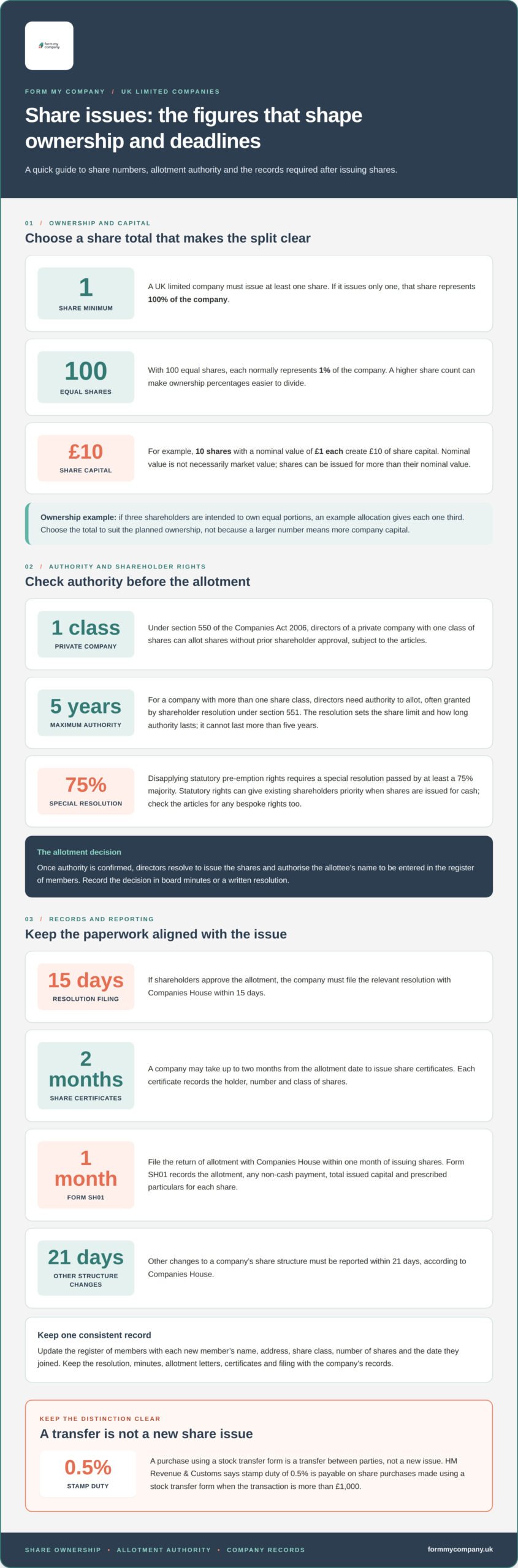
One share can be enough: a UK limited company must issue at least one, and that share represents 100% of the company if it is the only one issued. There’s no single ideal share count for every business. Issuing 10, 100 or 1,000 shares can make it easier to divide ownership into percentages. Knowing how to issue shares in a new limited company starts with choosing a structure that fits who will own it and how ownership may be divided.
It’s understandable to focus on the share total first, but that is only one part of the process. Directors need authority to allot shares, and the company’s records must accurately reflect the new ownership.
This guide explains how to decide on issued shares, what to consider before allotting them, and how to update the register of members and issue share certificates. It also covers form SH01: Companies House requires a company to report a share issue within one month. Follow the steps in order to keep the company’s records and filing aligned.
Key Takeaways
- A company must issue at least one share; choose a share total that makes ownership straightforward to divide.
- Before allotting shares, establish that the directors have authority under the company’s articles and any relevant shareholder resolutions.
- Record the allotment and update the register of members so the company’s records reflect who owns the shares.
- Issue share certificates and keep the company’s statutory records up to date after an allotment.
- Report a share issue to Companies House using form SH01 within one month; other changes to share structure must be reported within 21 days, according to Companies House.
How many issued shares should a company have?
A UK limited company must issue at least one share. In the incorporation application, state the rights, number and total value of each share type, along with how the shares are allocated to shareholders. This records the company’s initial ownership structure.
There’s no universal ideal total. One share gives its holder 100% ownership, whilst 10, 100 or 1,000 shares can make later percentage splits easier to calculate. With 100 equal shares, each normally represents 1% of the company. If three shareholders are intended to own equal portions, an example allocation gives each one third.
Choose a total that reflects the planned ownership, rather than treating a larger share count as more company capital. For example, issuing 10 shares with a nominal value of £1 each creates share capital of £10. The nominal value is the stated value attached to each share, not necessarily its market value. A company can issue shares for more than their nominal value.
Most UK companies limited by shares use one class, usually ordinary shares. Ordinary shares typically carry one vote per share on company decisions and may give holders dividend rights. The articles and share terms set out the rights attached to each class. Different classes can have different voting rights and dividend entitlements, separating ownership from decision-making.
For example, a company might create one share class with voting rights and another with different dividend entitlements. Set out each class’s rights and restrictions clearly in the company documents. Consider whether each class can vote, receive dividends or be transferred subject to restrictions. These choices affect how members participate, so avoid relying on informal understandings.
Pre-emption rights also affect how later shares are offered. Statutory rights can give existing shareholders priority when a company issues shares for cash. The articles may also include bespoke pre-emption rights, with their own scope and process. Review both before planning an allotment. Disapplying statutory pre-emption rights requires a special resolution passed by at least a 75% majority.
Keep share issues distinct from transfers. A purchase using a stock transfer form is a transfer between parties, not a new issue. HM Revenue & Customs says stamp duty of 0.5% is payable on share purchases made using a stock transfer form when the transaction is more than £1,000.
Directors’ authority to allot shares
At incorporation, the application records the company’s share structure and initial ownership. Include the rights, number and total value of each share type, together with the subscribers’ allocations. These details establish who holds the initial shares and the rights attached to them.
For a later allotment, start with the articles of association. The company must be legally entitled to issue the shares under its articles. Under section 550 of the Companies Act 2006, directors of a private company with one class of shares can allot shares without prior shareholder approval, subject to the articles.
Different rules apply where the company has more than one share class. Directors need authority to allot, often granted by shareholder resolution under section 551 of the Companies Act 2006. That resolution must state the maximum number or nominal value of shares and how long the authority lasts. It cannot last more than five years.
Companies incorporated under the Companies Act 1985 or earlier need one-off shareholder authority by ordinary resolution to allot under section 550. Check the company’s incorporation date and articles before the directors decide. If shareholder approval is required, record the resolution and its permitted share limit before proceeding.
The allotment takes place after the directors resolve to issue the shares and authorise entry of the allottee’s name in the register of members. Record the decision in board minutes or a written resolution. If shareholders approve the allotment, the company must file the relevant resolution with Companies House within 15 days.
If shares are not fully paid, shareholders may still have an amount to pay. Shareholders may have to pay that amount if the company closes. Giving shares to employees can also change the ownership split and voting balance. For example, allotting shares to an employee reduces existing shareholders’ proportional ownership unless they also receive shares.
After the directors approve an allotment, prepare a share certificate for each allottee and an allotment letter setting out the allocation. A company director is responsible for issuing a certificate for every allotment. The certificate records the holder, number and class of shares; the letter communicates the issue and its terms. Under the Companies Act 2006, a company may take up to two months from the allotment date to issue share certificates.
Form SH01 is the return of allotment filed with Companies House. It records the allotment, any non-cash payment, total issued capital, prescribed particulars for each share and an authorising signature. File it within one month of issuing shares. Keep the filing, resolution, minutes, allotment letters and certificates with the company’s records so the paperwork supports the same decision.
Updating the register of members
After an allotment, update the company’s register of members and related ownership records. This keeps the internal record aligned with the shares issued and their holders.
Member and shareholder records
The register of members records who holds the company’s shares and the details of their holdings. A person effectively becomes a shareholder when their name is entered in this register. Record each new member’s name, address, share class and number of shares, as well as the date they joined.
Update the register after the directors approve an allotment, rather than waiting for the next filing. The law allows two months after board approval to make the entry, but prompt updates help prevent discrepancies with board minutes, written resolutions or share certificates. If an allotment changes ownership percentages, record each resulting holding clearly.
Keep the register consistent with the company’s other shareholder records. A private limited company should be able to trace an allotment through its minutes or written resolution, the member entry and the relevant certificate. If a shareholder’s details later change, update the company records so they continue to identify the current holder accurately.
Statutory register updates
Updating statutory registers brings the company’s formal records into line with the allotment and any resulting ownership changes. Review the register of members alongside the company’s shareholding records and register of people with significant control (PSC register).
A person who owns more than 25% of a company’s shares or voting rights is classed as a person with significant control, according to Companies House. An allotment can therefore change who meets that threshold. For example, a new issue may reduce an existing holder’s percentage, or give a new holder significant control.
Record the change using the company’s allotment documents and updated member details. If the allotment affects PSC status, keep the PSC information consistent with the new ownership position. A clear record trail helps explain the change and supports accurate company records.
Ownership documents and confirmation statements
Ownership documents describe the company’s share allocation and the rights attached to each holding. After an allotment, align relevant investment or ownership documents with the register, including any written record of the agreed allocation. For example, an agreement showing an earlier ownership split should not contradict the current register of members.
Shareholder details are reported through the Confirmation Statement, rather than by adding the new member’s name to form SH01. The company records the allotment internally first, then includes shareholder information in its next Confirmation Statement. This keeps the filing consistent with the register and supporting documents.
Before submitting that statement, bring the shareholder information together with the company’s current records. If the register shows one allocation but an ownership document shows another, resolve the discrepancy in the records before reporting the details. A Confirmation Statement filing service can help with submitting the company’s statement.
Share certificates and statutory company records
After an allotment, issue a share certificate to each shareholder and keep a copy with the company’s records. Update the register of members with the new holding so it matches the allotment decision and certificate.
Preparing and issuing certificates
A share certificate records a shareholder’s holding. Prepare one for each allotment, using the company’s name and the correct shareholder and share details. Matching the certificate to the allotment helps prevent conflicting ownership records.
Before issuing a certificate, check it against the directors’ decision and the register of members. If the allotment gives a member shares of a particular class, for example, the certificate should accurately identify that class and holding. Keep a copy with the allotment paperwork.
Under the Companies Act 2006, a company may take up to two months from the allotment date to issue share certificates, according to legislation.gov.uk. Directors remain responsible for issuing a certificate for every allotment. Set a clear internal task after the allotment so certificates are prepared and sent within that period.
At formation, initial subscribers receive shares as part of setting up the company. For later allotments, use the directors’ resolution and allotment details as the basis for each certificate. Make sure the certificate date matches the company’s records, and retain evidence of the certificate issued to each shareholder.
Company records for shares
Statutory company records document the allotment, resulting ownership and certificates issued. Keeping these documents together helps directors explain how the company’s share position changed.
Update the register of members to show each new holder and their shares. The register is the formal record of membership, so an allottee becomes a shareholder when their name is entered. The company has two months after board approval to update it, although prompt entry helps keep the register aligned with the allotment.
Keep the board minutes or written resolution with the updated register and certificate copies. Include the return of allotment, form SH01, in the same records file once it has been prepared and filed. These documents show the decision, the shareholder entry and the company’s report of the allotment.
Keep a simple record trail for each issue: the directors’ decision, updated register, certificate and Companies House filing. If the certificate and register show different holdings, correct the company records so they match the approved allotment. This makes the ownership position clear to directors and members.
Filing form SH01 with Companies House
Form SH01 reports an allotment of shares to Companies House. Companies House requires a company to report an allotment within one month; filing SH01 is free.
Submitting Form SH01
SH01 is the return of allotment that records the new issue and the company’s share capital. Its details should match the directors’ decision and the company’s records, so the filing accurately reports the change.
Include details of the allotment, any non-cash payment, the company’s total issued capital and the prescribed particulars for each share type. The form also requires an authorising signature. For example, if the company allots ordinary shares in return for non-cash payment, include the allotment and payment details in the return.
Use the online route for changes to shares the company issues. Other changes to its shares must be registered by post. If a shareholder resolution approves an allotment, or a special resolution disapplies pre-emption rights, file a copy within 15 days. Keep the submitted form and relevant resolutions with the company’s records.
Filing fees and reporting requirements
SH01 and the Confirmation Statement serve different purposes. The return reports the allotment, while the Confirmation Statement updates shareholder details through the company’s regular filing. As of February 2026, a digital Confirmation Statement filing costs £50 and a paper filing costs £110.
Other changes to a company’s share structure have a separate deadline: Companies House requires them to be reported within 21 days. Identify whether the change is an allotment or another structural change, then use the applicable filing and deadline. A changed share holding should also agree with the company’s records and articles of association.
The tax treatment depends on the transaction. A share issue is distinct from a purchase using a stock transfer form: HM Revenue & Customs says stamp duty of 0.5% is payable on purchases made that way when the transaction is more than £1,000. If a company allots a £1 ordinary share for £4, the £3 difference is share premium, and the company must set up a share premium account.
Before submission, check each filing against its supporting documents. Confirm that the share class, number allotted, payment details and total issued capital match the directors’ decision. If an earlier resolution limits the directors’ authority, compare the allotment with that authority before reporting it.
Get help preparing company formation filings when you need support organising formation documents and share information.
Form My Company
Form My Company helps entrepreneurs set up a UK business through its company formation packages. If you’re preparing to incorporate, the Digital Package, Digital & Print Package and Entrepreneurs Choice Package offer options for new businesses. Start by choosing the business structure and formation approach that suit your plans.
If you’re considering a different legal structure, Form My Company also offers Limited Liability Partnership (LLP) Formation. For support with your company formation, contact Form My Company.
Set your ownership plan in motion
Planning how to issue shares in a new limited company is also an opportunity to think beyond incorporation. Consider how future investment, new founders or employee participation could affect the ownership structure you choose today. A clear plan gives directors and shareholders a shared reference point as the business develops.
Before moving ahead, align the proposed ownership arrangements with the company’s formation decisions. If the business changes direction later, treat each change as a formal company decision and keep its records consistent. This creates a dependable foundation for future discussions with shareholders and prospective investors.
Form My Company can help you take the next step with setting up your business. If you’d like support with the formation process, contact Form My Company for help. Start with the structure that suits your plans, then build your company’s records around it with confidence.
Frequently Asked Questions
Are members liable for more than the value of their shares?
A member’s payment obligation for their shares is limited to the amount due on those shares. If shares are not fully paid, the unpaid balance may still be payable, including if the company closes. This relates to liability arising from the shares themselves. It does not cover separate commitments a member might make, such as agreeing to fund the company under a separate arrangement.
Could a new shareholder affect my PSC register?
Yes. A new shareholder can change the company’s ownership or voting arrangements, which may affect who qualifies as a person with significant control. Consider both the shares held and the voting rights attached to them, rather than looking only at a shareholder’s name. If the company’s PSC position changes, update the PSC information and submit the required notification to Companies House.
How much do shares cost?
There is no standard purchase price for every company share. The amount depends on the issue terms and what the subscriber agrees to pay. For founders, the useful distinction is between a share’s nominal value and its agreed issue price. An allotment at a premium means the amount paid exceeds the nominal value, and the company records that premium separately.
What are the prescribed particulars?
Prescribed particulars briefly describe the rights attached to a share class, rather than identifying an individual shareholder. They help show what a holder of that class can expect under the company’s share terms. For example, the particulars can distinguish classes by their voting or dividend rights. The company reports the particulars for each relevant class in its allotment filing.
What is share capital?
Share capital is the combined nominal value of a company’s issued shares. It is not the company’s valuation, nor does it necessarily show how much cash the company currently holds. A company may receive more than the nominal value when issuing shares. The amount above nominal value is treated separately, so the share capital figure alone does not describe all the funds received.
How many shares should a new UK limited company issue, and what nominal value should they have?
Choose a share total and nominal value that make the intended ownership structure clear. Consider how the founders will divide ownership and whether the company expects to bring in other shareholders later. The number of shares does not, by itself, determine the business’s value. Review the proposed allocation alongside each class’s rights, so the share structure reflects both ownership and decision-making.
How do you allot new shares in a UK private limited company after incorporation?
If you’re considering how to issue shares in a new limited company after incorporation, start by matching the proposed allotment to the company’s articles and existing authority. The directors then make the allotment decision, after which the company updates its ownership records and reports the issue. Keep the documents together so the decision, shareholder information and filing all describe the same allotment.
What company approvals and resolutions are required to issue shares in the UK?
The required approval turns on the company’s articles, share classes and directors’ authority. For a private company with one class of shares, section 550 of the Companies Act 2006 can allow directors to allot without prior shareholder approval, subject to the articles. Other situations may require shareholder authority. Anyone planning how to issue shares in a new limited company should identify which route applies before the directors proceed.