
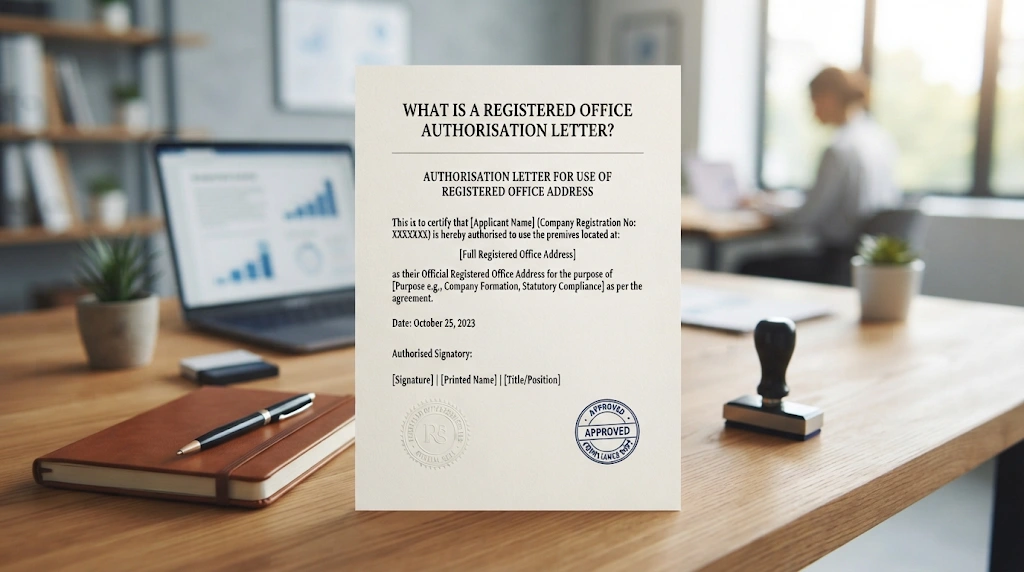
A registered office authorisation letter is a written confirmation from an address owner or provider. It states that a named UK company has permission to use that address as its registered office. Companies use it as evidence of that permission.
What Is a Registered Office Address in the UK?
A registered office address is a company’s official address, recorded at Companies House. It receives statutory notices and official correspondence. Every UK limited company maintains one, and it appears on the public register in the same part of the UK as the company’s registration.
The registered office is a legal requirement under the Companies Act 2006. Companies House publishes the address on its public register. Anyone searching the register sees where the company receives formal documents.
Companies House also shares registered office details with HMRC for newly incorporated companies. The address therefore carries real administrative weight. It is the point of contact for official mail from government bodies and other parties.
Which Jurisdictions Does the Address Cover?
A company registered in England and Wales uses an address in England or Wales. A Scottish company uses an address in Scotland. A Northern Ireland company uses an address in Northern Ireland. The address matches the company’s country of registration.
What Makes a Registered Office an “Appropriate Address”?
An appropriate address is a UK address where documents sent to the company reach a person acting for it. A person there must also be able to obtain an acknowledgement of delivery. Royal Mail PO Boxes no longer qualify.
The Economic Crime and Corporate Transparency Act 2023 introduced the appropriate address rule. GOV.UK states that companies cannot use a PO Box as a registered office. The restriction extends to similar services from other providers.
Companies House can change a non-compliant address to a default address held on the register. The company then provides an appropriate address with evidence of its link to that address. Failure to do so can lead to strike-off action.
The appropriate address test and the permission requirement are separate rules. An address passes the first test when documents reach the company. Permission is a distinct requirement. The company must hold the right to use that address.
Why Does a Company Need Permission to Use a Registered Office?
A company needs permission because Companies House guidance requires authorisation to use any address that belongs to someone else. Without it, the address owner can object to the registrar. The registrar can then change the registered office.
GOV.UK guidance states that a company must have permission to use its registered office address. This applies to an accountant’s office, a solicitor’s office, a registered office service, or a private residence owned by another person. The rule protects address owners from unauthorised use.
Companies House can act on objections. Legislation, including the Companies (Address of Registered Office) Regulations 2016, allows the registrar to change an address when the company lacks entitlement to use it. The company then holds a default address until it provides a valid replacement.
A written letter records the permission clearly. It names the company, identifies the address, and confirms the provider’s consent. This record supports the company if anyone questions its right to use the address.
What Does a Registered Office Authorisation Letter Contain?
A registered office authorisation letter identifies the address provider, the company, and the full registered office address. It confirms consent to use the address for statutory purposes. The provider signs and dates the letter.
No statutory form prescribes the wording. The letter is an administrative document, so layout varies between providers. Most letters include the same core details.
What Are the Core Details?
- The name of the company receiving permission.
- The full registered office address.
- The name and role of the person granting permission.
- A statement of consent to use the address as the registered office.
- The date of the letter.
- The signature of the authorised signatory.
The company name must match the name registered at Companies House. A mismatch weakens the letter as evidence. A mistyped address has the same effect.
The date matters because permission can end. A dated letter shows when the provider gave consent. If the arrangement ends, the company updates its registered office using Form AD01.
Who Issues a Registered Office Authorisation Letter?
The party that controls the address issues the letter. This is typically a registered office service provider, an accountant, a solicitor, a landlord, or a property owner. The provider confirms in writing that the company may use the address.
A person using their own home as the registered office does not require a letter from anyone else. The authorisation question arises when the address belongs to another party. This includes rented premises, where the lease or landlord’s consent governs use.
Registered office providers issue letters as part of their service. An agent supplying an address to a company has a direct interest in recording the arrangement. The letter confirms the scope of permission and protects both sides.
International clients and non-UK residents often rely on a third-party address. A UK-based registered office is mandatory for a UK limited company. Non-UK residents without a UK premises therefore obtain permission from a UK provider. The letter documents that arrangement.
The next stage of research covers the practical steps for obtaining the letter. Form My Company explains these in its guide on how to obtain a registered office authorisation letter.
Is a Registered Office Authorisation Letter a Legal Requirement?
The law requires permission to use the address, not a specific letter. A registered office authorisation letter is an administrative document that records that permission. It provides written evidence if Companies House, a bank, or another party asks for proof.
Statutory requirements, administrative procedures, and optional documents differ. The statutory requirement is an appropriate address that the company is entitled to use. The letter is the administrative record of that entitlement.
Companies House can ask for evidence of the link between a company and its registered office. A letter provides one form of that evidence. Other documents, such as service agreements, serve the same purpose.
Banks and other organisations carry out their own verification checks. A signed letter gives them a clear record of the address arrangement. Requirements differ between organisations, so the letter is a supporting document rather than a universal obligation.
How Does the Letter Relate to Supplementary Company Documents?
A registered office authorisation letter is a supplementary company document. It sits alongside the core incorporation documents without replacing any of them. Companies commonly keep it with their official records to evidence address permission.
Core incorporation documents include the memorandum of association and articles of association. These are statutory. Supplementary documents support the company’s administration and verification needs, and a registered office authorisation letter falls into this group.
Form My Company provides supplementary company documents for companies that require this supporting paperwork. The service covers documentation that supports the company after incorporation. It forms part of the wider business support services the company offers.
Companies keep supplementary documents with their statutory records. This includes registers, filings, and correspondence. A well-organised record shows how the company established its registered office.
Understanding the document before requesting it avoids errors. Accurate company details, a compliant address, and a signed confirmation all matter. Each element affects the letter’s value as evidence.
For wider context, Form My Company’s overview of registered office address requirements covers the address rules in more detail.
What Happens If a Company Lacks Permission to Use Its Registered Office?
Companies House can change the registered office to a default address if a company lacks permission or uses an inappropriate address. The company must then supply a compliant address. Continued failure can result in the registrar starting strike-off action.
An address owner who objects triggers a review by the registrar. If the registrar concludes the company has no entitlement, it replaces the address. The default address is held by Companies House and does not receive the company’s mail in a practical way.
A company whose address is changed this way misses statutory correspondence. Official notices, including those from Companies House itself, go to the default address. That creates compliance risk for the directors.
Companies maintain accurate registered office details at all times. Directors confirm permission before incorporation, because GOV.UK states the address must be in place before registration. A written letter at that stage removes later uncertainty.
What Are the Most Common Questions About Registered Office Authorisation Letters?
Does Companies House provide a template for the letter?
No statutory form exists for this letter. Address providers draft their own versions. The letter contains the company name, the address, the provider’s consent, a date, and a signature.
Can a company use a PO Box as its registered office?
No. GOV.UK confirms that a Royal Mail PO Box no longer qualifies as a registered office. The address must be a physical UK address meeting the appropriate address rules.
Does a director using their own home need a letter?
A letter is not required when the director owns the home and consents themselves. Rented properties differ, because the landlord’s permission or lease terms govern use.
Can a non-UK resident form a UK company?
Yes. A UK limited company requires a UK registered office. Non-UK residents obtain permission from a UK address provider and keep the written authorisation with company records.
How does a company change its registered office address?
A company files Form AD01 with Companies House, which GOV.UK offers as an online service. The company confirms the new address is appropriate and that it has permission to use it.
What Is the Key Takeaway on Registered Office Authorisation Letters?
A registered office authorisation letter documents a company’s permission to use a registered office address. UK law requires that permission and an appropriate address. The letter provides written evidence for Companies House and third parties.
The registered office is a statutory feature of every UK limited company. Companies House requires an appropriate address, and the company holds permission to use it. The letter records that permission clearly and supports the company’s records.
Understanding these rules before incorporation prevents address disputes and compliance problems. Form My Company supports businesses with supplementary company documents that include this type of supporting paperwork. Readers researching the next stage find practical steps in the related guide.