
The Companies House fee is only one part of a limited company’s ongoing costs. To understand what the ongoing costs of a limited company are, start with the digital Confirmation Statement fee: it is £50, and Companies House requires a filing at least once every 12 months. Accountancy, banking, software and any payroll or insurance needs can add to the total.
It’s easy to focus on recurring fees and overlook the time and deadlines involved. A limited company must also meet its accounts and tax responsibilities, while a sole trader has different reporting requirements. Which structure costs less overall depends on how the business operates and the support it needs.
This guide explains the main ongoing costs, key filing and Corporation Tax deadlines, and how software may fit into your budget. It also compares limited company and sole trader costs to help you plan before choosing how to run your business.
Key Takeaways
- Separate recurring filing fees from the wider costs of accountancy, banking, software and business operations.
- Keep company money separate from personal funds and include business banking in your budget.
- Plan for Corporation Tax deadlines around your accounting period, not just the end of the tax year.
- Choose bookkeeping software that suits your transaction volume and the records your company needs to maintain.
- Compare the extra administration of a limited company with sole trader reporting before deciding which structure fits your business.
Companies House Confirmation Statements and filing fees
A Confirmation Statement confirms whether key company information held by Companies House is accurate. It is separate from annual accounts and Corporation Tax returns, so include each requirement in your compliance calendar.
Confirmation statement filing frequency
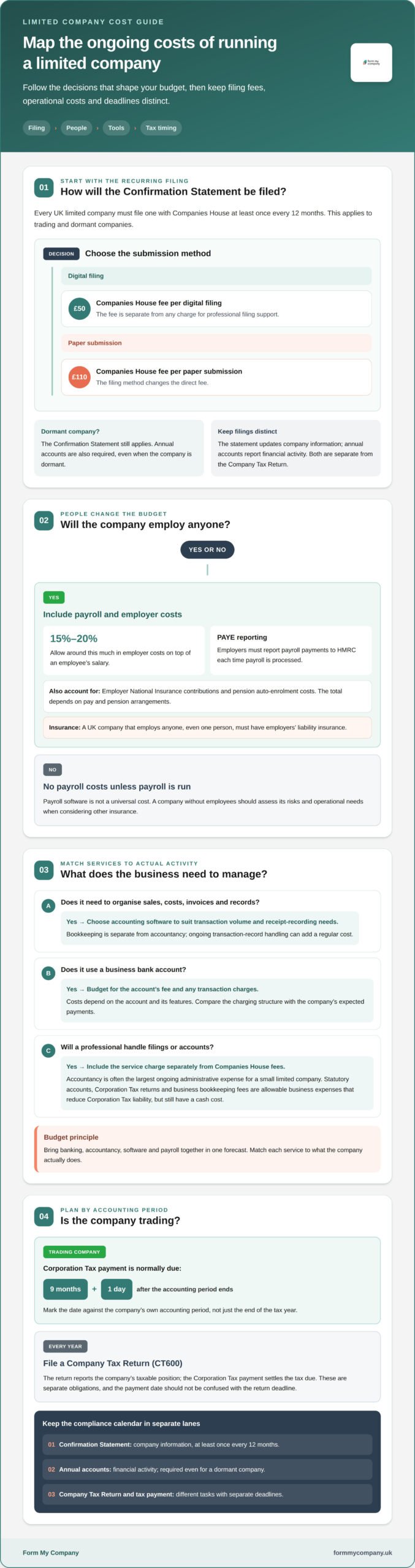
A UK limited company must file a Confirmation Statement with Companies House at least once every 12 months, according to Companies House. This applies whether the company is trading or dormant, so a pause in business activity does not remove the filing task.
The Confirmation Statement updates company details, rather than reporting financial performance. Before submitting it, check the information against current company records, especially after changes to directors, shareholders or the registered office. This helps keep the Companies House record accurate.
Confirmation statement filing fees
Companies House charges £50 for digital filing of a UK limited company’s Confirmation Statement. The paper submission fee is £110, according to Companies House. Choosing a filing method therefore affects the direct fee, so include the intended method when forecasting this recurring compliance cost.
Companies House filing fees are separate from the cost of professional assistance. If the company submits the statement itself, budget for the filing fee; an agent may charge separately for its service. Keep the filing confirmation, submission date and details with the company’s records.
Use an annual calendar to distinguish the Confirmation Statement from annual accounts. The statement updates company information, while accounts report financial activity for the accounting period. Companies House requires annual accounts even for a dormant company, so inactivity does not replace either filing.
For example, a company that has stopped trading still needs to keep its Companies House filings in view. Treat formation as the start of an ongoing record-keeping responsibility, not a one-off registration task. A Confirmation Statement filing service can help with this specific submission.
For late annual accounts, Companies House sets the automatic penalty for a UK private limited company at £150 annual. Confirmation Statements and tax returns are separate filings, so track each deadline independently and submit the required information on time.
In the UK, a company that employs anyone, even one person, must have employers’ liability insurance. A company without employees should assess its risks and operational needs when considering other insurance.
The cost of filing support depends on the submission method and the company’s requirements. A case-specific figure is provided in a quote, so distinguish that service cost from the Companies House fee when planning.
Business bank account fees
A limited company is a separate legal entity, so keep company and personal money separate. A business bank account gives transactions a clear record and makes it easier to reconcile income, expenses and balances when preparing accounts.
The fee depends on the account and its features, and transaction charges can also affect the total. Compare the account’s charging structure with how the company expects to receive and make payments.
Accountancy is often the largest ongoing administrative expense for a small limited company. Ongoing bookkeeping is separate and can add a regular cost if someone handles transaction records throughout the year.
Fees for statutory accounts, Corporation Tax returns and business bookkeeping are allowable business expenses that reduce Corporation Tax liability. They still have a cash cost, so include them in the company budget and keep the accountant’s invoice with its records.
Every UK limited company must prepare annual accounts and file them with Companies House. A Company Tax Return is a separate filing from the company’s annual accounts. These are distinct tasks: accounts report the company’s financial position, while the return reports its taxable profits and tax calculation.
Accounting software can help organise sales, costs, invoices and records for year-end accounts. Choose tools that suit the company’s transaction volume and receipt-recording process. Include payroll software in the budget if the company runs payroll, rather than treating it as a universal cost.
For employers, payroll adds reporting and employment costs. UK employers must report payroll payments to HMRC each time payroll is processed through PAYE. Allow around 15%-20% in employer costs on top of an employee’s salary. Employer National Insurance contributions and pension auto-enrolment costs affect the payroll budget; the total depends on pay and the pension arrangements.
Bring the costs together in one forecast: business banking, accountancy, software and payroll where relevant. For example, a company without employees may not need payroll software, while one that pays salaries must account for recurring PAYE reporting and related employer costs. Match each tool and service to actual business activity to avoid paying for functions the company does not use.
Corporation Tax payment deadlines
Corporation Tax creates both a reporting task and a cash-flow commitment for a UK trading company. HM Revenue & Customs says payment is normally due nine months and one day after the end of the accounting period. The deadline follows the company’s own accounting period, so mark it against that period’s end date. Don’t assume the payment date matches the Company Tax Return deadline; they are separate obligations.
A UK company must file a Company Tax Return, known as a CT600, every year. The return reports the company’s taxable position, while the payment settles the Corporation Tax due. Keep sales, allowable costs and supporting records organised throughout the accounting period. That gives the company a clearer basis for its tax calculation and helps directors plan the amount leaving the business bank account.
For cash flow, treat Corporation Tax as a planned business charge, not money available to spend. Review income and costs regularly, and update the expected tax position as the accounting period progresses. When drawing funds as a shareholder, consider future company liabilities as well as the current bank balance. Separating tax planning from personal withdrawals can help prevent a shortfall when payment is due.
VAT creates a separate cycle for businesses registered for the tax. HM Revenue & Customs requires VAT registration when taxable turnover exceeds £90,000 within a 12-month period. VAT-registered businesses usually submit returns every quarter. Track VAT collected and paid alongside sales records, because return preparation and payment can affect working cash at different points from Corporation Tax.
VAT registration, returns and bookkeeping can bring recurring administration costs. The amount depends on transaction volume, how complete the records are, and whether software or professional support is used. A VAT return needs organised transaction data, while bookkeeping keeps those records usable between filing dates. VAT registration assistance can help with the registration step when the company needs to register.
Use a simple calendar to keep the obligations distinct: note the accounting period end, Corporation Tax payment date, CT600 filing task and VAT return periods. HM Revenue & Customs’ nine-month-and-one-day payment rule makes the accounting period end the key date for Corporation Tax planning. A separate cash-flow forecast can then account for VAT payments and company spending without treating funds set aside for tax as available shareholder income.
Bookkeeping software subscriptions
Bookkeeping software brings a company’s sales, invoices, receipts and expenses into one record-keeping system. Its subscription is a recurring overhead, but the right package depends on transaction volume, reporting needs and who will use the records. Include it in your forecast for running the company, rather than treating it as a one-off setup cost.
Software packages differ in what they cover. A basic option may record income and expenditure, while a broader package may support invoicing, bank transaction matching and management reports. These features can reduce manual data entry, but the company still needs accurate source records. For example, software cannot categorise a supplier receipt correctly if its description is missing.
There is no single subscription price for every company. Software costs depend on the package, number of users, transaction volume and extra features. Compare these with the company’s routine before paying for functions it will not use.
Setting up bookkeeping software after incorporation is easier when the company’s record-keeping process is clear. Decide who enters sales and expenses, how receipts are stored and how often records are reconciled. Use consistent categories for common costs such as rent, supplies and travel. A consistent setup helps year-end accounts reflect the company’s activity.
Keep the company’s liability and reporting responsibilities in view. As a separate legal entity, the company must record its transactions as company activity, not mix them with a director’s personal spending. Use the business bank account for company payments and retain supporting documents for each entry. This creates a traceable record for whoever prepares the accounts and tax returns.
Software does not replace regular bookkeeping reviews. Set a routine to match entries against statements, flag missing receipts and review unpaid invoices. A company with few transactions may need a simpler system than one with frequent sales, supplier bills or payroll entries. Costs are driven mainly by the work and functionality the business needs, not simply by its formation date.
Include subscription terms in the cash forecast. Check whether the plan bills monthly or annually, and note renewal dates alongside other company obligations. If the business grows, review whether its current package still handles its records clearly. A practical bookkeeping setup supports timely accounts preparation, but software does not remove the director’s responsibility to maintain accurate company records.
Limited company costs compared with sole trader costs
A limited company and a sole trader may have similar operating expenses, such as premises, equipment, insurance and software. The difference is the administration attached to each structure. A limited company has its own reporting duties, while a sole trader does not operate through a separate company entity. Compare both the cash costs and the time needed to keep records up to date.
A limited company must prepare and file annual accounts with Companies House and submit a Company Tax Return to HMRC each year. Companies normally pay no Companies House filing fee for annual accounts submitted on time. A sole trader avoids these company filings but still needs organised records to work out business income and costs. When asking, “What are the ongoing costs of a limited company?”, compare them with your obligations as a sole trader.
This difference matters when estimating the cost of professional support. A limited company may need help preparing statutory accounts and its Corporation Tax return, as well as bookkeeping. A sole trader’s support needs depend on transaction volume, the nature of the work and how much record-keeping they handle themselves. For either structure, complete records can make year-end work more straightforward.
Late filing can change the company’s cost calculation. According to Companies House, the automatic penalty for a UK private limited company filing its annual accounts late starts at £150 annual. A sole trader doesn’t have this particular Companies House accounts filing obligation. Build filing dates into the company calendar rather than treating compliance as optional.
Staff can add payroll administration to either business model. For a limited company, payroll records sit alongside company accounts and tax reporting. Insurance requirements also depend on the company’s activity and whether it employs people. Include staffing plans and related administration in your comparison before assuming one structure is automatically cheaper.
Consider how money moves, too. A limited company is a separate legal entity, so keep company funds distinct from the owner’s personal money. This calls for clear transaction records and a business bank account. A sole trader may find business activity simpler to track, but separating personal and business spending can still support accurate records.
The practical takeaway is to compare the full workload, not just one fee. Ask, “What are the ongoing costs of a limited company?” and include operating expenses, reporting, bookkeeping and payroll where relevant. A new business with few transactions and no staff may have different needs from a growing company with regular sales and employees. Explore your company formation options as you decide which structure fits your plans.
Form My Company
Form My Company helps entrepreneurs set up a company with packages including Digital, Digital & Print and Entrepreneurs Choice. If you are weighing a limited company’s ongoing administration against sole trader reporting, choosing the right structure is a practical place to start. Form My Company also provides Limited Liability Partnership formation for businesses considering that structure.
Choose a formation route that fits your plans, then use the costs and deadlines in this guide to shape your ongoing budget. Formation support helps establish the company, while accounting, software and tax responsibilities remain part of running it.
Contact Form My Company to discuss your company formation.
Plan your next business step
Understanding the ongoing costs of a limited company gives you a stronger starting point for deciding how to structure your business. Connect your estimate to your plans by considering how the company will operate, what records it will need and how its responsibilities may change as it grows.
Build a working budget and revisit it when trading activity, staffing or reporting needs change. This makes compliance part of routine business planning rather than a last-minute task. It also helps you assess whether a limited company remains the right fit, instead of focusing on formation alone.
If you’re ready to set up a company, Form My Company can help you choose a formation package suited to your needs. Explore the structure you’re considering and take the next step with a clearer view of the responsibilities ahead.
Contact Form My Company to discuss your next step. A clear plan can help you approach your new venture with confidence.
Frequently Asked Questions
What are the costs of running a limited company?
Costs vary with the company’s activity, staffing and record-keeping needs. Budget for recurring administration such as filing, accountancy, banking and software, then add operational expenses like insurance or payroll where relevant. A company without employees will have a different cost profile from one running payroll. Separate predictable subscriptions from tax liabilities, which depend on the company’s taxable position.
Company formation comparison: what will you actually spend?
Formation costs depend on the registration route and the support or documents included. The statutory filing fee is separate from a formation package or professional support. Before comparing structures, distinguish the one-off formation cost from recurring compliance expenses, then consider whether the company needs additional setup services or printed documents.
So, how much should you budget overall?
There is no single total for every limited company: costs depend on business activity and the records or support required. List fixed subscriptions and recurring administrative services, then estimate variable expenses such as payroll and insurance. Keep tax payments separate from operating expenses and set aside funds as the company’s financial position develops. Review the forecast whenever staffing, sales or reporting needs change.
What are the annual Companies House filing fees for a UK limited company?
The Confirmation Statement filing fee is £50 digitally or £110 on paper, according to Companies House. Annual accounts submitted on time normally have no Companies House filing fee. These are separate filing tasks, so budget for the Confirmation Statement fee while keeping the accounts submission on the compliance calendar. Using an agent may add a service charge beyond the statutory filing fee.
How much does it cost to file a UK limited company’s annual accounts?
Companies House normally charges no filing fee for annual accounts submitted on time. The company may still pay an accountant or another professional to prepare them. The service cost depends on the company’s transaction records, financial activity and the support included. Keep preparation fees separate from Companies House filing charges when comparing quotes or planning the annual budget.
What is the UK corporation tax rate and how is it calculated?
The Corporation Tax rate applicable to a company depends on its taxable profits and the rules for its accounting period. The calculation starts with tax-adjusted profits, not simply the cash in the company’s bank account. Allowable expenses and accounting adjustments affect the taxable amount. Use the company’s accounts and tax records to establish the figure for its return.
What are the costs of preparing and filing a UK limited company’s accounts and corporation tax return?
The total depends on whether the company prepares records internally or pays for professional help, and on the amount of transaction work involved. Companies House normally charges no fee for annual accounts submitted on time, but preparing those accounts and the Corporation Tax return can involve separate accountancy charges. Clear, complete records can reduce the work needed to reconcile transactions and prepare year-end information.
How do the ongoing costs of a UK limited company compare with those of a sole trader?
A limited company generally has more formal reporting to plan for, including annual accounts and a Company Tax Return. A sole trader does not file company accounts with Companies House, but still needs records to calculate business income and expenses. The practical difference depends on transaction volume, staffing and whether either business pays for bookkeeping or accountancy support. Compare total administration, not just one filing fee.