

What if your company has no sales, but its first filing deadlines still arrive? Dormancy does not automatically remove a company’s filing responsibilities. The first year legal obligations for a UK limited company include meeting Companies House deadlines and understanding which tax and payroll duties apply to its activities. Start planning by identifying the dates linked to incorporation, trading and accounting periods.
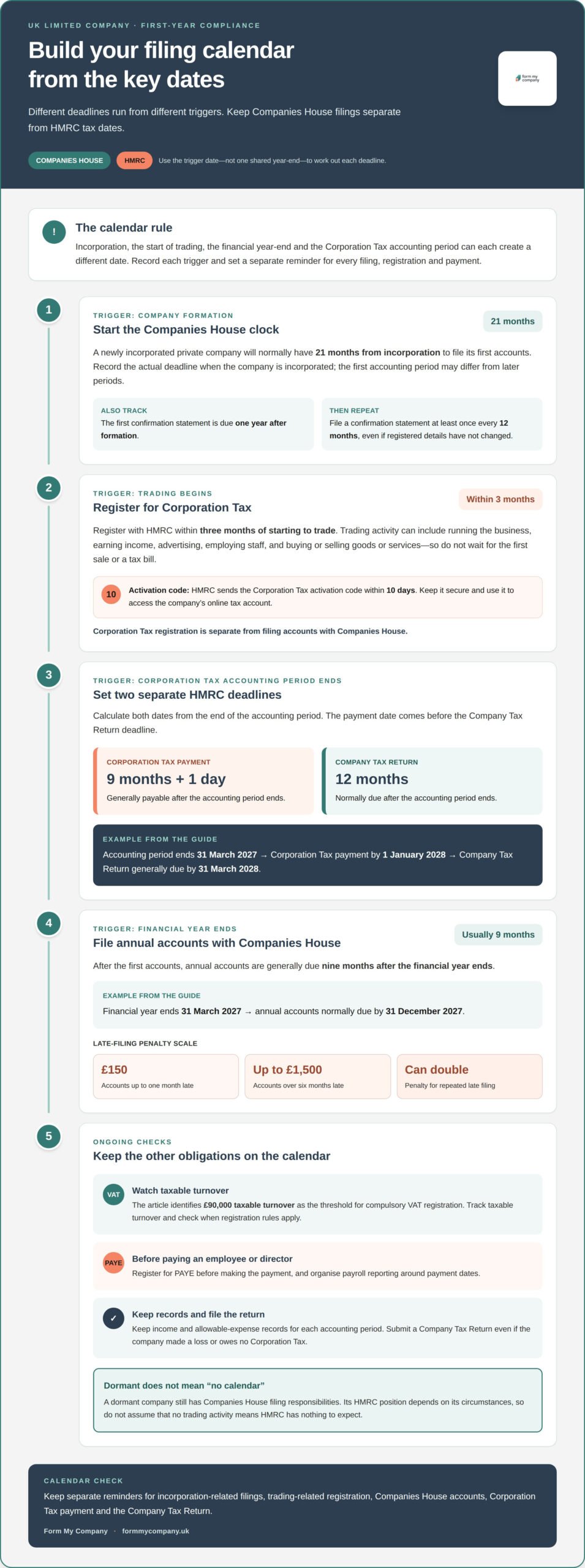
Companies House says a newly incorporated private company will normally have 21 months from incorporation to file its first accounts. After that, annual accounts are generally due nine months after the financial year ends. HMRC says a Company Tax Return is normally due 12 months after the end of the Corporation Tax accounting period. A dormant company’s position depends on its circumstances, so don’t assume that having no trading activity means HMRC has nothing to expect.
This guide sets out the key first-year dates, explains when to register for PAYE before paying an employee or director, and covers the £90,000 taxable-turnover threshold for compulsory VAT registration, according to HMRC. It also explains what to keep on your compliance calendar if the company is dormant, so you can plan each filing and know which obligations apply.
Key Takeaways
- Build a filing calendar around your company’s incorporation date, financial year-end and Corporation Tax accounting period.
- Separate Companies House accounts deadlines from HMRC tax return and payment dates so each task has its own reminder.
- Register for PAYE before paying an employee or director, and plan payroll reporting around payment dates.
- Track taxable turnover and act when VAT registration rules apply; late registration can bring additional liabilities and penalties.
- Keep a dormant company’s filing duties on the calendar too, and distinguish its Companies House responsibilities from its HMRC position.
What Do Key UK Business Finance Requirements and Deadlines Involve?
Display the company’s registered name, registered office address and company number on its website, emails, invoices and business premises. Include its place of registration so customers can identify the legal entity behind the business.
Registering for corporation tax
Register the company for Corporation Tax with HMRC within three months of starting to trade. Trading activity can include running the business, earning income, advertising, employing staff, and buying or selling goods or services. Set a reminder from the date trading begins, rather than waiting for the first sale or a tax bill.
Have the company’s accounting details ready for registration, then look out for HMRC’s Corporation Tax activation code, which is sent within 10 days. Keep the code secure and use it to access the company’s online tax account. Registration is a separate step from filing accounts with Companies House.
Managing corporation tax payments and returns
Record the end date of each Corporation Tax accounting period, then calculate both deadlines from it. HM Revenue & Customs says a Company Tax Return is normally due 12 months after the end of that accounting period. HMRC says Corporation Tax is generally payable nine months and one day after the period ends.
For example, if an accounting period ends on 31 March 2027, the payment deadline is 1 January 2028 and the return is generally due by 31 March 2028. Treat these as separate dates in your calendar. The earlier payment deadline means the tax return deadline is not a safe date to wait for before arranging payment.
- Keep complete records of the company’s income and allowable expenses for each accounting period. Use them to calculate taxable profit and support the figures reported to HMRC. Turnover alone does not show how much Corporation Tax is due, so retain evidence of transactions and costs as well as sales.
Submit a Company Tax Return even if the company made a loss or owes no Corporation Tax. No tax payment is due does not mean no return is required. Check that the return covers the correct accounting period and that the company’s records support its figures before filing.
- Set calendar reminders as soon as the company starts trading. Record the trading start date, Corporation Tax accounting period and its end date, then work out the payment and return deadlines. Keep separate reminders for registration, payment and filing.
Review the calendar if the company’s accounting period changes or its trading activity develops. Organise bank statements, invoices and expense records by period. This makes it easier to prepare the return and spot missing information before the deadline.
First and subsequent annual accounts deadlines
Register a limited company by submitting an incorporation application to Companies House with its proposed name, registered office and company details. Companies should keep their confirmation statement filings up to date and check the applicable filing fee.
Preparing year-end accounts
Set the company’s financial year-end and organise its records ahead of that date. Companies House says a newly incorporated UK private company will normally have 21 months from incorporation to file its first accounts. This longer first deadline can make the first accounting period different from later periods, so record the actual deadline rather than assuming every year follows the same timetable.
Bring together records of sales, expenses, bank transactions, assets and amounts owed. An accountant can use these to prepare statutory accounts and support tax figures. Keep the accounting period consistent across records and filings, and remember that accounts filed with Companies House serve a different purpose from the company’s tax return.
Filing annual accounts
Enter the first accounts deadline in the company calendar as soon as Companies House incorporates the business. After the first accounts, Companies House says annual accounts are generally due nine months after the financial year ends. For example, a company with a 31 March 2027 year-end normally files by 31 December 2027.
Check that the accounts cover the correct financial period and are complete before submission. Late filing penalties rise with delay: they start at £150 for accounts up to one month late, and reach £1,500 for accounts over six months late. A repeated late filing can double the penalty.
- Separate the annual accounts deadline from the confirmation statement date. A company must file a confirmation statement at least once every 12 months, even when its registered details have not changed. The first is due one year after formation, so set its reminder from the incorporation date, not the financial year-end.
Review the company’s details before filing, including its registered office, directors, shareholders and people with significant control. Submit the statement to Companies House and keep a record of the filing. If company information changes, update the relevant details promptly rather than relying on the annual statement.
- Complete the incorporation application accurately. Provide the proposed company name, registered office, director and shareholder details, and articles of association. Companies House uses this information to establish the company record. Errors can lead to avoidable corrections and make later filings harder to manage.
Track accounts, confirmation statements and tax records as separate items in one calendar. Each filing reminder should show the relevant period, due date and person responsible. If an accountant prepares the accounts, agree when to supply records and keep evidence of submission and any payment. This creates a clear audit trail for each reporting year.
Use a confirmation statement filing service to support this Companies House requirement when it falls due.
PAYE registration and employer responsibilities
Plan payroll before the company pays staff or directors. PAYE, company addresses, statutory records and VAT each require separate checks.
- Register as an employer and set up PAYE before making the first payment to an employee or director. Employers operate PAYE to collect Income Tax and National Insurance from wages. A UK employer generally needs to register if it pays an employee more than £96 per week. Don’t wait until the end of the financial year to organise payroll.
Set up a process to record each payment and send payroll information to HMRC. For 2026/27, directors taking a salary above the Lower Earnings Limit of £6,500 a year must submit Real Time Information reports to HMRC on or before each payment date. This timing makes the payment date a key payroll deadline.
- Check workplace pension duties when employing staff. UK employers must provide workplace pensions to eligible employees, so include eligibility checks and enrolment administration in your payroll process. Keep payroll records of wages, deductions and payment dates. These help the company reconcile its accounts and respond accurately to HMRC reporting requirements.
Assign responsibility for payroll submissions, whether a director handles them or an accountant does. Keep the payroll calendar aligned with actual pay dates, since Real Time Information reports are due on or before payment for qualifying director salaries in 2026/27.
- Set the company’s registered office address and registered email address as part of its administration. Ensure the people responsible can receive and act on official correspondence sent to these details. Keep access arrangements current when the team or working setup changes, and store important messages with the company’s records.
Use the registered office address consistently in company paperwork, and keep it aligned across internal records and Companies House filings. Treat the registered email address as an active channel for company notices, not an inbox nobody monitors.
- Keep statutory company records organised and make directors’ responsibilities clear. Directors must maintain company records, report certain information and follow the company’s articles of association. They should consider whether a company transaction could create a personal benefit for them. Directors can delegate day-to-day tasks but remain legally responsible for the company’s records, accounts and performance.
Record decisions and changes as they happen, and ensure the information used for Companies House filings stays accurate. A confirmation statement is one part of the filing calendar. It does not replace keeping company records or reporting relevant changes when required.
- Track taxable turnover against the VAT registration threshold. HM Revenue & Customs sets the compulsory VAT registration threshold in the UK at £90,000 of taxable turnover. Review turnover as the business trades, because reaching the threshold can trigger registration duties. A business expecting to exceed the threshold within the next 30 days may also need to register under the relevant rules.
Keep VAT monitoring separate from payroll. If registration applies, plan the registration alongside the company’s other tax administration; a VAT registration service can help with that step.
VAT registration thresholds and returns
- Monitor taxable turnover and register when the VAT rules require it. HM Revenue & Customs sets the compulsory VAT registration threshold in the UK at £90,000 of taxable turnover. This is the value of taxable supplies, not simply the money left after expenses. Keep sales records up to date so the company can see when turnover reaches the threshold.
Registration can also apply if the business expects taxable turnover to exceed £90,000 within the next 30 days. Review expected sales as well as completed transactions, especially when a large contract or order is approaching. A business that exceeds the threshold must register within 30 days, so put the relevant registration deadline into the company calendar.
- Once registered for VAT, submit returns on the company’s assigned schedule and keep related invoices and transaction records together. VAT returns are typically due one month and seven days after the quarter ends. A VAT-registered company files every three months, so note each period’s end and calculate its submission date separately.
Use the return to report VAT charged on sales and VAT paid on eligible purchases. Reconcile the figures against invoices and bookkeeping records before submission. Filing a VAT return and paying any VAT due are related tasks, but do not treat the return deadline as a substitute for planning payment.
- Act promptly if the company misses a VAT registration deadline. Late registration can leave the business liable for VAT from the date it should have registered, even if it did not charge customers VAT then. A late-registration penalty may be calculated as a percentage of VAT owed, with a minimum charge of £50.
Keep evidence of taxable turnover and the date the business became liable to register. These records help establish the period covered by a missed deadline and the VAT due. If the company expects sales to rise sharply, review its turnover before accepting orders that could affect its registration requirement.
- Keep VAT returns separate from Companies House annual filings. A VAT return reports VAT for its tax period; it is not the company’s annual accounts or confirmation statement. Companies House requires a confirmation statement at least once every 12 months, even if company information has not changed. Record its due date separately from VAT return dates.
“Annual return” is often used informally, but don’t confuse that phrase with a VAT return or a confirmation statement. Missing a confirmation statement can lead to a £5,000 fine and the company being struck off. Maintain separate reminders for each filing, record when you submit it, and retain the confirmation for the company’s records.
Dormant company obligations and compliance calendars
- Keep Companies House filings on the calendar even if the company is dormant. Dormancy does not remove the requirement to file annual accounts or a confirmation statement. After the first accounts, Companies House says accounts are generally due nine months after the financial year ends. Set reminders using the company’s actual year-end, not its trading activity.
File a confirmation statement at least once every 12 months, even if no company details have changed. Its filing window runs for 14 days after the confirmation date. Record the confirmation date and filing deadline separately from the accounts deadline, so one completed filing does not obscure another obligation.
- Keep HMRC obligations distinct from Companies House filings. A company’s Corporation Tax accounting period and financial year may not end on the same date, so calculate tax deadlines from the relevant accounting period. HMRC says a Company Tax Return is normally due 12 months after that period ends.
A company must file a Company Tax Return even if it made a loss or owes no Corporation Tax. Do not assume inactivity means no tax filing is due. Review HMRC correspondence and the company’s trading and financial records to establish which return or response applies to each period.
- Record activity throughout each period, including transactions that might affect the company’s dormant status. Keep bank statements, invoices and explanations for payments with the accounting records. This provides a clear basis for preparing the relevant accounts and responding to HMRC or Companies House if the company’s activity changes.
Before restarting trading, update the compliance calendar to include duties triggered by the new activity. For example, track the trading start date for Corporation Tax registration and monitor taxable turnover against the VAT registration threshold. A change in activity can mean the company’s obligations differ from those during dormancy.
- Assign each filing a named person, a due date and a record of submission. Include Companies House accounts, the confirmation statement and HMRC Corporation Tax returns. Review the calendar when the accounting period or company activity changes, and keep filing evidence with the company’s records rather than relying on memory or an email reminder alone.
If dormant accounts are due, use a dormant company accounts filing service to help manage that Companies House task. Keep HMRC tax-return requirements on the calendar separately, because Companies House and HMRC filings serve different purposes and follow different deadlines.
Form My Company
Form My Company helps entrepreneurs establish a UK business through company formation packages, including Digital, Digital & Print and Entrepreneurs Choice. If you are choosing a structure, its Limited Liability Partnership (LLP) Formation service helps you set up an LLP instead of a limited company.
Turn to Form My Company when you are ready to form a business and want a clear starting point for its structure and formation. After incorporation, use the deadlines in this guide to organise accounts, tax registrations and Companies House filings. Formation starts the company’s compliance calendar; it does not replace the duties that follow.
Contact Form My Company to discuss the right formation route for your business.
Make compliance part of your next business decision
Give each ongoing compliance task a clear owner and include it in regular business planning. When the company changes direction, starts employing people or expands its activity, revisit the affected processes and update your records. This keeps administration connected to how the business operates, rather than treating deadlines as isolated reminders.
Planning for the first year’s legal obligations for a UK limited company is also an opportunity to build habits that support future growth. Keep important company information organised, make responsibilities clear between directors, and bring in appropriate professional support when a task requires specialist expertise. A simple process that is regularly maintained is more useful than a calendar nobody reviews.
If you’re preparing to form a company or want help choosing a starting point, contact Form My Company. Take the next step with a clear plan, and build your business on an organised footing.
Frequently Asked Questions
Does a dormant company have HMRC obligations?
Yes. Dormancy does not automatically remove HMRC filing responsibilities. A UK limited company must file a Company Tax Return even if it made a loss or owes no Corporation Tax. Keep records of the company’s income, spending and bank activity for each accounting period. Review HMRC correspondence and respond to any filing request that applies to the company’s circumstances.
What Happens After You Register a Limited Company?
After Companies House incorporates the company, organise its records and create a calendar for upcoming filings. Identify the financial year-end and Corporation Tax accounting period, as they determine different deadlines. If trading begins, register for Corporation Tax within three months. Before paying an employee or director, register as an employer and arrange PAYE. Monitor taxable turnover to see whether VAT registration rules apply.
What are a limited company’s annual compliance obligations?
A limited company’s annual compliance usually includes preparing accounts, filing a confirmation statement and meeting HMRC’s Corporation Tax requirements. Directors must keep company records and follow the company’s articles of association. Record key decisions and changes, and keep company information accurate in filings. Employing staff or becoming VAT registered can bring additional duties, so add them to the company’s calendar.
What filings are required in my first year as a limited company?
First-year filings depend on the company’s activity and reporting dates. Plan for Companies House accounts and a confirmation statement, as well as a Company Tax Return for the relevant Corporation Tax accounting period. If the company employs people, employer registration and payroll reports may apply. VAT returns apply after VAT registration. Record each filing’s due date and responsible person, rather than treating incorporation as the only administrative step.
What is the confirmation statement?
A confirmation statement is a Companies House filing used to confirm the company’s registered information, including details such as its directors and shareholders. Companies House requires a statement at least once every 12 months, even if nothing has changed. The filing period ends 14 days after the confirmation date. Review the details for accuracy and submit the statement separately from the company’s annual accounts.
When is corporation tax due to be paid?
HM Revenue & Customs says Corporation Tax is generally payable nine months and one day after the end of the relevant accounting period. For example, a period ending on 31 March 2027 gives a payment deadline of 1 January 2028. Keep the payment date separate from the Company Tax Return deadline in your calendar. The amount due depends on the company’s taxable profits and applicable tax rules.
When is the CT600 filing deadline?
A CT600 is the Company Tax Return. HM Revenue & Customs says a company’s return is normally due 12 months after the end of its Corporation Tax accounting period. For an accounting period ending on 31 March 2027, the usual filing deadline is 31 March 2028. The return is still required if the company made a loss or owes no Corporation Tax, so don’t skip filing on that basis.
When must I file accounts with Companies House?
Companies House says a newly incorporated UK private company will normally have 21 months from incorporation to file its first accounts. After the first accounts, annual accounts are generally due nine months after the financial year ends. Use the company’s actual incorporation date and year-end to set reminders. These accounts are a separate filing from a Corporation Tax return, which goes to HMRC.