
A company limited by guarantee is a UK company structure in which members agree to contribute a specified amount towards the company’s debts if it is wound up and cannot pay what it owes. Instead of shareholders and share capital, it has guarantors who are members of the company. This structure is commonly used by non-profit organisations, clubs, associations and social-purpose organisations that want a formal legal identity without traditional share ownership.
Choosing the right structure affects how an organisation is governed, funded and managed. This guide explains the company limited by guarantee meaning, how the structure works in the UK, its advantages and limitations, and how it compares with a company limited by shares.
Company Limited by Guarantee: Definition and Meaning
A company limited by guarantee is a company whose members agree to pay a set amount if the company cannot meet its debts during winding-up, subject to the applicable legal rules. The agreed amount is known as the guarantee. A member who guarantees £1 will generally have liability limited to that amount in their capacity as a guarantor, although separate liabilities can arise in other circumstances.
In simple terms, limited by guarantee means that members’ liability is normally capped at the amount they have agreed to guarantee. The company does not issue shares, and members do not own it through shareholdings. Instead, its articles of association set out how it is governed and how members make decisions.
This makes the structure suitable for many organisations whose primary purpose is to deliver services, support a community or pursue a social objective rather than distribute profits to shareholders.
How Does a Company Limited by Guarantee Work?
A company limited by guarantee is registered with Companies House and operates as a separate legal entity. It can enter contracts, employ staff, open a business bank account, hold assets and conduct permitted trading activities in its own name.
Its members are called guarantors because they promise to contribute the agreed guarantee amount if the company cannot pay its debts in the circumstances covered by company law. The guarantee is not an upfront payment or a share investment. It is a commitment that may become payable if the relevant conditions arise.
The company’s directors manage its operations and must meet their legal duties. Members exercise the rights provided by company law and the company’s articles, which may include voting on appointments, changes to the articles and other important decisions.
The Main Features of a Limited by Guarantee Company
No share capital: The company does not issue shares to members.
Members act as guarantors: Each member agrees to a specified guarantee amount.
Limited liability: A guarantor’s liability under the guarantee is generally restricted to the agreed amount, subject to applicable law and any separate liabilities.
Separate legal identity: The company is legally distinct from its members and directors.
Governance through articles: The articles of association establish the organisation’s internal rules and decision-making arrangements.
Surplus funds support its objectives: Many companies limited by guarantee are designed to reinvest surpluses into their activities rather than distribute dividends. The articles and any charitable or other regulatory requirements should be checked carefully.
Company Limited by Guarantee UK: Who Uses This Structure?
Companies limited by guarantee are common among organisations that need formal incorporation but do not want a conventional shareholder structure. The model can support different types of organisations, depending on their objectives, governance arrangements and funding needs.
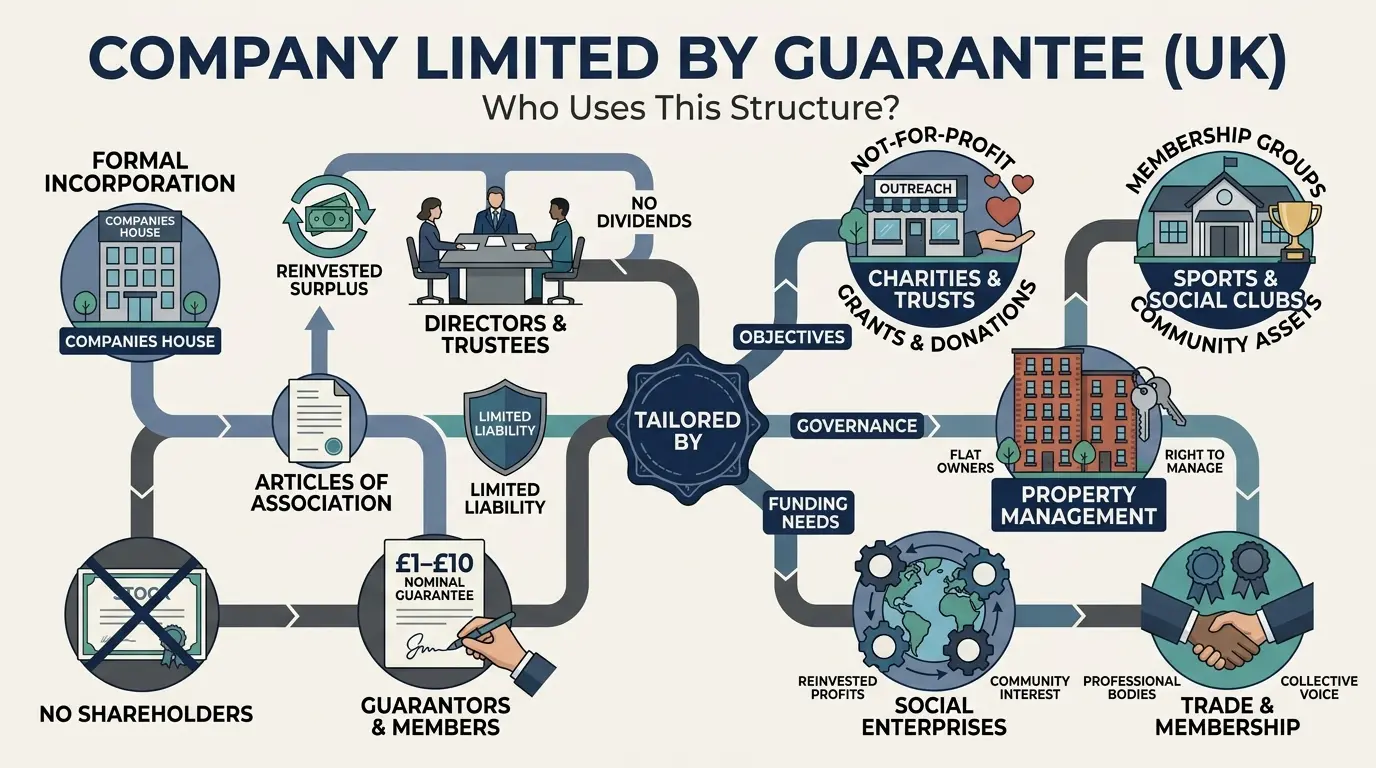
Charities and Community Organisations
A charitable organisation may use a company limited by guarantee to establish a legal entity that can enter contracts, employ staff and manage property. Incorporation as a company does not automatically make an organisation a registered charity. Separate registration and eligibility requirements may apply.
Community groups can also use this structure to manage facilities, organise activities, apply for funding and establish clear responsibilities for their members and directors.
Clubs, Associations and Membership Bodies
Sports clubs, professional associations, trade bodies and membership organisations may choose a limited by guarantee company when they need a formal governance framework. The articles can set out membership rules, voting rights, director appointments and the process for making significant decisions.
Social Enterprises and Public-Benefit Organisations
Some social enterprises use a company limited by guarantee to operate services and retain surpluses for their stated objectives. The structure does not, by itself, guarantee access to grants or tax relief. Funding eligibility depends on the funder’s criteria, while tax treatment depends on the organisation’s activities and circumstances.
Company Limited by Guarantee Example
Consider a local community sports club that wants to manage its facilities, collect membership fees and apply for grants. It forms a company limited by guarantee with members who each agree to guarantee £1.
The company appoints directors to oversee its finances, staff, contracts and daily activities. Membership fees and other income can be used to maintain equipment, pay operating costs and improve facilities, subject to the organisation’s governing documents and legal obligations.
If the company is wound up and cannot pay its debts, each guarantor’s contribution under the guarantee would generally be limited to the amount agreed, subject to the applicable rules and any separate liability. Members do not receive shares in return for their guarantee.
This example illustrates why the structure can suit a membership-based organisation that needs a recognised legal entity without introducing shareholders.
Limited by Guarantee vs Limited by Shares
Both structures provide a separate legal identity and can limit members’ or shareholders’ liability. Their ownership and funding models are different, so the right choice depends on the organisation’s objectives.
| Feature | Company limited by guarantee | Company limited by shares |
|---|---|---|
| Members or owners | Members who are guarantors | Shareholders |
| Share capital | No share capital | Has share capital |
| Liability | Usually limited to the agreed guarantee amount | Usually limited to unpaid amounts on shares |
| Profit distribution | Often structured to retain surpluses for its objectives | Can distribute dividends where legally permitted |
| Investment | Cannot raise equity by issuing shares | Can raise equity by issuing shares |
| Common uses | Clubs, associations, charities and social-purpose organisations | Commercial businesses seeking shareholder ownership or investment |
| Governance | Governed by company law and its articles | Governed by company law and its articles |
A company limited by guarantee is not automatically a charity or prohibited from every form of commercial activity. Likewise, a company limited by shares is not necessarily large or investor-funded. The organisation’s objectives, articles, funding plans and legal obligations should determine the choice.
If you are considering this structure for your organisation, review the limited by guarantee company formation package to explore the next steps.
Benefits of a Company Limited by Guarantee
Limited Liability for Members
The guarantee provides a defined limit on what members agree to contribute if the company cannot pay its debts in the relevant circumstances. This can make membership more accessible for organisations that rely on volunteers, community participation or professional members.
Limited liability is not a blanket exemption from responsibility. Directors and members may face separate liabilities in particular circumstances, including where they give personal guarantees or breach legal duties.
No Share Ownership Structure
A company limited by guarantee does not need to allocate shares or manage shareholder equity. This can make it more appropriate for organisations where membership, participation and governance matter more than ownership through shares.
A Formal Legal Identity
Incorporation enables the company to hold assets, enter contracts and employ staff in its own name. It can also help establish clear governance arrangements for suppliers, funders, members and other stakeholders.
Flexible Governance
The articles of association can be designed around the organisation’s needs, within the limits of company law. They may address membership eligibility, voting, board appointments, meetings, decision-making and what happens if the organisation closes.
Retaining Surpluses for the Organisation
Many guarantee companies are set up to use their income and surpluses to support their stated aims. This can suit organisations that prioritise community services, membership benefits or social objectives over payments to shareholders.
Limitations and Risks to Consider
Limited Access to Equity Investment
Because the company does not issue shares, it cannot raise equity investment by selling shares in the usual way. Depending on its circumstances, it may need to rely on membership fees, trading income, donations, grants or borrowing.
Ongoing Reporting and Administration
Incorporation brings continuing responsibilities. The company must maintain accurate records and meet applicable filing, accounting and reporting requirements. Depending on its activities, it may also need to manage payroll, VAT, data protection and other compliance obligations.
Directors’ Legal Duties
Directors must act in accordance with their legal duties and the company’s governing documents. Limited liability does not protect a director from every consequence of misconduct, breach of duty or other personal liability.
Funding and Tax Relief Are Not Automatic
A company limited by guarantee does not automatically qualify for charitable status, Gift Aid or tax exemptions. Eligibility depends on the organisation’s legal status, purposes, activities and the relevant rules. Organisations should assess these matters before relying on a particular source of funding or tax treatment.
Legal and Compliance Considerations in the UK
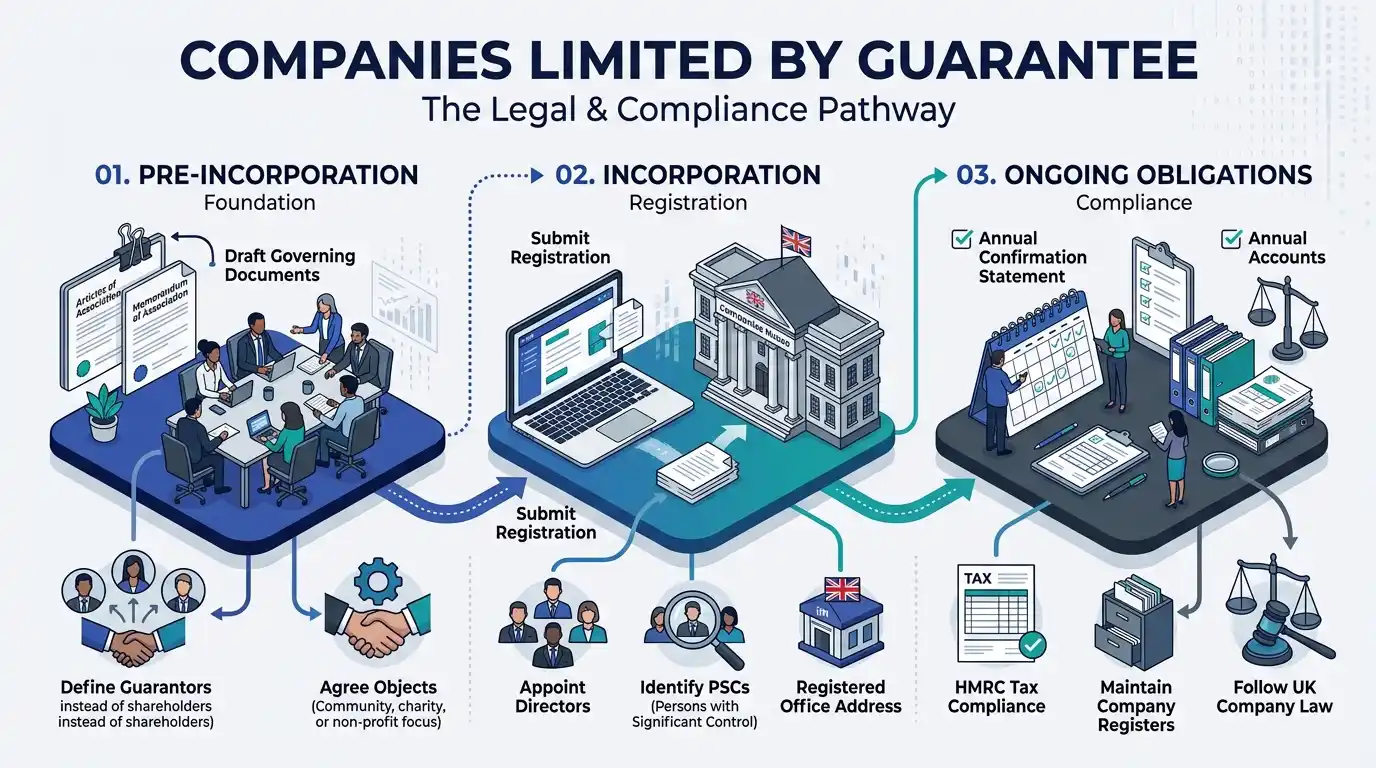
Companies limited by guarantee are subject to UK company law and the requirements that apply to their specific circumstances. Before incorporation, organisations should establish clear governing documents and understand their ongoing obligations.
Articles of Association and Member Details
The articles of association set out how the company is governed. They should reflect the organisation’s purpose and explain how members join or leave, how decisions are made, how directors are appointed and what happens if the company is dissolved.
At registration, Companies House requires information about the guarantors and the amount each has agreed to contribute. A low guarantee, such as £1, is common, but the amount should be chosen deliberately and recorded correctly.
Accounts and Confirmation Statements
A company generally needs to file the accounts and confirmation statements required by Companies House, even if its activity is limited. Deadlines and reporting requirements depend on the company’s circumstances. Charitable companies may have additional accounting and reporting obligations.
Charity Registration and Tax
Incorporation and charity registration are separate matters. If an organisation’s purposes and activities qualify, it may need to register with the relevant charity regulator. Charity status can bring additional obligations as well as potential tax advantages, so organisations should confirm their eligibility before making claims about reliefs.
For organisations specifically exploring charitable incorporation, Form My Company also provides a UK charity company package. Check the package details and the applicable charity-registration requirements before proceeding.
VAT and Payroll
VAT obligations depend on taxable turnover, the nature of supplies and the organisation’s circumstances. The standard UK VAT registration threshold is currently £90,000 of taxable turnover, but different rules can apply, including to certain businesses established outside the UK. Check current HMRC guidance rather than relying on turnover alone.
If the company employs staff, it must meet the applicable employer registration, payroll and reporting obligations. The exact requirements depend on its employment arrangements and activities.
Registered Office and Company Records
A UK company must maintain a registered office address that meets the applicable requirements for its jurisdiction. It must also keep company information and records up to date and notify Companies House of relevant changes. A registered office service may be useful for organisations that need an appropriate address for official correspondence.
Common Mistakes When Forming a Company Limited by Guarantee
Choosing unclear objectives: The organisation’s purpose should be clearly reflected in its governing documents and consistent with its intended activities.
Using unsuitable articles: Generic documents may not cover the organisation’s membership structure, voting arrangements or dissolution provisions adequately.
Assuming incorporation means charitable status: A company limited by guarantee is not automatically a registered charity and does not automatically receive charity tax reliefs.
Overlooking annual compliance: Filing accounts and confirmation statements, maintaining records and reporting relevant changes remain important after incorporation.
Relying on the guarantee as complete protection: The guarantee limits the member’s obligation under that commitment, but it does not remove every possible personal liability.
Failing to plan funding: Organisations should assess how they will finance operations if they cannot issue shares to investors.
Reviewing these issues before registration helps create a structure that supports the organisation’s objectives and reduces avoidable administrative problems.
Practical Tips Before Setting Up
Before forming a company limited by guarantee, consider the following checklist:
Define the organisation’s purpose and activities.
Decide who will become members and who will serve as directors.
Choose a suitable guarantee amount for each member.
Prepare articles that explain governance, voting and membership.
Establish a realistic plan for funding operating costs.
Confirm whether charity registration or other regulation applies.
Identify accounting, tax, payroll and filing responsibilities.
Arrange a suitable registered office and a process for keeping records current.
Getting these decisions right at the outset can make the organisation easier to manage as its membership, funding and activities develop.
Frequently Asked Questions
What is a company limited by guarantee?
A company limited by guarantee is a UK company whose members agree to contribute a specified amount if the company cannot pay its debts in the relevant circumstances. It has guarantors rather than shareholders and does not have share capital.
What does limited by guarantee mean?
Limited by guarantee means a member’s commitment to contribute to the company’s debts is generally capped at the guarantee amount they have agreed to, subject to applicable law and any separate liabilities.
What is a limited by guarantee company used for?
It is commonly used by charities, sports clubs, professional associations, community organisations and social-purpose ventures that need a formal company structure without shareholder ownership.
Can a company limited by guarantee make a profit?
It can generate a surplus through permitted activities. How that surplus can be used depends on its articles, legal status and any applicable regulatory requirements. Many such companies retain surpluses to support their objectives rather than distribute dividends.
Is a company limited by guarantee automatically a charity?
No. Incorporation as a company limited by guarantee does not automatically confer charitable status. An organisation must meet the relevant charity requirements and complete any necessary registration process.
What is the difference between a company limited by guarantee and a company limited by shares?
A company limited by guarantee has members who promise a specified contribution if the company cannot pay its debts. A company limited by shares has shareholders who own shares. The guarantee structure is common among membership and non-profit organisations, while the share structure is commonly used by businesses with shareholder ownership.
How much can a member be required to pay?
A member’s contribution under the guarantee is generally limited to the amount they agreed to guarantee, such as £1. The company’s statement of guarantee and the applicable legal rules determine the commitment. Separate liabilities may arise in other circumstances.
Does a company limited by guarantee have to file accounts?
Companies limited by guarantee generally have Companies House reporting and filing obligations, including accounts and confirmation statements as applicable. Additional requirements may apply if the organisation is also a registered charity.
Set Up a Company Limited by Guarantee with Form My Company
A company limited by guarantee can provide a suitable legal structure for organisations that need formal incorporation, member-based governance and a defined guarantee commitment rather than share ownership. The right setup depends on your objectives, governing documents, funding arrangements and compliance responsibilities.
Form My Company can help you explore the formation process and relevant services. Review the limited by guarantee company formation package and take the next step towards setting up your organisation with a structure that fits its needs.