
To register a company limited by guarantee in the UK, you need key documents including a Memorandum of Association, Articles of Association, and completed Form IN01 submitted to Companies House. Supporting materials such as identity verification for directors and members, a registered office address, and details of Persons with Significant Control (PSC) are also mandatory. Each document plays a vital legal role in defining the company’s purpose, structure, and compliance framework.
Setting up a company limited by guarantee is one of the most reliable ways for non-profit organisations, charities, and community bodies to formalise their structure. However, obtaining approval from Companies House requires precise documentation. From the Memorandum of Association confirming member intention to form the company, to Articles of Association outlining governance, every document must meet statutory standards under the Companies Act 2006.
For founders of charitable or community organisations, missing even a minor detail can delay registration or trigger rejection. Professional guidance ensures accuracy and enhances credibility when operating in a highly regulated environment. At Form My Company, we routinely handle document preparation, ensuring legal soundness, clarity of objectives, and compliance with future requirements like PAYE, VAT registration, and registered office protocols.
This guide unpacks every document, the reason behind each requirement, and best practices for smooth incorporation under UK law.
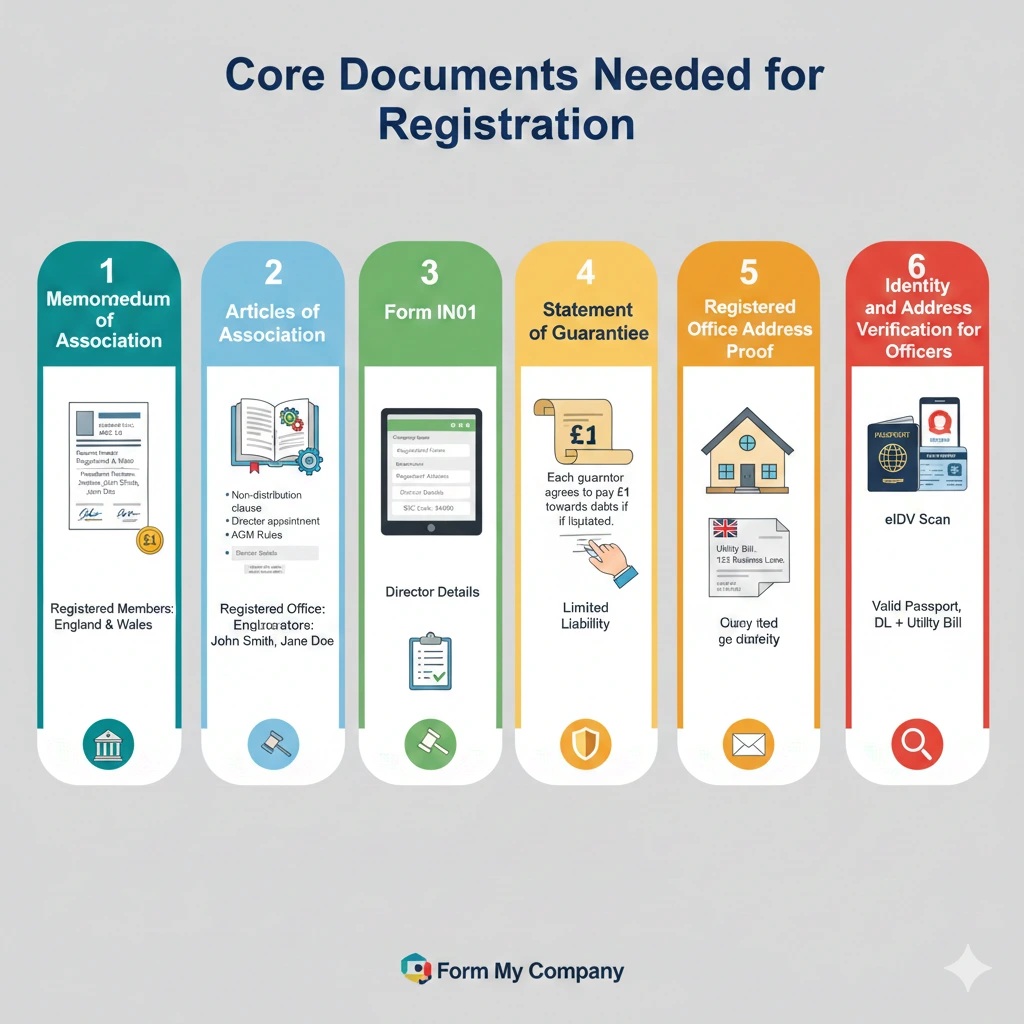
Step-by-Step Explanation: Core Documents Needed for Registration
1. Memorandum of Association
This foundational document states that the initial members (guarantors) agree to form the company and contribute a nominal sum—typically £1—if it winds up insolvent. It’s automatically created during online registration through Companies House but remains essential evidence of origin. For companies limited by guarantee, the memorandum must confirm non-distribution of profits and commitment to the company’s stated objectives.
Key details included:
- Company name and registered office jurisdiction (England & Wales, Scotland, or Northern Ireland).
- Names and signatures of founding members (digital consent accepted online).
- The statement of guarantee detailing each member’s financial obligation.
A well-drafted memorandum aligns with the non-profit nature of guarantee companies, avoiding ambiguity over purpose. Form My Company customises memoranda to ensure compatibility with charity registration under the Charity Commission, streamlining later tax exemption processes.
2. Articles of Association
The Articles of Association form the backbone of your company’s constitution. They define governance rules—how directors are appointed, meetings held, profits applied, and the process for amending objectives. Companies limited by guarantee use specific templates different from share-based companies, focusing on non-profit principles.
Mandatory inclusions:
- Non-distribution clause: profits must be reinvested, not paid as dividends.
- Member rights and conditions for resignation or termination.
- Director appointment, removal, and duties in line with the Companies Act 2006.
- Rules for holding Annual General Meetings (AGMs) and passing resolutions.
While Companies House offers model articles, tailored versions benefit organisations seeking charitable or membership-based governance. For instance, a community trust might require clauses about quorum or co-option. At Form My Company, experts ensure these align with both Companies House and Charity Commission standards, preventing costly re-filings.
3. Form IN01
Form IN01 formally registers the company with Companies House. It summarises vital information drawn from the memorandum and articles, serving as the official application. The form can be completed online (£12) or by paper (£40).
Information required in Form IN01:
- Company name and chosen suffix (“Limited” or exemption if permitted).
- Registered office address (must be a physical UK address—Form My Company offers compliant virtual office services).
- Details of each director (full name, service address, date of birth, nationality, occupation).
- Initial members’ names and guarantee contributions.
- Statement of compliance confirming adherence to statutory regulations.
Errors here cause the majority of registration delays. Accurate SIC codes (e.g., 94990 for membership organisations or 85520 for educational charities) ensure tax and HMRC alignment later.
4. Statement of Guarantee
Distinct from share capital declarations, this statement appears within incorporation documents but also exists as a standalone key assurance. It sets out that each guarantor agrees to pay an amount (commonly £1) towards the company’s debts if liquidated. The clause underpins the limited liability feature of guarantee companies, assuring external stakeholders like funders and partners of financial stability.
When forming non-profits, clarity in this statement helps avoid misinterpretation by donors or auditors. For multi-member structures, each person must sign this commitment during registration. Without this declaration, Companies House cannot verify limited liability status.
5. Registered Office Address Proof
Every limited by guarantee company must have a registered office in the same UK jurisdiction where it’s incorporated. This address appears on public record and is where Companies House, HMRC, or courts deliver official notices.
Companies may use:
- Their operating location (if accessible and secure).
- A professional business address (to maintain privacy).
- A virtual office service such as those offered by Form My Company—fully compliant for legal correspondence.
Failure to maintain an accurate address risks missed statutory notifications and potential strike-off. Always keep proof of address (utility bill or lease agreement) for verification if requested during submission or by banks post-registration.
6. Identity and Address Verification for Officers
To enhance anti-money laundering (AML) compliance, Companies House requires identity verification for directors and members. Accepted documents include a valid passport, driver’s licence, or national ID paired with proof of address (utility bill or bank statement less than 3 months old).
Digital verification systems (eIDV) check information automatically, but human oversight remains essential for accuracy. Each director must supply:
- Full legal name and date of birth.
- Service address (can match registered office).
- Nationality and occupation.
Trustees of charitable companies must also meet separate Charity Commission eligibility standards. Form My Company’s secure onboarding process simplifies document upload while ensuring compliance with 2026 Economic Crime Act changes mandating digital ID checks.
Benefits and Potential Risks
Benefits
Comprehensive documentation ensures fast incorporation, opening access to grants, bank accounts, and government funding. Proper memoranda and articles instil investor and donor confidence while affirming limited liability protection. Legal precision reduces future disputes between directors or members. Transparent governance through Articles also strengthens regulatory trust with the Charity Commission and HMRC.
Risks
Incomplete or poorly written documents delay registration or lead to rejection. Generic templates might omit non-profit clauses, accidentally categorising your company as profit-making, thereby nullifying tax relief eligibility. Errors in Form IN01 or ID verification invite Companies House queries, extending approval timelines. Avoiding these pitfalls demands expert drafting and review.
Legal and Compliance Considerations
The Companies Act 2006 governs company limited by guarantee formation, alongside the Charities Act 2011 where applicable. Articles must explicitly bar profit distribution, while memoranda embed guarantee liabilities. Annual filings with Companies House require consistency with these founding documents; discrepancies may prompt corrective action or penalties.
Charity Commission scrutiny applies for registered charities, requiring alignment between governing clauses and charitable objectives. Non-profits often combine these documents when applying for dual registration. PSC (People with Significant Control) declarations ensure transparency as part of anti-money laundering compliance.
Registered office addresses must remain current, with changes filed on Form AD01 within 14 days. Professional assistance, such as from Form My Company, ensures filings and renewals stay legally valid under all relevant UK frameworks.
Common Mistakes to Avoid
- Submitting altered model articles without legal vetting, leading to rejection.
- Omitting signatures or digital consents on memoranda and guarantee statements.
- Providing residential addresses publicly instead of service addresses.
- Using incorrect SIC codes, misclassifying the business activity.
- Failing ID verification under the new Economic Crime Act rules.
A real example: A London-based community group delayed registration by eight weeks after inputting an invalid postcode on Form IN01; Companies House flagged it as mismatch. Using professional services avoids similar errors through structured review before submission.
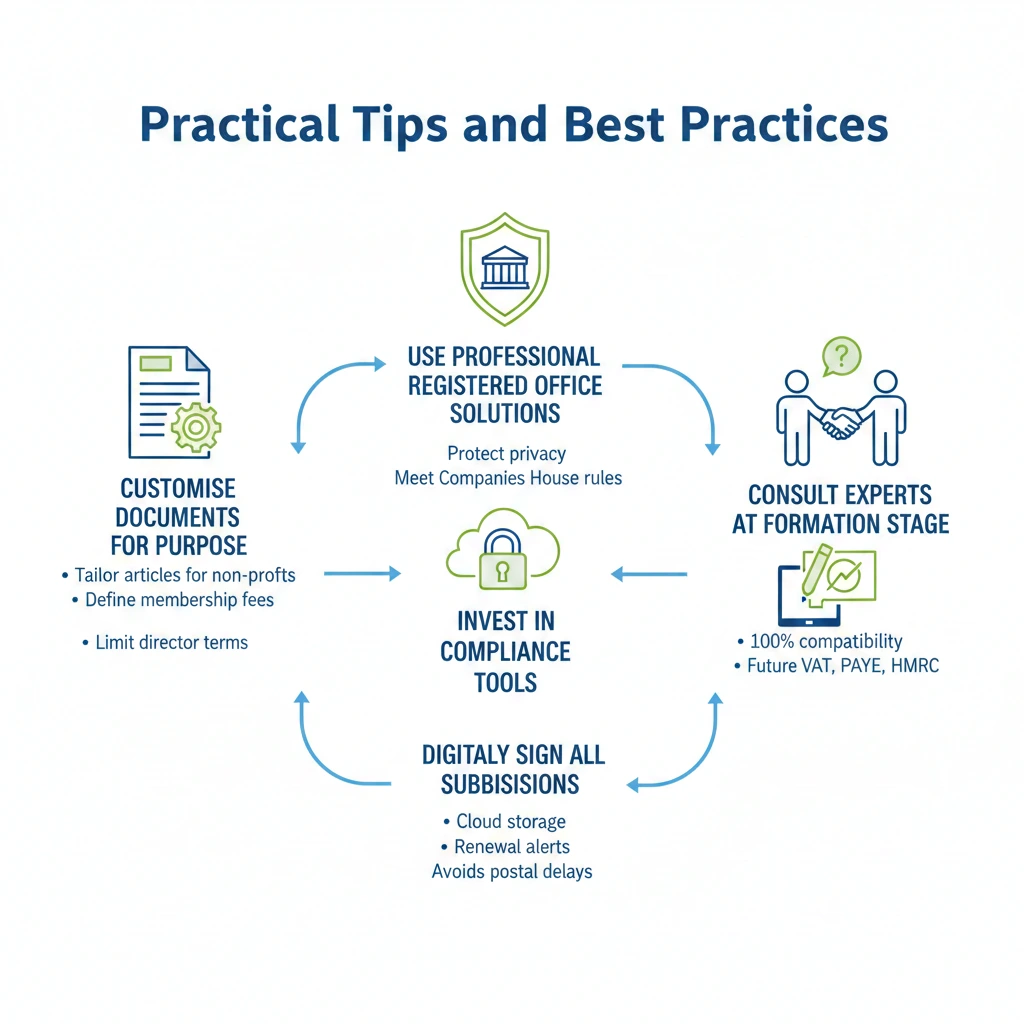
Practical Tips and Best Practices
- Customise documents for purpose – tailor articles to suit non-profits, such as defining membership fees or limiting terms for directors.
- Use professional registered office solutions – protect privacy while meeting Companies House rules.
- Invest in compliance tools – cloud storage for digital copies, renewal alerts for filings, and consistent version tracking for amendments.
- Digitally sign all submissions – avoids postal delays.
- Consult experts at formation stage – ensures 100% compatibility with future VAT, PAYE, and HMRC interactions.
Best practice example: A charitable sports foundation using bespoke articles gained registration within 48 hours and qualified instantly for grant applications due to well-drafted documentation.
FAQs
What is the primary document for registering a limited by guarantee company?
The Memorandum of Association, confirming members agree to form the company and guarantee a specific sum.
Do I need a registered office address at registration?
Yes, a UK-based address is mandatory, and virtual offices are acceptable for official mail.
Can I use standard model articles?
Yes, but tailored articles are strongly advised for bespoke governance and charitable eligibility.
What identification is required for directors?
Valid photo ID and recent proof of address under Companies House AML rules.
Do I need professional help?
Not legally, but experts ensure compliant, error-free submissions saving time and preventing rejections.
Preparing complete and accurate documents is critical to efficiently register a company limited by guarantee in the UK. From your Memorandum and Articles of Association to Form IN01, registered office evidence, and ID verification, each requirement upholds transparency, legality, and accountability.
If you’re ready to register your company with confidence, Form My Company provides fast, fully online company formation with expert compliance support, VAT & PAYE setup, virtual office solutions, and professional guidance. Get started today and let our specialists handle the paperwork while you focus on growing your organisation.