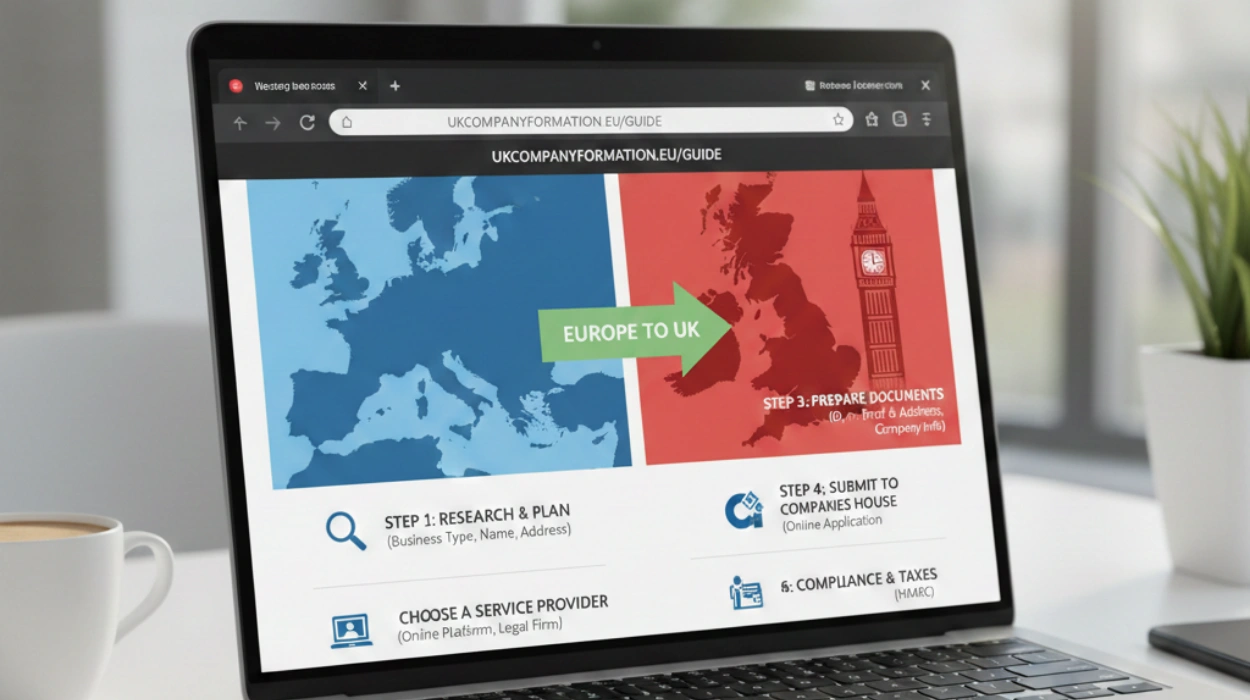
Yes, European entrepreneurs can register a UK limited company entirely online without needing to visit the UK or hold British residency, provided they secure a UK registered office address and meet standard Companies House requirements. The process typically takes 24–48 hours for approval, enabling seamless access to UK markets post-Brexit. This approach suits remote founders from Germany, France, Spain, Italy and beyond, leveraging digital filing for private limited companies (Ltd).
For business owners across Europe from Berlin startups to Madrid consultancies registering a UK company represents a strategic gateway to English-speaking markets, robust legal protections and global credibility. Post-Brexit, the UK’s Companies Act 2006 still permits non-UK residents to incorporate fully remotely, with no mandates for local directors, shareholders or physical presence. A private limited company (Ltd) formed from Europe gains a Companies House number, limited liability shielding personal assets, and eligibility for UK banking, VAT and international trade. This is particularly valuable amid EU regulatory complexities, offering a neutral base for cross-border operations.
Semantic elements like “UK company formation for EU non-residents” underscore the appeal: lower corporation tax bands (19–25%), access to R&D incentives and double-tax treaties with most European nations. However, nuances such as post-Brexit VAT rules for EU trade and mandatory identity verification (introduced 2025) require careful navigation. Drawing from Companies House protocols and practical cases—such as a Dutch e-commerce firm incorporating in 36 hours this guide equips you with authoritative steps, compliance insights and pitfalls, positioning your venture for compliant growth. Whether expanding from Poland or pivoting from Portugal, a UK entity enhances trust with clients and platforms like Amazon EU.
Step-by-Step Guide to UK Company Formation from Europe
Incorporating a UK company from Europe demands precision across digital platforms, starting with structural choices. Opt for a private company limited by shares (most common for Europeans), which limits liability to unpaid share capital and suits trading, services or holdings. Begin by selecting a unique name via the Companies House checker avoid similarities, offensive terms or protected words like “Bank” without approval. Appoint at least one director (you qualify, regardless of EU nationality) and shareholder (can be the same person), providing full details: name, DOB, nationality, occupation, residential address (private) and service address (public).
Secure a UK registered office a physical postcode for statutory mail, mandatory under Section 87 of the Companies Act. Europeans often use virtual offices in London or Manchester (£50–£150/year) since home addresses abroad won’t suffice. Prepare Form IN01 digitally: memorandum of association (shareholder formation agreement), articles of association (governance use model articles for simplicity), SIC codes (e.g., 62020 for IT consultancy), share structure (e.g., 100 £1 shares) and PSC statement (anyone with >25% control). Submit via WebFiling (£12, 24–48 hours) or agents for same-day service (£50+).
Post-approval, receive your Certificate of Incorporation. Register for Corporation Tax (HMRC online, within 3 months of trading), pursue UK business banking (remote via Starling or Wise), and assess VAT (£90,000 threshold 2026). For EU founders, import/export rules apply via EORI numbers. A Berlin-based software developer, for instance, completes this in 48 hours, gaining Stripe access denied to their GmbH. Total costs: £100–£600, with agents streamlining time-zone aligned support.

Benefits and Potential Risks of Registering from Europe
A UK company elevates European businesses with unmatched prestige: invoices under UK law reassure clients, while limited liability protects against claims. Tax perks include 19% small profits rate, full expensing for assets and treaties avoiding double taxation (e.g., UK-France DTA credits French taxes). Post-Brexit, UK entities bypass some EU customs friction for non-EU trade, ideal for exporters. Banking integrates seamlessly with Revolut Business or HSBC, supporting multi-currency for Eurozone invoicing. Structures like SEIS/EIS attract investors with reliefs unavailable in many EU states.
Risks demand vigilance: stringent AML checks delay non-resident bank accounts (prepare passports, utility bills). Compliance lapses late accounts or confirmation statements trigger £150–£1,500 fines, risking strike-off. Post-Brexit VAT MOSS or OSS schemes complicate EU sales, mandating quarterly filings. Central management from Europe might deem the company tax-resident there, per “place of effective management” tests e.g., a Spanish director holding board meetings in Madrid. Currency volatility (EUR/GBP) affects remittances, and GDPR equivalence requires data safeguards. Balanced, benefits dominate for scalable ventures, but pair with advisors for hybrid EU-UK operations.
Legal and Compliance Considerations for EU Non-Residents
UK law welcomes European directors without residency barriers, but fiduciary duties bind you globally: promote company success, exercise independent judgment, avoid conflicts. File annual confirmation statements (£13), accounts (micro-entity if turnover <£632k) and CT600 returns. PSC registers demand transparency (>25% ownership public). VAT compulsory over £90k (voluntary for input reclaim), with post-Brexit EU exports needing customs declarations despite Windsor Framework easements for NI.
PAYE activates for UK employees (RTI submissions, NI contributions). Identity verification (2026 mandatory) requires director uploads via Yoti or Post Office. For Europeans, DTA claims prevent dual taxation—e.g., Italian shareholders reclaim via HMRC forms. GDPR/UK GDPR mandates data officer if processing EU data (£17.5m fines possible). Regulated sectors (FCA finance) need approvals. Ongoing: £200–£800/year via accountants. Form My Company’s compliance packages ensure EEAT-aligned setups, from SIC selection to dormant filings.
Common Mistakes to Avoid When Forming from Europe
Europeans often stumble on name availability 15% rejections from EU trademark overlaps or “Ltd” omissions; pre-check TMview and Companies House. Skimping on registered offices risks dissolution; PO Boxes invalidate. Mismatching SIC codes delays HMRC (62012 software publishing vs 62090 consultancy). Post-incorporation neglect: 40% miss CT registration, incurring penalties. Assuming EU passports auto-qualify banking ignores enhanced due diligence delays hit 30% without business plans.
Overlooking articles leaves investor disputes unresolved; customise for multi-founder setups. VAT timing errors: voluntary registration aids EU reclaims but triggers audits. Ignoring EEA management tests risks dual residency claims. A French founder lost weeks refiling due to blurry ID scans. Mitigate with pre-audits and agents like Form My Company.
Practical Tips and Best Practices
Align SIC precisely for HMRC alignment. Budget £300–£1,200 year one (filing £12, office £99, accounts £400). Use Xero/QuickBooks for real-time compliance, linking to UK gateways. Secure EORI for EU trade. Network via EU-UK Business Councils. Annual reviews adapt to rule changes (e.g., 2026 OECD pillars). Outsource for scale.

Frequently Asked Questions
Can EU citizens be sole UK company directors?
Yes, no residency required. Provide verified ID; duties apply universally.
VAT rules for EU sales?
Threshold £90k; OSS for distance selling.
Bank account without UK visit?
Yes, digital like Tide; prep KYC.
Ongoing costs?
£13 confirmation, £300–£700 compliance.
UK company formation from Europe unlocks scalable opportunities with diligent compliance.
If you’re ready to register your company with confidence, Form My Company provides fast, fully online company formation with expert compliance support. Get started today and let our specialists handle the paperwork while you focus on growing your business.