
Setting up a UK company is a straightforward process once you understand the structure, legal requirements and filings involved. This guide walks you through each stage of UK company formation, from choosing the right structure to maintaining compliance, so you can launch with confidence and avoid costly mistakes.
Why UK company formation matters for entrepreneurs
For many entrepreneurs, forming a UK limited company is a key step in turning an idea into a credible business. Incorporation gives you a separate legal entity, limited liability, and a professional image when dealing with clients, suppliers and investors, but it also brings ongoing duties and filing obligations that you cannot ignore. A company registered at Companies House exists independently from you as an individual, which means it can own assets, enter into contracts, and be sued in its own name; in return, directors must meet legal responsibilities under the Companies Act 2006 and related regulations.
Understanding the formation process in detail helps you decide if a private company limited by shares is right for your venture and ensures you submit a clean, accurate application the first time. You will need to think about your company name, registered office, directors, shareholders, share structure and constitutional documents, as well as how you will deal with VAT, PAYE and ongoing statutory filings once trading begins. By approaching UK company formation methodically, you can accelerate your launch while building a compliant foundation that supports long‑term growth.
What are the main business structures in the UK?
Before forming a company, entrepreneurs should understand the key UK business structures, because each carries different tax treatments, liability protections and administrative burdens. The most common options are the sole trader model, traditional partnerships, limited liability partnerships (LLPs) and private companies limited by shares (Ltd). A sole trader operates as an individual, with business income taxed as personal income and full personal liability for business debts, which can be risky once you start hiring staff or signing substantial contracts. Partnerships share profits and losses between partners, but unless you opt for an LLP, partners also share personal liability. By contrast, a private limited company is a distinct legal person, and shareholders’ liability is generally limited to the amount unpaid on their shares, making it the favoured structure for growth‑focused entrepreneurs.
Professional advisers and formation agents typically recommend a private company limited by shares for most small and scaling businesses, because it combines limited liability, share ownership flexibility and investor‑friendly governance under familiar UK rules. Directors manage the company’s day‑to‑day affairs, while shareholders own the company and can receive dividends, vote on major decisions and ultimately replace directors if needed. This separation of ownership and management, anchored in the company’s Articles of Association, gives you scope to bring in co‑founders, investors or family shareholders without upsetting operational control. As your business grows, you can also issue new shares, create different share classes, and adapt your structure to match funding plans and succession strategies.
How do you register a company with Companies House? (Step‑by‑step)
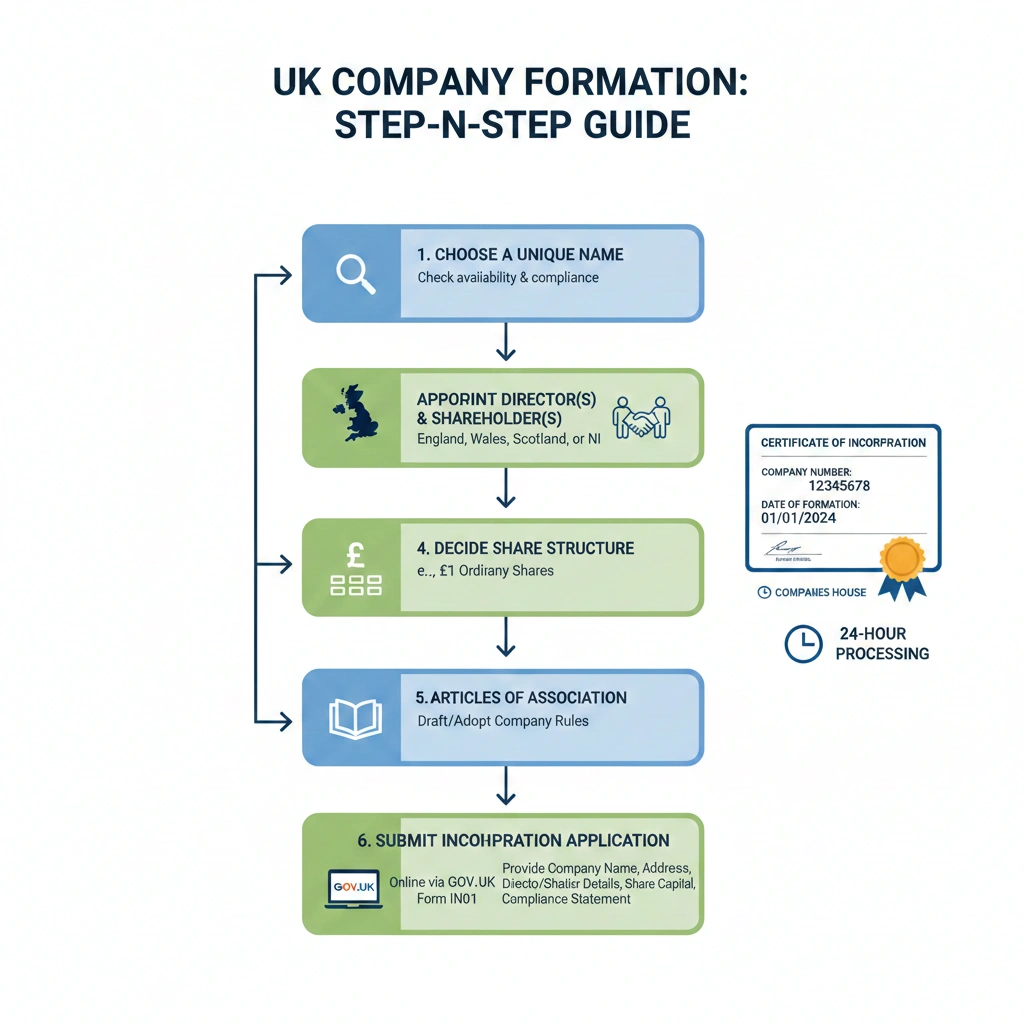
Company formation in the UK centres on registering your new entity with Companies House, the official registrar of companies. The core steps are: choosing a name, deciding your registered office, appointing at least one director and one shareholder, allocating shares, drafting or adopting Articles of Association, completing the incorporation application and submitting it online or through an agent. As outlined by multiple formation guides, you must provide specific details on Form IN01 or its online equivalent, including the company’s proposed name, registered office address, director and shareholder details, share capital and statement of compliance.
You start by selecting a unique name that complies with Companies House rules on “sensitive” words and is not identical or too similar to an existing company. You then choose a registered office address in the same UK jurisdiction (England and Wales, Scotland or Northern Ireland) where the company will be incorporated; official mail from Companies House and HMRC will be sent there. Next, you appoint at least one individual director and at least one shareholder, which can be the same person, and decide on your initial share capital structure, often opting for simple £1 ordinary shares split between founders. When you file your application online either direct via GOV.UK or via an authorised formation agent the information is submitted digitally to Companies House, which typically processes standard applications within 24 hours and issues a digital Certificate of Incorporation confirming your company number and date of formation.
What are the key legal and compliance requirements?
Once incorporated, your company must comply with a set of ongoing legal obligations that go beyond the initial registration form. Every UK private company must maintain an up‑to‑date registered office address, statutory registers (including registers of members, directors and persons with significant control), and ensure that its director information and shareholdings are accurately reflected on the public register. Directors have a duty under the Companies Act 2006 to act in the company’s best interests, exercise reasonable care, skill and diligence, and ensure the company meets its filing deadlines and accounting obligations.
From a reporting perspective, you must file an annual confirmation statement to confirm that company information remains correct, and submit annual accounts to Companies House within the required timeframe, even if the company is dormant. If the business is trading, you may also need to register for VAT once taxable turnover exceeds the current VAT registration threshold, and operate PAYE as an employer if you pay staff or directors a salary. HMRC will expect accurate corporation tax returns, and late or inaccurate filings can trigger penalties. Using a formation and compliance provider can help you manage registered office services, digital statutory registers, confirmation statement filing and tax registrations in a streamlined way, reducing the risk of missed deadlines or non‑compliance.
What are the benefits and risks of forming a UK company?
The benefits of forming a UK company are substantial, particularly for entrepreneurs with growth ambitions. Limited liability means that, in most circumstances, shareholders’ personal assets are protected if the company fails, which is a major advantage over trading as a sole trader or general partnership. A registered company with a Companies House number can appear more credible to customers, suppliers, banks and investors, often making it easier to open business bank accounts, secure trade credit and raise external funding. The UK’s well‑established legal framework, including clear rules on directors’ duties and shareholder rights, provides a predictable environment in which to structure long‑term commercial relationships.
However, incorporation also brings responsibilities and risks that must be taken seriously. Directors who fail to meet filing obligations, pay taxes, or act in the company’s best interests can face penalties, disqualification or, in extreme cases, personal liability. The public nature of Companies House filings means that your company’s basic financial information and control structure will be visible to third parties, which some founders may find uncomfortable. There are also practical risks in choosing an unsuitable share structure, appointing the wrong people as directors, or neglecting to set out clear shareholder agreements, all of which can cause conflict as the business grows. By understanding both benefits and risks at the outset, you can design a structure that protects you while remaining flexible and investor‑friendly.
What common mistakes should entrepreneurs avoid?
Entrepreneurs frequently make avoidable mistakes during company formation that create administrative or legal problems later. One common issue is rushing the choice of company name without checking for similar existing registrations or potential trade mark conflicts, which can lead to objections or forced rebranding. Another is using a personal home address as the registered office and for directors’ service addresses, exposing private residential details on the public record when more discreet registered office and virtual address services are available.
Many founders also underestimate the importance of getting the share structure and documentation right on day one. Issuing all shares to a single founder “for simplicity” can be problematic when bringing in co‑founders or investors later, especially if there is no written shareholders’ agreement. Errors or inconsistencies in director and shareholder details on the incorporation form such as incorrect dates of birth, addresses or share allocations can cause Companies House to reject the application or result in inaccurate public records that need to be corrected. Finally, some entrepreneurs incorporate but fail to register for VAT or PAYE at the appropriate time, or overlook annual confirmation statements and accounts, leading to penalties or even compulsory strike‑off. Avoiding these mistakes requires planning, accurate information and, often, professional guidance.

What practical tips and best practices improve a smooth formation?
A smooth, efficient company formation relies on preparation and the smart use of professional services. It is sensible to map out your ownership and management structure before you start the application: who will be directors, who will hold shares, how many shares to issue initially, and whether you need different share classes. Reviewing sample Articles of Association and considering a bespoke shareholders’ agreement with legal input can help prevent disputes over decision‑making, dividends and exits.
Using an authorised formation agent and compliance provider can streamline the process significantly. As shown by common practice in the market, formation packages can combine incorporation with registered office, service address, business address, statutory registers, VAT and PAYE registrations, and even company secretary support. This bundled approach reduces the number of separate tasks you must manage as a founder and ensures that key compliance steps are not missed as you focus on product, sales and investment. It is also wise to put a simple compliance calendar in place from the start, listing Companies House filing deadlines, tax dates and routine board or shareholder meetings, so that governance becomes a normal part of running the business rather than an afterthought.
Forming a UK company is more than just filling in a form; it is about choosing the right structure, putting solid governance in place and committing to ongoing compliance. By understanding the roles of directors and shareholders, the importance of your registered office and statutory registers, and the timelines for Companies House and HMRC filings, you can launch a business that looks professional and stays on the right side of UK law. For entrepreneurs, the result is a flexible, credible platform for growth, investment and long‑term value creation.
If you’re ready to register your company with confidence, Form My Company provides fast, fully online company formation with expert compliance support. Our services cover company registration at Companies House, ongoing statutory compliance, VAT and PAYE registrations, virtual registered office solutions and professional guidance at every step, so you stay focused on growing your business while we handle the paperwork.
Frequently Asked Questions
Do I need to live in the UK to form a UK company?
No, there is no requirement for directors or shareholders to be UK residents when forming a UK limited company. Non‑UK residents can incorporate remotely using online formation packages, provided they supply required identification checks and use a UK registered office address.
Can the same person be both director and shareholder?
Yes. UK law requires at least one director and one shareholder, but the same individual can hold both roles, which is very common in single founder companies. Directors manage the company, while shareholders own it and enjoy rights to dividends and votes on major decisions, even if in practice that is the same person at the outset.
How long does UK company formation take?
Digital incorporation is typically fast. Guidance from industry sources indicates that once you complete the online application, Companies House can approve a standard formation in as little as 24 hours, sometimes the same working day. Using an online agent helps ensure the information is complete and correctly formatted, reducing the risk of rejection and delay.
Do I need VAT and PAYE registration immediately?
Not always. You must register for VAT once your taxable turnover exceeds the current VAT threshold, although some businesses register voluntarily for commercial reasons. PAYE registration is required once you pay employees or directors a salary that meets HMRC criteria, and many formation packages now include VAT and PAYE registration options to simplify this step.