
UK business correspondence addresses must be physical locations capable of receiving official mail, with registered offices in the same jurisdiction as incorporation and “appropriate” for Companies House scrutiny since March 2024. Directors, PSCs and secretaries provide service addresses for personal filings, which can be anywhere but protect privacy when non-residential. Compliance prevents default address assignments, fines or strike-off, ensuring smooth operations.
Understanding Address Obligations in UK Business Law
Every UK limited company must maintain specific addresses for legal correspondence, forming the backbone of compliance from formation through ongoing operations. The registered office address receives all statutory mail from Companies House, HMRC and courts, appearing publicly and requiring physical accessibility in the incorporation jurisdiction (England/Wales, Scotland or Northern Ireland). Service addresses for directors, PSCs and LLP members handle role-specific documents, offering privacy options via non-home locations. These requirements, tightened since the Economic Crime and Corporate Transparency Act 2023 (effective March 2024), mandate “appropriate” addresses physical, permissioned sites ensuring mail notification and delivery confirmation.
For entrepreneurs post-incorporation, mismanagement risks default address imposition (e.g., Companies House PO Box in Cardiff), public embarrassment and strike-off proceedings. Virtual offices or agents fulfil needs discreetly, supporting VAT/PAYE registrations and shareholder communications without exposing homes. Grasping distinctions registered (company-wide, public), service (individual, flexible) prevents penalties while enabling professional facades. This framework upholds transparency amid economic crime crackdowns, balancing privacy with accountability.
Step-by-Step: Setting Up Compliant Addresses
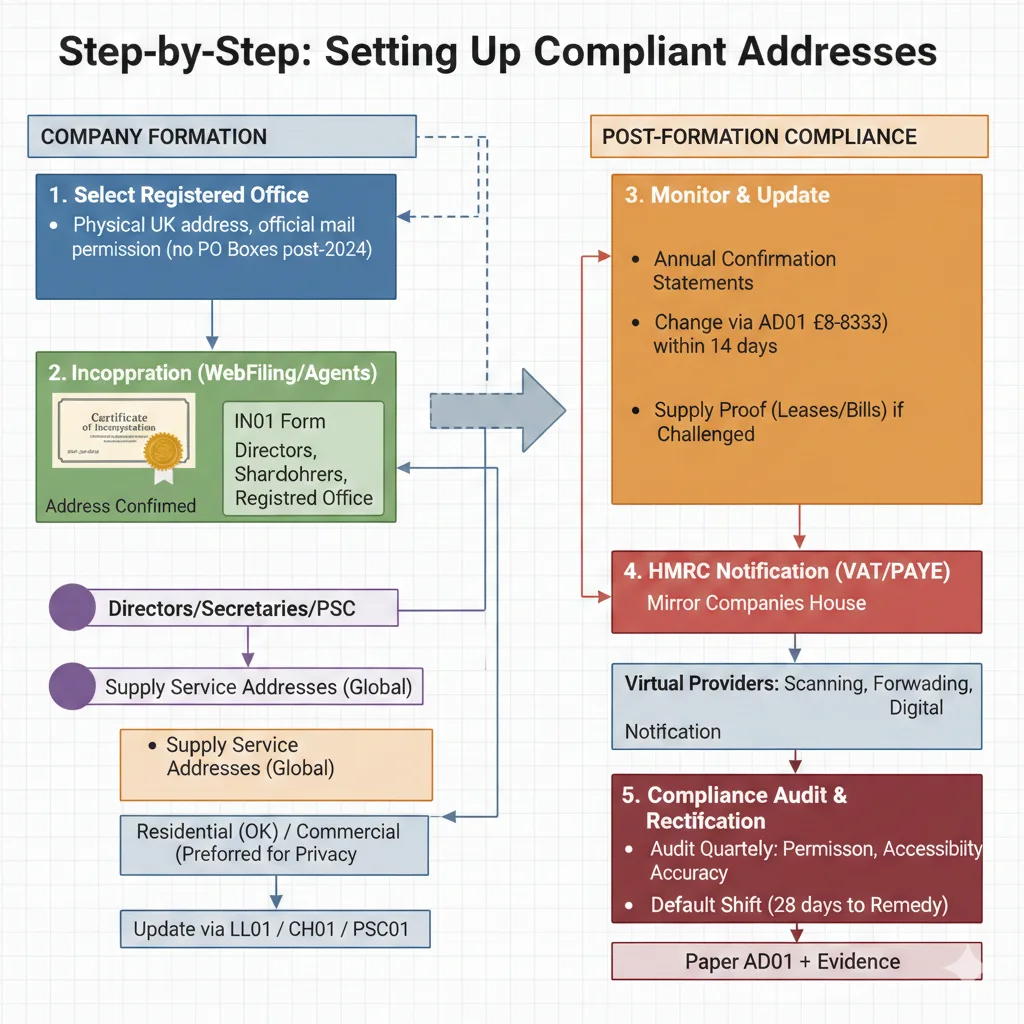
Commence during company formation by selecting a registered office: physical UK address in your jurisdiction, permissioned for official mail (no PO Boxes post-2024). Incorporate via WebFiling or agents, listing it on IN01 alongside directors/shareholders; approval yields Certificate with address confirmed. Directors/secretaries/PSCs supply service addresses anywhere globally, residential ok but commercial preferred for privacy updated via LL01/CH01/PSC01 if changed.
Post-formation, monitor via annual confirmation statements, changing via AD01 (£8-£33) within 14 days, supplying proof like leases/utility bills if challenged. For VAT/PAYE, notify HMRC mirroring Companies House to synchronise correspondence. Virtual providers handle scanning/forwarding, notifying digitally for remote directors. Audit quarterly: verify permission, accessibility and public accuracy. Non-compliance prompts 14-day rectification or default shift, with 28 days to remedy via paper AD01 plus evidence. This process embeds addresses into governance.
Benefits and Risks of Compliant Address Management
Proper addresses yield benefits like seamless statutory mail flow, averting missed deadlines for accounts/VAT returns that trigger £150-£1,500 fines. Professional/virtual options enhance branding London postcodes impress banks/investors scanning Companies House while shielding directors’ homes from spam/physical risks. Service addresses enable global shareholders, supporting diverse structures without residency mandates.
Risks loom in non-compliance: “inappropriate” addresses (unauthorised, inaccessible) prompt registrar intervention default assignment without notice, strike-off risks and public record stains hindering funding. Residential exposures invite unwanted visits; shared virtuals risk overload delays on HMRC PAYE notices. Overlooking updates post-move breaches 14-day rule, compounding penalties. Benefits dominate with diligence, risks materialise from neglect proactive management sustains compliance fortress.
Detailed Legal and Compliance Framework
The Companies Act 2006 mandates registered offices as “principal postal address,” physical and jurisdiction-matched, per s113. Post-2024 ECA, “appropriate” means mail-aware recipient and delivery proof, enforced via registrar powers: 14-day evidence demands or default (Cardiff PO Box). Service addresses (s288, PSC regs) route officer mail, public but privacy-protective if commercial.
HMRC integrates: VAT/PAYE mail to registered office, mismatches flag audits. GDPR governs virtual handlers processing data. Directors’ fiduciary duties (s172-177) include timely updates, failures risking disqualification. LLP equivalents mirror via s1130. Audits verify via utility/lease proofs; strike-off follows persistent breaches. Integrated services streamline, ensuring EEAT alignment.
Common Mistakes and Their Consequences
Failing jurisdiction match (Scottish firm using London) invalidates registration, demanding re-incorporation. Using PO Boxes post-2024 triggers immediate rejection/default. Residential without permission breaches landlord terms, exposing eviction risks alongside compliance flags. Delaying AD01 beyond 14 days incurs £100+ late fees, escalating to prosecution.
Overlooking service addresses leaves directors exposed publicly, inviting harassment; PSCs omitting invites PSC notifications fines (£500). Virtual without “appropriate” checks risks registrar override. Inconsistent HMRC sync delays refunds/audits. Consequences: fines (£150-£5k), disqualification (2-15yrs), strike-off dissolving entities. Case: 2025 firm struck off for unauthorised address, costing £10k reinstatement. Awareness averts derailment.
Practical Tips and Best Practices for Compliance
Audit addresses annually pre-confirmation statement: verify permissions, test mail delivery, document proofs (bills, leases). Adopt virtual/professional for all—£10-£50/month covers registered/service, GDPR-compliant forwarding. Automate updates via agent dashboards syncing Companies House/HMRC. Script staff for mail protocols, retain 6yrs per tax rules.
Diversify: primary registered, backup service for directors. Quarterly registrar checks flag issues early. Bundle with formation for seamless setup. Train shareholders on PSC duties. Providers with SLAs guarantee “appropriateness.” These embed resilience, turning mandates into advantages.

UK business correspondence addresses underpin compliance, with registered offices anchoring statutory mail and service addresses protecting individuals. Strict “appropriate” rules demand vigilance to evade defaults and penalties.
If you’re ready to secure compliant addresses effortlessly, Form My Company provides fast, fully online company formation with expert compliance support, virtual offices, VAT & PAYE, and professional guidance. Get started today and let our specialists handle the paperwork while you focus on growing your business.
Frequently Asked Questions
What qualifies as an “appropriate” registered office?
Physical UK address in incorporation jurisdiction, permissioned, ensuring mail notification/delivery proof—no PO Boxes, with recipient awareness.
What happens if non-compliant?
Registrar defaults address (e.g., Cardiff PO Box), 28-day remedy via AD01/proof, or strike-off risks fines/disqualification.
How to change addresses?
File AD01 online (£8) within 14 days for registered; LL01/PSC forms for service, with evidence if challenged.
Do shareholders need service addresses?
Only if PSCs or subscribers; members generally exempt unless officers.