
Yes, a virtual business address can significantly enhance privacy for UK business owners by shielding personal home addresses from public records at Companies House. It acts as a professional registered office address without revealing your residential details to directors, shareholders, or the general public. While not a complete shield against all legal obligations, it offers a practical, compliant way to maintain confidentiality during company formation and ongoing compliance.
In the digital age, where data breaches and unwanted solicitations are everyday threats, safeguarding personal information has become a top priority for entrepreneurs launching a UK limited company. A virtual business address provides a credible alternative to using your home address, ensuring that sensitive details like your residence remain off public registries such as Companies House. This service, often bundled with company formation packages, allows directors and shareholders to project a professional image while minimising exposure to risks like identity theft or doorstep marketing.
For new businesses registering with Companies House, the registered office address is mandatory and publicly searchable, making privacy a critical concern. Virtual office solutions from reputable providers bridge this gap, offering a physical UK address for official mail handling, scanning, and forwarding. Unlike a PO Box, which Companies House does not accept, these addresses comply fully with legal requirements for VAT registration, PAYE filings, and HMRC correspondence. As UK business structures evolve with over 4.5 million active companies as of 2025 demand for such privacy-focused services has surged among sole traders transitioning to limited companies, e-commerce startups, and remote directors. This post delves into how virtual addresses work, their benefits, risks, and best practices, empowering you to decide if they’re right for your company formation journey. Drawing from UK company law under the Companies Act 2006, we’ll explore real-world implications for compliance and privacy.
What Is a Virtual Business Address and How Does It Work Step by Step?
A virtual business address is a serviced UK postcode where your company can receive statutory mail, without requiring physical occupancy. It’s ideal for limited companies needing a registered office address that meets Companies House standards, distinct from your personal home. Providers like Form My Company offer these as part of comprehensive packages, ensuring seamless integration with company formation, VAT, and PAYE setup.
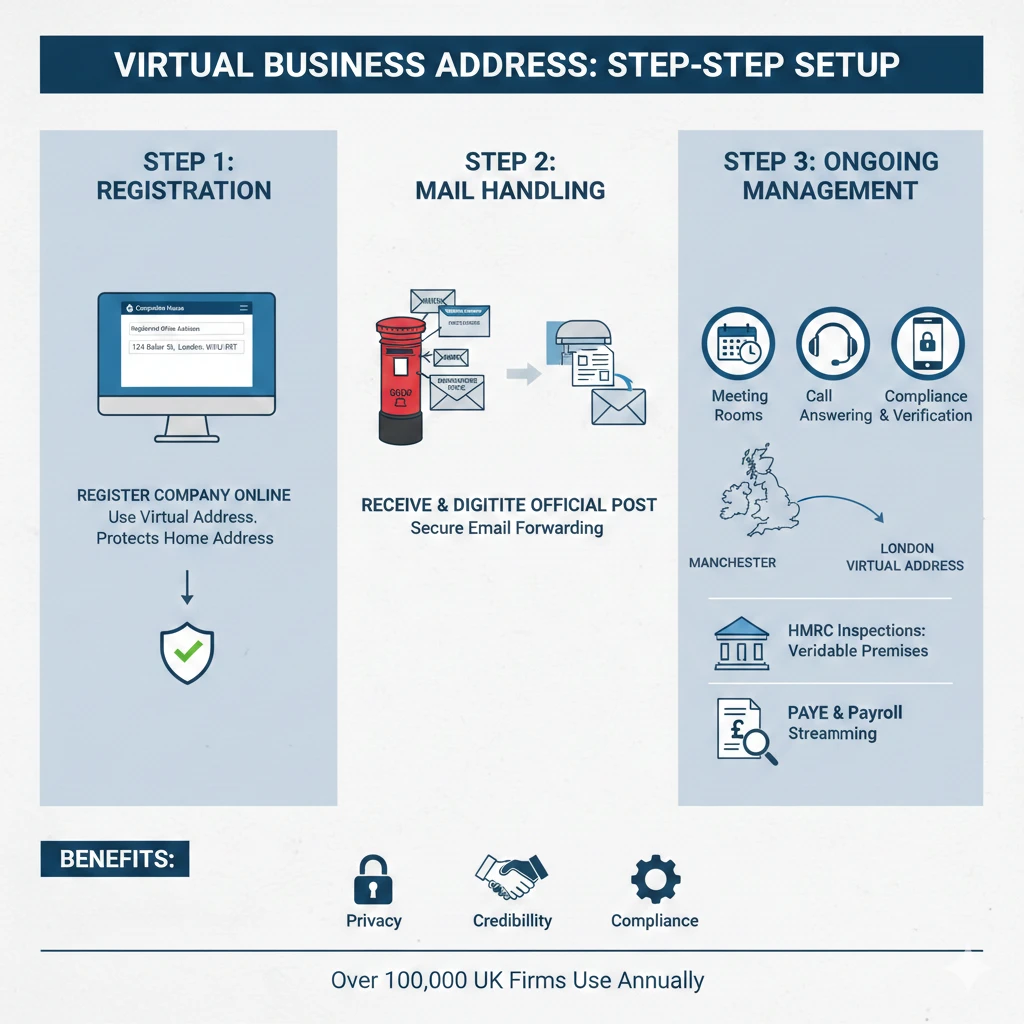
The process begins with selecting a provider during or after company formation. Step one: Register your company online via Companies House, listing the virtual address as the registered office this automatically updates public records, protecting directors’ and shareholders’ home addresses from view. Step two: The provider receives all official post, including HMRC letters, court documents, and shareholder notices, then digitises and forwards them securely via email or post. For instance, if you’re a director in Manchester but use a London virtual address, Companies House filings remain professional and central.
Step three involves ongoing management: Providers handle mail redirection, often with options for meeting rooms or call answering to enhance credibility. Compliance is key— the address must be a physical location in the same UK jurisdiction as your company (England/Wales, Scotland, or NI). During VAT registration, HMRC verifies the address for inspections, so choose providers with verifiable premises. For PAYE, payroll documents route through this address, streamlining operations for remote teams.
In practice, a tech startup might form a ltd company, assign the virtual address, and receive their Certificate of Incorporation within 24 hours all without exposing the founders’ homes. This step-by-step setup not only boosts privacy but aligns with business structures like LLPs or PLCs needing robust compliance. Over 100,000 UK firms use virtual addresses annually, per industry estimates, proving their reliability in maintaining directorial anonymity while fulfilling legal duties.
Benefits and Potential Risks of Using a Virtual Business Address
Virtual addresses deliver multifaceted advantages, starting with superior privacy. Directors and shareholders avoid public scrutiny, reducing spam, fraud risks, and personal disturbances crucial for high-profile entrepreneurs or those in sensitive industries. Professionally, a prestigious postcode (e.g., EC1 in London) elevates your brand, aiding client trust during company formation pitches or investor meetings.
Cost savings are substantial: No commercial lease means £50–£150 monthly versus thousands in rent, perfect for bootstrapped SMEs handling VAT and PAYE remotely. Flexibility shines for nomadic directors scale services as your business grows, from basic mail to full virtual office suites. Compliance benefits include reliable handling of Companies House reminders, preventing strikes-off for missed filings.
However, risks exist. Reputable providers mitigate most, but pitfalls include non-compliance if the address isn’t a ‘real’ office Companies House rejects virtual setups without physical access. Mail delays could miss HMRC deadlines, risking penalties. Visibility issues arise: Customers mistaking it for a PO Box might question legitimacy, and banks may require extra verification for accounts.
Weigh these against benefits: A Form My Company client saved £10,000 yearly on office space while shielding their home from 500+ annual Companies House searches. Risks pale with vetted providers offering HMRC-approved addresses, ensuring VAT/PAYE smooth sailing. Ultimately, for privacy-conscious shareholders, the pros dominate, fostering secure business structures.
Legal and Compliance Considerations for Virtual Addresses in the UK
Under the Companies Act 2006 (Section 86), every UK limited company must maintain a registered office address for serving documents, publicly listed at Companies House. Virtual addresses qualify if they’re physical premises capable of receiving post during business hours no PO Boxes or DX boxes allowed. This ties directly to compliance: Annual returns, confirmation statements, and director changes all reference this address.
For VAT and PAYE, HMRC mandates a UK address for correspondence; virtual setups work if the provider facilitates inspections. Directors must ensure the address aligns with their service address (private, non-public), further anonymising homes. Shareholders benefit too PSC registers (Persons with Significant Control) can use it, barring public exposure.
Legal nuances include jurisdiction matching: An England/Wales company can’t use a Scottish address. GDPR compliance demands secure mail handling to protect personal data. Non-compliance risks fines up to £1,500 for late filings or dissolution. Case example: In 2024, a fintech firm faced HMRC scrutiny but resolved it swiftly via their virtual provider’s audit-ready premises.
Authorities like Companies House actively monitor: Virtual addresses appear in 20% of new formations, per 2025 data. Choose providers with indemnity insurance and FCA/HMRC vetting for trust. Integrating with company formation services ensures seamless VAT/PAYE setup, making virtual addresses a compliant privacy cornerstone.
Common Mistakes to Avoid When Choosing a Virtual Business Address
New entrepreneurs often falter by selecting cheap, unvetted providers, leading to Companies House rejection ensure the address has a physical door sign and mail acceptance proof. Another error: Overlooking mail volume; basic plans cap scans, delaying PAYE payroll or VAT returns amid HMRC’s 30-day response rules.
Ignoring jurisdiction mismatches dooms setups Scottish firms can’t use London addresses. Failing to notify banks post-formation causes account delays, as they cross-check Companies House. Directors neglect updating service addresses, exposing homes inadvertently.
A prevalent mistake: Treating it as a full office substitute without add-ons like call handling, eroding professionalism for client-facing businesses. Overpaying for unused features drains startups, while skimping risks data breaches vet GDPR compliance.
Real fallout: A 2025 case saw a director fined £500 for missed filings due to provider blackout. Avoid by researching reviews, trialling services, and bundling with formation experts. Proactive checks safeguard your business structure’s integrity.
Practical Tips and Best Practices for Implementation
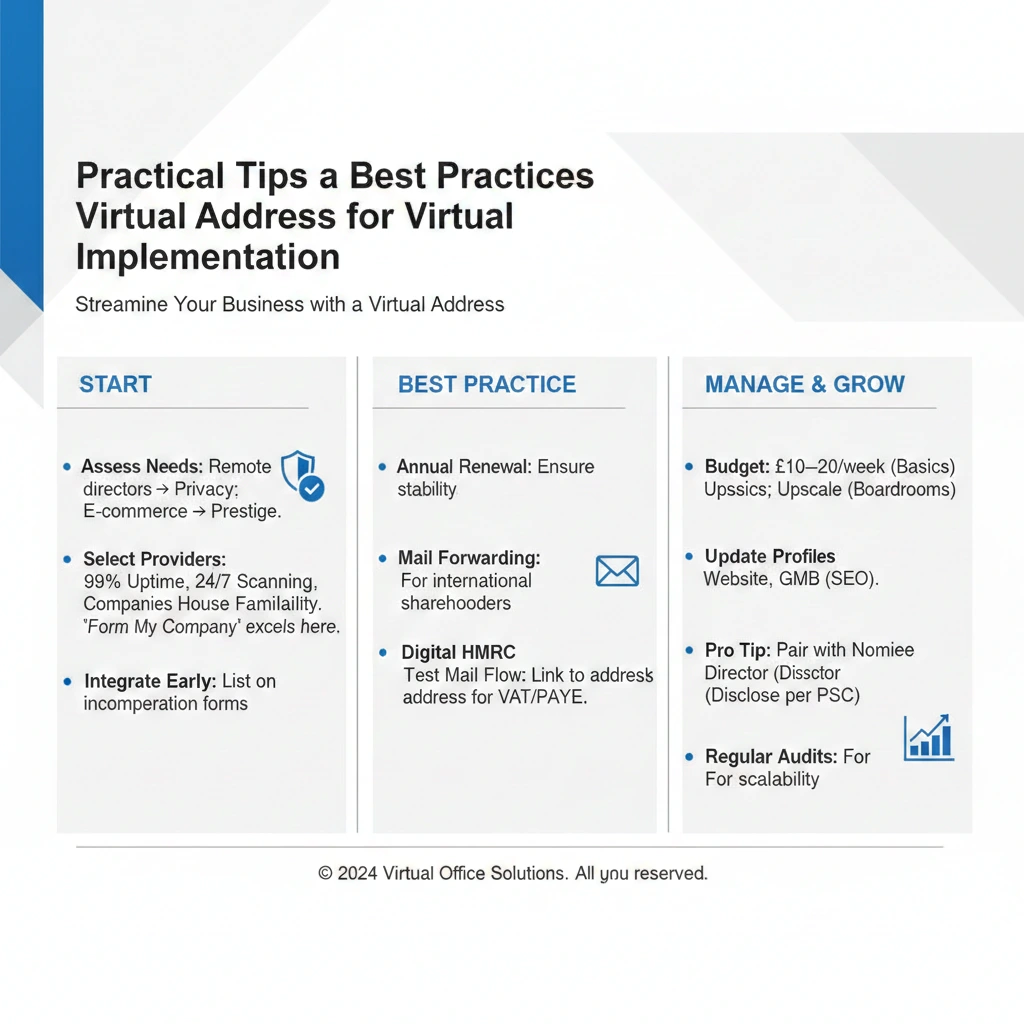
Start by assessing needs: Remote directors prioritise privacy; e-commerce needs prestige. Select providers with 99% uptime, 24/7 scanning, and Companies House familiarity Form My Company excels here. Integrate during formation: List the virtual address on incorporation forms for instant protection.
Best practice: Sign annually for stability, adding forwarding for international shareholders. Test mail flow pre-launch send a Companies House mock document. For VAT/PAYE, enable digital HMRC portals linked to the address.
Budget wisely: £10–£20/week covers basics; upscale for boardrooms. Update all profiles website, Google My Business for SEO gains. Monitor via provider dashboards to preempt compliance slips.
Pro tip: Pair with nominee director services for ultra-privacy, but disclose per PSC rules. Regular audits ensure ongoing suitability as your company scales.
A virtual business address unlocks superior privacy without compromising UK compliance, ideal for savvy entrepreneurs navigating company formation, Companies House, VAT, and PAYE. By shielding personal details, it fosters focus on growth amid rising data threats.
If you’re ready to register your company with confidence, Form My Company provides fast, fully online company formation with expert compliance support, virtual office addresses, VAT & PAYE handling, and professional guidance. Get started today and let our specialists handle the paperwork while you focus on growing your business.
Frequently Asked Questions
Can I use a virtual address for Companies House registration?
Yes, provided it’s a physical UK address in the correct jurisdiction. Companies House verifies via post acceptance; providers supply proof. It fully complies for limited companies, protecting directors/shareholders during formation and annual filings.
Does a virtual business address affect VAT or PAYE compliance?
No impact HMRC accepts them for correspondence and inspections. Ensure provider access for visits; many facilitate. Thousands of VAT-registered firms use them seamlessly for payroll and returns.
Is a virtual address the same as a PO Box?
No, PO Boxes are banned by Companies House. Virtual addresses are staffed premises handling legal mail, offering scanning/forwarding for professional compliance.
How much does a virtual business address cost in the UK?
£50–£200 monthly, varying by location/features. London premiums apply; bundles with formation save 20–30%. Compare for HMRC vetting and insurance.
Can shareholders use it for privacy too?
Absolutely list as service address in PSC registers. It shields homes publicly while meeting transparency laws.