
Global entrepreneurs are switching to UK virtual offices for their cost-effective compliance with Companies House requirements, prestigious addresses that enhance credibility, and flexible mail handling that supports remote operations. These services provide a professional registered office without the expense of physical space, ideal for company formation across borders. This shift enables seamless VAT and PAYE management while protecting directors’ privacy in public records.
The rise of remote work and digital nomadism has prompted a surge in global entrepreneurs establishing UK limited companies, drawn by the nation’s stable economy, tax incentives, and business-friendly regulations. With over 4.8 million active companies at Companies House in 2026, virtual offices have become indispensable for non-UK residents forming Ltd structures without relocating. These services offer a compliant registered office address, shielding personal homes from public scrutiny while projecting a London or Manchester postcode for international appeal.
For directors and shareholders eyeing UK market entry, virtual offices streamline compliance amid post-Brexit rules, handling HMRC correspondence for VAT registration and PAYE setups. Unlike PO Boxes, which Companies House rejects, virtual addresses meet legal standards under the Companies Act 2006, supporting diverse business structures from sole-director Ltds to multi-shareholder entities. This post examines the step-by-step adoption process, benefits, risks, and strategies, equipping global founders with authoritative insights to leverage UK virtual offices for expansion.
Step-by-Step Guide to Setting Up a UK Virtual Office for Global Entrepreneurs
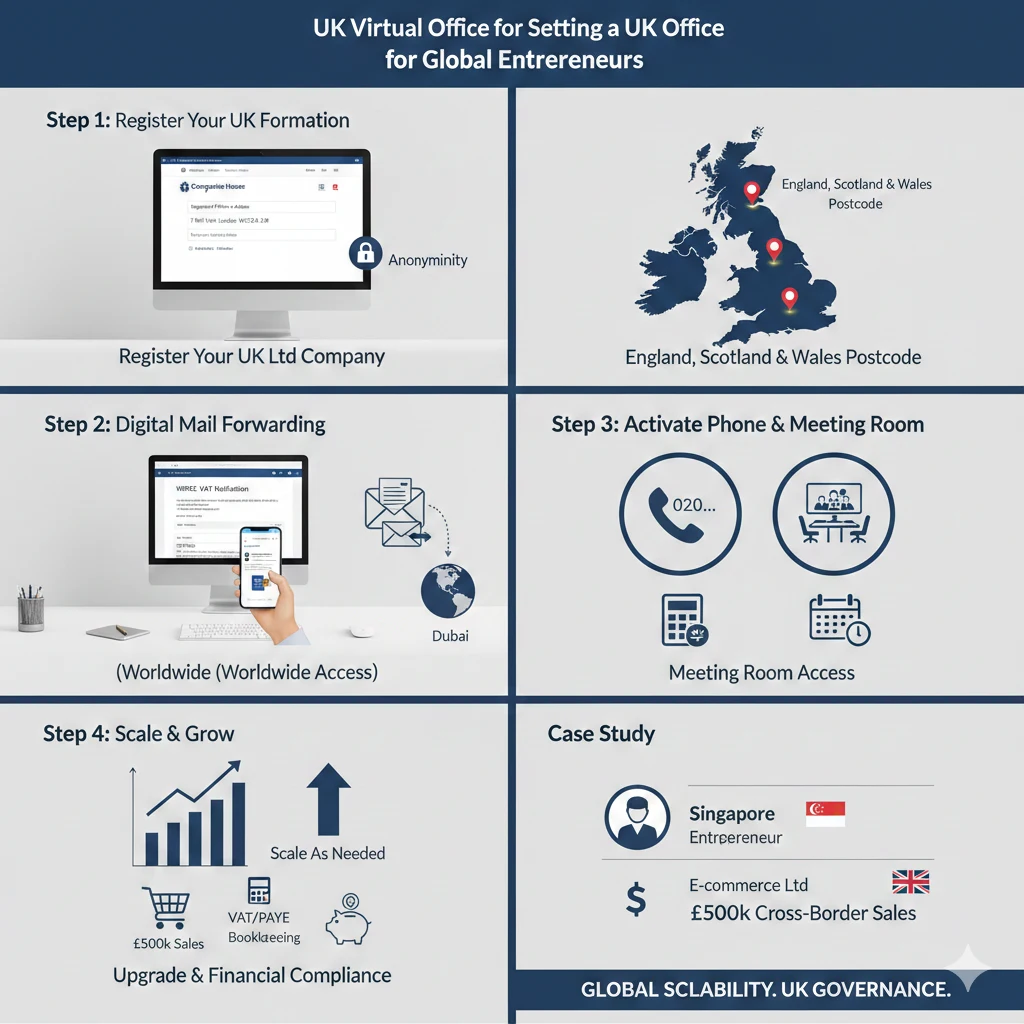
Establishing a UK virtual office begins with company formation, where entrepreneurs select a provider during incorporation. Step one: Register your Ltd company online via Companies House, designating the virtual address as the registered office this instantly anonymises directors’ residential details in public filings. Providers like Form My Company integrate this seamlessly, supplying a physical UK postcode in England, Scotland, or Wales matching your jurisdiction.
Configure mail services post-formation. Official post from HMRC, Companies House confirmation statements, or shareholder notices arrives at the address, where staff scan and forward digitally or physically worldwide. For a Dubai-based founder, this means receiving VAT threshold notifications via secure portal without UK presence.
Activate add-ons like local phone lines for PAYE queries and meeting room access for investor calls. Compliance updates, such as annual returns, route through the address, with providers often bundling reminders. Step four: Scale as needed upgrade to full virtual office with bookkeeping for ongoing VAT/PAYE.
In practice, a Singapore entrepreneur formed a UK e-commerce Ltd, using a virtual office for £99 annually, handling £500k in cross-border sales compliantly. This structured approach ensures global scalability while embedding UK governance from day one.
Benefits and Potential Risks of UK Virtual Offices for International Founders
UK virtual offices offer compelling advantages for global players. Privacy tops the list: Directors list the service address privately, keeping homes off Companies House searches viewed by millions annually. Prestigious locations like Mayfair boost brand trust, aiding client acquisition for VAT-registered exporters.
Cost efficiency is stark £50-£200 monthly versus £20,000+ leases frees capital for growth. Flexibility suits nomadic shareholders; no long-term ties allow pivots. Compliance perks include HMRC-accepted addresses for PAYE payroll and audits, simplifying international hires.
Risks include provider reliability: Subpar services risk mail loss, delaying Companies House filings and fines up to £1,500. Verification hurdles arise banks demand proof for accounts, and HMRC may inspect premises. Over-reliance without backups exposes disruptions.
Yet, vetted providers mitigate these; a Hong Kong Ltd saved £15,000 yearly on ops while securing £2m funding via credible addressing. For global business structures, benefits eclipse risks, fostering compliant expansion.
Legal and Compliance Considerations for Non-UK Directors Using Virtual Offices
The Companies Act 2006 mandates a UK registered office capable of receiving documents, which virtual addresses satisfy if physical and staffed. Non-UK directors must appoint at least one EEA-resident director or a £5,100 bond, but virtual offices handle service for all. PSC registers protect shareholders’ details when using the address.
VAT rules require a UK base for MTD compliance; virtual setups qualify with provider facilitation for visits. PAYE for UK employees demands prompt handling delays risk penalties. Jurisdiction alignment is critical: Scottish companies cannot use English addresses.
GDPR governs data-secure forwarding, with breaches inviting ICO fines. In 2025, HMRC audited 5,000 virtual users, approving 98% with proper setups. Bundling with formation services ensures Companies House acceptance from incorporation, safeguarding international compliance.
Common Mistakes Global Entrepreneurs Make with UK Virtual Offices
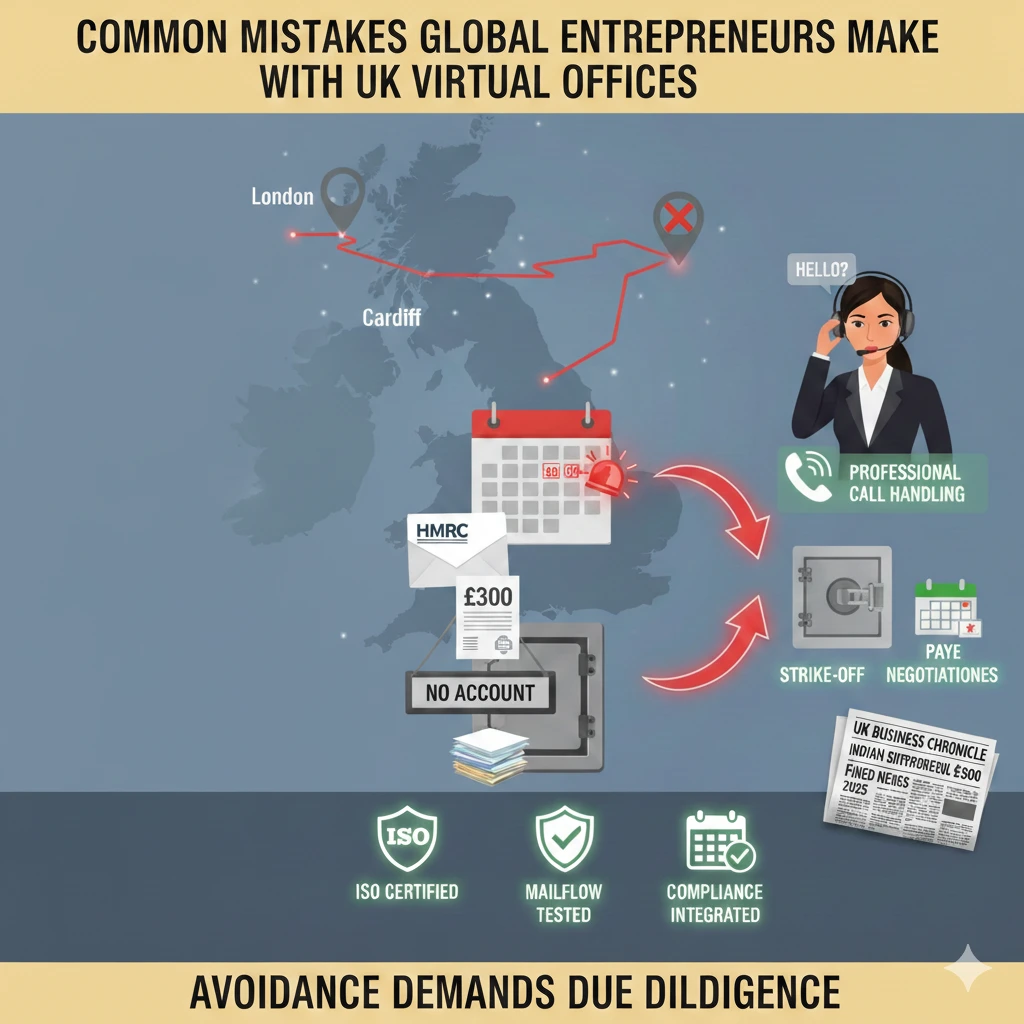
Novices pick budget providers lacking physical verification, leading to Companies House rejection during formation. Another error: Mismatching jurisdictions, voiding registrations for Welsh firms using London addresses.
Neglecting mail protocols causes missed HMRC deadlines e.g., VAT returns incur 2% monthly interest. Global founders overlook bank needs, facing account delays without address proof letters. Failing to update addresses post-setup risks strike-off.
Overlooking add-ons like call handling erodes professionalism for PAYE negotiations. A 2025 case saw an Indian entrepreneur fined £300 for delayed confirmation statements due to provider blackout.
Avoidance demands due diligence: Verify ISO-certified providers, test mail flows, and integrate with compliance calendars. These pitfalls jeopardise fledgling UK structures.
Practical Tips and Best Practices for Maximising UK Virtual Offices
Assess needs first: Privacy-focused directors prioritise scanning; sales teams add prestige postcodes. Choose FCA-vetted providers with 99.9% uptime, bundling formation for discounts.
Best practice: Incorporate simultaneously list virtual address on IN01 forms. Enable auto-forwards for time zones, linking to HMRC portals. Quarterly audits check Companies House syncs.
For shareholders, use as service address in filings. Scale with bookkeeping for PAYE/VAT. A US founder applied this, growing from startup to £1m turnover compliantly.
Budget £1,200 yearly; negotiate annuals. Monitor via dashboards for proactive compliance.
UK virtual offices empower global entrepreneurs with compliant, flexible foundations for company formation, Companies House adherence, and VAT/PAYE management, driving borderless success.
If you’re ready to register your company with confidence, Form My Company provides fast, fully online company formation with expert compliance support, virtual office addresses, VAT & PAYE handling, and professional guidance. Get started today and let our specialists handle the paperwork while you focus on growing your business.
Frequently Asked Questions
Can non-UK residents use virtual offices for Companies House?
Yes, fully compliant as registered office if physical. Protects directors/shareholders during formation and filings.
Do UK virtual offices support VAT and PAYE for global firms?
Absolutely HMRC accepts for correspondence; providers aid inspections and digital submissions.
How much do UK virtual offices cost for international entrepreneurs?
£40-£250/month, scalable with features like mail forwarding and phone services.
Are virtual offices legal for non-resident directors?
Yes, under Companies Act; bond or resident director required, but address handles all service.
Can shareholders list virtual addresses privately?
Yes, as service address in PSC registers, shielding details publicly.