
Professional meeting rooms significantly boost the chances of closing high-value deals by creating an environment that signals credibility, ensures privacy, and enhances focus. These spaces allow entrepreneurs, directors, and shareholders to present their company formation strategies or compliance plans with authority, far surpassing the limitations of coffee shops or virtual calls. For UK businesses registered with Companies House, they provide a compliant venue that aligns with legal expectations for board decisions and client negotiations.
In the competitive landscape of UK business, where company formation, VAT registration, PAYE compliance, and ongoing Companies House filings demand precision, the setting for high-stakes discussions can make or break outcomes. Professional meeting rooms often accessed via virtual office providers or business centres offer more than just a table and chairs; they embody a strategic asset for entrepreneurs scaling their operations. These spaces project stability to investors, partners, and clients who scrutinise every detail, from the registered office address on your business structure to the quality of your pitch environment.
Consider a startup director pitching to shareholders about incorporating a limited company structure. A makeshift home office risks undermining trust, while a well-equipped meeting room in a prestigious location reinforces the professionalism expected under UK company law. Research shows that first impressions form in just seven seconds, with environmental cues heavily influencing perceptions of competence. For businesses navigating compliance complexities like annual returns or director duties, this initial trust is crucial for securing deals that fund growth. Professional meeting rooms thus serve as an extension of your brand, particularly vital for sole traders transitioning to Ltd companies or those maintaining a virtual office for their registered office address. By minimising distractions and maximising polish, they create the psychological edge needed to convert negotiations into signed contracts, directly impacting revenue and scalability in a market where 90% of deals hinge on rapport built in the first meeting.
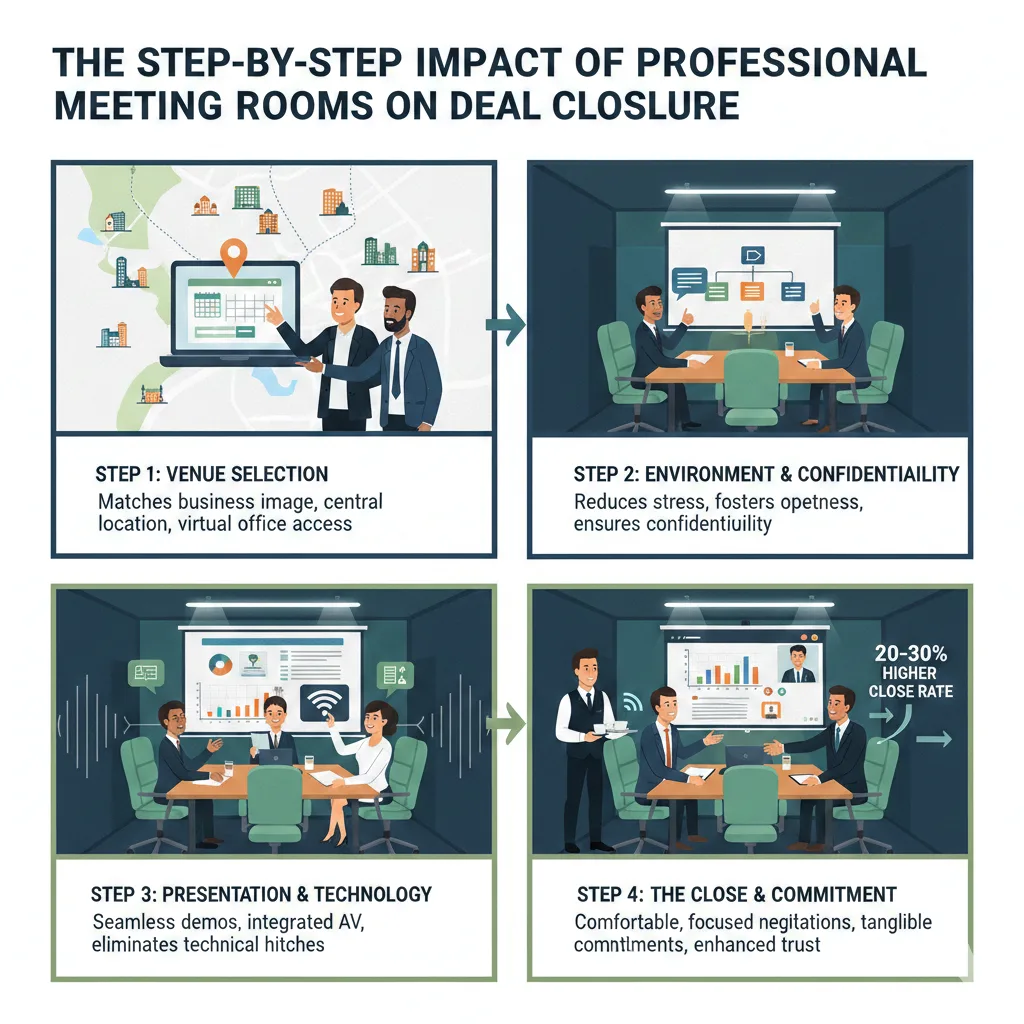
The Step-by-Step Impact of Professional Meeting Rooms on Deal Closure
The process begins long before the handshake. Step one involves selecting a venue that matches your business’s image often through providers offering virtual offices with on-demand meeting access, ideal for companies without a physical registered office. Booking a room in central London or Cambridge positions your discussion in a hub of commerce, subtly associating your venture with established success.
As participants arrive, step two activates: the environment sets the tone. High-quality furniture, ambient lighting, and acoustic design reduce stress, fostering openness essential for discussing sensitive topics like shareholder agreements or VAT thresholds. Unlike open-plan cafes, these rooms ensure confidentiality, critical when outlining PAYE strategies or Companies House compliance risks.
Step three is the presentation phase, where integrated AV technology projectors, high-speed Wi-Fi, and video conferencing enables seamless demos of financial models or business plans. Directors can reference model articles under the Companies Act 2006, explaining quorum requirements or resolution processes without technical hitches that erode confidence.
Finally, step four: the close. Comfortable seating and neutral decor keep energy high during extended negotiations, while on-site support handles refreshments, allowing focus on value propositions. This structured flow transforms abstract pitches into tangible commitments, with studies indicating a 20-30% higher close rate in optimised spaces due to enhanced cognitive performance and trust signals.
Key Benefits and Potential Risks of Using Professional Meeting Rooms
The benefits extend beyond aesthetics to tangible business gains. Primarily, they elevate your professional image, crucial for new companies post-formation where a credible address bolsters investor pitches. Access to prime locations enhances networking, while flexible bookings suit variable deal timelines, avoiding the overhead of permanent leases.
Productivity surges in distraction-free zones, with superior acoustics and ergonomics minimising fatigue key for multi-hour sessions on compliance audits or shareholder dilutions. Cost-effectiveness shines for SMEs: hourly rates from virtual office bundles undercut full office rents, yet deliver premium facilities that impress high-net-worth clients.
Privacy is paramount; secure rooms prevent leaks on proprietary strategies, aligning with director fiduciary duties. Environmentally, they promote collaboration via layouts like round tables that equalise dynamics, boosting creative deal terms.
However, risks exist if mismanaged. Over-reliance on unfamiliar tech can cause delays, eroding momentum. Location mismatches too flashy for conservative sectors might signal ostentation. Budget overruns from add-ons like catering are pitfalls, and last-minute availability issues could derail schedules. Mitigation involves advance scouting and hybrid options tying into virtual offices for registered addresses, ensuring benefits outweigh drawbacks while supporting compliance-heavy operations.
Legal and Compliance Considerations for UK Businesses
Under UK law, particularly the Companies Act 2006, directors must exercise duties diligently, including holding board meetings with proper notice and quorum—often best in neutral, professional venues to avoid bias claims. For private limited companies, articles may permit virtual participation, but high-value deals with shareholders demand documented, secure settings to validate resolutions.
A professional meeting room doubles as a compliant venue for AGMs or investor meets, especially if your registered office is virtual many providers handle Companies House correspondence while offering rooms. This setup satisfies HMRC for VAT/PAYE discussions, where privacy prevents data breaches under GDPR.
Shareholder approvals for major transactions require clear records; a professional space lends evidentiary weight, reducing disputes. For public companies, stricter transparency applies, making impartial environments essential. Virtual office integrations ensure your business address remains valid, avoiding fines up to £5,000 for non-compliance. Always confirm provider policies align with your articles, and retain minutes meticulously failure risks director disqualification.
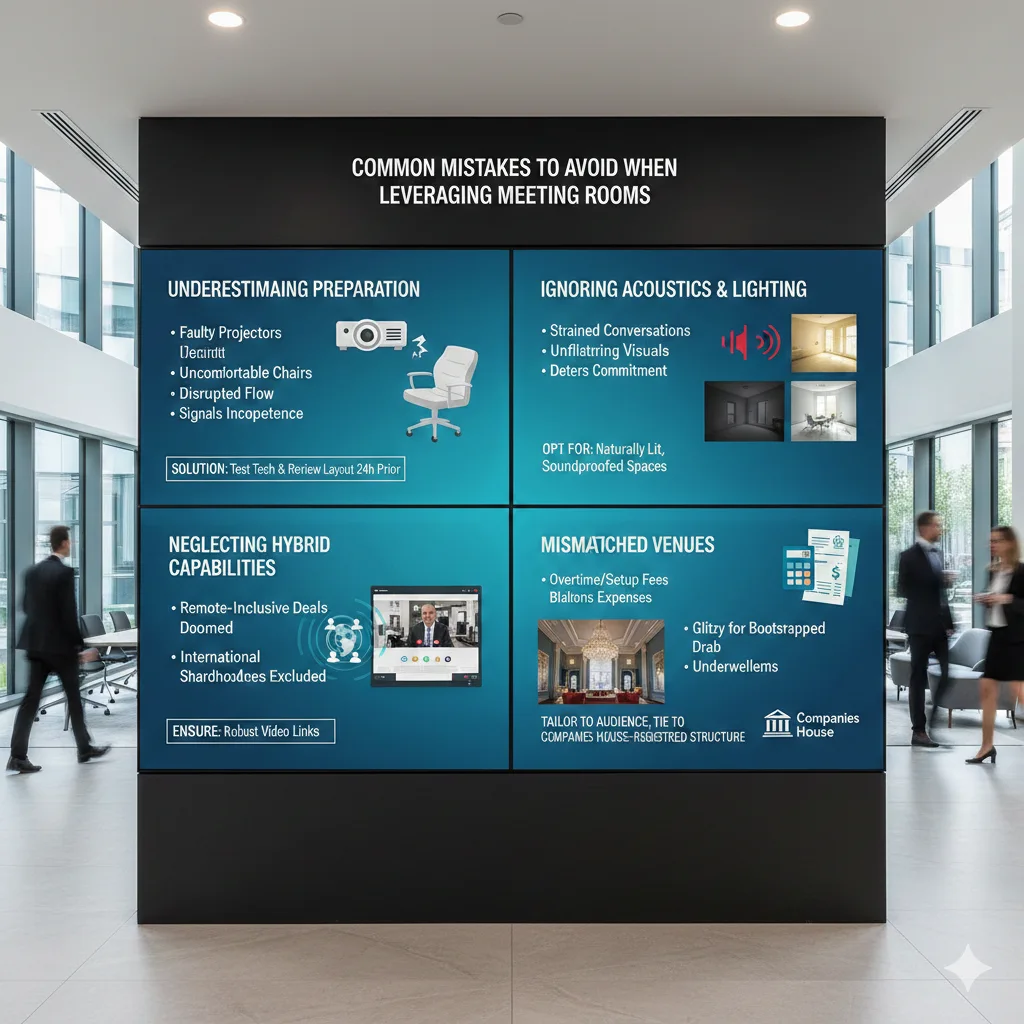
Common Mistakes to Avoid When Leveraging Meeting Rooms
A frequent error is underestimating preparation: arriving to faulty projectors or uncomfortable chairs disrupts flow, signalling incompetence to discerning clients. Solution: test tech 24 hours prior and review room layouts.
Another pitfall: ignoring acoustics and lighting, leading to strained conversations or unflattering visuals that subconsciously deter commitment. Opt for naturally lit, soundproofed spaces.
Neglecting hybrid capabilities dooms remote-inclusive deals; ensure robust video links for international shareholders.
Overlooking costs hidden fees for overtime or setup balloons expenses; bundle with virtual office services for predictability.
Finally, mismatched venues: a glitzy room for bootstrapped pitches alienates, while drab ones underwhelm. Tailor to audience, and always tie back to your Companies House-registered structure for authenticity.
Practical Tips and Best Practices for Maximising Deal Success
Select providers with virtual office ties for seamless registered office integration. Book in advance, specifying AV needs and catering aligned with UK hospitality standards.
Design agendas leveraging room features: use whiteboards for real-time modelling of post-formation finances.
Incorporate breaks in ergonomic spaces to sustain focus. Follow up with digital minutes from the session, reinforcing compliance.
For directors, rotate venues to maintain neutrality in shareholder meets. Track ROI via close rates pre/post-use.
Best practice: hybrid setups for global deals, ensuring all comply with notice requirements under model articles.
Professional meeting rooms are indispensable for UK entrepreneurs closing high-value deals, bridging image, productivity, and compliance in a regulated landscape. From impressing shareholders to streamlining Companies House obligations, they deliver measurable returns.
If you’re ready to register your company with confidence, Form My Company provides fast, fully online company formation with expert compliance support, VAT & PAYE handling, virtual office solutions, and professional meeting access. Get started today and let our specialists handle the paperwork while you focus on growing your business.
Frequently Asked Questions
Can I use a professional meeting room for Companies House-required board meetings?
Yes, as long as it aligns with your articles of association. Under the Companies Act 2006, directors can meet in any suitable location with proper notice; professional rooms provide the documentation-friendly environment needed for resolutions on filings or compliance, often linked to virtual registered offices.
How do meeting rooms impact VAT and PAYE discussions with advisors?
They ensure confidentiality vital for sensitive HMRC matters, with secure setups preventing breaches. Clients perceive greater professionalism, facilitating smoother approvals on thresholds or registrations.
Are professional rooms cost-effective for startups?
Absolutely hourly rates from £20-50 beat office leases, bundling with virtual addresses for full compliance support without fixed costs.
What if my business uses a virtual office only?
Most offer day room access, maintaining your Companies House address while providing physical presence for deals.
Do room layouts affect negotiation outcomes?
Yes, round tables promote equality, enhancing collaboration per psychological studies, ideal for shareholder equity talks.