
UK virtual offices transform small business credibility by providing a prestigious registered office address, mail handling, and professional facilities without the expense of physical premises. This setup instantly elevates your company formation profile, reassuring clients, investors, and partners while ensuring full Companies House compliance. Directors and shareholders gain a compliant base that supports scalable growth from sole trader to limited company structures.
In the UK’s competitive business landscape, first impressions often determine success, particularly for small businesses navigating company formation and compliance hurdles. A virtual office serves as more than a postal address; it establishes a professional registered office that meets Companies House requirements under Section 87 of the Companies Act 2006, shielding directors’ home addresses from public scrutiny. For entrepreneurs transitioning business structures, this credibility boost is invaluable whether pitching to shareholders for funding or reassuring HMRC during VAT registration.
Consider a freelance consultant incorporating as a limited company: listing a home address on the public register risks perceptions of instability, while a virtual office in London’s Mayfair or Manchester’s city centre signals established operations. Integrated services like mail forwarding, call answering, and access to meeting rooms further enhance trust, facilitating PAYE setups and annual confirmation statements. Studies from business networks indicate that 70% of clients judge credibility by address alone, making virtual offices a strategic necessity for remote or startup teams. This infrastructure not only complies with legal mandates but positions your enterprise as a serious player, ready for expansion amid rising remote work trends.
Step-by-Step Guide to Implementing a Virtual Office
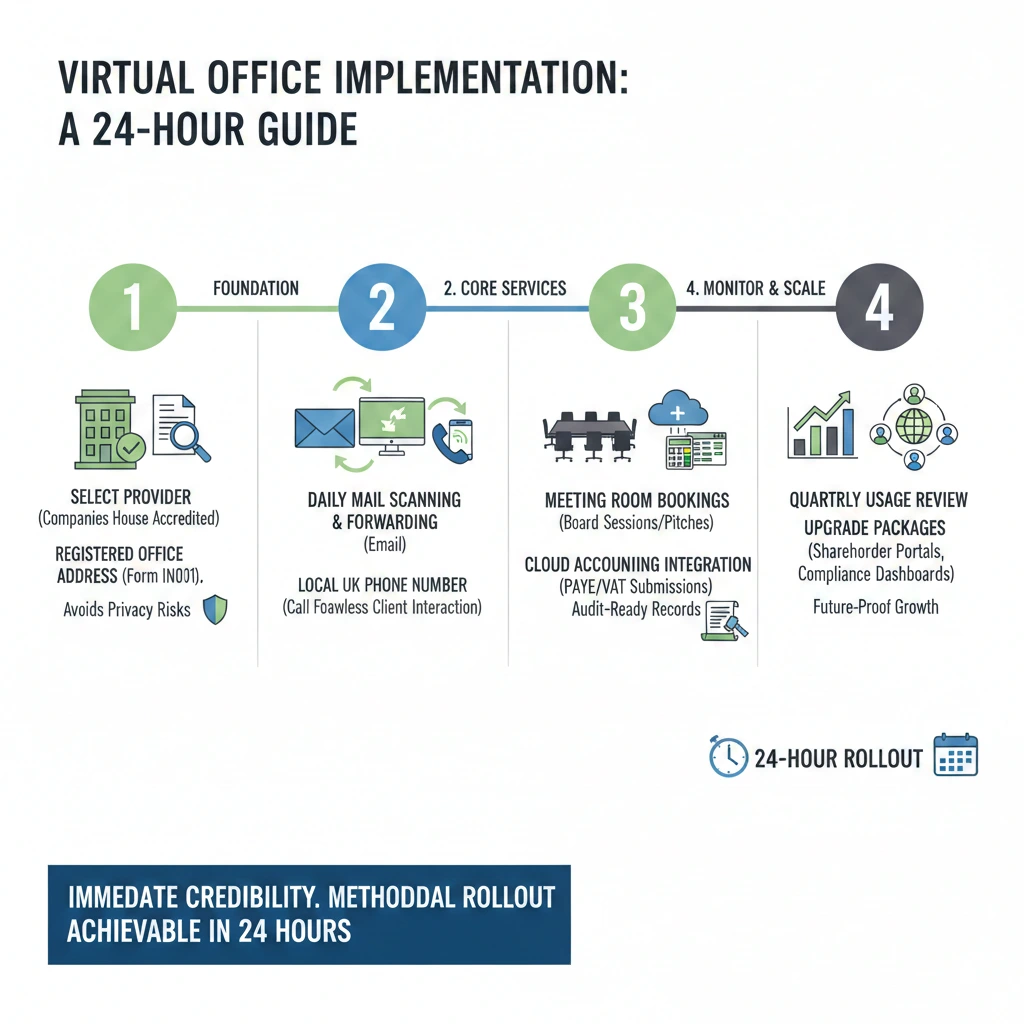
Begin with selecting a provider accredited for Companies House filings, ensuring the address qualifies as your official registered office. During company formation via Form IN01, list this address prominently, avoiding personal residences that expose directors to privacy risks and spam.
Next, configure core services: opt for daily mail scanning and forwarding to your email, crucial for timely responses to HMRC VAT assessments or shareholder correspondence. Integrate telephone services with a local UK number, routing calls to your mobile for seamless client interactions without revealing operations’ scale.
Progress to advanced features like meeting room bookings for board sessions or investor pitches, vital for documenting resolutions under the Companies Act. Link your virtual office to cloud accounting tools for automated PAYE and VAT submissions, maintaining audit-ready records.
Finally, monitor and scale: review usage quarterly, upgrading to packages with shareholder portals or compliance dashboards as your business structure evolves. This methodical rollout ensures immediate credibility gains while future-proofing against growth demands, typically achievable within 24 hours of signup.
Benefits and Potential Risks of Virtual Offices
The primary benefit lies in enhanced credibility: a prime location instantly aligns small businesses with established firms, swaying shareholders during equity raises or banks for lending. Cost savings are dramatic monthly fees from £20-£100 versus £2,000+ for physical offices freeing capital for marketing or compliance experts.
Operational flexibility shines for remote directors managing multiple entities; one virtual office supports various business structures, from Ltd companies to partnerships, with global mail redirection. Compliance integration streamlines Companies House annual returns and HMRC interactions, reducing administrative burdens by 50% per industry benchmarks.
Client trust amplifies through professional facades: branded mail and local numbers foster repeat business, while meeting access facilitates high-stakes PAYE negotiations. Scalability accommodates headcount growth without relocation disruptions.
Risks include provider unreliability mail delays could miss statutory deadlines, incurring £150+ fines or address mismatches eroding authenticity if overused across unrelated entities. Over-dependence on digital mail risks cyber threats to sensitive shareholder data, and premium locations may inflate perceived costs. Careful vetting and diversification mitigate these, preserving net positives for sustained credibility.
Legal and Compliance Considerations for Virtual Offices
Under UK law, every incorporated company must maintain a registered office open to public inspection, as per Companies Act 2006. Virtual offices fully comply, provided they accept deliveries during business hours essential for summons or HMRC notices on VAT/PAYE discrepancies.
Directors’ duties extend to accurate PSC registers; virtual setups enable secure online updates via Companies House WebFiling, with providers often offering confirmation statement reminders. For VAT-registered firms, the address serves as proof during audits, aligning with Making Tax Digital mandates for digital record-keeping.
Shareholder meetings gain legitimacy in provider meeting rooms, satisfying quorum rules and producing minutes admissible in disputes. GDPR compliance requires encrypted mail handling, protecting personal data in director appointments or employee contracts.
Non-compliance pitfalls loom: using invalid addresses triggers striking off, while home alternatives violate privacy for public figures. Virtual offices shield against this, but contracts must stipulate service levels matching statutory timelines, ensuring robust legal standing across business structures.

Common Mistakes to Avoid with Virtual Offices
A critical oversight is choosing unverified providers, leading to addresses rejected by Companies House or flagged in credit checks, undermining credibility at formation. Always confirm SRA or ICO registration and client testimonials.
Neglecting mail protocols causes missed deadlines e.g., 14-day responses to HMRC queries resulting in penalties; implement auto-notifications and daily checks.
Overlooking integration: standalone virtual offices falter without ties to accounting software, complicating PAYE real-time information submissions; select bundles with API access.
Misrepresenting scale by using luxury addresses for micro-businesses invites scrutiny from savvy partners, eroding trust; match prestige to sector norms.
Failing scalability planning strands growing firms with inflexible plans; audit expansion clauses early to avoid mid-year migrations disrupting shareholder confidence.
Ignoring termination clauses traps in long contracts post-pivot; review 30-day exits and data handover processes meticulously.
Practical Tips and Best Practices for Maximum Impact
Pair your virtual office with a professional website mirroring the address, reinforcing Companies House listings for SEO and client searches. Utilise provider dashboards for real-time mail tracking, prioritising HMRC/VAT items.
Customise call scripts to reflect business structures, training virtual receptionists on director names and services for authentic interactions.
Leverage meeting rooms quarterly for compliance rituals like AGMs, video-linking remote shareholders to maintain engagement.
Integrate with tools like Xero for seamless VAT/PAYE syncing, auto-populating from scanned correspondence.
Monitor address reputation via Google reviews, addressing any provider hiccups promptly.
For multi-director setups, assign sub-accounts for segmented access, enhancing privacy in shareholder dealings.
Budget 10% over base fees for add-ons like notarised scans, ensuring audit readiness.
Virtual offices revolutionise small business credibility, delivering legal compliance, cost efficiency, and professional stature essential for UK growth. From Companies House adherence to shareholder confidence, they underpin every stage of expansion.
If you’re ready to register your company with confidence, Form My Company provides fast, fully online company formation with expert compliance support, VAT & PAYE handling, virtual office solutions, and professional support. Get started today and let our specialists handle the paperwork while you focus on growing your business.
Frequently Asked Questions
Can a virtual office serve as my company’s registered office with Companies House?
Yes, absolutely provided it meets accessibility criteria under the Companies Act. Providers handle all statutory post, scanning for digital access, ensuring compliance during formation and annual filings without physical visits.
How does a virtual office impact VAT and PAYE compliance for small businesses?
It provides a verifiable UK base for HMRC correspondence, streamlining quarterly VAT submissions and PAYE RTI via integrated digital mail. This reduces errors, with timestamps proving timely responses to queries.
Are virtual offices suitable for director and shareholder meetings?
Definitely most offer bookable rooms compliant for resolutions, with AV for hybrids. This satisfies legal notice requirements, producing verifiable minutes for Companies House.
What if my business outgrows a basic virtual office package?
Scalable tiers add staff mail, call volumes, or boardroom hours seamlessly, avoiding disruptions. Review metrics like mail volume quarterly to upgrade proactively.
Do virtual offices protect director privacy effectively?
Yes, by substituting public home addresses, complying with data protection while enabling opt-outs for service addresses on sensitive filings.