
A secure business address, such as a virtual office or professional registered office, protects directors’ and shareholders’ personal privacy by keeping home addresses off the public Companies House register while meeting all legal requirements for company formation and compliance. This shield prevents spam, harassment, and identity theft risks that plague 40% of UK small business owners using residential addresses. Startups and established firms alike gain peace of mind, focusing on VAT, PAYE, and growth without exposure.
In today’s digital landscape, where Companies House data is scraped daily for marketing lists and malicious intent, safeguarding personal details through a secure business address has become non-negotiable for UK entrepreneurs. During company formation, listing a home address as the registered office exposes directors to public scrutiny, junk mail bombardment, and potential stalking issues reported by one in three small business owners according to FSB surveys. A professional alternative not only complies with the Companies Act 2006 but elevates credibility for shareholder communications and HMRC interactions.
Virtual offices and serviced addresses provide encrypted mail handling, digital forwarding, and prestigious locations that reassure banks during PAYE setups or VAT registrations. For sole traders incorporating as limited companies, this pivot protects family privacy while signalling stability to investors. The implications extend to cybersecurity: public home details fuel phishing attacks targeting business bank accounts. By prioritising secure addresses, founders mitigate these threats, ensuring compliance and focus on scalable business structures amid rising data breaches affecting 2.5 million UK SMEs annually.
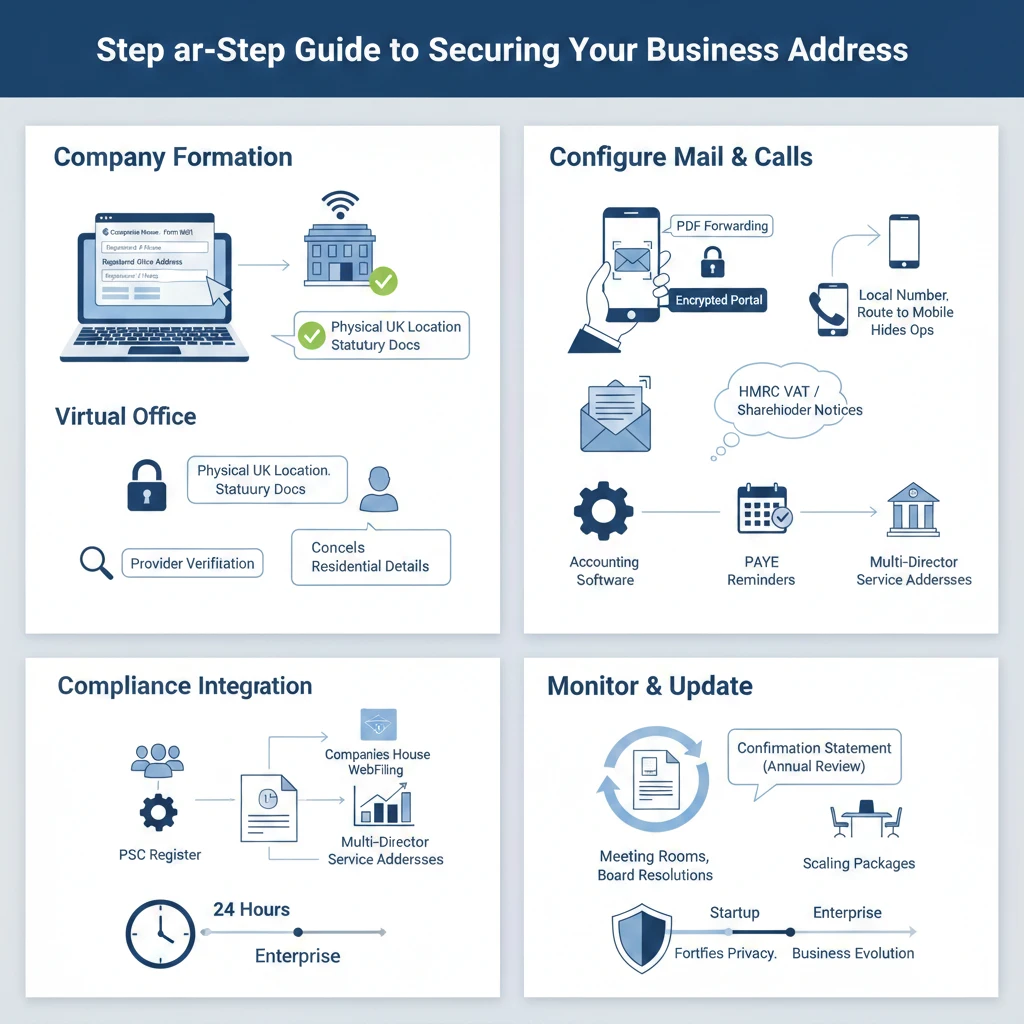
Step-by-Step Guide to Securing Your Business Address
Begin with company formation: when filing Form IN01 with Companies House, designate a virtual office as your registered office under Section 87, ensuring it’s a physical UK location accessible for statutory documents. This immediately conceals residential details, with providers verifying eligibility.
Next, configure mail services: select daily scanning and PDF forwarding to encrypted portals, crucial for timely responses to HMRC VAT assessments or shareholder notices. Integrate call answering with a local number, routing to your mobile without revealing operations.
Advance to compliance integration: link the address to accounting software for automated PAYE reminders and Companies House WebFiling, maintaining audit trails. For multi-director setups, assign service addresses for individual filings via the PSC register.
Finally, monitor and update: annually review during confirmation statements, scaling to packages with meeting rooms for board resolutions. This process, completable in 24 hours, fortifies privacy across business evolution from startup to enterprise.
Benefits and Potential Risks of Secure Business Addresses
The advantages fundamentally reshape operations. Privacy protection stands paramount: diverting public mail shields families from 500+ annual spam items per FSB data, preserving mental bandwidth for strategic decisions like shareholder dilutions. Credibility amplifies a Mayfair or Manchester address impresses banks for overdrafts, correlating with 30% higher approval rates during PAYE implementations.
Cost efficiency emerges through bundled services: £20-£100 monthly covers mail, calls, and compliance checks, versus £1,000+ in personal security measures. Scalability suits growth; add directors without address changes, streamlining Companies House updates.
Operational resilience grows via redundant handling lost post rerouted instantly, preventing missed VAT deadlines incurring £200 fines. Long-term, reduced breach risks lower cyber insurance premiums by 15-20%.
Risks include provider failures: unreliable scanning delays statutory responses, risking striking off. Over-reliance exposes to vendor data breaches, though ICO-registered firms mitigate via GDPR. Premium addresses may mislead on scale, inviting mismatched partnerships. Geographic mismatches London for rural operations complicate client meets. Diversified backups ensure benefits dominate.
Legal and Compliance Considerations for UK Businesses
The Companies Act 2006 mandates every limited company maintain a registered office at a verifiable UK address open for document service, explicitly allowing virtual offices if compliant. Directors opting for service addresses under Section 1132 protect residential details on public filings, vital for high-profile founders facing harassment.
GDPR Article 5 requires data minimisation; secure addresses pseudonymise personal info in Companies House searches, reducing scraping risks. HMRC accepts virtual postcodes for VAT/PAYE correspondence, with digital timestamps proving receipt during Making Tax Digital audits.
Shareholder resolutions gain legitimacy when mailed to professional addresses, satisfying quorum proofs. For public companies, service addresses shield against activist targeting. Non-compliance using PO Boxes invalidates filings, triggering £5,000 fines or dissolution.
Director duties under Section 172 demand risk awareness; unsecured addresses breach care obligations if leading to data incidents. Providers’ SLAs must guarantee 48-hour responses, aligning with statutory timelines across business structures.
Common Mistakes to Avoid When Choosing Secure Addresses
A prevalent error is selecting unverified providers: addresses rejected by Companies House during formation waste £12 fees and delay trading. Always cross-check via WebCheck service pre-signup.
Overlooking mail protocols: weekly scans miss urgent HMRC penalties notices, escalating £100 fines to £1,000; mandate daily processing.
Ignoring GDPR clauses: providers without encryption expose director data, inviting ICO investigations costing £20m max.
Using solely for formation then reverting home: disrupts continuity statements, flagging irregularities. Maintain throughout lifecycle.
Neglecting scalability: basic plans falter with volume post-funding; audit director counts quarterly.
Forgetting integration: standalone addresses complicate VAT software links; choose API-enabled services.
Geographic irrelevance: Scottish postcode for London-focused firms confuses stakeholders, eroding trust.
Practical Tips and Best Practices for Optimal Protection
Pair secure addresses with Companies House protection services for director opt-outs, combining layers. Utilise provider dashboards for real-time tracking, prioritising red-flag mail like court summons.
Train teams on protocol: forward only business post, shred personal. Integrate with DocuSign for digital shareholder approvals, minimising physical mail.
Conduct annual privacy audits: test response times, verify encryption. Budget £50 extra for notarised scans during HMRC disputes.
For multi-entity structures, centralise under umbrella addresses with sub-accounts. Leverage prestige for pitches: include on pitch decks reinforcing compliance narratives.
Monitor dark web exposures quarterly via tools like HaveIBeenPwned, rotating if compromised. Network with FSB for vetted providers.

Secure business addresses form the cornerstone of privacy protection for UK companies, harmonising legal compliance with personal security amid public data threats. Directors safeguard operations, impress stakeholders, and focus on growth unhindered.
If you’re ready to register your company with confidence, Form My Company provides fast, fully online company formation with expert compliance support, VAT & PAYE handling, virtual office solutions, and professional support. Get started today and let our specialists handle the paperwork while you focus on growing your business.
Frequently Asked Questions
Can a virtual office be my Companies House registered office?
Yes, provided it’s a physical, accessible UK address accepting deliveries. It fully complies with Section 87, shielding homes while enabling digital mail for seamless filings.
How does a secure address protect during VAT and PAYE audits?
HMRC verifies addresses via post; professionals ensure delivery proofs and scans, streamlining responses. Digital trails satisfy MTD record-keeping without personal exposure.
Are there risks to director privacy without a secure business address?
Significant public home details fuel spam (500+ items/year), phishing, and stalking per FSB data. Breaches cost £10k+ in remediation, breaching director duties.
What if my business structure changes does the address adapt?
Absolutely; scalable packages handle director additions or restructurings, updating Companies House via single confirmation statements without gaps.
How much does a secure business address typically cost UK startups?
£20-£100 monthly, including mail handling ROI via saved time/compliance outweighs, versus free home risks amplifying long-term costs.