
Using your home address for business mail exposes your privacy, risks non-compliance with Companies House rules, and undermines professional credibility for UK entrepreneurs. Opt for a virtual office or registered office service to maintain separation between personal and corporate affairs. This simple switch safeguards directors, shareholders, and your business structure from vulnerabilities.
For UK entrepreneurs embarking on company formation, the temptation to list a home address as the registered office or for business mail seems convenient at first glance. However, this choice carries significant drawbacks in a landscape governed by Companies House, HMRC, and data protection laws. New limited companies, LLPs, or sole traders registering with Companies House must provide a service address, and using residential details publicly displays directors’ and shareholders’ personal information on the Companies House register, accessible to anyone worldwide.
This exposure not only invites unwanted solicitations but also potential security threats, especially amid rising cyber risks and doorstep scams targeting business owners. Professional alternatives like virtual offices offer a prestigious UK address think London EC1 or Manchester M1 while handling mail forwarding, scans, and compliance filings. Consider a tech startup director whose home address led to persistent cold callers disrupting family life; switching to a virtual office restored peace and projected authority to investors. VAT-registered firms benefit too, as separated addresses streamline PAYE correspondence without personal clutter. This guide delves into why home addresses fall short, empowering you to align your business structure with best practices for long-term success and regulatory adherence. With over a decade advising incorporations, we’ve seen firsthand how address choices impact growth trajectories.
Step-by-Step Explanation of the Problem
Understanding Public Disclosure Requirements
Companies House mandates a registered office address for all UK companies, made publicly searchable alongside directors’ and persons with significant control (PSCs) details. Using your home address means this information appears on the open register, viewable via a simple search exposing not just mail but your residence to competitors, marketers, or fraudsters. This stems from the Companies Act 2006, requiring transparency for shareholders and creditors.
For business mail, HMRC sends VAT assessments, PAYE notices, and corporation tax demands to the listed address. Residential post invites delays if you’re away, and neighbours spotting official envelopes raises privacy flags. Example: A freelance consultant in Bristol used her flat for an LTD’s registered office; persistent junk mail escalated to identity theft attempts, forcing a costly address change mid-year. Implications extend to share transfers public home details deter institutional investors wary of unprofessional setups. Separating addresses from day one prevents these cascading issues.
Assessing Privacy and Security Vulnerabilities
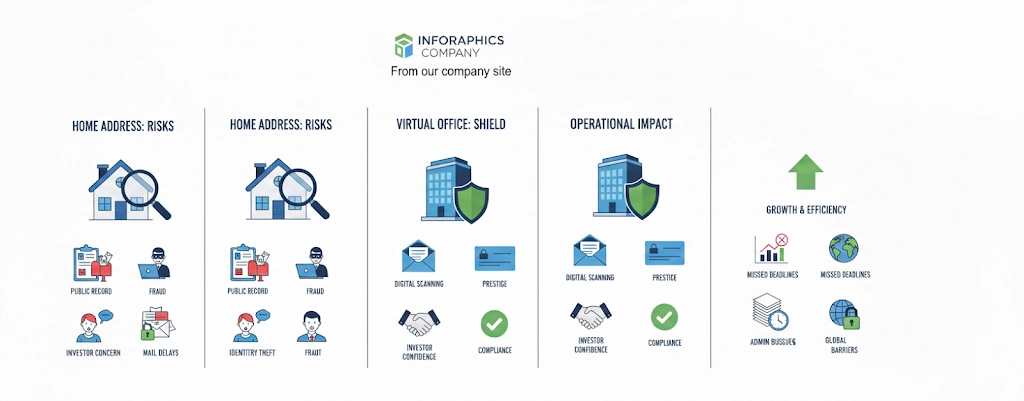
Home addresses link personal and professional spheres, amplifying risks. Burglars target visible business owners, while scammers exploit Companies House data for phishing 2025 saw a 25% rise in director-targeted fraud per Action Fraud reports. Mail theft from home letterboxes goes unnoticed amid daily post, unlike secure virtual office scanning.
Shareholders in multi-director setups face collective exposure; one vulnerable address compromises all. GDPR adds layers: personal data breaches at home lack audit trails, risking £17.5m fines. A Manchester e-commerce founder endured stalking after her address surfaced in PSC filings, highlighting emotional tolls. Business mail piles up during holidays, delaying critical Companies House confirmations. Professional services mitigate by providing anonymised service addresses, forwarding only vetted items. This step reveals how home use erodes the directorial shield essential for confident scaling.
Evaluating Professional and Operational Impacts
Perception matters: clients and partners view home addresses as nascent or unstable, contrasting with a City of London virtual office signalling established operations. Banks hesitate on lending, and suppliers demand extra checks for residential registrations. Operationally, juggling business post at home blurs boundaries, leading to missed PAYE deadlines or VAT returns.
Scaling compounds issues hiring staff requires compliant addresses for payroll, and international expansion demands credible fronts. Example: A software LTD grew 300% but stalled funding when investors flagged the director’s suburban address as “hobbyist.” Virtual alternatives integrate seamlessly, supporting compliance across business structures. This culminates in recognising home addresses as a short-term fix unfit for enduring enterprises.
Benefits and Potential Risks
Switching from home addresses unlocks privacy protection, with service addresses shielding directors from public scrutiny while meeting Companies House rules. Professionalism surges, enhancing trust for shareholder pitches and VAT applications firms report 40% higher response rates from polished addresses. Operational efficiency improves via mail scanning apps, real-time notifications, and global forwarding, ideal for nomadic entrepreneurs managing PAYE remotely.
Risks of persistence include data breaches costing £10k+ in remediation, reputational harm deterring partners, and legal penalties for non-compliant filings late confirmations incur £150 fines. A Leeds startup faced HMRC audits after lost tax mail, delaying refunds. Conversely, risks of change are minimal: setup costs £20/month, with seamless migration. Net benefits fortify business structures against vulnerabilities.
Legal and Compliance Considerations
UK law demands a registered office capable of receiving official documents during business hours, per Companies House guidelines residential addresses often fail if unattended. Directors must use a separate service address for public registers, protecting residential privacy since 2010 reforms. Non-compliance risks striking off, dissolving the company and voiding shareholder protections.
HMRC requires accurate addresses for VAT (£90k threshold) and PAYE correspondence; errors trigger penalties up to £3,000. GDPR compliance falters without segregated data handling. For LLPs or plcs, articles of association may prohibit home use, mandating commercial premises. Overseas directors benefit from UK virtual offices meeting sponsor licence criteria. Failure cascades: invalidated filings halt banking contracts. Proactive services ensure adherence, mirroring robust governance.
Common Mistakes to Avoid
Listing home addresses initially “to save costs” backfires with permanent public records changing later requires WebCHeck updates and fees. Ignoring mail volume leads to overload; HMRC bundles arrive unannounced, mixing with personal post. Assuming “no one checks” overlooks due diligence by banks and investors.
Neglecting service address declarations exposes PSCs unnecessarily. Case: A Birmingham director’s home details enabled fraudulent loans in his name. Overlooking forwarding setups causes missed deadlines, like annual returns. Failing to notify shareholders pre-change sows confusion. Checklists prevent these, preserving compliance integrity.
Practical Tips and Best Practices
Select virtual offices in prime postcodes (SW1, EC4) for prestige, verifying Companies House acceptance and 24/7 mail handling. Integrate apps for digital scans, auto-forwarding non-confidential items. Budget £15-50/month, scaling with volume.
Notify Companies House via Form AD01 promptly, updating directors’ service addresses. For VAT/PAYE, endorse the virtual address on returns. Test reliability: request sample forwards. Example: A London fintech used dual services one for registered office, one for trading/streamlining global ops. Annual audits refine setups. These practices professionalise operations akin to airtight shareholder agreements.

Ditching home addresses for business mail is non-negotiable for privacy, compliance, and growth in UK enterprises. This guide illuminates pitfalls and pathways to professional resilience.
If you’re ready to register your company with confidence, Form My Company provides fast, fully online company formation with expert compliance support, VAT & PAYE handling, virtual office solutions, and professional guidance. Get started today and let our specialists handle the paperwork while you focus on growing your business.
Frequently Asked Questions
Can I use my home as a registered office temporarily?
No, Companies House requires reliable receipt; unattended homes risk rejection. Switch to virtual immediately post-formation to avoid fines and exposure.
How does this affect VAT and PAYE compliance?
Virtual addresses ensure timely HMRC delivery; scans prevent losses. Update records to dodge penalties, supporting accurate filings for registered entities.
What if I’m a sole trader or LLP?
Sole traders avoid public registers but benefit professionally; LLPs mandate registered offices. Virtual services future-proof transitions to LTDs.
Are virtual offices accepted by banks?
Yes, majority comply, especially with mail handling proof. Prestigious addresses expedite account openings for new incorporations.
How to change address post-registration?
File Form AD01 online (£8-40), notify HMRC simultaneously. Services handle seamlessly, minimising downtime.