
To maintain an accurate PSC Register, your company must record, verify, and update details of anyone with significant control according to the latest Companies House regulations. This involves ongoing monitoring, timely filing of changes, and strict adherence to disclosure requirements to remain fully compliant.
Maintaining an accurate register of People with Significant Control (PSC) isn’t just good governance it’s a statutory duty for all UK companies. The PSC Register increases transparency around company ownership and control, helping prevent misuse of corporate entities for illicit activities. Yet, many businesses struggle to stay fully compliant once the initial register is set up.
This guide explains how to properly manage your PSC Register, what legal requirements you must meet, and how Form My Company can help you maintain continuous compliance through its professional PSC Register service.
Understanding the Purpose of the PSC Register
The PSC Register identifies individuals or entities that own or control more than 25% of shares or voting rights in a company, or who otherwise exercise significant influence or control.
The system was introduced under the Small Business, Enterprise and Employment Act 2015 and is a cornerstone of the UK’s approach to corporate transparency. Keeping an accurate PSC Register is therefore both a legal necessity and a demonstration of your company’s ethical commitment to openness and accountability.
When you maintain a precise and up-to-date register, it ensures your business avoids penalties and remains credible to stakeholders, investors, and regulatory authorities.
Legal Requirements for PSC Register Maintenance
Every company registered in the UK (except exempt publicly listed companies) must maintain a PSC Register. This includes limited companies, LLPs, and SEs. The law requires two main actions:
- Maintain the internal register, a company-held document listing all current People with Significant Control.
- File PSC information with Companies House, ensuring that public records reflect accurate and current details.
What Must the Register Include
Your PSC Register must accurately identify each PSC and include the following details:
- Full name and date of birth
- Service address and usual residential address
- Nationality and country of residence
- Date they became a PSC
- Nature of control (e.g., ownership percentage, voting rights, or other control forms)
It’s not sufficient to maintain a static list—companies must review and confirm these details regularly.
When to Update the Register
According to Companies House guidance, you must update your PSC Register as soon as any relevant change occurs. This may include:
- A person’s shareholding increasing above 25%
- Changes to control rights or voting power
- A PSC leaving, selling their shares, or transferring control
Any such change must be recorded internally within 14 days and reported to Companies House within another 14 days.
Timely updates are essential to remain compliant with the Companies Act 2006 and PSC regulations.
Common Compliance Challenges
Even diligent company directors can face obstacles when managing PSC records effectively. The most common issues include:
- Failure to verify PSC details properly before entry
- Delayed reporting when ownership changes occur
- Incomplete disclosure due to complex ownership structures
- Lack of awareness among directors about reporting deadlines
- Administrative errors such as missing forms or inconsistent data
These issues can trigger formal notices, fines, or even criminal sanctions for company officers. An inaccurate register may also create reputational damage, as it can be interpreted as a lack of corporate transparency.
For many small and growing businesses, outsourcing PSC Register management to a professional compliance service, like the PSC Register Service from Form My Company helps eliminate these pitfalls.
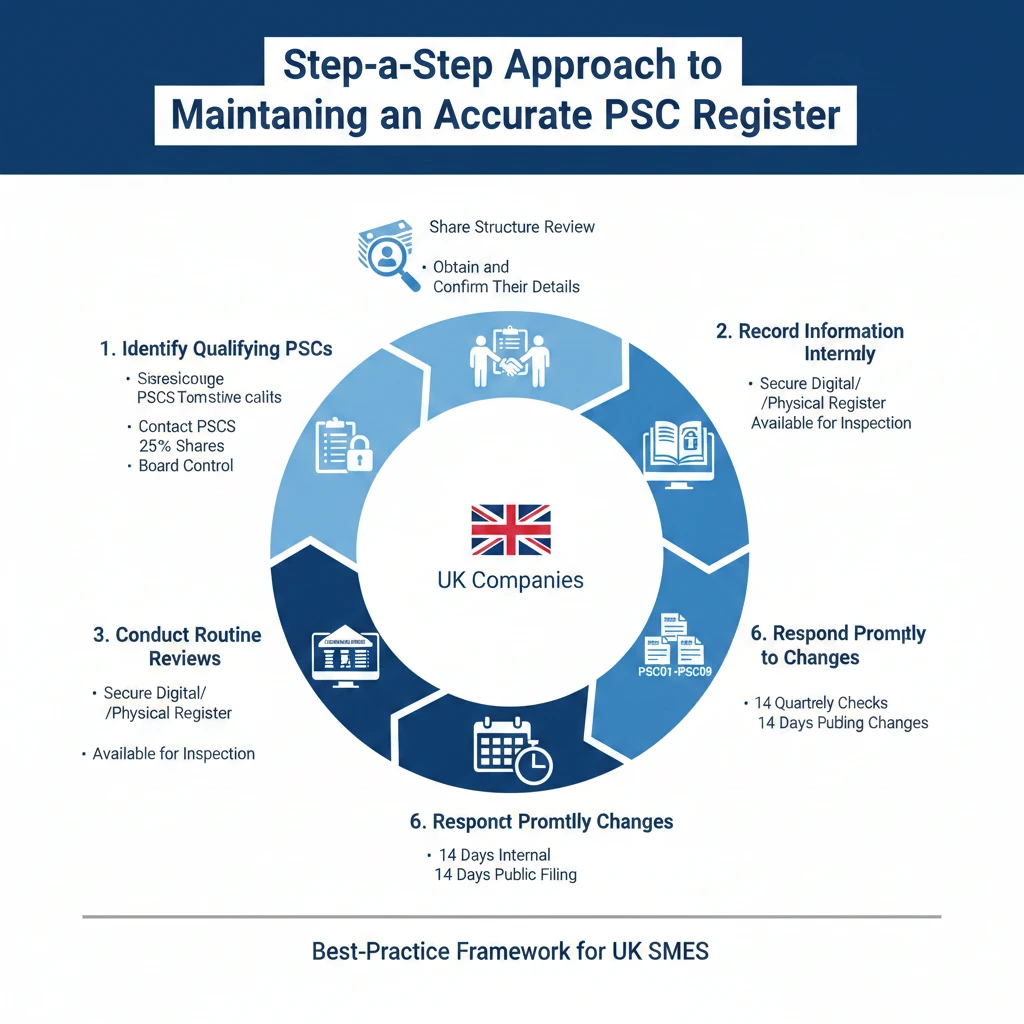
Step-by-Step Approach to Maintaining an Accurate PSC Register
Maintaining your PSC Register accurately involves a structured, proactive approach. Below is a best-practice framework suitable for most UK companies.
Identify Qualifying PSCs
Begin by reviewing your company’s share structure and governance documents. Identify anyone who meets one or more of the five PSC conditions, such as owning more than 25% of shares or having the right to appoint or remove a majority of the board.
Obtain and Confirm Their Details
Once identified, contact each PSC to confirm their particulars before recording them. It’s important to verify data accuracy at this stage rather than after submission to Companies House.
Record Information Internally
Keep your PSC Register in a secure but accessible format either digital or physical. Ensure it’s available for inspection at your registered office, as Companies House may request access.
File Information With Companies House
Report the information using the correct forms (PSC01–PSC09, depending on the circumstances). Ensure that your online or paper filings match exactly what is recorded in your internal register.
Conduct Routine Reviews
Set recurring internal reviews at least quarterly for most SMEs to check for changes in shareholdings, management control, or ownership transfers.
Respond Promptly to Changes
When updates occur, act within the statutory window of 14 days for internal amendments and a further 14 days to file those changes publicly.
Practical Example: Why Accuracy Matters
Consider a private limited company where two initial shareholders each hold 50% of the shares. A new investor later acquires 10%, reducing one founder’s shareholding to 40%.
If the company fails to update its PSC Register promptly, the public record will show an inaccurate ownership structure, potentially misleading stakeholders and breaching Companies Act compliance. Timely file updates maintain credibility and protect company officers from penalties.
Integrating PSC Data Into Company Compliance Systems
Integrating PSC Register oversight into your wider corporate governance systems improves accuracy and efficiency. Companies can align PSC updates with regular filings, annual confirmation statements, and board record reviews.
Modern compliance systems often embed automatic alerts when shareholding or voting power changes, prompting updates before deadlines lapse. Using a professional compliance management provider can further streamline this process.
Using Professional PSC Services for Assurance
Professional support ensures both accuracy and peace of mind. A dedicated PSC Register service handles verification, filing, and ongoing monitoring crucial for growing companies or those with multiple shareholders.
Form My Company provides this through its structured PSC Register service, which ensures every detail conforms to Companies House standards and legal mandates. Accuracy, timeliness, and confidentiality are central to their process, reducing compliance risk while freeing internal teams to focus on business growth.
Aligning With Broader Business Transparency Goals
Maintaining your PSC Register is part of demonstrating accountability. Transparent ownership structures improve investor confidence, attract responsible partners, and align your company with good governance principles expected in the modern business environment.
Accurate PSC records also support ethical initiatives such as anti-money-laundering (AML) compliance and ESG (Environmental, Social, and Governance) reporting frameworks.
For a deeper understanding of why these registers exist and their importance, you can review our informational article, What Is a PSC Register and Why Is It Legally Required? an essential resource for directors new to corporate governance obligations.
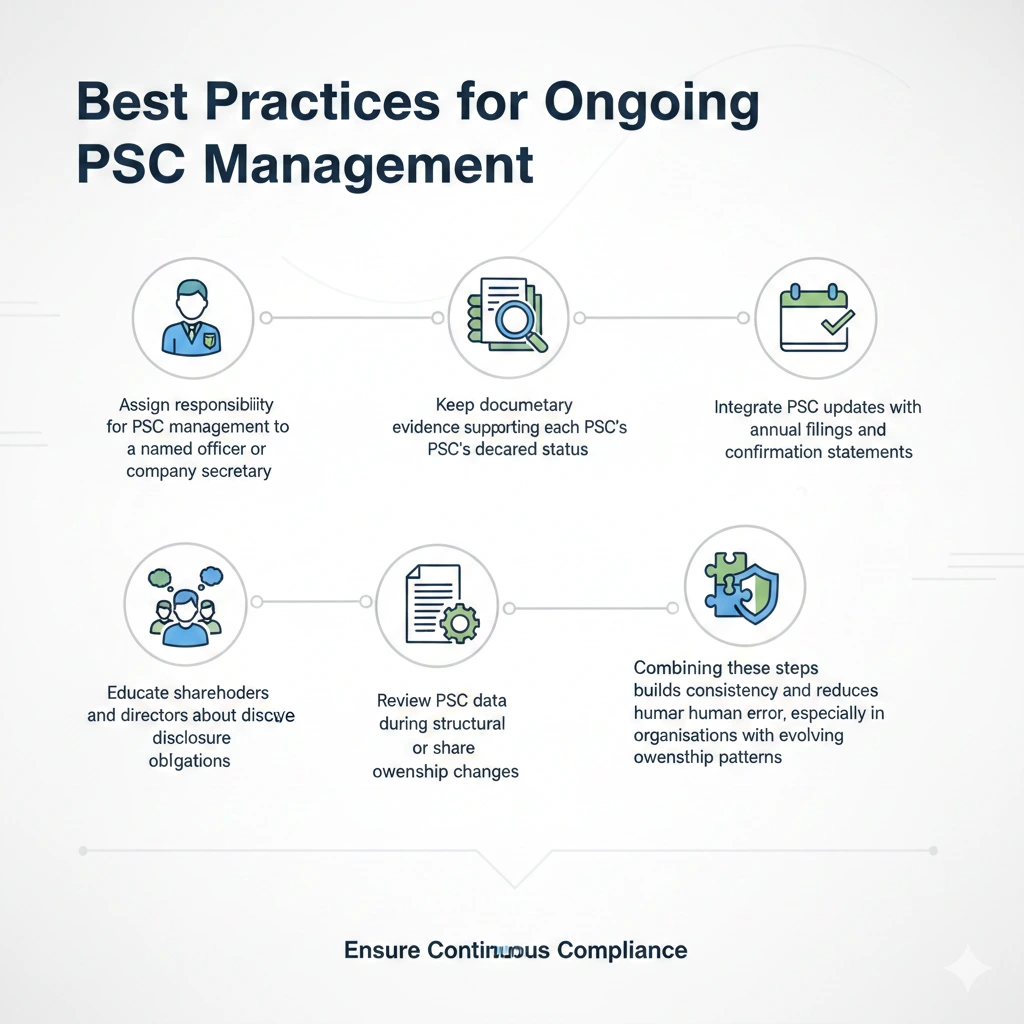
Best Practices for Ongoing PSC Management
To ensure continuous compliance, companies should:
- Assign responsibility for PSC management to a named officer or company secretary.
- Keep documentary evidence supporting each PSC’s declared status.
- Integrate PSC updates with annual filings and confirmation statements.
- Educate shareholders and directors about disclosure obligations.
- Review PSC data during structural or share ownership changes.
Combining these steps builds consistency and reduces human error, especially in organisations with evolving ownership patterns.
When to Seek Expert Help
You should consider professional assistance if:
- Your ownership structure involves trusts, overseas entities, or nominee shareholders.
- Multiple directors or departments handle compliance tasks inconsistently.
- You’ve received a notice or warning from Companies House about inaccurate filings.
Using a professional service like Form My Company ensures your PSC records remain compliant even as your corporate structure evolves. Their PSC Register experts manage ongoing maintenance and updates seamlessly, offering long-term operational confidence.
If you’re ready to ensure your company remains compliant year-round, explore how to get PSC Register Service for full company compliance today.
Keeping Your Company Transparent and Compliant
An accurate PSC Register demonstrates that your company operates transparently, ethically, and in accordance with UK law. Proper identification, verification, and maintenance of PSC data ensure you remain compliant with Companies House regulations while reinforcing your corporate credibility.
Form My Company provides professional assistance to help maintain your PSC Register, combining regulatory knowledge with reliable process management. This partnership ensures that your company meets its legal obligations consistently without unnecessary complexity or administrative burdens.
What is a PSC Register and why is it required?
A PSC Register, or People with Significant Control Register, is a legal record of individuals who own or control more than 25% of a UK company. It helps promote transparency and prevent misuse of corporate entities. Companies must maintain and update it under UK law.
How often should a PSC Register be updated?
A PSC Register must be updated whenever there’s a change in ownership, voting rights, or control typically within 14 days of any update. From My Company advises reviewing PSC details regularly to ensure continuous compliance with Companies House requirements.
What information must be included in a PSC Register?
The PSC Register must list each controller’s name, date of birth, nationality, service address, and nature of control. From My Company’s PSC Register experts ensure all mandatory fields meet legal and formatting standards for compliance.
What happens if a company fails to maintain an accurate PSC Register?
Failure to keep an accurate PSC Register is a criminal offence under the Companies Act 2006. Company officers may face fines or prosecution, and their registration at Companies House could be challenged. From My Company recommends continuous monitoring to prevent such risks.
Can From My Company help manage my PSC Register?
Yes. From My Company offers professional PSC Register support, handling verification, updates, and filings with Companies House. This ensures your company remains compliant, accurate, and transparent throughout the year.