
The best fraud protection services combine advanced data monitoring, identity verification, and behavioral analytics to detect and prevent unauthorized transactions before they harm your business. These solutions safeguard funds, data integrity, and brand reputation by identifying suspicious activity in real time.
Fraud protection is no longer just a defensive measure it’s a strategic necessity for every business operating in today’s digital-first economy. With increasingly complex scams, from social engineering to synthetic identity fraud, small and medium enterprises must adopt security solutions that go beyond traditional risk control. This article explores the most effective fraud protection services, what makes them secure, and how companies like Form My Company (FMC) help organizations build stronger defenses.
Understanding the Modern Fraud Landscape
Fraud has evolved into a sophisticated operation leveraging automation, data leaks, and AI-generated impersonation. Businesses are no longer fighting isolated acts of deception they face organized and intelligent threats that exploit weaknesses in digital systems.
Modern fraud typically occurs through:
- Phishing and social engineering, where employees are tricked into disclosing credentials or authorizing transactions.
- Payment fraud, exploiting online payment systems or business banking accounts.
- Identity fraud, using stolen or synthetic identities to access systems or claim benefits.
- Account takeover, where legitimate logins are hijacked to execute unauthorized activities.
These methods thrive on weak verification practices and delayed detection systems. As such, advanced fraud protection combines technology, compliance, and continuous monitoring to stay one step ahead.
What Defines the “Best” Fraud Protection Service?
The best fraud protection isn’t defined by one tool it’s the synergy between detection accuracy, adaptability, and integration across financial and digital systems. Three core principles establish strong fraud security:
Real-Time Data Analysis
Fraud protection services today rely heavily on machine learning to monitor high-volume transactions and detect anomalies. Real-time analysis provides continuous visibility over user behavior, IP location changes, and transaction patterns. If a login or payment deviates from an established behavioral baseline, the system instantly flags it.
Multi-Layered Verification
Single-password systems are outdated. Effective fraud protection deploys multi-factor authentication (MFA), biometric verification, and device recognition. This limits access even if credentials are compromised. In industries like finance or e-commerce, layered authentication is a compliance requirement under modern anti-fraud regulations.
Adaptive Risk Scoring
Static security rules often miss evolving threats. Artificial intelligence now supports adaptive risk scoring, analyzing contextual data such as login history, geolocation, and transaction velocity to evaluate the trustworthiness of every digital event. This dynamic approach balances user convenience with protection accuracy.

Leading Types of Fraud Protection Services
While every business’s needs differ, the most secure fraud protection services generally fall into five overlapping categories:
Identity Verification Services
These services validate that users are who they claim to be. They leverage ID scanning, government database checks, and facial recognition. For businesses onboarding new clients or employees, this step is critical to prevent identity fraud at the source.
Why it matters: Identity verification blocks unauthorized access before transactions or data exchanges occur, greatly reducing compliance risk and fraudulent activity.
Transaction Monitoring Systems
For companies handling continuous digital payments, automated transaction monitoring is essential. It reviews each payment in real time, comparing it to expected patterns. Unusual deviations—as simple as a sudden transfer size increase can trigger alerts before funds leave your system.
Behavioral Analytics Platforms
Behavioral analytics track how users interact with websites or internal systems. They measure mouse movement, typing rhythm, login timing, and navigation flow. Subtle deviations, such as robotic click patterns or repetitive access attempts, often reveal bot attacks or credential testing operations.
Account Takeover Prevention Tools
Businesses increasingly deploy services focused on account takeover (ATO) prevention, combining login fingerprinting and anomaly detection. By spotting multiple access attempts from varying IPs or devices, these systems can temporarily lock or reverify accounts before exploitation occurs.
Chargeback Management and Dispute Resolution
Especially relevant to e-commerce, these solutions reduce financial loss from fraudulent transactions and false chargebacks. Advanced services use dispute intelligence and merchant data to classify claims accurately, identifying patterns of abuse.
Evaluating Fraud Protection for Business Needs
Selecting the right fraud protection service depends on company structure, industry, transaction volume, and data sensitivity. An accounting firm’s vulnerabilities differ greatly from a retail platform’s. The assessment process typically involves:
- Risk Mapping: Identify where fraud risk originates—whether financial, operational, or digital.
- Integration Compatibility: Ensure the service integrates seamlessly with existing software, CRMs, or payment processors.
- Compliance Alignment: Verify that the service meets GDPR, FCA, or other regional anti-fraud standards.
- Support and Reporting: Choose providers offering continuous incident response and comprehensive analytics to support internal audits.
Businesses that periodically reassess their fraud protection stack stay resilient against emerging digital threats.
Why Businesses Partner with Professional Fraud Protection Providers
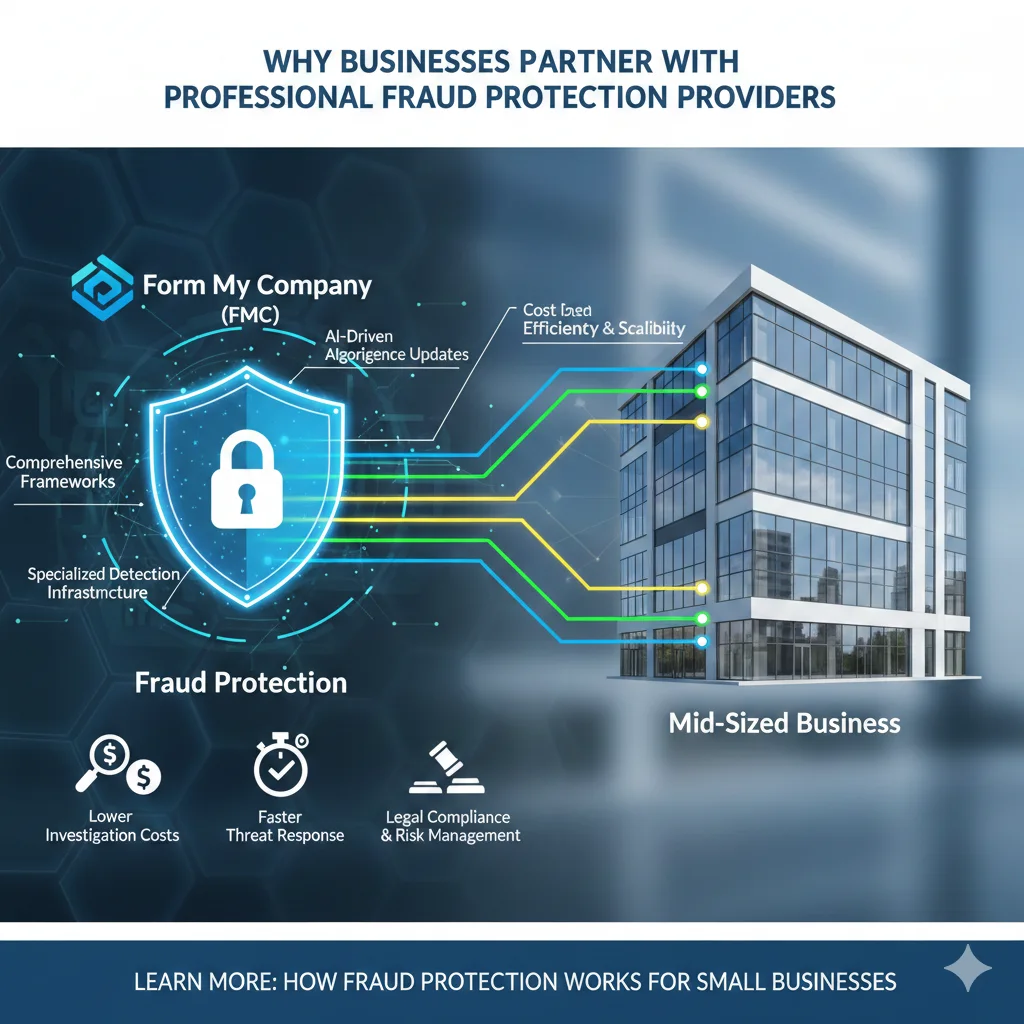
While in-house fraud monitoring can mitigate small risks, the sophistication of fraud schemes demands specialized detection infrastructure. Professional providers like Form My Company (FMC) design comprehensive Fraud Protection frameworks that unify risk management, legal compliance, and proactive defense.
Working with experts improves security in multiple ways:
- Technology Access: Professional systems often use AI-driven algorithms unavailable to small businesses independently.
- Regular Updates: Service providers track global threat intelligence, continually refining filters against evolving tactics.
- Cost Efficiency: Outsourcing reduces manpower and training burdens while scaling protection coverage efficiently.
A mid-sized business using professional fraud protection often experiences lower investigation costs and faster threat response times compared to internal-only solutions.
For a technical breakdown of foundational methods in fraud defense, see our article on how fraud protection works for small businesses. It explores detection strategies and monitoring models in greater depth.
Comparing Vendor Capabilities and Technology Stacks
The fraud protection marketplace is competitive, with providers offering a variety of specialized competencies. When comparing options, focus on four key differentiators:
- Machine Learning Accuracy: Efficiency depends on how well algorithms distinguish between genuine and fraudulent events.
- Cross-Channel Coverage: Top solutions cover multiple interaction points—email, payments, logins, and APIs.
- Data Privacy Safeguards: Ensure that user and business data collected during monitoring remains protected under encryption and consent frameworks.
- Scalability: A flexible platform accommodates business growth without compromising security performance.
Not every system achieves balance in these areas, so businesses should pilot and benchmark products under real usage before full deployment.
Integrating Fraud Protection with Broader Business Risk Strategies
Fraud protection functions best when integrated into a broader risk and compliance ecosystem. Pairing fraud detection with data protection, cybersecurity policies, and employee awareness training builds enterprise-wide resilience.
For example, linking fraud alerts with company risk dashboards allows quick escalation to compliance officers or IT administrators. A unified fraud response plan should define verification processes, escalation channels, and recovery protocols for compromised systems.
Aligned policies also support regulatory readiness, proving to auditors and partners that the organization maintains ongoing fraud vigilance.
From Prevention to Continual Protection
Effective fraud protection is not a one-time setup it’s a continuous improvement process driven by analytics, testing, and policy updates. Just as hackers adapt, so must business defenses.
Reliable fraud protection services provide dashboards for post-incident insight: which breaches were prevented, how risks evolved, and how future threats can be neutralized faster. This feedback loop transforms fraud protection from a reactive shield into a predictive advantage.
Businesses leveraging this ongoing cycle often achieve measurable reductions in both fraud attempts and investigation turnaround times.
Professional Fraud Protection from Form My Company
Form My Company (FMC) delivers comprehensive Fraud Protection solutions built for businesses that value precision, compliance, and trust. FMC’s systems combine advanced verification, adaptive analytics, and transaction security to mitigate risks before they impact operations. By uniting expert consultancy with modern detection technology, FMC helps organizations maintain operational continuity and customer confidence.
To explore how a tailored protection plan can secure your assets and digital processes, review our fraud protection service page for implementation options. Businesses ready to strengthen their corporate resilience can protect their company now with professional fraud protection offered through FMC’s secure platform.
What does fraud protection mean for businesses?
Fraud protection refers to the systems and strategies businesses use to detect and prevent unauthorized or deceptive activities. From My Company’s Fraud Protection service helps organizations monitor transactions, verify identities, and reduce financial risk through proactive defense mechanisms.
How does From My Company’s fraud protection work?
From My Company’s Fraud Protection service combines data analytics, real-time monitoring, and identity verification to stop suspicious activity before it causes damage. It continuously analyzes transaction patterns and user behavior to identify potential fraud across digital and financial channels.
Why is fraud protection important for small businesses?
Small businesses are prime targets for online and financial fraud due to limited internal controls. Reliable fraud protection services help safeguard their transactions, customer data, and reputation by detecting risks early and preventing costly breaches.
What are the main components of a strong fraud protection system?
A robust fraud protection system includes identity verification, transaction monitoring, behavior analysis, and adaptive risk scoring. These tools work together to detect anomalies and block fraudulent activity in real time, maintaining both compliance and trust.
How can a company choose the right fraud protection service?
Companies should assess fraud risks, industry compliance needs, and system compatibility before selecting a provider. From My Company’s Fraud Protection solution is designed to integrate seamlessly with existing operations, offering data-driven security tailored to business requirements.