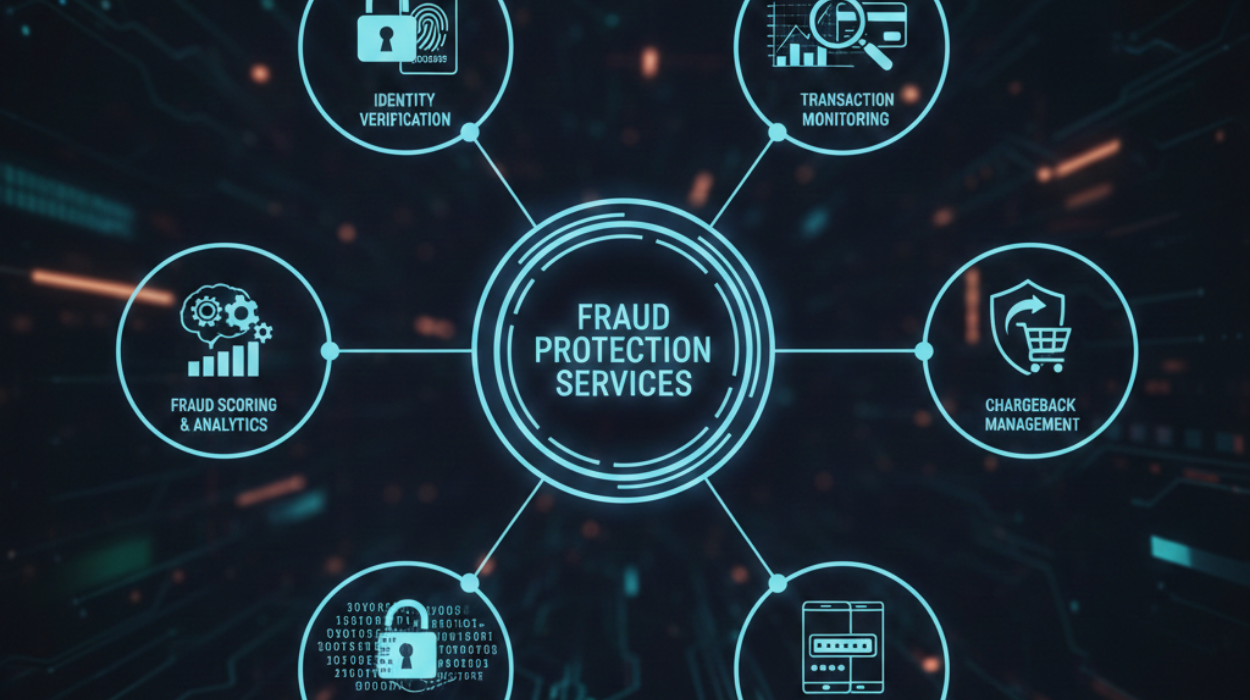
Fraud protection services help businesses identify suspicious company record changes, detect identity theft risks and respond to potential fraud before problems escalate. For UK businesses, the right service may include Companies House monitoring, email alerts, identity checks and guidance on responding to unauthorised filings. Form My Company provides a dedicated service focused on monitoring company records and notifying business owners when relevant changes occur.
Choosing between fraud protection companies requires a clear understanding of what each provider monitors, which alerts it sends, what support it offers and how much it costs. This guide explains the main types of fraud protection services, the features businesses should compare and how to select an option that suits their company’s needs.
What Fraud Protection Services Cover
Fraud protection services are designed to help businesses recognise and respond to activities that may threaten their company identity, official records or financial security. The exact protection offered depends on the provider and the service selected.
For UK limited companies, an important risk is company identity fraud involving unauthorised changes to public records. A suspicious director appointment, an unexpected registered office address change or an unfamiliar filing can indicate that someone is attempting to misuse a company’s identity.
A dedicated monitoring service can notify the company when selected changes appear on its Companies House record. Directors can then investigate the activity and contact the relevant authorities if they believe a filing is fraudulent.
Fraud protection for businesses can also refer to wider controls covering payments, customer accounts, employee access, cybersecurity and supplier verification. These services address different risks, so businesses should confirm whether a provider offers company record monitoring, financial transaction monitoring or broader fraud prevention tools.
Why Businesses Need Fraud Protection
Company fraud can affect businesses of different sizes and sectors. A small company may have limited resources to investigate suspicious activity, while a larger organisation may need to monitor several entities, directors and reporting processes.
Common risks include:
Company identity theft: Someone misuses a company’s name or official information.
Unauthorised Companies House filings: Unexpected changes appear on a company’s public record.
Director or ownership changes: An unfamiliar appointment, resignation or update requires investigation.
Registered office address changes: An unexpected change may affect where official correspondence is received.
Impersonation and false instructions: Criminals pose as directors, suppliers or professional advisers.
Payment and invoice fraud: A business receives misleading payment instructions or fraudulent invoices.
Account compromise: Unauthorised individuals gain access to business accounts or sensitive information.
Not every unusual change means fraud has occurred. However, timely alerts and a defined response process help directors check activity before an issue goes unnoticed for an extended period.
Businesses looking for a general explanation of the concept can read what fraud protection is and why businesses need it. This article focuses on comparing services and providers rather than repeating a general definition.
Types of Fraud Protection Services
Fraud protection is not one universal product. Different providers focus on different threats, and the most suitable option depends on the information and activities a business needs to monitor.
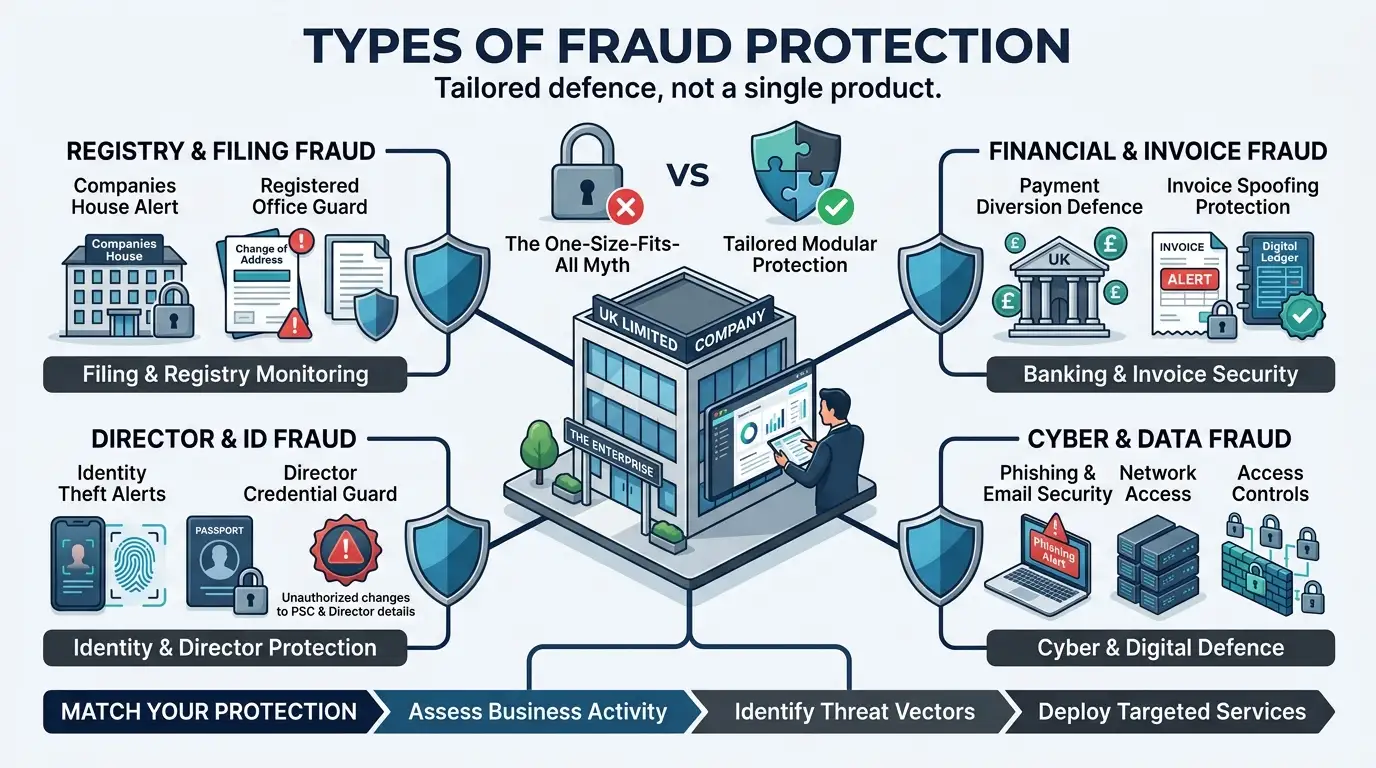
1. Companies House Monitoring and Alerts
Companies House monitoring is particularly relevant to UK companies that want visibility over changes to their official public records.
A monitoring service can send notifications when relevant filings or changes are recorded against a company. Depending on the service, these may include:
Director appointments and resignations.
Changes to director information.
Registered office address updates.
Changes to people with significant control.
Other monitored updates to the company record.
Email alerts help directors identify changes they do not recognise. The director or an authorised representative can then compare the alert with internal records and confirm whether the filing was expected.
When comparing fraud protection companies, ask which company record changes are monitored, how alerts are delivered and what information each notification contains. Also check whether the provider monitors activity continuously or at scheduled intervals.
Form My Company’s Fraud Protection service focuses on monitoring Companies House records and sending alerts about relevant changes. It is designed to help company owners identify unexpected activity and respond promptly.
2. Identity Verification and Identity Theft Monitoring
Identity verification checks whether a person or business is who they claim to be. Identity theft monitoring focuses on identifying possible misuse of personal or corporate information.
Depending on the provider, identity-related services may include document checks, verification of director details, business identity checks and alerts about suspicious use of company information.
These controls can support onboarding processes and help businesses confirm that people requesting access or authorising important changes are legitimate.
When evaluating an identity verification service, consider:
Which individuals or business details are checked.
What evidence the provider requires.
Whether checks are completed during onboarding or throughout the relationship.
How failed or inconclusive checks are handled.
How personal and business information is protected.
Identity checks and company record monitoring serve different purposes. Verification helps establish identity, while monitoring helps identify relevant changes or activity after the initial checks. Businesses should not assume that one automatically replaces the other.
3. Fraud Alerts and Unusual Activity Notifications
Fraud alerts notify a business when monitored activity meets a provider’s defined criteria. These alerts may relate to company record changes, unusual transactions, suspicious login attempts or other activity, depending on the system.
For company record monitoring, alerts are valuable because directors do not need to rely entirely on manual checks of the public register. Notifications provide a prompt to investigate activity that may otherwise be overlooked.
Before choosing a provider, establish:
Which events trigger an alert.
Whether alerts arrive by email, text message or through a dashboard.
How quickly notifications are sent after a monitored event is detected.
Whether more than one contact can receive notifications.
What steps the business should take when an alert appears.
A useful alert should explain what changed and provide enough information for the recipient to investigate. Businesses should also maintain a clear escalation process so that suspicious activity is reviewed by someone with authority to respond.
An alert is an early warning, not proof that fraud has taken place. It also does not necessarily prevent a filing or transaction from being processed. Businesses need to review notifications and take appropriate action.
4. Payment and Transaction Monitoring
Payment monitoring services analyse financial activity to identify transactions that may be suspicious. They are most relevant to businesses that process online payments, handle frequent transfers or face risks involving unauthorised purchases and payment instructions.
Depending on the platform, transaction monitoring may examine:
Unusual transaction values or frequency.
Changes in customer payment behaviour.
Repeated failed payment attempts.
Inconsistencies in transaction details.
Potentially suspicious payment patterns.
Some platforms use automated rules and statistical models to identify activity that needs further review. A payment provider may also offer controls such as additional authentication or transaction holds.
These tools differ from Companies House monitoring. A service that alerts directors to changes in company records should not be assumed to monitor bank transfers, customer payments or card transactions. Businesses requiring both types of protection should check whether separate services are necessary.
5. Cybersecurity and Account Protection
Cybersecurity services protect the systems and information businesses use to operate. Depending on the provider, these services may include access controls, endpoint protection, network monitoring, secure backups and detection of suspicious account activity.
Such controls can help reduce the risk of unauthorised access to business email, accounting platforms, customer databases and other important systems.
For example, criminals who gain access to a business email account may attempt to impersonate a director or supplier and request a change to payment details. Strong access controls, staff awareness and verification procedures can make these attempts harder to carry out successfully.
Cybersecurity tools should be selected according to the company’s systems, data sensitivity and operational risks. They are complementary to company record monitoring, not a substitute for it.
6. Regulatory and Compliance Support
Some fraud protection providers offer services that support identity checks, record accuracy and compliance procedures. Other providers focus only on monitoring and alerts.
Businesses should identify which responsibilities remain with the company and which activities the provider actually performs. A commercial monitoring service does not automatically make a business compliant with every legal or regulatory obligation.
For UK companies, it is important to maintain accurate statutory information, protect access to filing credentials and follow the relevant Companies House requirements. Businesses handling personal information must also consider applicable data protection obligations.
Ask providers to explain the scope of their service in writing. This helps avoid assuming that a monitoring subscription includes legal advice, regulatory representation, transaction screening or remediation support when those services may be separate.
How to Choose Between Fraud Protection Companies
The best provider is the one whose monitoring scope, alert process, support and pricing match the risks facing your business. A service designed for Companies House records may be appropriate for a director concerned about unauthorised company changes, while a high-volume online retailer may also need dedicated payment fraud tools.
Use the following criteria to compare available providers.
Check the Monitoring Coverage
Start by identifying the records and activity you need to monitor. If your primary concern is company identity theft, check whether the service tracks director changes, registered office updates and changes to people with significant control.
If you also need payment screening, customer identity verification or cybersecurity monitoring, confirm whether these are included or require separate products.
Understand the Alert Process
Review how alerts are generated and delivered. Find out what triggers a notification, who receives it and how the business can investigate a change.
For Companies House monitoring, ask whether alerts relate to changes recorded on the public register or whether the service also offers a separate prevention mechanism. These are different functions and should not be confused.
Review Support and Response Guidance
Monitoring is most useful when the business knows what to do after receiving an alert. Check whether the provider explains how to verify a change, report suspected fraud and contact the appropriate authority.
Clarify whether support is included in the price or charged separately. Do not assume that receiving an alert means the provider will automatically dispute a filing or resolve a fraud incident on your behalf.
Consider Security and Data Handling
Ask how the provider collects, stores and protects the information required to deliver the service. Review its privacy information and determine which staff or third parties can access your data.
If the service requires company identifiers, director information or contact details, confirm that the information is handled for clearly explained purposes and in line with applicable data protection requirements.
Compare the Total Cost
Compare the full cost rather than looking at the headline price alone. A low subscription may cover only basic notifications, while additional checks, support or other services may cost extra.
Check the billing period, renewal terms, any setup charge and whether statutory fees apply separately. The right choice should provide relevant protection without paying for features the business does not need.
Businesses comparing different providers can also review our guide to evaluating fraud protection tools for new UK startups, which explains how new businesses can assess available tools and choose options suited to their needs.
Fraud Protection Costs: What Should Businesses Expect?
The cost of fraud protection services varies according to the type of monitoring, number of companies covered, service scope and level of support.
For example, a company record monitoring service is different from a platform that screens customer payments or provides a complete cybersecurity package. Their features and pricing should not be compared as if they were identical products.
When reviewing a quote, check the following:
| Cost factor | What to confirm |
|---|---|
| Subscription | Whether the service is billed monthly or annually |
| Setup | Whether activation or onboarding carries an additional charge |
| Monitoring scope | Which company records or activities are covered |
| Alerts | Whether notifications are included in the standard price |
| Support | Whether help with investigating or reporting suspicious activity costs extra |
| Additional services | Whether identity checks, filing assistance or other protections are separate |
| Renewal | When the service renews and how cancellation works |
Form My Company’s service page displays a fraud protection company formation package at £19.99 per year and refers separately to the standard Companies House fee. Confirm the current price, eligibility and full checkout total directly with the provider before purchasing, as fees and package arrangements can change.
A business should select a service based on the risks it needs to address and the features actually supplied, rather than assuming that the most expensive option offers the most relevant protection.
What Is Included in a Business Fraud Protection Service?
Before subscribing, request a clear description of the service. For a Companies House monitoring solution, useful details include the following.
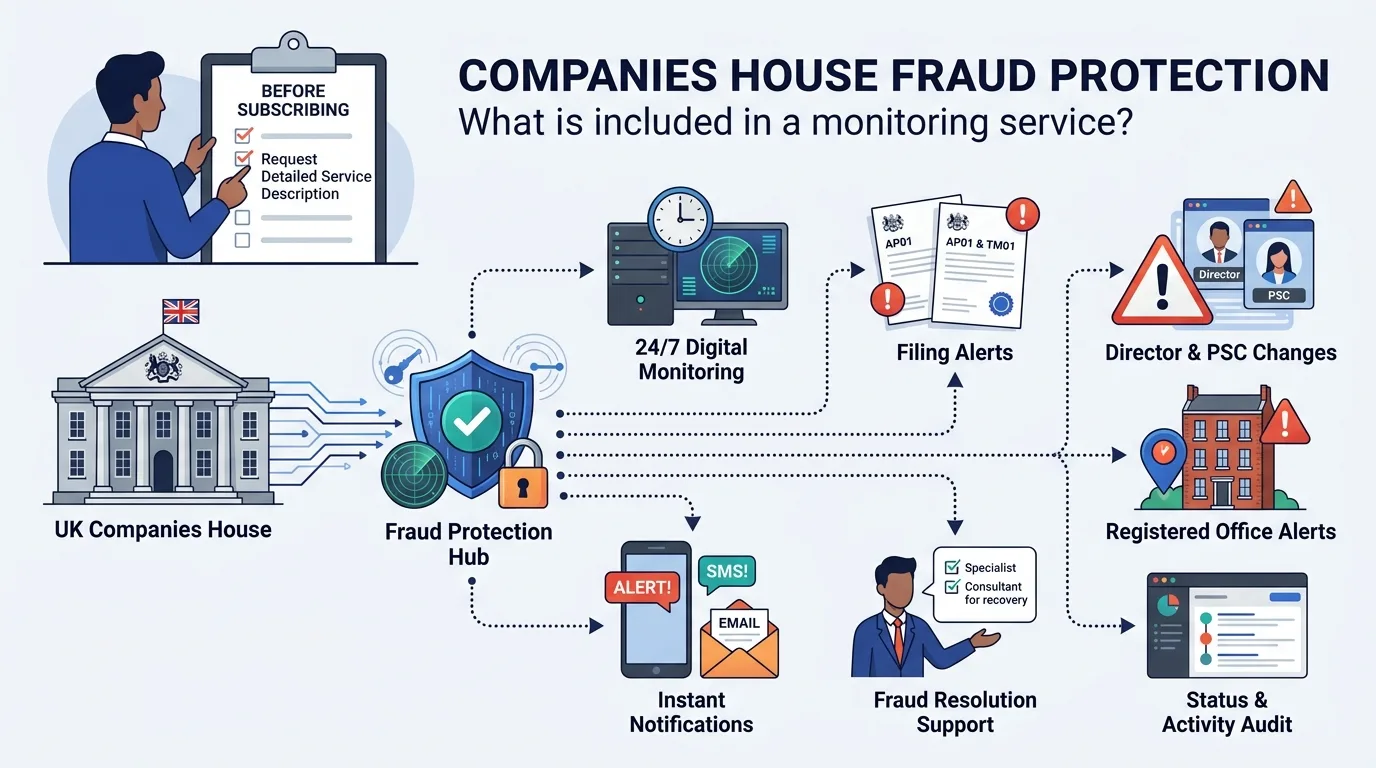
Company record monitoring: Confirmation of which public record changes are monitored.
Email notifications: Details of how alerts are sent and which contacts can receive them.
Coverage of director and address changes: Confirmation of whether director appointments, resignations and registered office updates are included.
Monitoring of ownership information: Confirmation of whether changes to people with significant control are covered.
Instructions for suspicious activity: Guidance on how to verify an alert and report a change that appears unauthorised.
Transparent pricing: A breakdown of the subscription, any applicable statutory fees and any additional charges.
These points help businesses compare providers on a like-for-like basis. If a feature is important, confirm it in the service terms rather than relying on a general description of fraud protection.
Why Consider Form My Company for Fraud Protection?
Form My Company provides a fraud protection service for businesses seeking greater visibility over changes to their Companies House records.
The service focuses on monitoring relevant company record updates and notifying business owners about changes that may require investigation. This is useful for directors who want an additional source of information rather than relying solely on occasional manual checks.
The service may be relevant to:
Directors who manage one or more UK limited companies.
Business owners who want notifications about changes to their official company records.
Companies that delegate filings to accountants or other advisers but want independent visibility.
Owners of dormant companies who want to keep track of changes to their public records.
Businesses concerned about possible unauthorised director, address or ownership updates.
The exact features, eligibility and current charges should be checked on the Form My Company Fraud Protection service page.
Fraud protection is an additional safeguard, not a guarantee that every fraudulent attempt will be prevented or detected. Businesses should continue to protect filing credentials, maintain accurate records and investigate unexpected notifications promptly.
How to Get Started With Fraud Protection for Businesses
Choosing and activating a service is easier when the business identifies its main risks before comparing providers.
Step 1: Identify the Main Risk
Decide whether your priority is Companies House record changes, customer identity verification, payment fraud, cybersecurity or a combination of these areas.
Step 2: Compare Relevant Services
Review the features offered by each provider. Focus on the coverage and response process rather than relying on broad marketing claims.
Step 3: Check the Terms and Pricing
Confirm the service period, monitoring scope, alert delivery, renewal conditions and additional charges before subscribing.
Step 4: Set Up the Right Contacts
Ensure alerts go to an appropriate company contact who can review unexpected activity. Use an email address that is checked regularly and maintain a backup contact where the service permits it.
Step 5: Create an Internal Response Process
Decide who will review notifications, how legitimate changes will be confirmed and how suspected fraud will be escalated. Keep records of the investigation and any reports made to the relevant authorities.
Step 6: Review the Protection Regularly
Reassess your requirements when the company adds directors, changes its structure or introduces new financial and digital systems. The service that suits a newly incorporated company may not cover every risk as the business grows.
Frequently Asked Questions About Fraud Protection Services
What are fraud protection services?
Fraud protection services are products or professional services that help businesses identify, monitor and respond to suspected fraudulent activity. Depending on the provider, they may include Companies House monitoring, identity checks, suspicious activity alerts, payment screening or cybersecurity controls.
What should I look for in fraud protection companies?
Compare the provider’s monitoring coverage, alert delivery, support process, data handling, service terms and total cost. For UK company record protection, check whether the service monitors relevant Companies House changes and explains how to respond to an unexpected filing.
What is the difference between business fraud protection and cybersecurity?
Business fraud protection is a broad term covering measures that help detect and respond to fraudulent activity. Cybersecurity focuses on protecting systems, networks, accounts and information from digital threats. The two overlap, but a Companies House monitoring service does not automatically provide cybersecurity or payment screening.
How much do fraud protection services cost?
Prices depend on the service type, monitoring coverage, billing period and support included. Some services charge a recurring subscription, while others have setup fees or separate charges. Check the provider’s current terms and total cost before purchasing.
Can a fraud protection service prevent Companies House fraud?
A monitoring service can help identify unexpected company record changes by sending alerts, giving directors an opportunity to investigate and report suspected fraud. However, an alert service does not necessarily block a filing, and no service should be treated as a guarantee that fraud cannot occur.
Is fraud protection for businesses a legal requirement?
A commercial fraud protection subscription is not a universal legal requirement for every UK company. However, businesses must still meet their applicable legal obligations, maintain accurate records and follow relevant requirements for identity verification and data protection. The duties that apply depend on the company and its activities.
Who should use a fraud protection service?
A fraud protection service may benefit directors, company owners and organisations that want better visibility over changes to their official records. Businesses handling substantial online payments or sensitive customer information may also need specialist transaction monitoring or cybersecurity solutions.
Protect Your Company Records With Form My Company
Unexpected changes to company records can be difficult to identify if nobody is checking the public register regularly. Fraud protection services give businesses an additional way to monitor relevant activity and investigate changes that do not match their instructions.
Form My Company offers a dedicated service focused on Companies House monitoring and notifications about relevant company record changes. Review the service details, confirm the current price and check that its coverage matches your requirements.