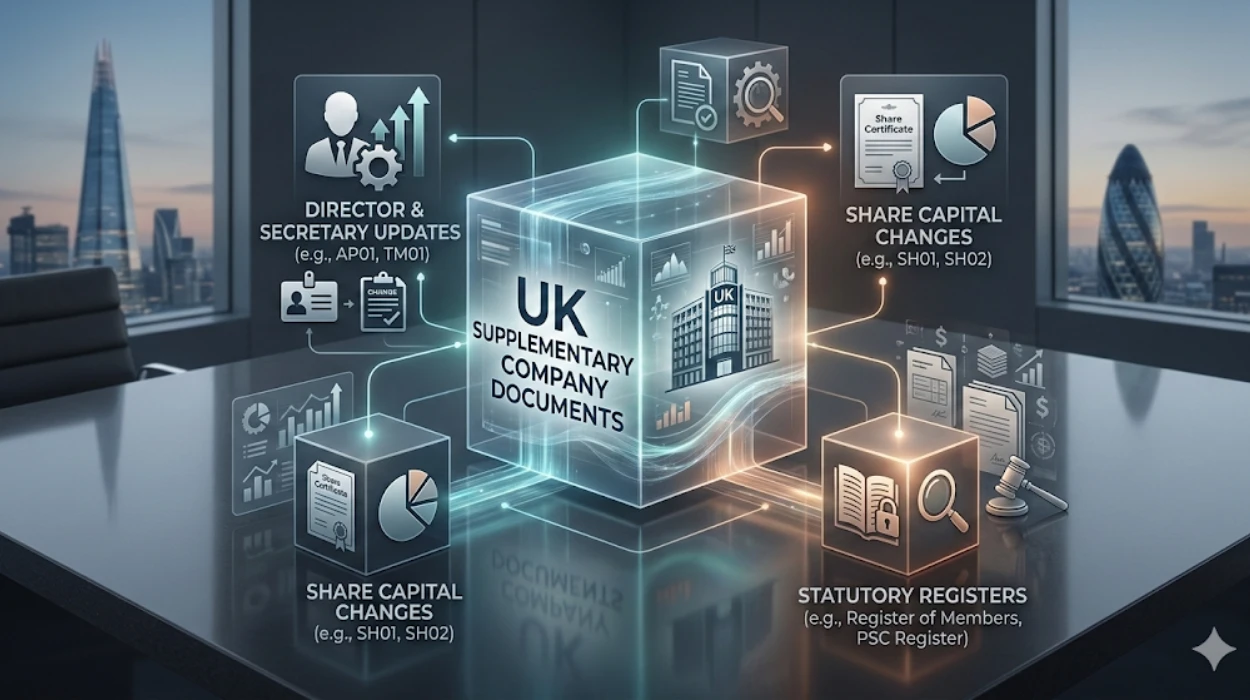
Supplementary company documents in the UK are additional filings and records that companies submit to Companies House beyond core incorporation papers like the Memorandum and Articles of Association. These documents support ongoing compliance, ownership changes, and operational updates for limited companies.
Why Supplementary Documents Matter
Companies House requires these supplementary filings to maintain accurate public records of UK businesses. They ensure transparency for stakeholders, regulators, and the public by capturing key events post-incorporation, such as director appointments or share allotments. Without them, businesses risk penalties, striking off, or legal challenges in proving their status.
For instance, a growing startup might need to file supplementary documents to reflect new investors or address changes, keeping its profile current. Form My Company specializes in streamlining this process through its Supplementary Company Documents service, helping entrepreneurs avoid administrative hurdles.
Core Types of Supplementary Documents
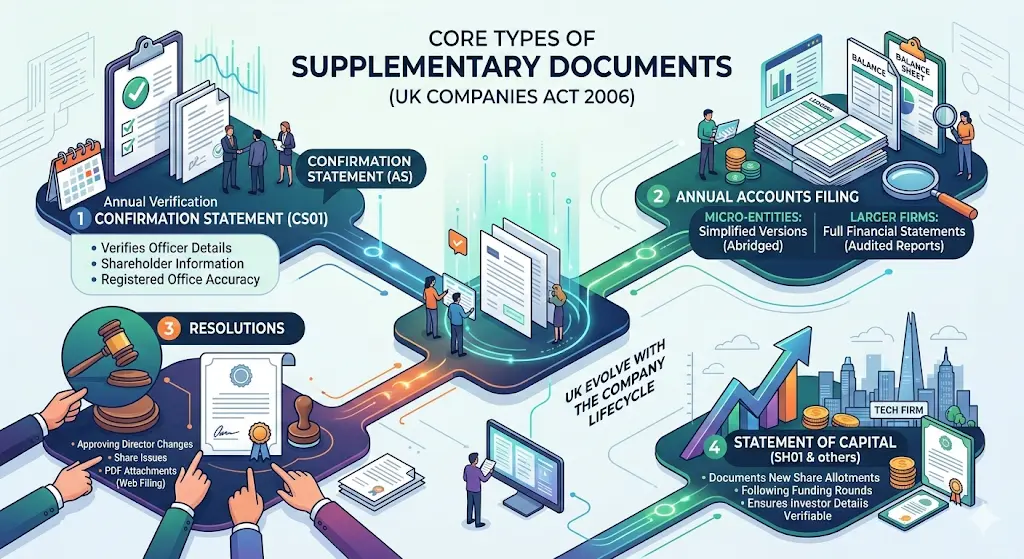
UK law under the Companies Act 2006 mandates various supplementary documents based on business activities. Common examples include Confirmation Statements, which annually verify officer details, shareholder information, and registered office accuracy.
Another key type is the annual accounts filing, where companies submit abridged or full financial statements depending on size micro-entities file simplified versions, while larger firms provide audited reports. Resolutions, such as those approving director changes or share issues, also qualify as supplementary, often filed as PDF attachments via Web Filing.
These documents differ from incorporation essentials; they evolve with the company lifecycle. A tech firm in London, for example, might file a Statement of Capital to document new share allotments after a funding round, ensuring investor details are publicly verifiable.
Ownership and Share-Related Filings
Share allotments and transfers form a significant category of supplementary documents. When a private limited company (Ltd) issues new shares, it must file Form SH01 within one month, detailing the allottee, number of shares, and amount paid.
This transparency prevents disputes and supports due diligence for mergers. Similarly, Form SH08 notifies changes in share capital structure, like rights attached to classes of shares. For a Cambridgeshire-based e-commerce business expanding, properly filing these maintains compliance amid rapid growth.
Compliance Filings for Officers and Addresses
Director and secretary appointments or resignations require prompt supplementary submissions. Form AP01 records new director details, including service address and occupation, while RP02 handles removals. These filings protect personal data by allowing a service address separate from home.
Changes to the registered office address demand Form AD01, crucial for firms relocating within the UK. A company moving from Cambridge to Huntingdon must file this to update public records, avoiding mail disruptions or fines up to £5,000.
Person with Significant Control (PSC) notifications, like Form PSC01 for new PSCs, identify ultimate beneficial owners holding over 25% shares or voting rights. Non-compliance here triggers Companies House enforcement, underscoring the need for vigilance.
When to File Supplementary Documents
Timing is critical; most supplementary filings have strict deadlines from the triggering event. Confirmation Statements, due annually within 14 days of the review period end, consolidate multiple updates into one filing.
For urgent matters like director deaths or insolvency, forms like TM01 (termination of appointment) must precede within two weeks. Late filings incur fees starting at £150, escalating with delays, and repeated issues can lead to compulsory strike-off.
Consider a scenario where a UK manufacturing firm appoints a new CFO mid-year; filing AP01 promptly ensures seamless board operations and audit trails. To learn more about the step-by-step process, check out
How to Request Supplementary Company Documents in the UK.
Legal Framework Governing These Documents
The Companies Act 2006, enforced by Companies House, outlines supplementary requirements in Sections 854-859 for accounts and Sections 167-169 for officers. Regulations like The Companies (Filing of Accounts and Reports) Regulations 2015 specify formats, such as iXBRL for digital tagging.
Brexit has influenced filings indirectly, with no major shifts for domestic companies but added scrutiny on overseas entities via the Register of Overseas Entities. Companies House digital reforms, including the AUTH system planned for 2026, aim to enhance authentication for supplementary submissions.
Penalties for inaccuracies include fines up to £1,500 per offence, plus director disqualification. Accurate, timely filings thus safeguard reputations and operations.
Penalties and Enforcement
Companies House issues reminders before escalating to penalties. For example, overdue Confirmation Statements trigger £150 late fees, with public notices following. Persistent non-filers face dissolution, halting trading.
In a case study style review, a Midlands retailer overlooked PSC updates, facing £30,000 in fines before rectifying via Form My Company’s expertise. Proactive management prevents such outcomes.

Role of Supplementary Documents in Business Growth
These filings enable scalability by evidencing compliance for loans, partnerships, or investments. Banks often demand recent Confirmation Statements during due diligence.
For international expansion, supplementary documents like LLP agreements or overseas company registrations support UK presence. A biotech firm in Cambridge might file share allotments to attract venture capital, publicly validating its cap table.
Form My Company’s Supplementary Company Documents service simplifies obtaining certified copies or filing new ones, ensuring businesses focus on core activities.
Digital Filing and Tools for Efficiency
Companies House WebFiling portal handles most supplementary documents free or low-cost. Larger firms use Software Filing Agents for bulk submissions, integrating with accounting platforms like Xero or QuickBooks.
Digital authentication via Government Gateway evolves with upcoming digital identity checks. Tips for efficiency include batching non-urgent filings and using protected service addresses for privacy.
A service business scaling from sole trader to Ltd filed multiple supplements seamlessly, crediting automated tools. For decision-ready support, see Get Supplementary Company Documents for Your UK Company.
Common Misconceptions Addressed
Many assume supplementary documents are optional for small firms; however, all active companies must comply. Another myth: sole directors skip PSC filings they must self-notify if controlling.
Dormant companies file simplified confirmations, but reactivation demands full supplements. Understanding these nuances prevents costly errors.
Streamlining with Professional Help
Navigating supplementary filings solo suits simple cases, but complexity arises with multi-shareholder structures or frequent changes. Form My Company provides authoritative handling of Supplementary Company Documents, leveraging expertise for accuracy and speed.
In a practical example, a property development company managed rapid director changes via professional filing, avoiding disruptions. Their service ensures compliance without the administrative burden.
What are supplementary company documents in the UK?
Supplementary company documents in the UK are additional filings submitted to Companies House after incorporation, such as Confirmation Statements, director appointment forms (AP01), and share allotment records (SH01). These ensure ongoing compliance and transparency for limited companies under the Companies Act 2006. From My Company offers a Supplementary Company Documents service to help businesses manage these essential updates accurately.
Why do UK companies need supplementary documents?
UK companies require supplementary documents to report changes like officer appointments, share issues, or address updates, maintaining accurate public records at Companies House. Failure to file can result in fines up to £1,500 or strike-off risks. From My Company’s Supplementary Company Documents service streamlines compliance for growing businesses.
How long do I have to file supplementary company documents?
Most supplementary company documents must be filed within one month of the triggering event, such as director changes via AP01 or share allotments via SH01, while Confirmation Statements are due annually within 14 days. Late filings incur fees starting at £150, escalating with delays. From My Company assists with timely Supplementary Company Documents submissions to avoid penalties.
What is included in a Confirmation Statement as a supplementary document?
A Confirmation Statement, a key supplementary company document, confirms details like directors, shareholders, PSC registers, and registered office address during its annual review period. It consolidates updates into one filing for efficiency. From My Company’s Supplementary Company Documents service ensures accurate preparation and submission.
Can From My Company help obtain copies of supplementary documents?
Yes, From My Company’s Supplementary Company Documents service provides certified copies of filings like accounts or resolutions directly from Companies House. This supports due diligence, loans, or audits quickly via WebCHeck or official requests. The process typically takes 24-48 hours for standard access.