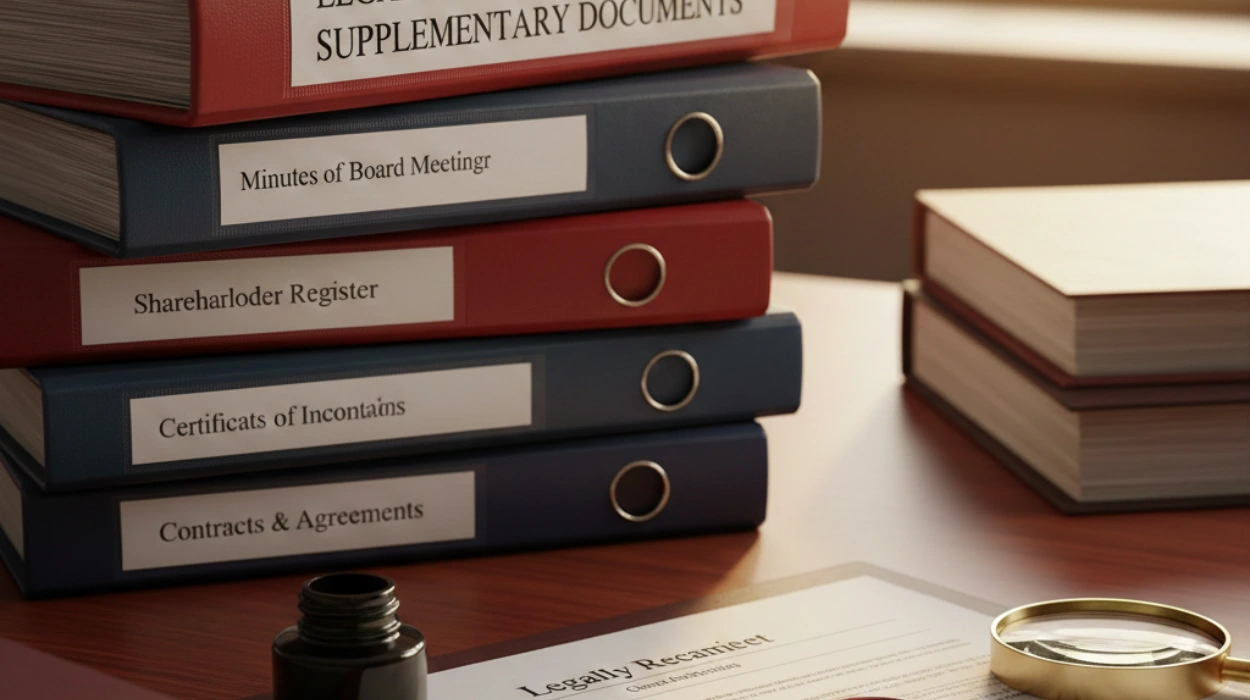
Limited companies in the UK are legally required to maintain several supplementary company documents, including statutory registers, company resolutions, and shareholder agreements. These documents ensure compliance with the Companies Act 2006 and demonstrate transparency and accountability in corporate governance.
Supplementary company documents form the backbone of a company’s legal, administrative, and operational structure. From incorporation through daily management, each record plays a distinct role in upholding corporate integrity and regulatory compliance. Understanding which documents are mandatory, how they are maintained, and why they matter not only protects your business from legal risk but also reinforces credibility with clients, investors, and stakeholders.
Understanding Supplementary Company Documents
In UK corporate governance, “supplementary company documents” refer to the additional records a company must maintain alongside its core incorporation paperwork. While the certificate of incorporation and memorandum of association establish a company’s existence, supplementary documents track its ongoing governance and structural activities.
Examples include statutory registers, company resolutions, shareholder agreements, and director records. Each document type provides evidence of how a company is managed and how decisions are made, ensuring compliance with the Companies Act 2006 and related regulations.
Legally Required Supplementary Documents
Statutory Registers
Statutory registers are among the most critical records every limited company must maintain. They include detailed information about:
- Directors and company secretaries
- Shareholders and share allotments
- Charges over company assets (if applicable)
- People with Significant Control (PSC)
These registers must be updated regularly and kept at the company’s registered office or an approved inspection location. They serve as official proof of ownership and governance structure, accessible to regulatory authorities and sometimes the public upon request.
Company Meeting Minutes and Resolutions
Company resolutions document the formal decisions made by directors or shareholders. Board meeting minutes provide a record of discussions, decisions, and approvals during governance meetings.
Maintaining accurate minutes and resolutions is essential for demonstrating compliance with decision-making protocols. Under the Companies Act 2006, these records must be preserved for at least ten years. Examples include the appointment of directors, approval of dividends, and the issuance or transfer of shares.
Shareholder Agreements
Although not always mandatory by statute, shareholder agreements are legally significant supplementary documents that define the rights, responsibilities, and expectations of shareholders. They complement the company’s Articles of Association and help prevent disputes over control, profit distribution, and company strategy.
Articles of Association (Amended Copies)
While every company has Articles of Association upon registration, amended versions are also considered supplementary company documents. If your company modifies its governance rules, share structure, or directorship powers, updated copies of the articles must be filed with Companies House and retained for internal reference.
Director Service Contracts
Companies must keep copies of service contracts or written memoranda outlining the terms of employment for directors. These contracts describe duties, remuneration, and notice periods, forming part of the company’s compliance record and corporate governance transparency.
Accounting Records and Confirmation Statements
Accounting records and annual confirmation statements are also supplementary documents that must be preserved for inspection. They provide transparent evidence of the company’s financial health and continued existence, fulfilling statutory obligations to Companies House and HMRC.

Why Supplementary Documents Matter
Supplementary company documents do far more than satisfy regulatory formality. They operate as a company’s institutional memory and legal protection framework. Without them, it becomes difficult to prove compliance, ownership, or decision-making authority.
A company lacking proper statutory documents may face severe consequences, including fines, director disqualification, or even dissolution. Moreover, maintaining robust documentation enhances investor confidence, speeds up due diligence during audits, and protects a business during legal or financial disputes.
For example, when a company applies for funding or undergoes an acquisition, verified statutory registers and board resolutions are often the first documents requested by auditors or legal counsel. Their accuracy can directly influence the outcome of such processes.
Key Compliance Requirements under UK Law
The Companies Act 2006, HMRC requirements, and Companies House guidelines collectively govern the management of supplementary documents.
Retention Periods and Storage Obligations
Companies must maintain most statutory records for a minimum of ten years, either in hard copy or electronic form. These may be stored at the registered office or an approved address (SAIL – Single Alternate Inspection Location). Any change of storage location must be notified to Companies House.
Accessibility and Inspection Rights
Certain records especially statutory registers must be available for inspection by shareholders and regulators on reasonable request. Failure to provide access can lead to penalties or administrative scrutiny.
Filing and Reporting Duties
Not all supplementary documents must be filed with Companies House, but updates to key records such as director appointments, share allocations, or changes in control must be promptly reported. Failing to do so can result in late filing penalties and reputational damage.
How Professional Support Ensures Compliance
While it is possible to create and maintain these documents internally, professional services like Supplementary Company Documents management from Form My Company ensure accuracy, consistency, and legal compliance.
Qualified company formation specialists verify that every required record from shareholder registers to amended articles is prepared precisely to Companies House standards. This reduces the risk of oversight and ensures that documentation remains audit-ready at all times.
Professionally managed document services also help companies navigate changes in corporate law. For instance, updates to PSC register requirements or new electronic filing procedures are automatically reflected in your document management process, saving time and preventing non-compliance.
Common Mistakes Businesses Make
Many small and growing companies overlook supplementary company documentation after incorporation. Common errors include:
- Failing to update statutory registers after share issuance or director changes
- Misplacing historical board resolutions or minutes
- Retaining only digital records without backup or version tracking
- Assuming shareholder agreements are optional rather than essential
These mistakes might seem minor but can create serious legal and financial exposure. Investors and lenders rely on these documents to confirm corporate legitimacy, and missing records can undermine that trust.
Supplementary Documentation in Different Business Stages
Start-up Phase
Upon incorporation, companies must create initial statutory registers, record the first director resolutions, and retain incorporation certificates. Establishing these records correctly sets a strong foundation for compliance.
Growth Stage
As a company expands, the number of shareholders, directors, and transactions increases. Supplementary documents become more complex, requiring professional oversight to manage share issuance, equity changes, and governance resolutions effectively.
Maturity and Expansion
For mature companies or those operating across jurisdictions, supplementary documentation ensures regulatory harmony. It supports mergers, acquisitions, and legal restructuring efforts, maintaining certified evidence of governance history and shareholder activity.

The Role of Transparency and Corporate Governance
Maintaining comprehensive supplementary company documents supports corporate accountability and ethical governance standards. Transparent businesses attract investment, maintain stability during audits, and project an image of reliability within their industries.
In a digital-first environment, ensuring these documents are securely stored, accessible, and verifiable is equally important. Professional documentation specialists employ encrypted record systems, version tracking, and automated filing schedules that meet both legal and operational demands.
Beyond Compliance: Strategic Benefits
Maintaining complete supplementary company records improves operational continuity and decision-making efficiency. When directors can reference past resolutions or shareholder approvals quickly, strategic planning becomes more precise and informed.
Additionally, compliant documentation strengthens your company’s ESG (Environmental, Social, and Governance) reporting posture by evidencing responsible management practices an increasing expectation among investors and partners.
To further understand the advantages of using a professional documentation service, explore our article on the Benefits of Professional Supplementary Company Documents Service. This guide highlights how managed compliance can reduce administrative burdens and enhance business integrity.
Partnering with Form My Company
Form My Company provides tailored services to help UK businesses meet every documentation requirement confidently. Through structured document management, legal compliance oversight, and secure record handling, the brand ensures companies maintain full transparency and readiness for audits or shareholder review.
For companies ready to formalize or update their record-keeping, the Apply for Supplementary Company Documents in Simple Steps guide outlines a streamlined path to compliance through expert assistance.
In an increasingly regulated business environment, ensuring your supplementary documents are complete, compliant, and professionally maintained is not just a requirement it’s a strategic advantage.
What are supplementary company documents?
Supplementary company documents are the official records a company must maintain beyond its incorporation papers, such as statutory registers, company resolutions, and shareholder agreements. These documents demonstrate legal compliance and governance under the Companies Act 2006.
Which supplementary company documents are legally required in the UK?
UK companies are legally required to keep statutory registers, board meeting minutes, shareholder records, and up-to-date confirmation statements. Maintaining these supplementary company documents ensures compliance with Companies House and supports transparent corporate management.
Why are supplementary company documents important for compliance?
Supplementary company documents provide verifiable evidence of a company’s operations, ownership, and legal decisions. From My Company explains that proper documentation prevents penalties, supports audits, and safeguards directors from potential compliance risks.
How long should UK companies keep supplementary company documents?
Most supplementary company documents, including statutory registers and resolutions, must be retained for at least ten years. From My Company advises businesses to store both digital and physical copies securely for regulatory and audit purposes.
Can professionals help manage supplementary company documents?
Yes. Professional company formation services like those offered by From My Company help businesses prepare, maintain, and update their supplementary company documents in line with current UK legal standards, reducing the risk of errors or omissions.