
Supplementary company documents help with due diligence by providing detailed, verifiable evidence of how a company is structured, governed, and managed in practice. They minimise uncertainty, reveal hidden risks, and give investors, lenders, and counterparties confidence that the information they rely on is complete and accurate.
In a modern transaction environment, due diligence rarely relies on core incorporation records alone. Instead, professional buyers, investors, and advisers expect a comprehensive documentary trail covering ownership, decision‑making, financial commitments, and regulatory compliance. Supplementary company documents bridge the gap between basic Companies House filings and the real‑world picture of how a UK company operates, making them a critical component of any serious risk‑assessment process.
What Are Supplementary Company Documents?
Supplementary company documents are additional corporate records that sit alongside statutory filings and constitutional documents to provide a more granular view of how a company functions. Typical examples include board minutes, shareholder resolutions, registers, key contracts, group structure charts, and policy documents. These records show how decisions are authorised, who really controls the business, and what obligations the company has undertaken beyond the basic public record.
In the UK, companies often focus on meeting minimum Companies House filing obligations and neglect the wider documentary framework. However, professional counterparties conducting due diligence will expect to see complete sets of historical and current documents, not just articles of association and incorporation certificates. Services such as Supplementary Company Documents solutions offered by Form My Company help UK firms assemble, standardise, and maintain this broader set of records so they are deal‑ready when an investor, buyer, or bank asks for them.
Why Due Diligence Depends on Supplementary Documents
Due diligence is the process by which an investor, lender, acquirer, or strategic partner validates what they are being told about a business before committing capital or entering into a binding transaction. It aims to confirm value, expose hidden liabilities, and test the reliability of management’s narrative. Core incorporation documents set the scene, but they are not enough on their own to answer all the questions that arise in a serious review.
Supplementary company documents provide the detail that due diligence teams need to test assumptions. Board minutes reveal how decisions were made and whether directors complied with their duties. Shareholder agreements and registers show who really owns and controls the business. Key contracts and internal policies highlight long‑term obligations, risks, and operational standards. Without these additional records, due diligence becomes slower, more uncertain, and more likely to result in price reductions, extended warranties, or even aborted deals.
Types of Supplementary Company Documents Relevant to Due Diligence
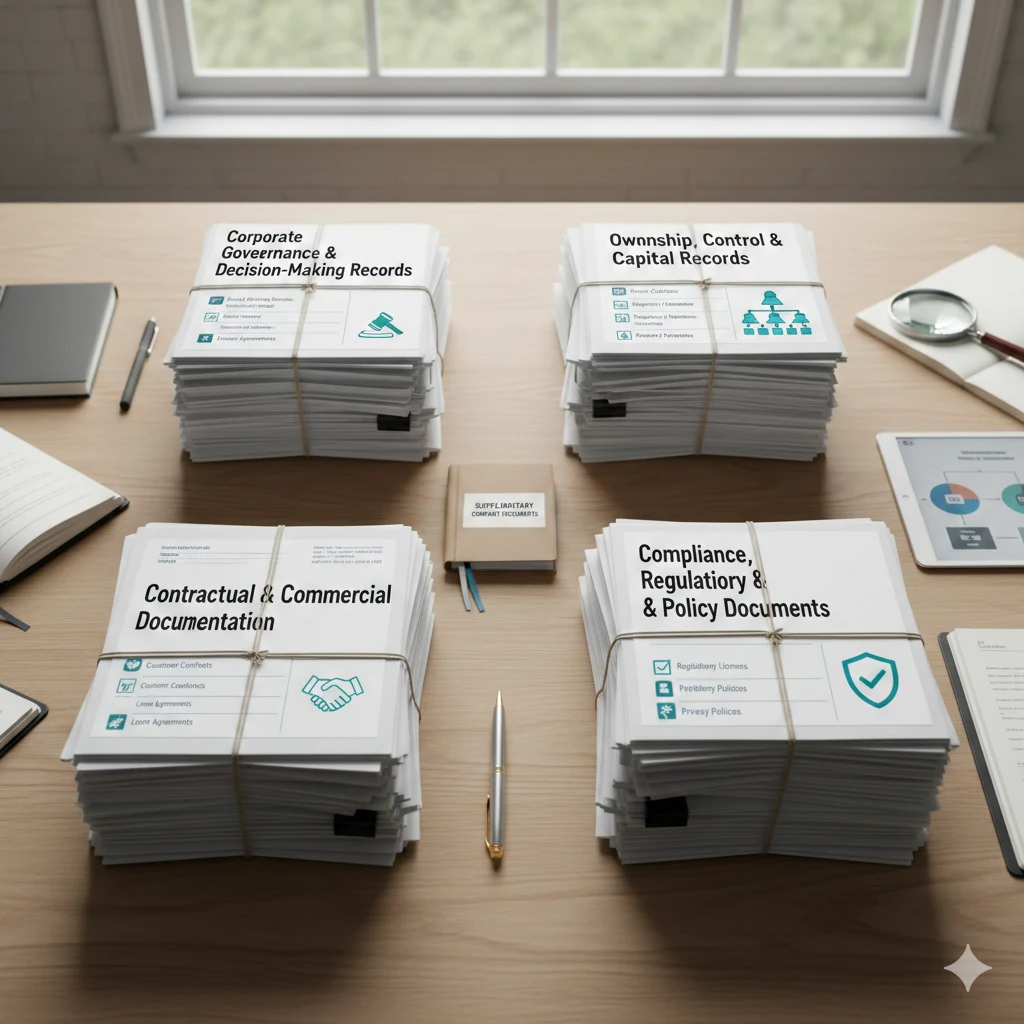
Corporate governance and decision‑making records
Corporate governance documents show how the company is managed and whether decisions are taken in a structured, compliant way. Common examples include:
- Board meeting minutes and written resolutions
- Committee terms of reference and minutes (for audit, risk, or remuneration committees)
- Directors’ service agreements and appointment or resignation documentation
These materials help due diligence teams verify that key business decisions were properly authorised and that the board has followed internal processes and legal duties. They also demonstrate that corporate governance is more than a formality and is supported by a documented audit trail.
Ownership, control, and capital records
Ownership and capital‑related documents are essential for confirming who has rights over the company and on what terms. Relevant supplementary documents include:
- Detailed registers of members, directors, and persons with significant control
- Historic and current share certificates and share allotment documentation
- Shareholder agreements, option agreements, and warrants
- Group structure charts and records of intra‑group reorganisations
These records allow investors and buyers to confirm that the equity story presented during negotiations is accurate. They also help identify any unusual rights, such as vetoes, anti‑dilution protections, or pre‑emption arrangements that could affect future fundraising or exit options.
Contractual and commercial documentation
Due diligence teams need insight into the agreements that underpin revenue, supply chains, financing, and strategic relationships. Supplementary company documents in this area may include:
- Customer and supplier contracts, framework agreements, and long‑term service arrangements
- Distribution, franchise, or licensing agreements
- Loan agreements, security documents, guarantees, and debentures
- Joint venture or collaboration agreements
Having complete, well‑organised documentation allows reviewers to assess concentration risk, termination rights, pricing mechanisms, change‑of‑control provisions, and hidden obligations. Where a company uses a Supplementary Company Documents service, these contracts are typically catalogued and cross‑referenced, making it much easier for advisors to navigate and understand the commercial landscape.
Compliance, regulatory, and policy documents
Regulatory compliance is increasingly central to due diligence, particularly in regulated sectors, data‑driven businesses, and organisations with cross‑border operations. Supplementary documentation in this category can include:
- Regulatory licences, registrations, and correspondence with regulators
- Data protection and privacy policies, records of processing activities, and DPIAs
- Anti‑bribery, anti‑money‑laundering, and sanctions policies and training records
- Health and safety policies, risk assessments, and incident logs
These records allow counterparties to evaluate compliance culture, spot gaps that could lead to enforcement action, and estimate the cost and effort required to remediate any non‑compliance. For a UK firm preparing for due diligence, working with a specialist provider like Form My Company to organise these supplementary materials can significantly enhance the credibility of its compliance profile.
How Supplementary Documents Improve Due Diligence Outcomes
Supplementary company documents improve due diligence outcomes by making the process faster, clearer, and less risky for all parties. When a company can provide a complete, coherent documentary set from the outset, it reduces the number of follow‑up queries, clarifications, and document chases that otherwise slow transactions. A well‑curated document set signals professionalism and reduces the perceived execution risk of a deal.
From the perspective of the buyer or investor, robust supplementary documentation supports more accurate valuation and risk pricing. Clear board minutes and contracts reduce uncertainty around historic decisions and future obligations, which in turn can support stronger offers and more favourable terms. From the company’s perspective, having these documents ready protects negotiating leverage and helps prevent late‑stage surprises that might otherwise lead to re‑pricing or renegotiation.
Supplementary Company Documents and Risk Management
Risk management is a central theme in due diligence, and supplementary documents are one of the most effective tools for identifying, assessing, and responding to risk. For example, comprehensive registers and shareholder documents help uncover potential disputes over ownership or voting rights before they crystallise into litigation. Contract collections highlight minimum‑spend obligations, exclusivity clauses, or onerous indemnities that could affect cash flow.
Internal policies and compliance records help reviewers judge whether regulatory breaches are isolated issues or symptoms of systemic weaknesses. Where gaps or inconsistencies are identified, these documents also provide a roadmap for remediation. In this sense, supplementary company documents not only reveal risk but also support the design of mitigation strategies, such as targeted warranties, indemnities, or post‑completion action plans.
The Role of Supplementary Documents in Different Types of Transactions
Although the core concepts are similar, the emphasis on particular supplementary documents varies by transaction type. In M&A deals, buyers will typically scrutinise governance records, shareholder arrangements, material contracts, and regulatory licences to ensure that the acquired business is structurally sound and operationally robust. The quality of supplementary documentation directly affects how comfortable they feel integrating the target into their existing structure.
In equity and debt fundraising, investors and lenders look closely at capital records, authority for past issuances, and the company’s ability to comply with future covenants. Supplementary documents in these contexts support correct share pricing, clean security packages, and enforceable covenants. Even in non‑transactional contexts such as major tenders or strategic partnerships, counterparties may conduct due diligence that relies on similar supplementary materials to assess reliability and long‑term viability.
How a Structured Document Service Supports Due Diligence
Many businesses struggle to keep decades of board minutes, resolutions, contracts, and policy documents organised and accessible. Files may be scattered across email accounts, shared drives, and physical storage, making rapid response to due diligence requests difficult. This is where a structured Supplementary Company Documents service becomes particularly valuable.
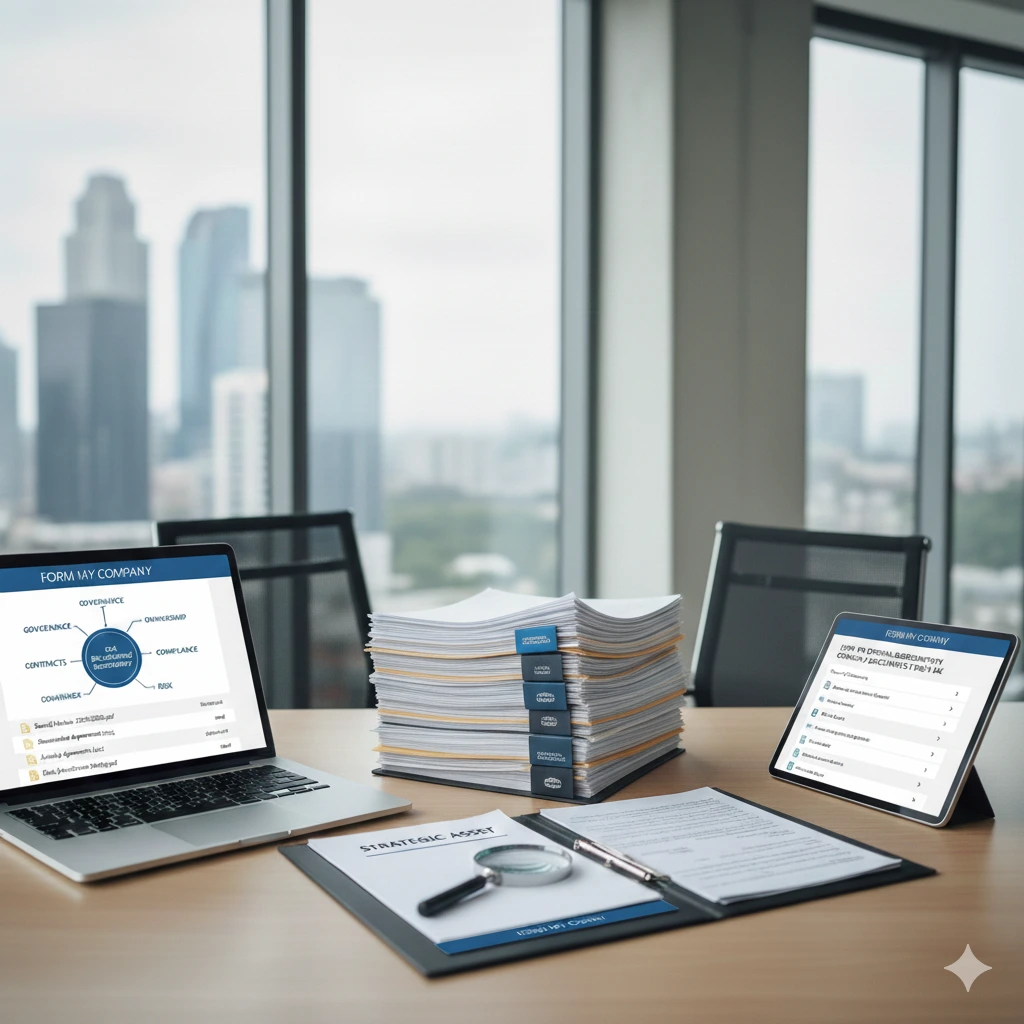
A specialist provider such as Form My Company can help UK businesses identify which documents are material for due diligence, standardise formats, and create a logically organised repository that can be quickly surfaced in a transaction. By mapping documents to key due diligence themes governance, ownership, contracts, compliance, and risk the service not only improves day‑to‑day corporate housekeeping but also ensures that the company is ready for investor or buyer scrutiny at short notice. Over time, this level of organisation becomes a strategic asset rather than a reactive administrative exercise.
Connecting Due Diligence Focus with Information‑Seeking Behaviour
From a marketing and funnel‑strategy perspective, interest in how supplementary company documents support due diligence typically signals a mid‑funnel mindset. Readers at this stage understand the basics of corporate documentation and are actively exploring how to professionalise their records for deals, fundraising, or regulatory scrutiny. They want practical, outcome‑focused guidance rather than high‑level theory or hard‑sell messaging.
An informational, topic‑focused resource such as a guide on how to obtain supplementary company documents in the UK helps organisations at the early research stage clarify what they need and where to find it. As they refine their requirements and recognise the complexity of maintaining a complete documentation set, they become more receptive to outcome‑oriented services that can centralise and manage these documents for them. This is where mid‑funnel content about the strategic value of supplementary documentation during due diligence naturally leads towards more detailed service exploration.
How Form My Company Supports Due Diligence‑Ready Documentation
Form My Company positions supplementary documentation not as a static compliance task but as a living framework that supports stronger, faster transactions. Through its Supplementary Company Documents offering, the brand helps UK firms assemble missing records,
regularise historic gaps where possible, and adopt a forward‑looking approach to document maintenance. This reduces the risk of embarrassing omissions during due diligence and protects the company’s ability to move quickly when opportunities arise.
By aligning documentation practices with investor and acquirer expectations, Form My Company enables clients to present a clear, consistent story backed by evidence. That, in turn, enhances credibility with professional advisers and counterparties. For organisations anticipating future deals or capital events, partnering with a specialist provider to manage supplementary documentation is a practical way to turn corporate housekeeping into a strategic advantage.
What are supplementary company documents?
Supplementary company documents include records like board minutes, shareholder resolutions, registers of members and directors, key contracts, and compliance policies that go beyond basic Companies House filings. These documents provide a detailed view of a company’s governance, ownership, and operations. Form My Company offers Supplementary Company Documents services to help UK businesses compile and organise these essential records.
Why are supplementary company documents important for due diligence?
Supplementary company documents are crucial for due diligence as they reveal governance practices, ownership details, contractual obligations, and compliance status that core filings alone cannot show. They help investors and buyers identify risks, verify management decisions, and assess operational realities. Accessing complete sets through services like Form My Company’s Supplementary Company Documents ensures smoother transaction processes.
How do I obtain supplementary company documents in the UK?
Supplementary company documents can be obtained from the company’s internal records, Companies House for public extracts, or specialist providers who reconstruct missing historic files. They are not always publicly available and often require direct company access or professional assistance. Form My Company’s Supplementary Company Documents service streamlines retrieval and organisation for UK firms preparing for deals or audits.
What types of supplementary company documents are needed for M&A transactions?
Key types include board minutes, shareholder agreements, material contracts, registers of directors and PSC, and regulatory compliance records relevant to M&A due diligence. These documents confirm decision-making authority, ownership structure, and potential liabilities. Form My Company assists with Supplementary Company Documents to make UK businesses M&A-ready by curating these critical files.
Can Form My Company provide supplementary company documents quickly?
Yes, Form My Company specialises in rapidly assembling Supplementary Company Documents, including historic reconstructions where possible, to meet urgent due diligence timelines. Turnaround depends on complexity but typically supports time-sensitive transactions for UK companies. This service ensures all necessary governance and operational records are verified and presented professionally.