
The Hague Apostille Convention includes over 120 countries that recognize a single internationally standardized method for document authentication the Apostille. If your document comes from one of these member countries, obtaining an Apostille certifies it for legal use abroad without further embassy legalization.
Understanding which countries participate in the Hague Apostille Convention helps businesses, professionals, and individuals avoid unnecessary bureaucracy when operating or expanding internationally. This guide by Form My Company explains the Convention, its purpose, current member countries, and how to ensure your Apostilled Documents are recognized worldwide.
What Is the Hague Apostille Convention?
The Hague Apostille Convention, formally known as the “Convention of 5 October 1961 Abolishing the Requirement of Legalisation for Foreign Public Documents,” simplifies the process of using documents abroad. Before the Convention, verifying a document’s authenticity required multiple steps from notarial certification to embassy legalization. The Convention introduced a single-step process: the Apostille.
An Apostille is a standardized certificate issued by an authorized government authority confirming the authenticity of a public document. Once applied, the document is legally valid across all member countries of the Convention. For example, a company registration certificate issued in the UK with an Apostille can be recognized in France, Japan, or Mexico without further legalization.
You can read about what an Apostille is and why it matters in our related piece, What is an Apostille and Why Does Your Business Need One? a useful overview of Apostille fundamentals.
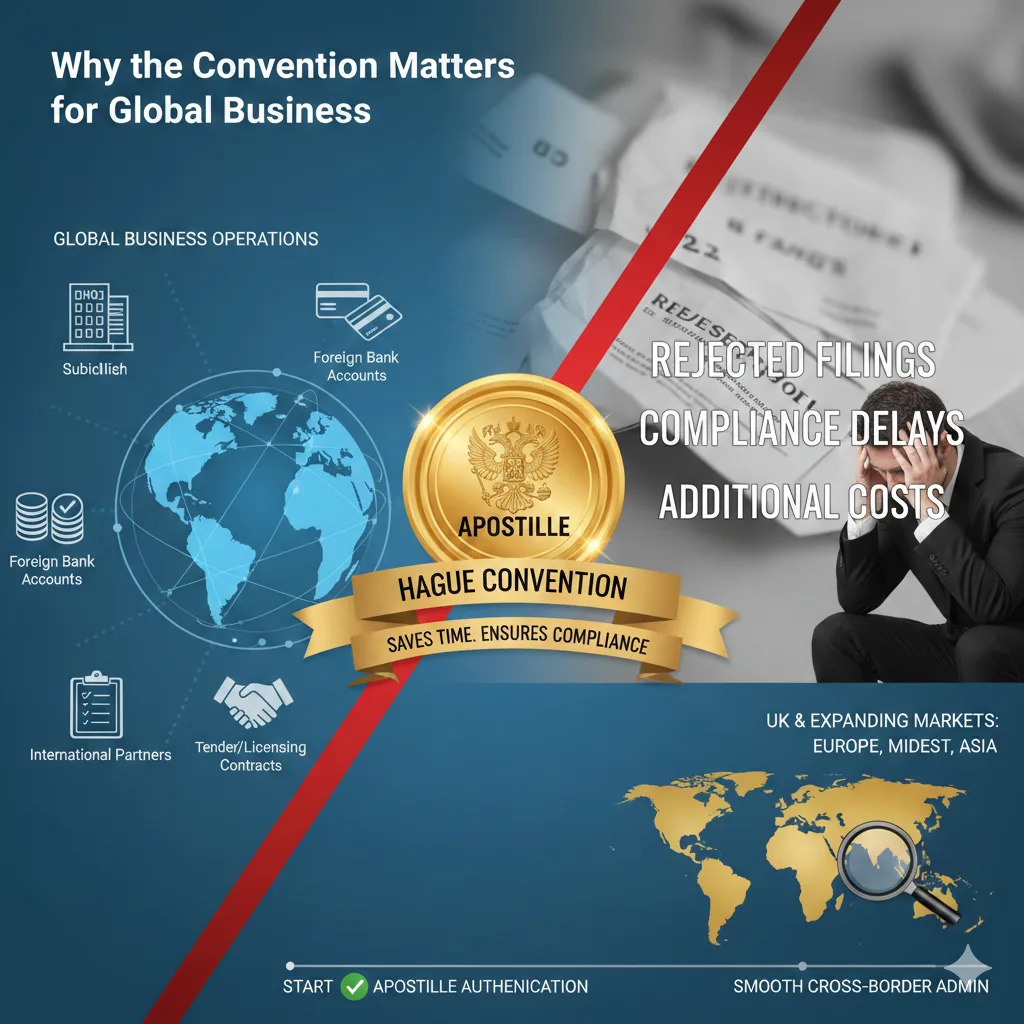
Why the Convention Matters for Global Business
Modern business operations often span borders, requiring legal, financial, or corporate documents to be recognized in multiple jurisdictions. Some common cases include:
- Registering overseas subsidiaries or branches
- Opening foreign bank accounts
- Submitting company documents for tender or licensing
- Establishing representation contracts with international partners
Without an Apostille, firms may face rejected filings, compliance delays, or additional legalization costs. By knowing which countries participate in the Convention, companies can save time and ensure compliance from the start.
For UK businesses and particularly those expanding into European, Middle Eastern, or Asian markets Apostille authentication has become a standard component of cross-border corporate administration.
How the Apostille System Works
The Apostille system operates on mutual trust among Convention members. Each country designates officials (known as “Competent Authorities”) to issue Apostilles verifying:
- The authenticity of the signer’s signature.
- The capacity in which the person has acted.
- The identity of the seal or stamp appearing on the document.
In the United Kingdom, the Foreign, Commonwealth & Development Office (FCDO) is the designated authority issuing Apostilles. Entities like Form My Company help clients navigate this process easily, ensuring that documents meet official standards before submission.
After issuance, the Apostille must be attached (either physically or digitally) to the original document. Any recipient in another Hague member state can verify it without further checks.
Countries That Recognize the Hague Apostille Convention
As of 2026, over 120 countries are parties to the Hague Apostille Convention. Major regions represented include Europe, the Americas, Asia-Pacific, Africa, and the Middle East. Countries may join the Convention at different times, which occasionally influences bilateral recognition periods.
Europe
Europe contains the majority of Convention members, including all EU states and many non-EU nations such as the United Kingdom, Norway, and Switzerland. Documents Apostilled in one European member country are broadly accepted across the continent a foundation for seamless business transactions.
Examples include:
United Kingdom, France, Germany, Italy, Spain, Netherlands, Belgium, Poland, Ireland, Portugal, Norway, Switzerland, Greece, Sweden, Finland, Austria, and Czech Republic.
The Americas
The Apostille Convention enables both North and South American countries to authenticate documents efficiently across borders. This is particularly useful in trade, migration, and education exchanges.
Examples include:
United States, Canada, Mexico, Argentina, Brazil, Chile, Colombia, Peru, and Panama.
Asia-Pacific
Many Asia-Pacific jurisdictions have joined the Convention, reflecting growing global legal cooperation. Businesses expanding into Asia benefit significantly from this shared recognition system.
Examples include:
Australia, New Zealand, India, Japan, South Korea, Singapore, Philippines, Indonesia, and Hong Kong (SAR).
Middle East and Africa
Though participation varies, the number of Hague Apostille Convention members in these regions continues to grow. International firms working across borders in construction, energy, and trade sectors often rely on Apostilled documents here.
Examples include:
Israel, Bahrain, Oman, Morocco, South Africa, and Tunisia.
How to Check If a Country Recognizes the Convention
The Hague Conference on Private International Law (HCCH) maintains an official, continuously updated list of member countries. To confirm whether your destination country participates:
- Visit the official HCCH website.
- Find the country name in the table.
- Check if the Convention is “In Force” for that country.
- Review any declarations or special conditions that may apply.
For businesses, this check is essential before preparing or submitting important legal or corporate documents abroad.
Documents Commonly Requiring an Apostille
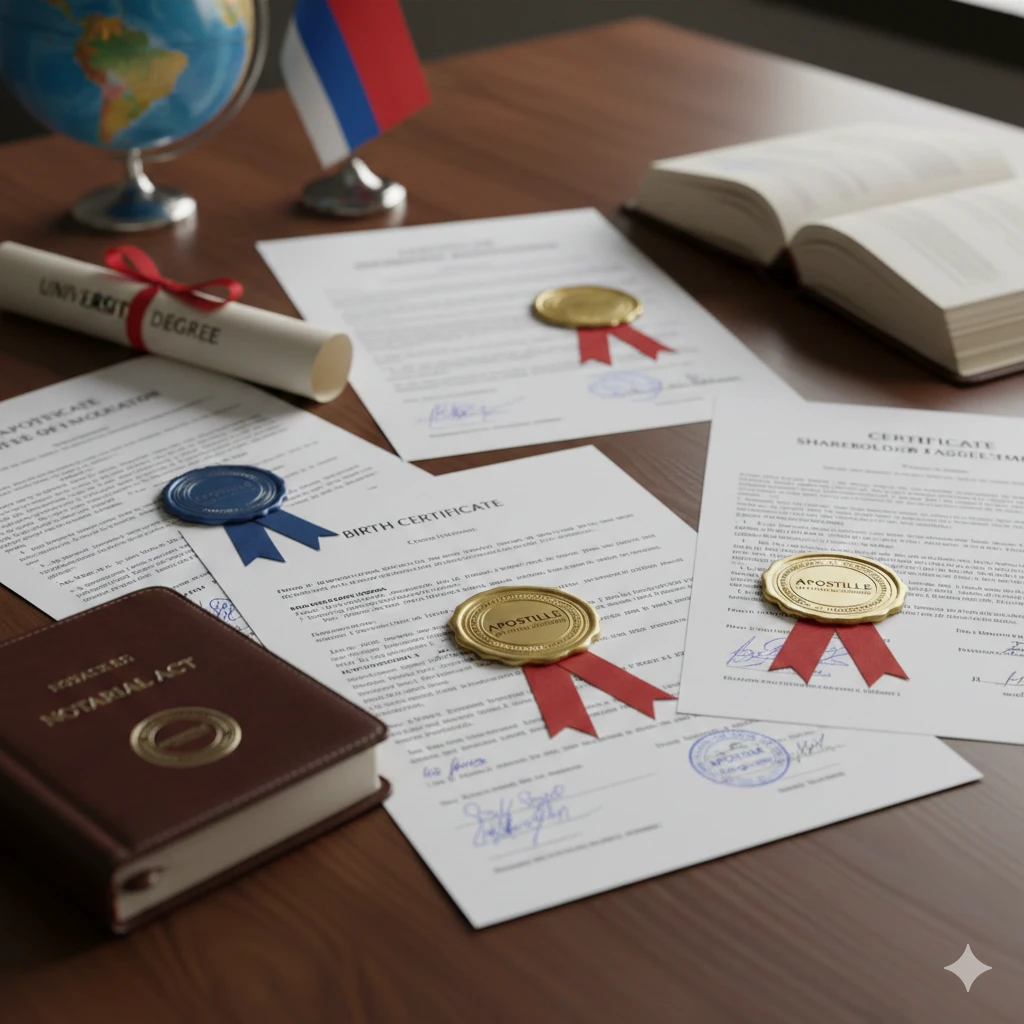
Not every document qualifies for Apostille certification. The rule applies to “public documents” issued or certified by authorities such as courts, registrars, or government departments. Examples include:
- Birth, marriage, or death certificates
- Academic transcripts or degree certificates
- Notarial acts and affidavits
- Court judgments or legal filings
- Corporate formation documents, board resolutions, or contracts
When expanding overseas, entities often need Apostilled Documents such as certificates of incorporation or shareholder agreements. This assures foreign regulators and partners of their authenticity.
How to Get a Document Apostilled in the UK
For UK-issued documents, Apostille certification is completed through the Foreign, Commonwealth & Development Office (FCDO). The process involves:
- Ensuring the document is correctly notarized or certified.
- Submitting the document to the FCDO Apostille service (either online or by post).
- Receiving the Apostilled document, which bears a unique reference confirming its authenticity.
To avoid rejection or administrative errors, many businesses use professional services like Form My Company. As a specialist provider of Apostilled Documents, we pre-check documentation, obtain official stamps, and manage FCDO authentication efficiently.
For more details on professional FCDO Apostille solutions, explore our detailed overview: Professional FCDO Apostille Certification | Reliable & Fast.
Non-Member States: When Additional Legalization Is Required
If a destination country is not part of the Hague Apostille Convention, Apostille certification alone will not suffice. Documents must undergo consular legalization an additional process where the embassy or consulate of that country authenticates the document after the Apostille.
This two-step method is common for countries outside the Hague framework, such as China, Canada (joining recently but not fully in effect across all territories), and several Middle Eastern or African states not yet ratified.
Working with professionals ensures that your document preparation matches each country’s specific legal standards, avoiding rejection or delays.
Benefits of Apostilled Documents for International Transactions
Using Apostilled documents offers distinct advantages for global businesses and individuals:
- Global acceptance: Once Apostilled, a document is recognized in all member countries without further verification.
- Simplified legal process: The process replaces multi-step embassy legalization with a single certification.
- Faster business onboarding: Corporate documents can be submitted internationally almost immediately.
- Digital verification possibilities: Many countries now allow online validation of Apostille references, speeding up international processing.
This standardized system reflects the world’s increasing demand for seamless cross-border commerce and trusted documentation.
How Form My Company Simplifies Apostille Authentication
At Form My Company, we specialize in helping UK businesses and professionals prepare and obtain fully compliant Apostilled Documents for global use. Our process ensures each document is properly notarized, reviewed, and Apostilled in line with FCDO requirements.
Whether you are expanding your company, entering new markets, or handling international tenders, having correctly Apostilled documentation supports smoother legal and administrative workflows.
Our team handles the details from pre-verification to FCDO submission ensuring confidence in every international filing.
For businesses scaling internationally, Apostille compliance is not just a formal step; it’s a cornerstone of global credibility.
The Hague Apostille Convention remains the global standard for validating public documents across borders. By knowing which countries participate and ensuring proper document certification through trusted providers like Form My Company businesses can operate internationally with efficiency and confidence.
From corporate registrations to international contracts, properly Apostilled Documents safeguard your credibility and help accelerate business expansion worldwide.
What are Apostilled Documents used for?
Apostilled Documents are used to verify the authenticity of public documents such as company registrations, birth certificates, or contracts for legal use in other countries that are part of the Hague Apostille Convention. From My Company helps ensure these documents meet international standards for recognition abroad.
How do I get a document Apostilled in the UK?
In the UK, Apostilles are issued by the Foreign, Commonwealth & Development Office (FCDO). From My Company assists by preparing, certifying, and submitting documents to obtain an official Apostille quickly and correctly.
Which countries accept Apostilled Documents?
Apostilled Documents are accepted in all nations that are members of the Hague Apostille Convention over 120 countries worldwide, including the UK, USA, EU states, Australia, and Japan. From My Company ensures your documents are valid wherever the Apostille is recognized.
How long does it take to receive Apostilled Documents?
The processing time for Apostilled Documents depends on document type and submission method. Typically, with complete documentation, the FCDO issues an Apostille within a few working days; using From My Company’s service can help streamline this process.
Do digital documents qualify for an Apostille?
Yes, some authorities in the UK now issue digital Apostilles for electronically signed documents. From My Company ensures your electronic or physical documents meet the legal standards required for Apostille certification.