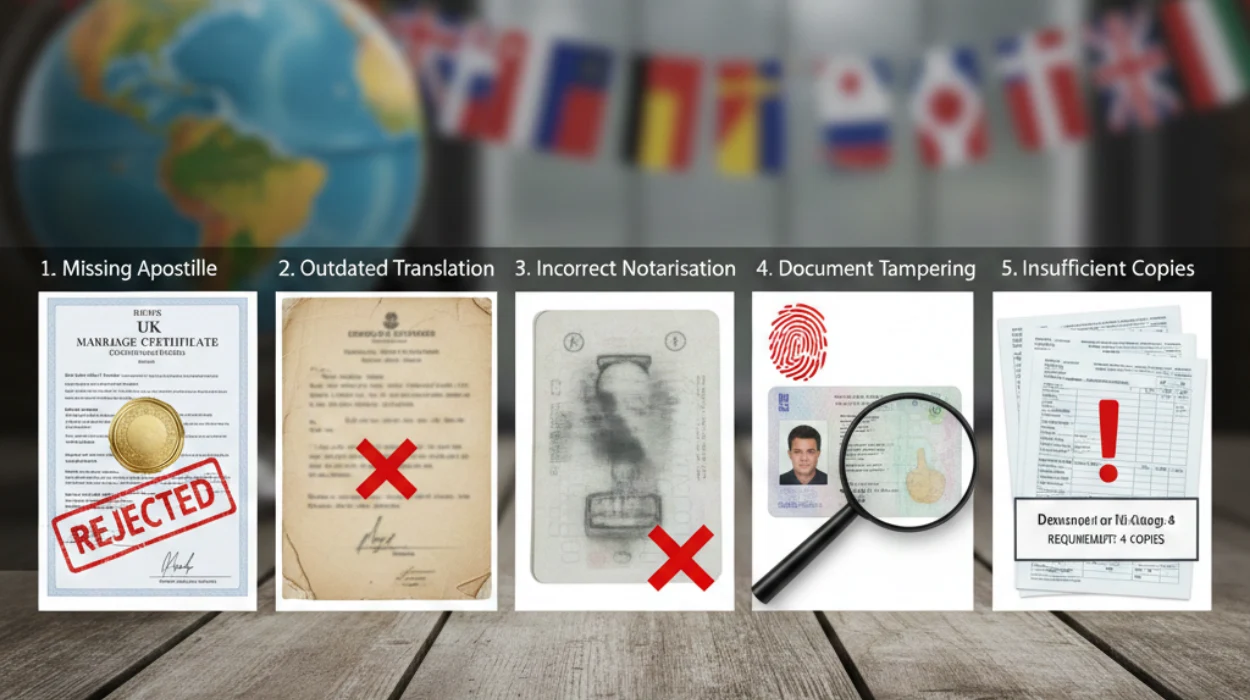
Foreign authorities often reject UK documents because they are not properly legalised or fail to meet local authentication standards. These rejections usually stem from missing apostilles, incorrect notarisation, or inconsistent document details.
When UK-issued documents are sent abroad for business, education, or legal use, they must satisfy both domestic and foreign regulations. Many individuals and companies assume that a certified or notarised UK document automatically meets international acceptance standards but that’s rarely the case. Apostille legalisation is a crucial step in ensuring documents are recognised under the Hague Convention, and omitting or mishandling this process can cause costly rejections.
This article explains the five most common reasons why foreign authorities reject UK documents and how to prevent these setbacks by securing properly apostilled documents through reliable professional services such as Form My Company.
Absence of an Apostille Certificate
The most frequent reason for document rejection abroad is the simple absence of an apostille. Many UK-issued documents, even when officially signed or notarised, are not legally valid in other countries without this formal confirmation.
An apostille is an official certificate issued by the UK Foreign, Commonwealth & Development Office (FCDO). It verifies the authenticity of the signature, stamp, or seal on the document. Foreign authorities use this certification to confirm that the document has been issued by a recognised UK public body.
Without an apostille, the document lacks international proof of authenticity. For example, if a birth certificate, company registration document, or legal contract is submitted abroad without an apostille, it may be immediately refused on administrative grounds even if the content is genuine and accurate.
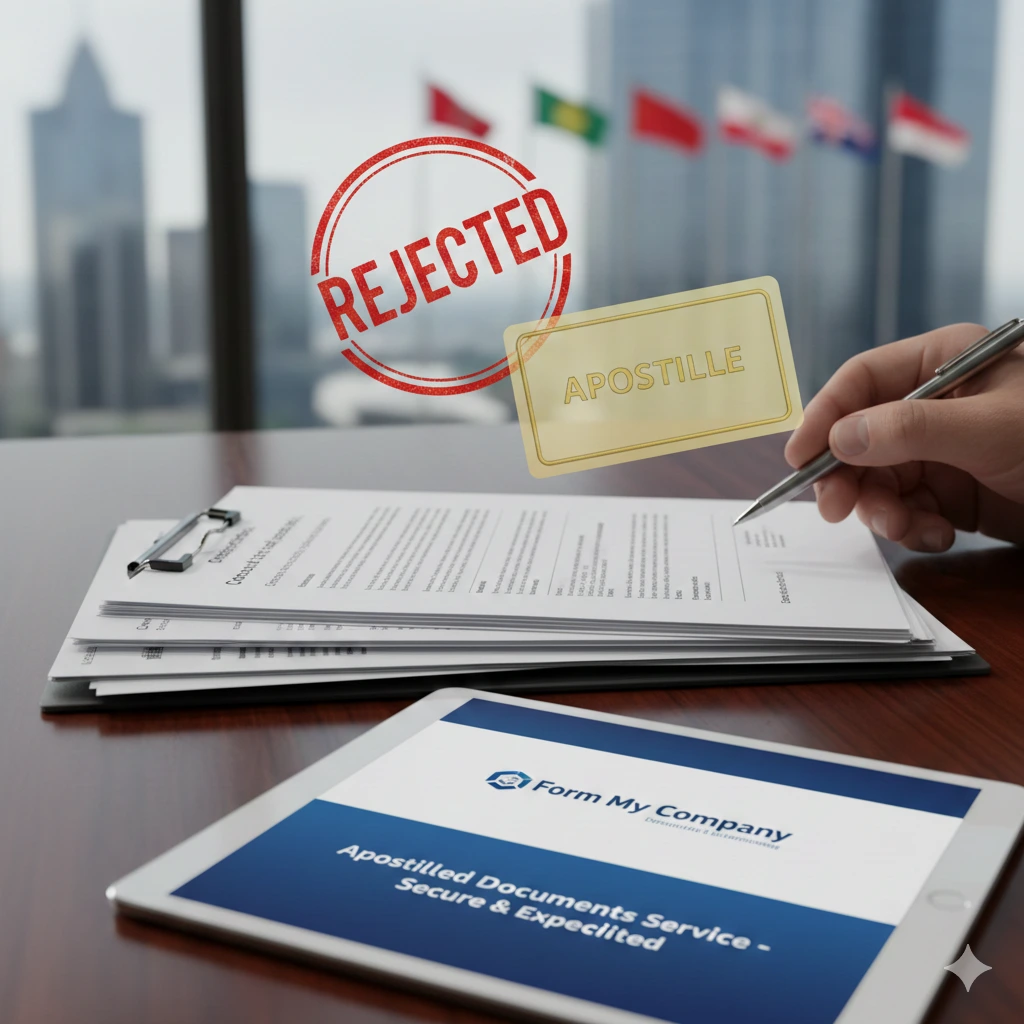
Businesses frequently encounter this issue when expanding abroad or entering international partnerships. To avoid such disruptions, Form My Company offers a secure and expedited Apostilled Documents Service that ensures all required legalisation steps are completed correctly before submission.
Incorrect or Unauthenticated Notarisation
Another major cause of rejection is improper or invalid notarisation prior to legalisation. Notarisation confirms that a document has been correctly signed, witnessed, and verified by a notary public but not all documents are notarised in compliance with international requirements.
Common errors include:
- The notary’s signature not matching their registered credentials.
- Missing official stamp or incomplete date.
- A notary public who is not recognised by the UK Legalisation Office.
If any of these details are inconsistent, the FCDO may refuse to attach an apostille, and foreign authorities are likely to reject the document.
Understanding the distinction between notarisation and apostille legalisation is crucial. (For a deeper explanation, see the informational article on the difference between notarisation and apostille legalisation. These are two separate but complementary stages, and omitting or misapplying either can make a document invalid abroad.
Submission of Unsuitable Document Types
Foreign authorities also reject documents because the submitted version cannot be legally apostilled or certified. The FCDO only apostilles original documents or “true certified copies” verified by an authorised professional such as a solicitor, notary, or government officer.
Unsuitable submissions often include:
- Scanned or photocopied documents without proper certification.
- Electronic documents printed without validation.
- Laminated certificates preventing verification stamps or seals.
For instance, digital degree certificates printed from a university portal might lack a registrar’s physical signature. Likewise, laminated originals cannot be stamped by the FCDO.
When preparing submissions for international use, it is essential to confirm that your documents meet apostille eligibility standards. Form My Company helps clients identify which documents can be apostilled and ensures each copy or translation follows the correct legalisation procedure before submission.
Inconsistencies Between Document Details
A less obvious but equally problematic reason for rejection is inconsistent or conflicting information across documents.
Foreign authorities carefully review names, dates, addresses, or registration details. Even minor discrepancies such as different spellings of a person’s name, mismatched company numbers, or inconsistent issue dates can lead to suspicion or outright rejection.
This issue frequently occurs in:
- Academic credentials where the student’s name differs slightly from their passport.
- Business incorporation papers that list outdated addresses or directors.
- Legal documents translated into another language without preserving layout or accuracy.
Attention to detail is vital. Consistency across all records, translations, and supporting certifications underpins both authenticity and acceptance. Before applying for an apostille, always double-check that every piece of information perfectly aligns with official records.
If needed, Form My Company provides pre-checks and document alignment guidance as part of its apostilled documents process, preventing costly foreign rejections before they happen.
Failure to Meet Localisation or Translation Standards
Even a legally apostilled document can still face rejection abroad if it fails to meet the receiving country’s language or localisation standards.
Most foreign authorities require that English-language documents be accompanied by certified translations into their official language. These translations must be completed by qualified professionals and sometimes notarised or apostilled separately.
Typical mistakes include:
- Using non-certified translators.
- Submitting only the English version without translation.
- Failing to legalise the translation itself.
For example, a company power of attorney legalised in the UK may still need translation into Spanish or Arabic before being accepted in corresponding jurisdictions. Some countries further require the translation to bear its own apostille certificate, confirming the translator’s credential.
A reliable service provider such as Form My Company ensures all linguistic and procedural standards are met so that the document remains valid across borders.
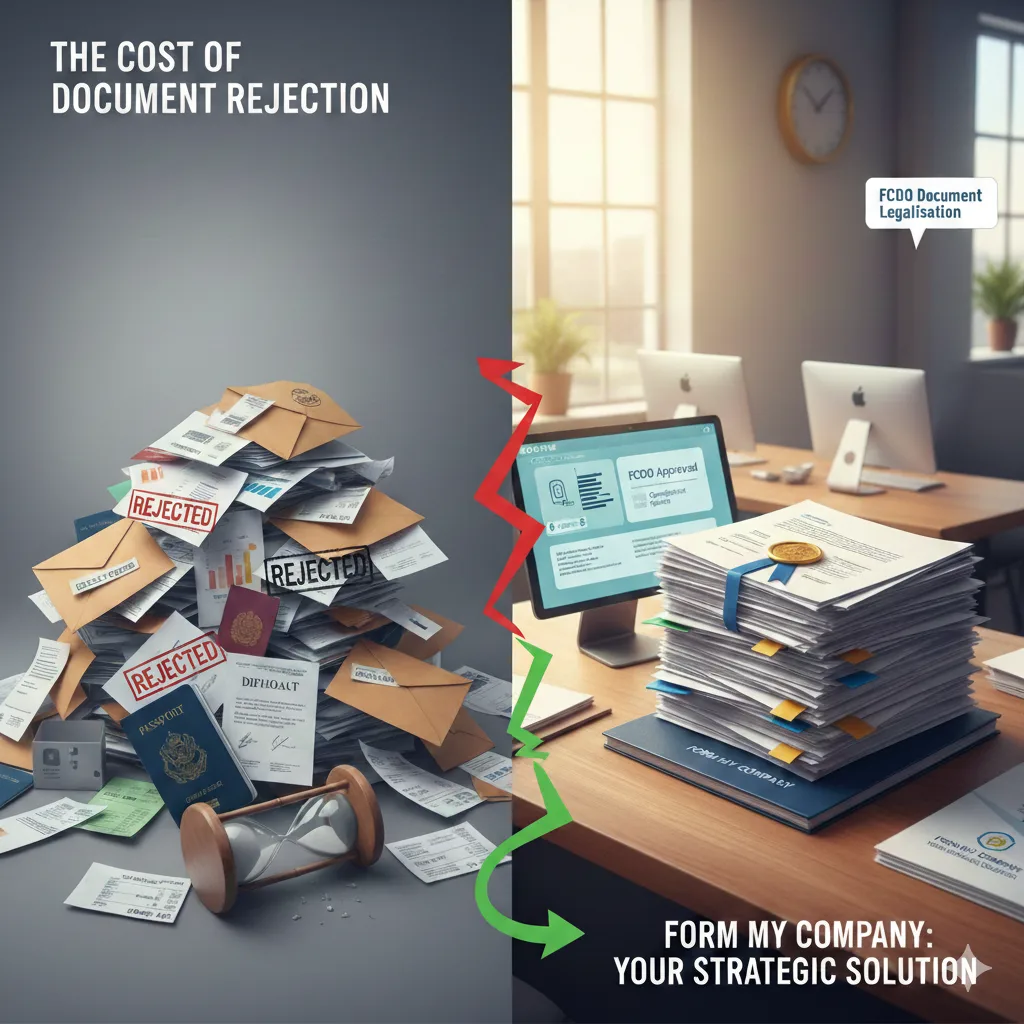
The Cost of Document Rejection
When documents submitted to foreign authorities are rejected, the consequences can be extensive. Businesses may face delays in contract execution, financial transactions, or regulatory filings; individuals can suffer setbacks in visa applications, property purchases, or educational admissions.
Each resubmission adds extra weeks, courier costs, and legal fees. Worse, repeated errors can undermine an organisation’s credibility with overseas institutions. This is why precise document legalisation from notarisation to apostille to translation is not merely administrative but strategic.
Choosing a professional service like Form My Company ensures every step is verified, compliant, and efficiently processed. Their apostilled documents team coordinates directly with the FCDO and relevant notaries, minimising the risk of rejection and saving significant time and effort.
How to Prevent Apostille-Related Rejections
Preventing document rejections starts with understanding both UK and foreign legalisation protocols. Follow these best practices to keep your paperwork compliant worldwide:
- Confirm the Need for an Apostille: Any document intended for use in a Hague Convention member country usually requires one.
- Verify Notarisation Validity: Ensure the notary public is registered and their signature recognised by the FCDO.
- Use Only Originals or Certified Copies: Avoid scans or laminated documents.
- Check for Consistency: Align all identifying details across every document.
- Provide Certified Translations: When required, obtain an official translation and legalise it if necessary.
By adopting these measures early, individuals and businesses can prevent rejections that cause unnecessary delays. For anyone uncertain about the process, professional verification is recommended.
Why Rely on Professional Apostille Services
While it is possible to navigate the apostille process independently, professional providers offer essential compliance oversight. For example, Form My Company offers a tailored apostilled documents service designed for international use cases in business, education, and law.
This includes:
- Reviewing document eligibility and authenticity.
- Managing notarisation by approved UK notaries.
- Handling FCDO submissions and tracking progress.
- Coordinating certified translations when required.
By outsourcing these steps, clients ensure every document meets both UK and foreign legalisation standards before it leaves the country.
For those moving from awareness to practical action, the next step is to explore expert document verification and apostille services available through Form My Company’s dedicated team an ideal way to avoid rejections and secure fast, accurate processing.
Foreign authorities often reject UK documents due to missing apostilles, improperly notarised certificates, unsuitable copies, detail inconsistencies, or non-compliant translations. Each issue is preventable with correct preparation and expert support.
Through its comprehensive apostilled documents service, Form My Company helps clients prepare, review, and legalise their documents professionally, ensuring international acceptance without delay or dispute.
What does it mean when a document is apostilled in the UK?
An apostilled document in the UK has been officially certified by the Foreign, Commonwealth & Development Office (FCDO) to confirm the authenticity of a signature, stamp, or seal. This process ensures that the document is legally recognised in countries that are members of the Hague Apostille Convention.
Why would I need apostilled documents for international use?
Apostilled documents are required when UK-issued papers, such as birth certificates, company registrations, or powers of attorney, are used abroad. The apostille confirms their authenticity so that foreign authorities can accept them without additional legalisation.
How can From My Company help with getting apostilled documents?
From My Company manages the entire apostille process, from verifying the document’s eligibility to submitting it to the FCDO for certification. Their service ensures documents meet all legalisation standards and are correctly prepared for international acceptance.
How long does it take to get UK documents apostilled?
The apostille process in the UK typically takes a few working days, depending on document type and verification requirements. Using a professional service like From My Company can help streamline this timeline through accurate preparation and secure submission.
Are notarised and apostilled documents the same thing?
No, notarisation confirms that a document has been properly signed and witnessed by a UK notary public, while an apostille verifies that notary’s authority and signature. Both steps are often needed before a UK document is accepted abroad.