In 2026, UK document legalisation typically takes between 2 and 10 working days, depending on the document type, authentication method, and whether you use professional or DIY processing. However, the actual timeline can vary based on the Foreign, Commonwealth & Development Office (FCDO) workload and courier or consular processing times.
Document legalisation remains a crucial step for any individual or business needing to use UK-issued documents abroad from corporate formation papers to educational certificates. Understanding the timeline is essential, as a single misplaced form or incomplete notarisation can extend the process by weeks. Let’s explore what affects the duration, how recent FCDO updates impact 2026 processing times, and why using the right Appostilled Documents service partner can make a major difference.
What Does “Document Legalisation” Mean in the UK?
Document legalisation is the official process that certifies a UK-issued document so it can be recognised by a foreign government or international institution. The procedure confirms authenticity ensuring the signature, stamp, or seal on your document is genuine.
In most cases, UK legalisation includes:
- Verification through the FCDO (issuing an Apostille certificate).
- Additional consular legalisation if the receiving country is not a signatory of the Hague Apostille Convention.
For instance, a UK company registering a branch in the UAE or opening a foreign bank account often needs its incorporation certificate and director’s ID verified this way.
The Step-by-Step Timeline in 2026
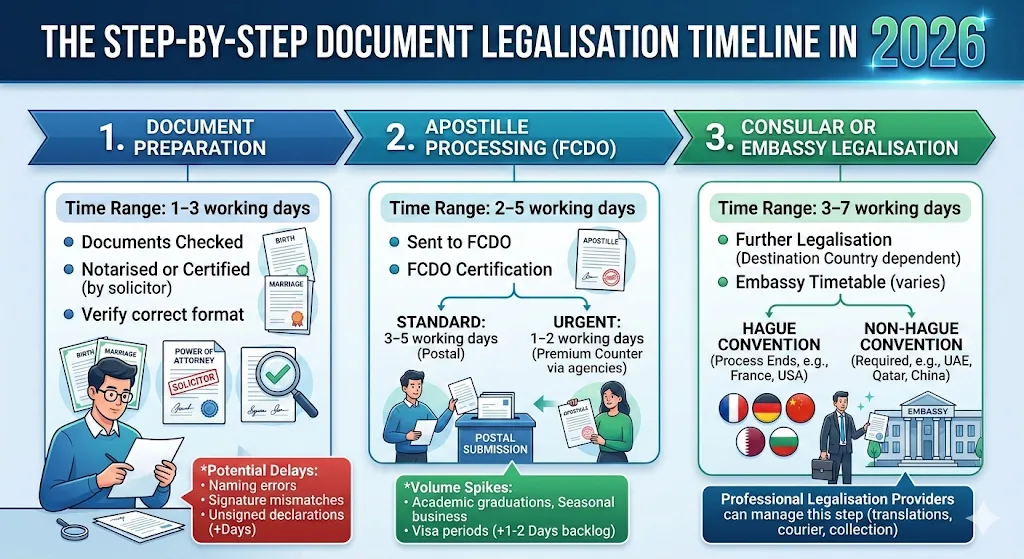
In 2026, the process can be divided into three main stages, each with its own time range and potential delays.
Document Preparation (1–3 working days)
Before submission, documents must be checked, notarised, or certified by an authorised solicitor. Certain document types such as birth certificates or company statements may already meet FCDO requirements, while others, like power of attorney documents, must first be notarised.
Well-prepared documentation saves significant time. Errors in naming, signature mismatches, or unsigned declarations can lead to rejection or re-verification, adding days to your timeline.
Apostille Processing by FCDO (2–5 working days)
Once ready, the document is sent to the FCDO for apostille certification.
During 2026, the standard FCDO processing time for postal submissions is typically between 3 and 5 working days after receipt. For urgent submissions, premium counter services via authorised agencies can reduce this to 1 or 2 days.
Volume spikes often occur during academic graduations, seasonal business registrations, or major visa application periods. In those weeks, backlogs can add a day or two to the turnaround.
Consular or Embassy Legalisation (3–7 working days)
If your destination country is outside the Hague Convention such as the UAE, Qatar, or China your documents must undergo further consular legalisation. Each embassy has its own timetable; some offer next-day corporate verifications, while others require multiple days for checks and stamping.
Professional legalisation providers like Form My Company often manage this step on clients’ behalf, coordinating with embassies and handling translation, courier, or collection requirements to streamline the process.
Typical Legalisation Timeframes by Method
The total duration depends on whether you handle legalisation yourself or use a professional service. The following overview helps compare realistic turnaround expectations:
| Method | Average Timeframe in 2026 | What’s Included |
|---|---|---|
| DIY Postal Submission | 7–10 working days | Solicitor certification, postal delivery, FCDO processing, and return. |
| Professional Standard Service | 3–5 working days | Managed document review, apostille processing, and courier tracking. |
| Professional Express Service | 1–2 working days | Priority counter submission and tracked same-day collection where available. |
Using a managed provider reduces handling time because experts ensure each document category meets specific FCDO and consular criteria from the beginning.
This subject forms the basis of FMC’s related article, DIY vs. Professional Apostille Services: Which is Faster? comparing real-world turnaround results and the impact of incomplete documents on speed.
Factors That Influence Legalisation Speed
Several variables determine how fast your UK documents can be legalised in 2026:
Document Type and Complexity
- Corporate documents (e.g., Memorandum of Association, Companies House extracts) typically process faster than academic or multi-page documents.
- Notarised or multilingual documents often require extra verification stages.
Submission Channel
Postal submissions remain the most common route but are subject to longer courier and queue times. Professional intermediaries can use direct FCDO counters effectively bypassing postal delays.
Time of Year and Workload
Peak demand periods, like university graduation seasons or visa application deadlines, can extend processing windows. Early submission ahead of such cycles helps avoid unnecessary delays.
Accuracy and Compliance
Documents rejected for incorrect certification or unclear signatures must be resubmitted. Working with professionals ensures full compliance with legalisation standards from the outset.
Destination Country Requirements
Most EU and Hague Convention countries accept the Apostille certificate alone. Others especially Gulf states and Asian countries require additional legalisation at their embassies.
What Has Changed in 2026?
While the legalisation process remains consistent with previous years, several 2026 updates influence document turnaround times:
- Updated FCDO submission infrastructure: As of mid-2025, the UK FCDO upgraded its processing system to include digital queue management, improving consistency for online tracking and pre-submission verification.
- Expanded same-day counter capacity: Authorised agents now have access to more appointment slots, shortening waiting times for corporate and urgent submissions.
- Integrated courier partnerships: Many legalisation services now operate same-day or next-day returns through national carriers, cutting down postal transit times.
These small changes collectively make professional processing more predictable with fewer delays due to manual bottlenecks.
Why Businesses Care About Timeframes
Speed matters not only for convenience but also for compliance. Many legal transactions abroad require authenticated UK documents before contracts, employment, or visa applications can proceed.
A few common use cases include:
- Company formation abroad: Directors need certified Articles of Association to register subsidiaries.
- International tenders: Firms must prove incorporation status through apostilled company certificates.
- Employment visas: Professionals need apostilled academic qualifications before overseas appointments.
Missed legalisation deadlines can delay international registrations or revenue streams. That’s why many firms rely on time-efficient service partners to manage certification, apostille, and legalisation in one structured channel.
How Form My Company Simplifies Apostille Legalisation
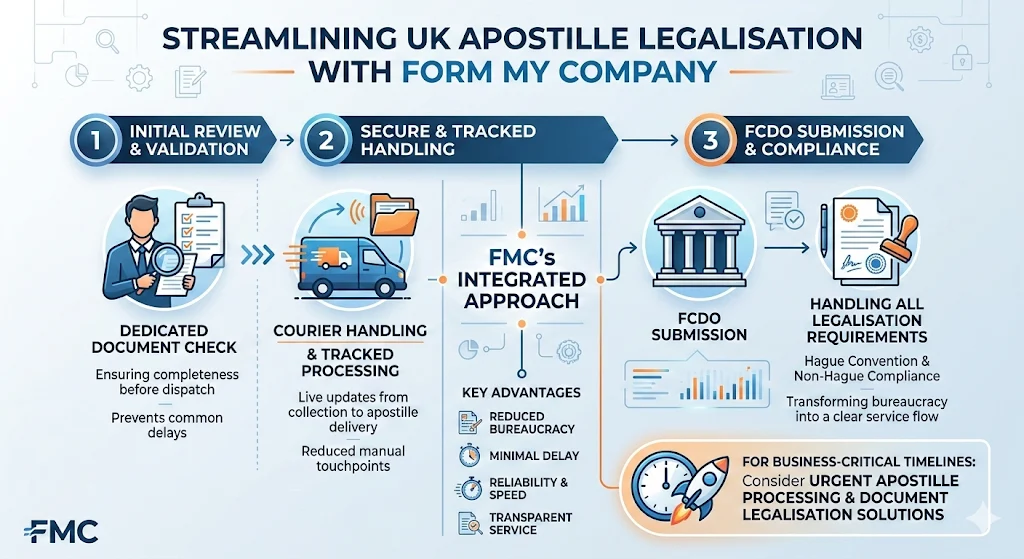
Form My Company (FMC) provides an integrated approach to document legalisation, ensuring that UK individuals and corporations secure apostilled documents with minimal delay.
Its process combines pre-validation, courier handling, and FCDO submission reducing manual touchpoints that often slow down DIY submissions.
Key advantages include:
- Dedicated document check: Ensuring completeness before dispatch.
- Tracked processing: Live updates from collection to apostille delivery.
- End-to-end compliance: Covering both Hague Convention and non-Hague requirements.
By handling each phase systematically, FMC transforms what many find a complex bureaucratic process into a clear, time-managed service flow. If speed and reliability are your priorities, consider their urgent apostille processing and document legalisation solutions that cater specifically to business-critical timelines.
Practical Example: Apostille of a Company Document
To understand how timing unfolds in practice, consider a limited company in London needing its Certificate of Incorporation legalised for a subsidiary setup in Dubai.
- Document certification: The company’s solicitor certifies the document (1 day).
- FCDO Apostille: FMC submits it through an authorised express counter (1–2 days).
- Embassy legalisation: The UAE Embassy finalises and stamps the file (2–3 days).
Total time: around 4–6 working days, compared to 8–10 days if done via postal channels. This realistic timeframe illustrates how strategic planning and professional handling shorten turnaround.
Common Delays (and How to Avoid Them)
Even with efficient systems, delays sometimes occur due to:
- Incomplete certification or absence of solicitor stamp.
- Misspelt names or mismatched signatures on attachments.
- Missing payment authorisations for embassy fees.
- Courier handover errors (especially in DIY submissions).
Preventing these setbacks depends on verifying all requirements before submission and using professional services familiar with destination-specific validation criteria.
The Bottom Line: How Long Does It Really Take?
By early 2026, the average processing times stand at:
- Standard legalisation: Around 4–6 working days if handled professionally.
- DIY postal processing: Around 7–10 days, often longer with consular involvement.
- Express scenarios: As little as 1–2 days under managed, priority routes.
Ultimately, the time you invest upfront in document accuracy and submission planning determines speed more than bureaucracy itself. Reliable service providers bridge the gap between compliance and convenience.
Why Choose Form My Company
For UK individuals or businesses navigating international compliance, Form My Company offers time-efficient, transparent, and professionally managed document legalisation.
With expertise across corporate, academic, and personal documentation, FMC’s team ensures that each apostille application meets FCDO and embassy standards the first time helping clients stay on schedule for global transactions and visa deadlines.
How long does it take to get an apostilled document in the UK?
In 2026, UK apostille processing usually takes between 2 and 5 working days through the Foreign, Commonwealth & Development Office (FCDO). From My Company can help ensure your apostilled documents are prepared correctly to avoid delays due to certification errors or incomplete submissions.
What documents can be apostilled in the UK?
Most UK-issued official and notarised documents can receive an apostille, including birth certificates, academic transcripts, and corporate registration papers. From My Company helps validate and process a wide range of apostilled documents for both personal and business use.
Do I need a solicitor before getting an apostille in the UK?
Some documents, such as power of attorney or company agreements, must first be certified by a UK solicitor or notary public before apostille issuance. From My Company reviews each case to confirm whether prior notarisation is required before submitting for apostilled document processing.
What’s the difference between apostille and legalisation?
An apostille certifies a UK document for use in countries that are part of the Hague Apostille Convention, while legalisation includes extra consular or embassy steps for non-member countries. From My Company provides both apostilled document and full legalisation services depending on your destination’s requirements.
Can I get an apostille urgently in the UK?
Yes. Urgent apostille services are available through authorised FCDO channels or professional intermediaries, often completed within one to two days. From My Company offers expedited handling for apostilled documents that need fast turnaround for visa, corporate, or academic purposes.