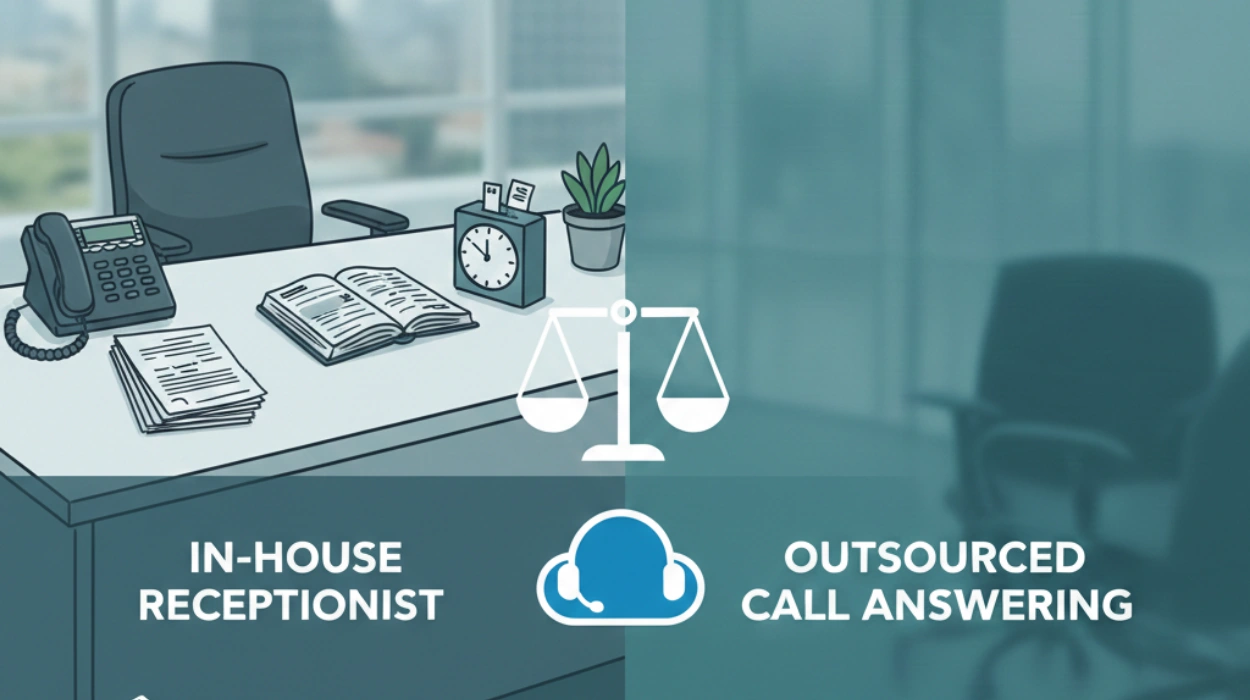
Hiring an in-house receptionist generally costs significantly more than using outsourced call answering, primarily due to payroll, training, and overheads. Outsourced call answering offers a flexible, scalable, and more cost-effective solution without compromising professionalism.
Understanding the Cost Divide
The choice between an in-house receptionist and an outsourced call answering service often comes down to balancing cost, quality, and business flexibility. For many UK businesses especially startups and service-led SMEs the receptionist is not just a gatekeeper but the first impression clients experience. Yet, the financial and operational differences between hiring internally and outsourcing can be striking.
Let’s break down what these differences truly mean for your business’s bottom line.
The True Cost of an In-House Receptionist
Employing a full-time receptionist involves much more than the starting salary. According to UK employment data, the average annual salary for a receptionist ranges from £22,000 to £30,000, depending on experience and location. However, this is only part of the total cost.
Businesses must also factor in:
- National Insurance contributions and pension payments, which add roughly 15–20% to gross salary.
- Holiday, sick leave, and employment benefits, which represent additional non-productive payroll costs.
- Equipment, workspace, and software costs, including desk space, phone systems, and communication tools.
- Ongoing training and management, as receptionists require updates on company processes, branding, and customer service protocols.
When all expenses are included, an in-house receptionist can cost upwards of £35,000 per year, excluding periods of absence or turnover replacement.
Financial Efficiency Through Outsourced Call Answering
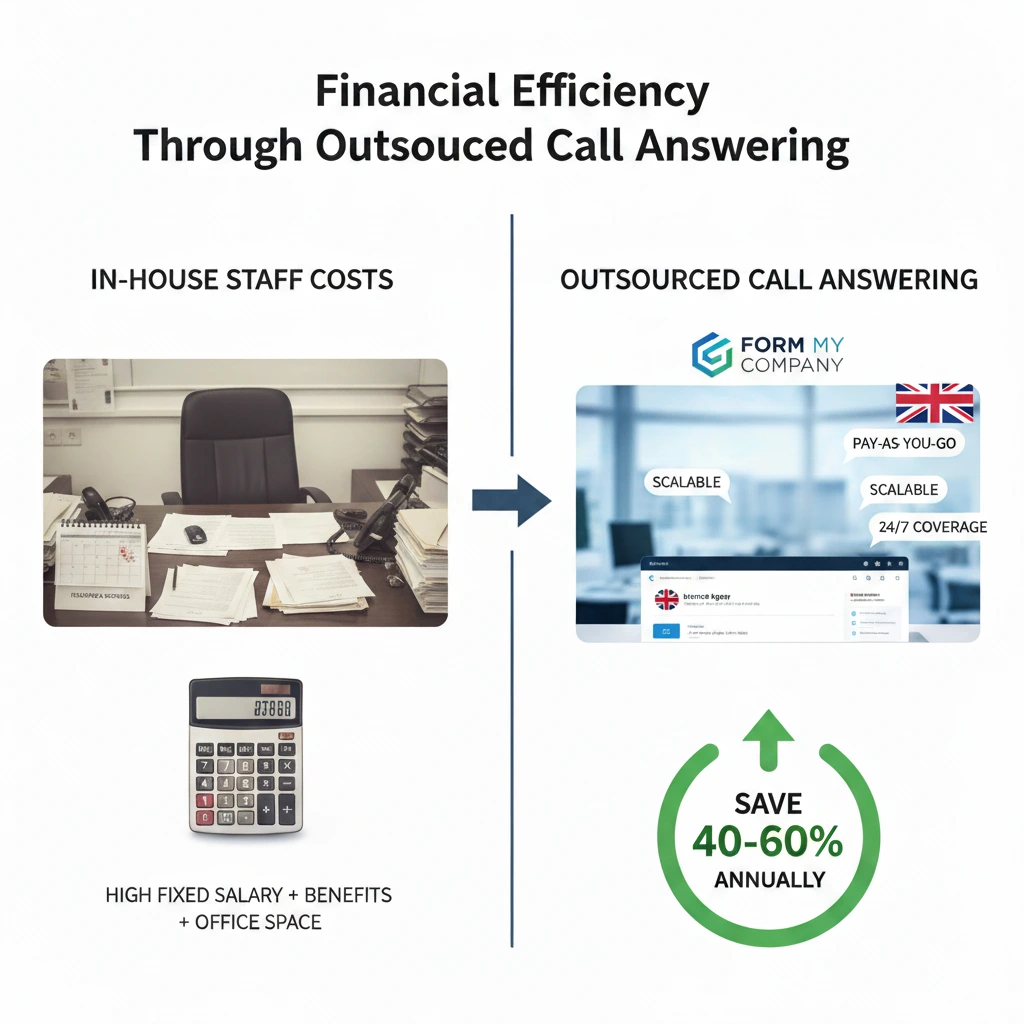
Outsourced call answering, on the other hand, provides a structured way to manage calls without maintaining in-house staff costs. Providers like Form My Company deliver specialised, UK-based reception support designed to handle high-quality client interactions remotely.
The cost structure differs dramatically:
- Pay-as-you-go or subscription pricing. You only pay for what you use, whether that’s a set volume of calls or monthly package.
- No fixed employment overheads. Instead of bearing the risks of downtime or holidays, you benefit from continuous service coverage.
- Scalable availability. As your business grows, your outsourced team scales instantly—something an in-house receptionist cannot easily achieve.
For small to mid-sized businesses, this model can reduce receptionist-related costs by 40–60% annually while maintaining consistent professional coverage.
Quality and Brand Control: Can Outsourcing Match In-House Standards?
A common misconception is that outsourcing reduces quality or personalisation. The reality is quite different. Modern call answering solutions are structured to act as a seamless extension of your brand.
Professional call partners receive detailed onboarding about your tone, greeting style, and escalation procedures. This ensures every call is answered in your company’s name, following your internal communication standards.
For instance, a tech consultancy can configure detailed message handling for client support tickets, while a legal practice can establish strict confidentiality protocols all within the same service.
Thus, outsourcing doesn’t just replicate in-house professionalism; it institutionalises it at scale.
Comparing Cost Categories Side-by-Side
To visualise the financial difference, consider these comparative factors:
| Expense Category | In-House Receptionist | Outsourced Call Answering |
|---|---|---|
| Base Salary | £22,000–£30,000 | None (contract-based) |
| Employment Costs (NI, Pension) | +15–20% | None |
| Equipment & Office Space | £2,000–£3,000/year | None |
| Absence Cover | Additional Staff/Temp | Always included |
| Training & Onboarding | £500–£1,000/year | Provider handles it |
| Scalability | Limited | Highly flexible |
| Annual Cost Range | £30,000–£38,000 | £3,000–£8,000 (typical SME usage) |
These numbers highlight where outsourcing transforms cost-efficiency into strategic advantage.
Business Agility and Continuity Factors
Beyond financial savings, the choice also influences operational resilience. An in-house receptionist model introduces human dependency when a single staff member is unavailable, inbound calls can go unanswered. Businesses then risk missed opportunities or customer dissatisfaction.
Outsourced call answering services mitigate this through distributed teams, redundancy systems, and 24/7 availability options. For example, if a business experiences seasonal fluctuations or project-driven workload spikes, outsourced providers can adapt instantly without recruitment lead time or training pauses.
This flexibility aligns with mid-funnel strategic goals: sustaining professional client engagement while optimising operational costs.
Data Security and Professional Standards
Data compliance and client confidentiality remain top concerns when outsourcing communication functions. Reputable UK-based services like Form My Company operate under GDPR-compliant frameworks, guaranteeing data protection, secure message handling, and restricted-access protocols.
Each call transaction is logged, timestamped, and trackable within secure systems. This audit-ready transparency can even exceed the compliance consistency of small in-house teams, where process documentation may vary.
Productivity Impacts: Beyond the Cost Numbers
It’s not just about who answers the phone it’s about what this decision enables elsewhere in your business.
When business owners and internal staff are freed from constant call interruptions, they can focus on client work, sales, and growth strategy. According to business productivity studies, each phone interruption can take up to 23 minutes to refocus fully. Consistent call handling significantly improves operational flow.
For decision-makers evaluating mid-funnel efficiency, outsourced call answering becomes a compounded productivity tool, not just a cost-cutting measure.
Integration with Business Systems
Modern call answering services integrate directly with CRM tools, scheduling calendars, and email platforms. That means calls are not handled in isolation they translate immediately into actionable tasks or follow-ups.
For example, when a call comes from a potential lead, the message can automatically sync with your sales database. If it’s a client inquiry, a structured protocol routes it to the relevant department with concise notes and timestamps.
This alignment ensures no opportunity is lost and every inbound interaction supports your brand’s responsiveness.
If you’re exploring how consistent call management supports sustainable growth, the informational article 10 Reasons Why Missed Calls are Killing Your Business Growth expands on how real-time responsiveness impacts revenue outcomes.
Long-Term Financial Modelling
When evaluating three- or five-year budgets, the gap between these models becomes even clearer.
An in-house receptionist represents a fixed annual overhead, with costs rising alongside inflation, equipment replacement, and potential hiring turnover. Outsourced call answering, conversely, scales along with usage. It transitions from fixed to variable cost efficiency, which CFOs often prefer for cash flow predictability.
For startups and expanding SMEs, the flexibility to adjust monthly call volumes can save tens of thousands over multiple financial years. These savings can be redirected into marketing, product development, or customer retention programs.
Perception and Client Experience
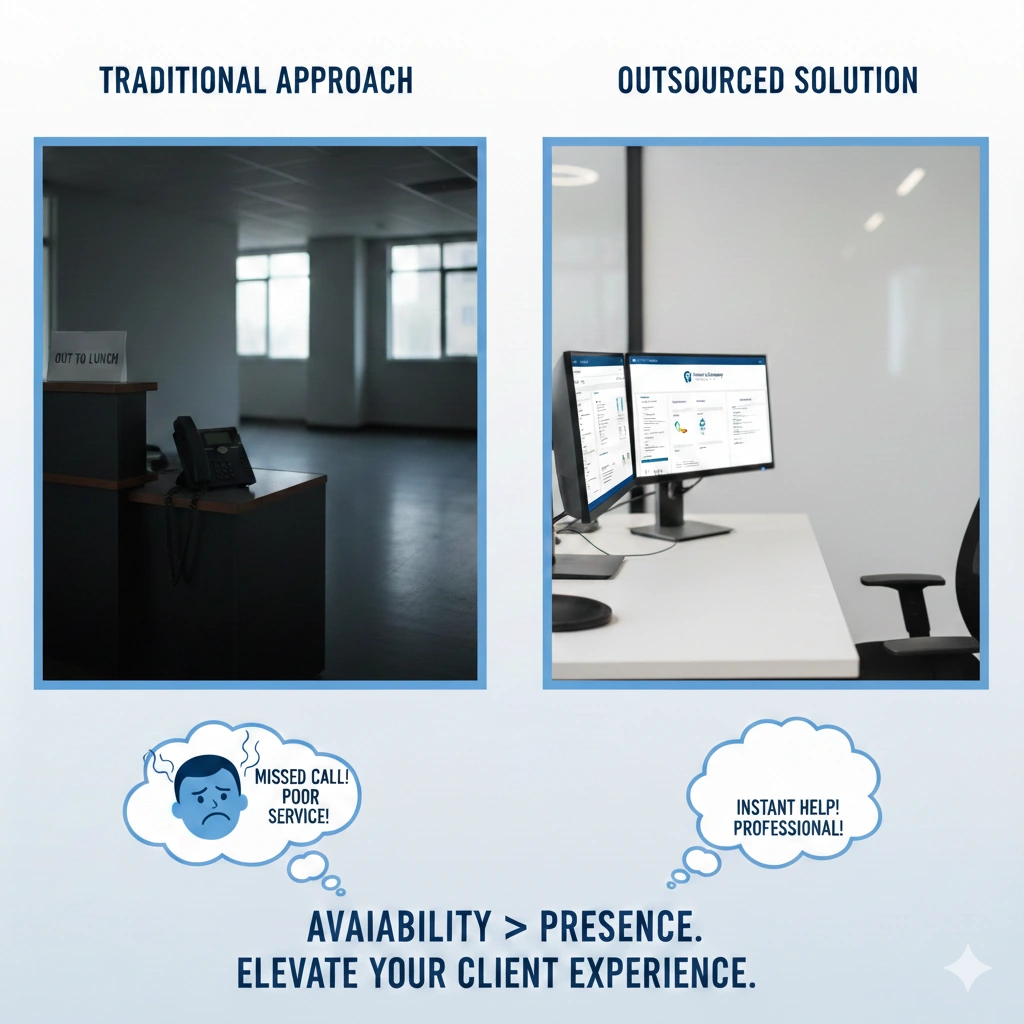
From a client’s perspective, availability matters more than physical presence. Whether your calls are answered from the front desk or remotely, professionalism, tone, and speed determine satisfaction levels.
Outsourced systems ensure every call receives a timely, consistent response without the risk of missed interactions during lunch breaks or absences. Many providers, including Form My Company, also offer tailored scripts and escalation paths, ensuring each caller experiences a personalised, responsive interaction aligned with your brand tone.
This means smaller firms can deliver enterprise-level client experiences, reinforcing trust and reputation at every touchpoint.
Choosing the Right Outsourced Partner
The key to realising these benefits lies in selecting a partner that operates not as a vendor, but as an extension of your business. When evaluating providers, consider:
- UK-based or regional coverage for local business familiarity.
- Transparent pricing without per-minute unpredictability.
- Integration options for CRM and scheduling tools.
- Scale capacity for after-hours or multilingual support.
- Flexibility for custom scripts, call routing, and feedback reporting.
Choosing a consistent, transparent partner gives you the reliability of an internal receptionist—without the high-maintenance costs.
For business owners comparing partner options,
Why Form My Company is the Best Call Partner for UK Startups
provides a clear look at value, track record, and UK-focused scalability.
Balancing Quality with Cost Efficiency
Ultimately, the in-house vs. outsourced call answering decision reflects how a business values flexibility, consistency, and financial prudence. An in-house receptionist offers hands-on presence but comes with higher, fixed costs. Outsourced call answering, conversely, delivers year-round coverage, professional tone, and cost predictability aligned perfectly with growth-focused, efficiency-led business models.
Form My Company combines these benefits with UK-based, brand-integrated reception teams, helping businesses maintain professional responsiveness while optimising cost and scalability. For growing firms navigating the mid-stage of development, this hybrid model offers an ideal balance of professionalism and affordability.
What is a call answering service and how does it work?
A call answering service, like the one offered by From My Company, handles incoming business calls on behalf of your team. Trained receptionists answer calls in your company’s name, take messages, and forward urgent enquiries according to your instructions, ensuring no opportunity is missed.
How is outsourced call answering different from hiring a receptionist?
Outsourced call answering from From My Company provides 24/7 professional coverage without the costs of full-time employment. Unlike an in-house receptionist, this service scales easily with call volumes and removes expenses such as training, holiday pay, and office space.
Is a call answering service suitable for small businesses or startups?
Yes. From My Company’s call answering service is ideal for startups and small businesses needing professional call handling without the expense of hiring staff. It offers flexibility, affordability, and ensures every client call is answered promptly and professionally.
Can a call answering service handle after-hours or weekend calls?
Most professional services, including From My Company’s call answering solutions, provide extended hours or 24/7 coverage. This helps businesses maintain availability beyond standard office times, improving customer service and responsiveness.
How secure is a call answering service for client information?
From My Company follows strict GDPR-compliant procedures to protect all client data during call handling. Information shared through their call answering service is securely stored and transmitted using encrypted systems to ensure full confidentiality.