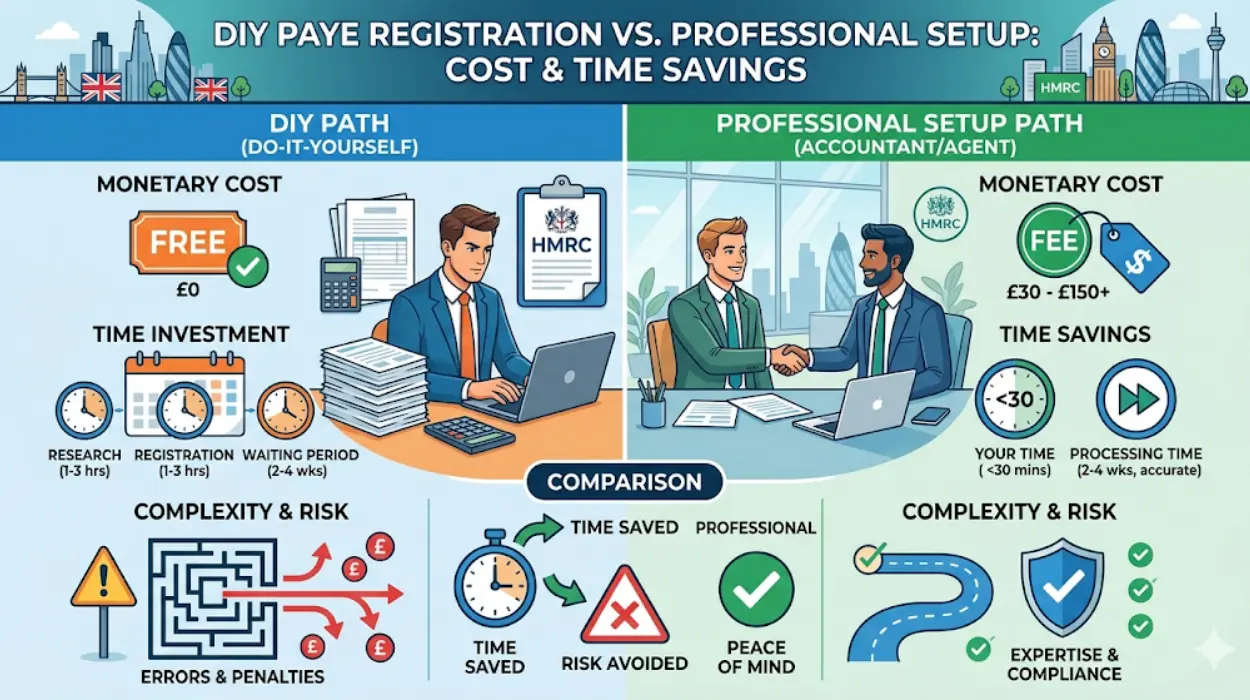
Registering for PAYE yourself can seem cost-effective at first, but it often takes more time, carries compliance risks, and may lead to hidden costs later. Using a professional PAYE setup service can save both time and long-term expenses by ensuring your payroll is HMRC-compliant from day one.
Understanding PAYE Registration in the UK
PAYE (Pay As You Earn) is how UK employers collect Income Tax and National Insurance from employees’ wages. Every company that hires staff whether directors, part-time employees, or contractors must register with HMRC before running payroll.
The registration ensures the business deducts and submits income tax and NIC contributions correctly, protecting both employer and employee from penalties.
For directors of new limited companies, PAYE setup also allows you to legally pay yourself a salary, qualifying for personal tax and pension contributions under HMRC rules.
The DIY PAYE Registration Route
Handling PAYE registration yourself means navigating HMRC’s online portal, setting up payroll software, and ensuring correct code alignment for employees. While this process is theoretically straightforward, it often involves more time and expertise than expected.
Steps Involved in DIY PAYE Registration
- Creating a Government Gateway account for the company.
- Submitting company and employee details to HMRC for PAYE setup.
- Installing and configuring payroll software.
- Aligning tax codes, NI categories, and payment timelines.
- Reporting payroll each month through RTI (Real Time Information).
Each of these steps has multiple layers of compliance especially when it comes to coding directors, setting start dates, and handling irregular pay. Errors in the initial setup can trigger HMRC notices, late filings, or payroll mismatches.
The Hidden Costs of DIY Payroll Setup
Although DIY PAYE registration seems free, the opportunity cost is time. Business owners may spend several hours researching HMRC guidance, correcting input errors, or dealing with penalties for late registration.
Common DIY complications include:
- Incorrect tax code assignments for directors.
- Missed reporting deadlines during setup.
- Mismatched details between Companies House and HMRC systems.
- Payroll software configuration errors (e.g., Real Time Information submissions).
Beyond time, financial repercussions emerge if mistakes result in HMRC fines, underpayment of tax, or employees being incorrectly compensated.

The Professional PAYE Setup Approach
Professional PAYE registration assistance such as through Form My Company’s Paye Registration Assistance service provides businesses with expert management of their payroll setup, ensuring every compliance checkpoint is met without stress.
These services typically include:
- Registering your company with HMRC for PAYE.
- Setting up payroll accounts and linking software.
- Ensuring tax codes and NI categories match employees and directors.
- Advising on optimal payment timing and salary structures.
- Delivering confirmation and documentation for audit readiness.
Because professionals handle this daily, they understand HMRC’s workflow, potential data mismatches, and corrective protocols. As a result, businesses avoid trial-and-error delays and can start payroll processing immediately after registration approval.
Cost Comparison: DIY vs. Professional PAYE Setup
Upfront Financial View
- DIY PAYE registration: Free via HMRC portal but time-intensive.
- Professional setup: Generally ranges between £40–£120, depending on service level and turnaround time.
The difference appears simple on the surface. However, the effective cost shifts when considering time value, error correction, and delayed payroll setup.
Time and Efficiency Value
DIY PAYE setup can take between 3–7 hours for business owners unfamiliar with the process, plus potential back-and-forth with HMRC for clarifications. Professionals complete it within 1–2 business days, including configuration and confirmation.
When calculating hourly opportunity cost (e.g., at £50/hour), this time difference alone exceeds the professional fee. In other words, professional setup pays for itself through efficiency.
Compliance and Risk Management Advantages
Meeting HMRC’s compliance standards is not simply administrative it’s legally binding. Failure to register for PAYE before the first company salary payment can trigger penalties or invalidate certain expense claims.
Professional services like FMC’s Paye Registration Assistance offer reassurance through:
- Verified alignment between HMRC and Companies House data.
- Proper classification of directors and employees.
- Real Time Information (RTI) compliance setup.
- Ongoing guidance on payroll obligations.
This reduces audit risk and ensures the company starts payroll operations on a compliant footing.
By comparison, DIY errors might go unnoticed until HMRC review notices arrive, potentially months after the issue originated.
Time Savings in the Long Run
The initial registration is just one part of the payroll journey. Long-term time savings come from consistent accuracy and having designated systems correctly configured from the start.
Professional setup also ensures that:
- Payroll reporting cycle (weekly or monthly) syncs with business operations.
- Tax code updates are applied automatically.
- Director salary adjustments follow HMRC tax bands optimally.
These structural benefits accumulate substantial savings in administrative effort each year. Over time, outsourced setup and guidance enhance overall operational efficiency especially valuable for growing limited companies managing multiple employees.
Scaling Considerations for Growing Companies
Many new businesses begin with one or two directors but soon evolve to hire staff, interns, or contractors. DIY setup often fails to account for these scaling needs, requiring reconfiguration later.
Professionals ensure the system is scalable from day one. Adjustments such as:
- Adding employee records.
- Managing pension auto-enrolment integration.
- Handling multiple pay frequencies.
All can be easily incorporated into a professionally set up system without major rework or downtime.
When DIY Might Still Make Sense
Not every business requires professional setup immediately. If you are a sole director company paying yourself through dividends only, and not drawing a taxable salary, you may not need PAYE registration right away.
For businesses with financial or tax advisors already managing their accounts, DIY registration under guidance may also be fine. However, when the company employs staff or pays directors via salary, professional setup quickly becomes the practical and compliant choice.
For a detailed explanation of when a new UK limited company should register for PAYE tax, refer to the informational article: When Should a New UK Limited Company Register for PAYE Tax?.
The Mid-Funnel Perspective: Decision Factors
At this MOFU (Middle of the Funnel) stage, business owners already understand what PAYE is they’re deciding how to approach registration most effectively.
Professional setup provides:
- Time savings.
- Fewer compliance risks.
- A smoother onboarding for payroll operations.
DIY, while cost-free on paper, often creates friction, uncertainty, and long-term administrative tasks. For limited companies with active or planned payroll, the professional route offers measurable value in both the short and long term.
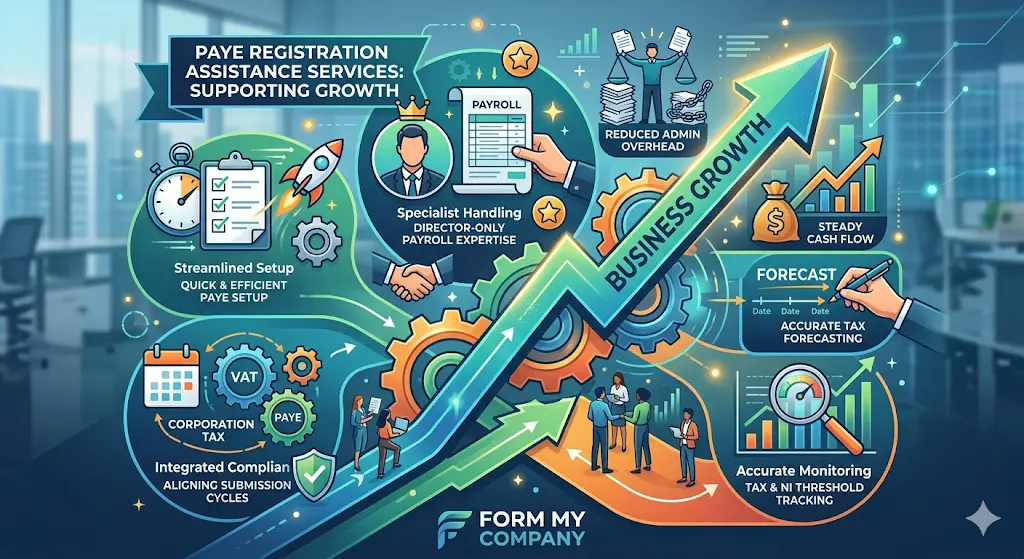
How PAYE Registration Assistance Services Support Growth
Using Form My Company’s Paye Registration Assistance service ensures your PAYE setup complements your broader business framework. That includes:
- Specialist handling of director-only payroll.
- Aligning submission cycles with other filings (VAT, Corporation Tax).
- Ensuring tax and NI thresholds are accurately monitored.
By integrating PAYE registration into a wider company formation or compliance package, businesses streamline their administrative overhead and remain focused on core operations.
For companies preparing to hire or expand, professional services remove the administrative friction entirely. That clarity is essential for maintaining steady cash flow and accurate tax forecasting from your first payroll run onwards.
Transitioning to Full Payroll Management
Once PAYE registration is complete, many companies naturally progress to full payroll management monthly processing, HMRC submissions, and employee record maintenance.
This is where handover efficiency matters. A professional setup helps ensure snag-free transitions into managed payroll tools or accounting software later.
Companies that begin with structured setup often find less ongoing maintenance cost and better reporting accuracy, as their systems were configured correctly from inception.
For those seeking ongoing setup or correction support, FMC’s broader compliance services simplify this path through expert oversight and dedicated client guidance.
To see how a fully managed option can build on the foundation of compliant registration, visit Expert PAYE Registration Service: Set Up Your UK Payroll Correctly a commercial overview outlining professional setup advantages in greater depth.
Between DIY and professional PAYE registration, the difference lies in what your time is worth.
DIY might appear cheaper upfront, but when factoring in setup delays, potential compliance penalties, and administrative strain, professional setup routinely delivers better return on investment.
Businesses that outsource PAYE registration enjoy immediate HMRC compliance, verified payroll configuration, and reduced pressure on directors. It’s not just about cost efficiency it’s about operational certainty.
Form My Company helps new and growing businesses achieve that certainty with reliable, HMRC-approved Paye Registration Assistance, adding transparency, speed, and professional assurance to a crucial compliance process.
What does PAYE registration involve for a new UK company?
PAYE registration is the process of setting up your company with HMRC to deduct Income Tax and National Insurance from employee salaries. It ensures all payroll submissions meet Real Time Information (RTI) compliance. From My Company’s Paye Registration Assistance helps business owners complete this setup efficiently and accurately.
How long does it take to register for PAYE with HMRC?
HMRC usually activates a PAYE reference within 5–10 working days after submission. However, timeline can vary based on company verification and data accuracy. Using From My Company’s Paye Registration Assistance can help reduce setup delays by ensuring all required details are correctly lodged.
Do I need PAYE registration if I am the only director?
A sole director must register for PAYE if they are paid a salary through the company payroll. If income is taken only as dividends, PAYE registration may not be necessary. From My Company provides guidance through its Paye Registration Assistance to determine whether your business needs to register.
What information is required for PAYE registration?
To register for PAYE, HMRC requires your company’s registration number, business address, start date of employment, and employee or director details. Providing accurate information ensures payroll records align across HMRC systems. From My Company includes full data verification within its Paye Registration Assistance service.
What happens if a company doesn’t register for PAYE on time?
Late PAYE registration can result in HMRC penalties, delayed payroll processing, and incorrect tax deductions. It can also affect employee payments and National Insurance records. From My Company’s Paye Registration Assistance helps businesses avoid these risks by ensuring timely registration and compliance setup.