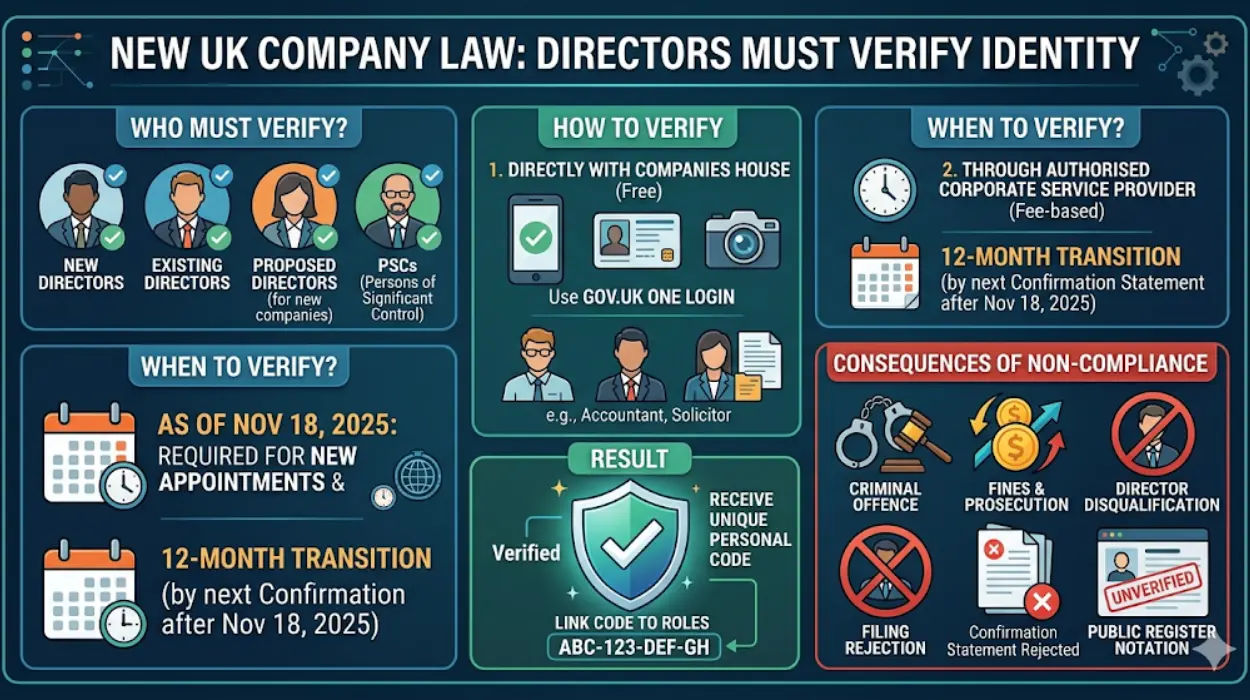
Yes, under the new UK company law effective from March 2024, directors must undergo ID verification to comply with Companies House requirements. This applies to all new and existing directors, ensuring accurate identity records amid rising economic crime concerns.
The Economic Crime and Corporate Transparency Act 2023 (ECCTA) introduced these changes to bolster trust in the UK company register. Directors now face mandatory identity checks, with non-compliance risking fines or disqualification. This article explores the details, implications, and practical steps for businesses navigating these updates.
Understanding the New UK Company Law Changes
The ECCTA marks a significant shift in how Companies House verifies identities, targeting directors and Persons with Significant Control (PSCs) to prevent fraud. Previously, self-certification sufficed for many filings, but the new rules demand verified proof of identity before key actions like incorporation or officer appointments.
This evolution stems from data showing thousands of shell companies exploited for illicit activities. Companies House now acts as an active regulator, requiring digital submission of identity documents. For directors, this means providing government-issued ID, such as a passport or driving licence, verified through secure methods.
Semantic keywords like “director ID verification” and “UK company compliance” underscore the focus on robust checks. Businesses must adapt quickly, as transitional periods end soon, leaving little room for delays.
Who Counts as a Director Under These Rules?
Directors include anyone formally appointed to manage a company’s affairs, whether executive, non-executive, or shadow directors exerting significant influence. The new law closes loopholes, mandating verification regardless of role size.
Consider a startup founder registering their first company: they qualify as both director and PSC, triggering dual checks. Larger firms appointing board members mid-year must also verify promptly. Even alternate directors fall under scrutiny.
Verification confirms not just name and address but biometric elements like facial recognition. This structured approach uploading ID to a Companies House-approved provider ensures entity-based accuracy. Failure here blocks filings, halting operations.
ID Verification Requirements for Directors
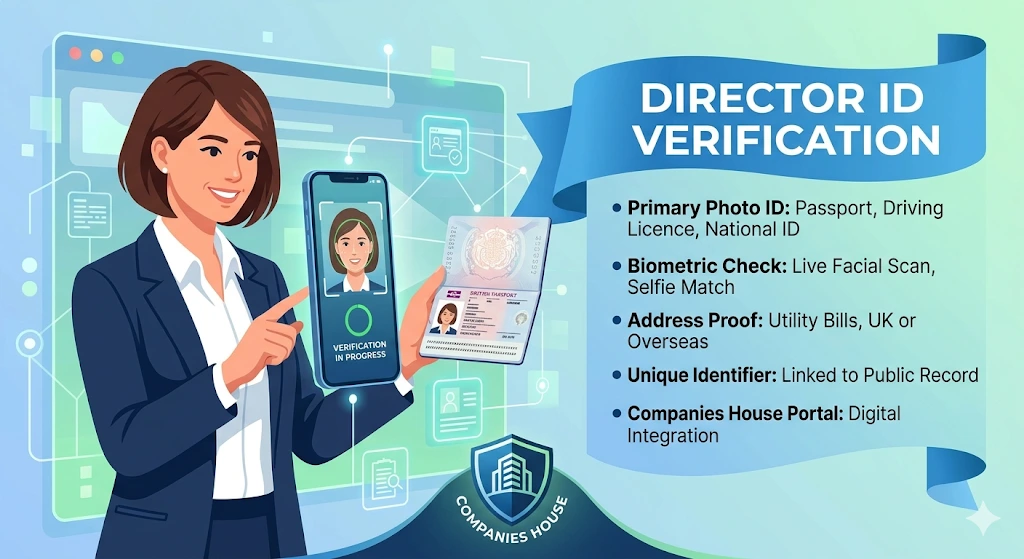
Directors need to submit one primary photo ID (passport, driving licence, or national identity card) plus a “live” biometric check, often via app-based facial scan. Secondary proofs like utility bills support address confirmation.
The process integrates with Companies House’s digital portal. Once verified, a unique identifier links to the director’s record, visible publicly for transparency.
Key requirements include:
- Valid, unexpired government-issued photo ID.
- Proof of UK residency or overseas address if applicable.
- Biometric selfie matching the ID photo.
These steps align with “director identity verification service” standards, preventing impersonation. For PSCs holding over 25% shares or voting rights, similar rules apply, though directors often overlap.
Penalties for Skipping Director ID Verification
Non-compliance carries steep consequences. Companies House can issue civil penalties up to £1,000 per unverified director, escalating to criminal sanctions for deliberate evasion.
Disqualification looms for repeat offenders, barring individuals from directorships for up to 15 years. Companies risk strike-off, dissolving entities without recourse.
A practical example: a small business director delays verification during annual confirmation. Filing rejection follows, triggering fines and reputational damage. Proactive verification via trusted providers avoids this cascade.
The law’s teeth reflect broader anti-fraud efforts. Directors ignoring “new UK company law ID checks” expose themselves and firms to audits, underscoring urgency.
How to Complete Director Identity Verification Efficiently
Streamline the process by choosing an authorised provider registered with Companies House. Upload documents digitally, complete the biometric scan, and receive confirmation within hours.
For instance, a tech firm onboarding a new director selects a service offering end-to-end support. The director scans their passport via mobile app, verifies their face, and gets a shareable code for Companies House submission.
Opt for solutions handling both director and PSC needs simultaneously. This “identity verification service for director or PSC” saves time, especially for multi-director boards.
If you’re wondering about sequencing checks, explore our informational guide on UK Director vs PSC Identity Checks: Which One Do You Need First? for clarity.
Differences Between Director and PSC Verification
While overlapping, director verification focuses on governance roles, whereas PSC checks target ownership control. Directors manage daily operations; PSCs influence via stakes.
Both require ID and biometrics, but PSCs update changes within 14 days. A holding company director might verify once, but multiple PSC entities demand separate filings.
Case-study style insight: Imagine a family business where the owner serves as director and PSC. One verification covers both initially, but share transfers trigger PSC re-checks. Services like Form My Company‘s identity verification service for director or PSC handle these nuances seamlessly.
Timeline and Transitional Provisions
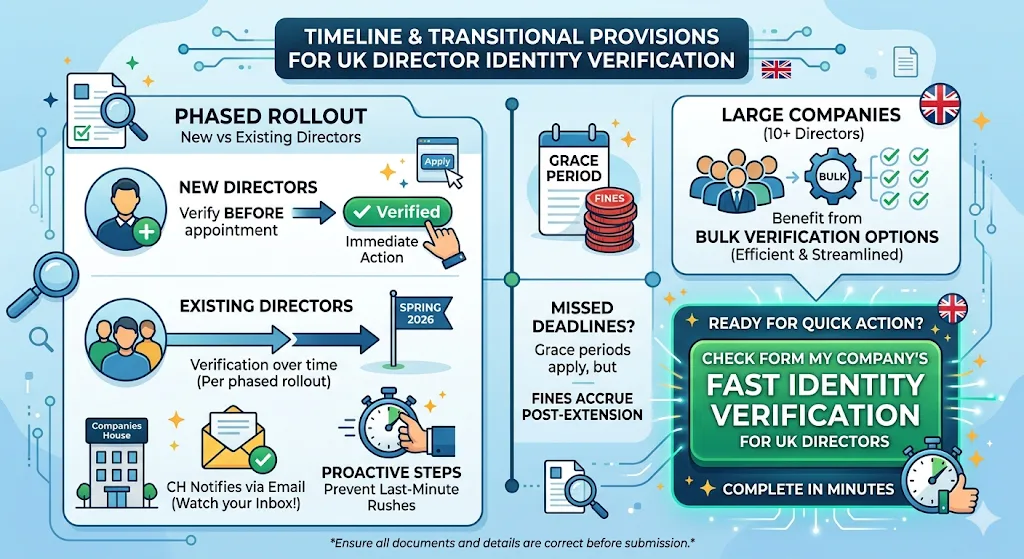
New directors verify before appointment; existing ones by spring 2026, per phased rollout. Companies House notifies via email, but proactive steps prevent last-minute rushes.
Missed deadlines? Grace periods apply, but fines accrue post-extension. Businesses with 10+ directors benefit from bulk verification options.
Ready for quick action? Check Form My Company’s fast identity verification for UK directors to complete in minutes.
Common Challenges and Solutions
Many directors struggle with document quality blurry scans fail uploads. Solution: Use high-resolution cameras and approved apps.
Overseas directors face address proof hurdles; international IDs suffice with apostille stamps. Rural businesses cite tech access issues, but mobile-friendly services bridge gaps.
Form My Company addresses these pain points, providing guided support for seamless compliance under new UK company law.
Preparing Documents for Submission
Gather ID early: passport trumps others for global acceptance. Ensure no alterations; digital copies must match originals exactly.
Practice biometric scans in good lighting. Providers offer tutorials, reducing rejection rates.
For teams, centralise records via dashboards. This entity-based system linking director profiles to company numbers enhances audit trails.
The Role of Authorised Providers
Companies House mandates third-party providers for security. These handle encryption, storage, and verification, sharing only codes with the registrar.
Select providers with FCA oversight for trust. Form My Company’s identity verification service exemplifies this, processing thousands annually with 99% success rates.
Benefits include 24/7 access and integration with incorporation tools.
Future Implications for UK Businesses
These laws pave the way for AI-enhanced registers, flagging anomalies real-time. Directors gain credibility, attracting investors wary of fraud.
Global firms eye UK setups more confidently, boosting FDI. Yet, over-burdened SMEs need efficient partners.
Navigating new UK company law demands precision, but solutions exist. Form My Company delivers professional identity verification for directors and PSCs, ensuring compliance without hassle. Their service integrates effortlessly, safeguarding your business amid evolving regulations.
What is director ID verification under new UK company law?
Director ID verification under the Economic Crime and Corporate Transparency Act requires submitting government-issued photo ID and a biometric selfie to Companies House-approved providers. This confirms identity for new or existing directors to prevent fraud. From My Company’s Identity Verification Service: Director or PSC handles this securely for compliance.
Do PSCs need identity verification in the UK?
Yes, Persons with Significant Control (PSCs) with over 25% ownership must verify their identity via ID documents and biometrics, similar to directors. This applies to company filings and updates with Companies House. From My Company’s Identity Verification Service: Director or PSC covers both roles efficiently.
How long does UK director identity verification take?
UK director identity verification typically completes in minutes to hours using digital apps for ID upload and facial scan. Results link directly to your Companies House record once approved. From My Company’s Identity Verification Service: Director or PSC offers fast processing for immediate filings.
What documents are needed for PSC identity checks?
Required documents include a valid passport, driving licence, or national ID card plus proof of address and a live biometric check. Overseas PSCs may need apostilled equivalents. From My Company’s Identity Verification Service: Director or PSC guides users through acceptable formats.
What happens if a director skips ID verification?
Skipping director ID verification can lead to filing rejections, fines up to £1,000, or disqualification from Companies House. It blocks incorporations and annual confirmations. From My Company’s Identity Verification Service: Director or PSC ensures timely compliance to avoid penalties.