
Yes, UK law permits using your home address as a company registered office, but doing so exposes your private residence on the public Companies House register. This exposure makes your residential address permanently accessible to public searches, direct marketers, cold callers, and unsolicited corporate visitors.
Why Is Your Registered Office Address Publicly Accessible?
UK corporate law requires Companies House to maintain an open public register of all statutory company addresses to ensure corporate transparency. Statutory bodies, official creditors, and members of the public access this database to verify legal entities, direct formal communications, and serve judicial documents.
The UK legal framework establishes corporate accountability through public disclosure. The Companies Act 2006 dictates that every legal entity formed within England, Wales, Scotland, and Northern Ireland must maintain a physical location within its jurisdiction for official service. This location receives statutory mail, legal notices, and official court orders.
Companies House uploads all registered office details directly to its public database. Independent web crawlers, commercial data brokers, and search engines index these official filings instantly. Once an address appears on the public ledger, third-party sites archive the record indefinitely.
Removing a historical residential address from corporate registers presents severe administrative friction. Current legal frameworks allow individual directors to suppress personal residential addresses from public inspection. However, suppressing historical registered office locations requires complex legal petitions and official Companies House applications under strict administrative guidelines.
Residential privacy disappears immediately upon incorporating with a personal dwelling address. Commercial vendors scrape Companies House filings daily to capture newly registered business records. Scraped records fuel aggressive postal marketing lists, telemarketing databases, and unsolicited sales pitches sent straight to personal front doors.
What Are the Main Risks of Publicly Exposing Your Residential Address?
Exposing your home address on public corporate registers compromises personal privacy, compromises personal security, invites physical spam, risks residential mortgage violations, and damages corporate credibility. Personal living spaces become exposed to commercial disputes, unsolicited doorstep visits, and permanent digital indexing.
Security risks increase when business owners publish personal living locations on statutory databases. Aggrieved customers, disgruntled contractors, or litigious commercial entities access Companies House records directly to locate business officers. Physical visits to private homes create safety hazards for household members and disturb personal living environments.
Leasehold contracts and residential mortgage agreements frequently restrict commercial activities on domestic premises. Lenders and landlords write restrictive covenants into property agreements to prohibit formal business registration on private properties. Registering a personal dwelling as an official corporate headquarters triggers contractual violations, jeopardizes tenancy agreements, and causes mortgage disputes.
Commercial credibility suffers when prospective enterprise clients inspect corporate filings. Institutional buyers analyze official company addresses during due diligence checks. A residential street address signals temporary operations, lower operational scale, and potential administrative instability to corporate procurement teams evaluating potential vendor contracts.
Statutory documents delivered to personal living spaces get mixed with personal mail. High volumes of corporate spam, legal compliance demands, and tax notices clutter domestic mailboxes. Missing an urgent legal communication or HM Revenue and Customs tax demand because of domestic mail disorganization leads to statutory penalties, financial fines, and corporate strike-off notices.
Local authority compliance creates administrative hurdles for home-based founders. Local councils apply business rates or specific zoning restrictions when property owners execute formal business administration from domestic buildings. Local planning authorities evaluate residential zones strictly to prevent commercial noise, excessive traffic, and unauthorized signage.
How Does a Professional Registered Office Address Protect Your Privacy?
A professional registered office address substitutes your personal residential location on statutory public records with a commercial venue. Professional address providers receive, process, and forward legal mail while keeping your home location completely off Companies House filings.
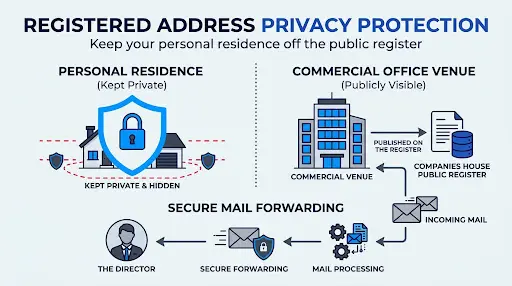
Privacy protection relies on establishing a distinct separation between personal real estate assets and statutory corporate entries. Professional corporate address services offer prestigious commercial locations in major financial hubs. Incorporating with a commercial address guarantees that statutory public portals list business district credentials rather than suburban domestic properties.
Digital address management services process statutory communications efficiently. Operational teams receive incoming correspondence from statutory bodies, including HM Revenue and Customs and Companies House. Professional staff scan legal letters, digitize statutory notices, and forward uploaded documents directly to secure digital portals within hours of delivery.
A commercial presence elevates market perception among enterprise clients, partners, and financial institutions. Operating with a prime corporate address builds operational trust, demonstrates commercial stability, and strengthens brand presence. Corporate clients favor vendors that maintain established commercial profiles during competitive tender processes.
Property contracts stay protected when founders separate home life from corporate filings. Landlords and mortgage underwriters require property owners to comply strictly with residential usage terms. Utilizing a dedicated commercial address prevents domestic breach of contract notices and keeps personal property insurance policies intact.
Professional facilities manage legal service of process structured around statutory compliance guidelines. Qualified administrative staff handle official deliveries, court summonses, and formal compliance notices professionally. Systematic mail processing prevents mislaid documentation, eliminates missed legal deadlines, and ensures statutory compliance across all operations.
When Should You Transition Away From a Home Address Registration?
You should transition away from a home address registration before scaling operations, taking external capital, hiring staff, or launching public marketing campaigns. Changing your address early prevents long-term public exposure and simplifies corporate record management.
Growing businesses require formal privacy structures before raising capital or executing public relations campaigns. Investor group check lists mandate strict risk management standards across portfolio companies. Venture capitalists and angel investors require clean corporate governance structures, including dedicated commercial addresses, before releasing funds.
Hiring remote or office-based team members requires professional operational boundaries. Employees, contractors, and agency partners examine public company filings during employment onboarding. Maintaining personal domestic premises on corporate registers exposes personal life to staff, creates professional boundaries issues, and reduces executive authority.
Launching aggressive marketing strategies drives digital traffic directly to corporate filings. Curious consumers, competing brands, and media journalists routinely audit Companies House listings. Exposing personal domestic properties during public product launches undermines promotional efforts and exposes family members to unwanted public attention.
Updating corporate records early limits historical digital trails across external data archives. Search engine crawlers crawl Companies House updates constantly, indexing official corporate addresses across hundreds of public registry mirrors. Changing registered details swiftly reduces the distribution of private information across third-party corporate data directories.
Switching statutory registered addresses involves specific legal steps. Directors submit official notification to Companies House using statutory electronic filing tools. Once Companies House confirms registration, corporate teams update stationery, banking records, domain registrations, supplier agreements, and legal contracts to complete the administrative transition.
What Official Alternatives Exist for UK Registered Office Addresses?
Official UK registered office alternatives include commercial office spaces, specialized virtual address providers, solicitor offices, and corporate service partners. These services provide physical locations within designated UK jurisdictions to fulfill statutory requirements legally.
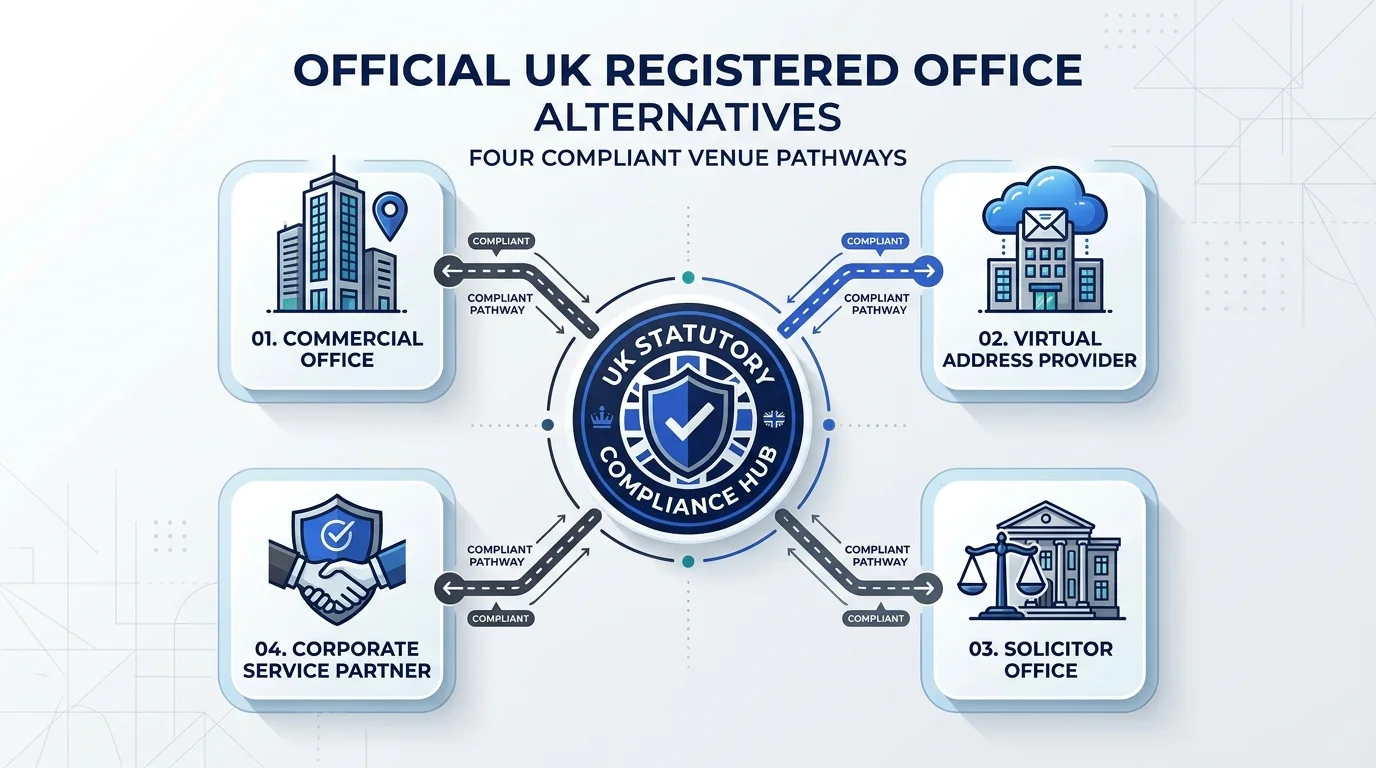
Specialized corporate address solutions supply statutory compliance without requiring physical office space rentals. Service providers operate established commercial premises across key business districts. These facilities accept official government communications, handle physical legal deliveries, and maintain statutory inspection logs required under UK corporate law.
Solicitors and accountants occasionally offer statutory address accommodation for established retainers. Legal firms host corporate entries on their premises to oversee compliance documentation directly. However, traditional law firm retainers typically carry higher recurring administrative costs compared to specialized corporate secretarial services.
Renting physical commercial property provides a direct registered address alternative for larger organizations. Taking commercial leases on offices, retail shops, or industrial units fulfills Companies House location criteria. However, commercial property leases require long-term financial commitments, substantial security deposits, and ongoing property management fees.
Corporate secretarial teams offer comprehensive compliance documentation alongside basic address handling. Selecting structured corporate administration services ensures complete statutory alignment with UK filing mandates. When establishing official corporate governance frameworks, incorporating targeted Supplementary Company Documents ensures your business maintains fully compliant statutory records, official registers, and corporate filings.
Comparing address protection choices requires evaluating long-term operational privacy objectives against administrative budgets. Reading a comprehensive breakdown on Home Address vs Registered Office Service: Which Protects Your Privacy? helps directors choose optimal operational security frameworks for their corporate structure.
Securing corporate privacy demands robust statutory documentation and specialized legal administrative tools. Securing your business operations early with a professional structure ensures complete domestic protection. You can easily Protect Your Privacy With a Form My Company Letter of Authority to delegate statutory correspondence management, maintain total domestic anonymity, and protect personal real estate assets.
Explore More Supplementary Company Documents Guide,
What Do Investors Look for in Your Articles of Association?
What Are the Share Transfer Rules in Articles of Association?
Frequently Asked Questions
What are supplementary company documents for a UK business?
Supplementary company documents are official legal certificates, registers, and legal resolutions that complement a UK company’s core incorporation papers. Services provided by Form My Company help directors issue, update, and maintain these essential governance files—including certificates of good standing, share certificates, and director service agreements—to ensure full statutory compliance under the Companies Act 2006.
Why does a business need supplementary company documents after incorporation?
Companies require Supplementary Company Documents to verify corporate structure during banking setup, investor due diligence, property leases, or statutory audits. Obtaining these official legal records through Form My Company ensures that director appointments, share allocations, and legal authorities are accurately documented and recognized by financial institutions and government regulators.
How do I order supplementary company documents online?
Business owners can request official legal paperwork directly through the Form My Company portal by selecting the required statutory forms. The Supplementary Company Documents service compiles, validates, and delivers digitally signed or physical legal certificates formatted to meet UK Companies House standards.
Which documents are included in supplementary company documentation services?
Standard supplementary packages include corporate registers, share transfer forms (J30 stock transfers), director service contracts, power of attorney documents, and minutes of board meetings. Form My Company tailors these supplementary company documents to reflect current corporate changes and maintain audit-ready business records.
Are supplementary company documents legally binding in the UK?
Yes, statutory documents prepared according to UK corporate law are legally binding when properly executed by company officers. Utilizing Form My Company to draft and maintain your Supplementary Company Documents ensures all statutory registers and corporate filings comply with current legal requirements and withstand legal inspection