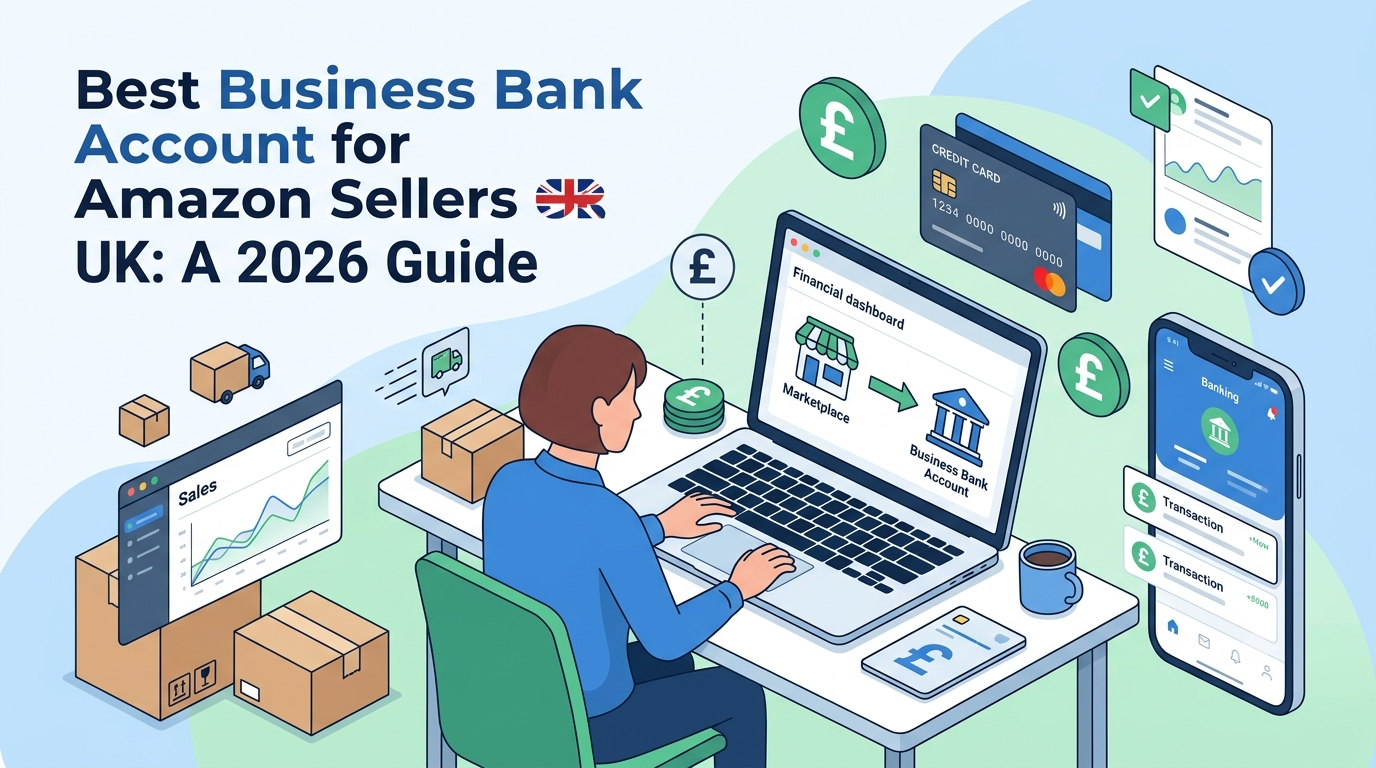
Best Business Bank Account for Amazon Sellers
If you sell on Amazon UK or across Europe from a UK limited company, your business bank account isn’t just where money sits. It’s the point where marketplace disbursements land, where FBA fees and advertising costs come out, and where currency conversions quietly eat into your margin. Choosing the right account can make a genuine difference to your take-home profit. At Form My Company, we help Amazon sellers form their UK companies and connect them with banking partners suited to their needs. In this guide we explain what Amazon sellers should look for and compare the main options in 2026.
Because features and fees change and the “best” account depends on how you sell, this guide focuses on what to prioritise and the current landscape, and we recommend checking terms directly with any provider before applying.
Why Amazon Sellers Have Distinct Banking Needs
Amazon selling has its own rhythm that a general business account may not handle well. The factors that matter most for FBA and marketplace sellers include:
- Marketplace disbursement cycles. Amazon typically pays out on a rolling schedule (often every 14 days for standard sellers), sometimes with reserves held back. Your account needs to receive these disbursements smoothly and give you visibility on reconciliation.
- Multi-currency payouts by storefront. If you sell on Amazon.co.uk, Amazon.de, Amazon.fr, and beyond, payouts arrive in different currencies (GBP, EUR, and more). Without a multi-currency account, you’re forced to convert each payout at potentially poor rates.
- Foreign exchange on outgoing costs. Amazon fees, FBA charges, and Sponsored Ads spend for European marketplaces are often billed in EUR. Paying these from a GBP-only account triggers FX fees every single month.
- Overseas supplier payments. Cost of goods often comes from China, the EU, or the US. Every conversion on supplier payments costs margin.
- VAT payments to HMRC. UK Amazon sellers registered for VAT need reliable GBP payments to HMRC, and Amazon’s VAT Calculation Service and VAT invoicing add administrative complexity.
- Chargebacks and A-to-z claims. Amazon customer refunds and A-to-z Guarantee claims come back through your finances, so your account needs to handle these smoothly.
- Accounting integration. With Amazon fees, reserves, refunds, storage fees, and multiple currencies flowing through, connecting your account to software like Xero, QuickBooks, or Link My Books is essential for clean bookkeeping.
- Amazon Seller Central verification. Amazon requires bank account details on your Seller Central profile that match your legal business name, and the account must be in a supported country. Getting this right first time avoids account suspensions.
Multi-Currency Is Almost Always the Priority
Of all the factors above, multi-currency capability tends to be the single biggest driver of profitability for Amazon sellers trading beyond the UK marketplace alone. Here’s why: if you sell on Amazon.de and get paid in EUR, you can either:
Receive the EUR into a local EUR account (via a multi-currency provider), hold it, and pay your EUR-denominated Amazon fees, VAT, and EU suppliers directly from that balance, keeping conversion to a minimum. Or, receive the EUR into a GBP-only account, force conversion at your bank’s exchange rate (often with a markup), then convert GBP back to EUR every time you need to pay a EUR bill.
The second option costs you FX twice on the same money. Over a year, this can add up to a meaningful chunk of your net profit. This is why most serious Amazon sellers trading internationally lean toward providers with strong multi-currency features.
The Main Business Bank Account Options for Amazon Sellers
Several providers are widely used by UK Amazon sellers, each with its own strengths:
- Wise Business. Very strong for cross-border Amazon sellers, thanks to UK account details plus local receiving details in EUR, USD, and many other currencies, mid-market exchange rates, and transparent FX fees (from around 0.33%). Popular for receiving multi-marketplace payouts and paying overseas suppliers. UK pricing is a free Essential plan and a £50 one-off Advanced plan that unlocks receiving payments. FCA-authorised e-money institution, not FSCS protected.
- Airwallex. Purpose-built for globally trading businesses, with strong multi-currency features, business cards, expense management, and integrations aimed at online sellers. Well suited to Amazon sellers scaling across multiple marketplaces and managing team spending.
- Revolut Business. Multi-currency accounts, cards, and business tools that scale as your operation grows. Widely used by Amazon sellers, particularly those valuing card-based team expense management.
- Tide. UK-focused fintech account with FSCS protection through ClearBank. Best for UK-focused sellers, or as a secondary GBP account alongside a multi-currency fintech. Less strong for heavy international marketplace activity.
- Starling Bank. Fully licensed UK digital bank with FSCS protection and strong app-based features. Usually requires UK proof of address, which limits it for non-resident Amazon sellers.
- High street banks (Barclays, HSBC, Lloyds, NatWest). Offer FSCS deposit protection and traditional banking services, but international transfers are typically more expensive and non-resident applications are often difficult. Sometimes used as a secondary account for holding larger reserves.
The Important FSCS vs E-Money Point for Amazon Sellers
Before deciding where to hold your money, understand the difference. Fully licensed banks offer FSCS deposit protection on eligible balances up to the scheme’s limit. E-money providers like Wise are FCA-authorised and safeguard customer funds, but those funds sit outside FSCS. Neither is inherently wrong, but for an Amazon seller holding significant working capital (particularly leading into peak seasons like Q4), it’s a genuine consideration. A common approach is to use a multi-currency fintech for operational money that’s constantly moving in and out, and hold larger reserves in a fully FSCS-protected account.
Matching an Account to How You Sell
Rather than crown a single winner, match provider strengths to your Amazon model:
- UK-only Amazon seller in GBP. Tide or Starling often suit well, offering low-cost, FSCS-protected UK banking. A multi-currency account may be less essential.
- Multi-marketplace European seller. Wise Business or Airwallex tend to be strongest, thanks to local receiving accounts in EUR (and other currencies) that let you hold funds and pay EU-denominated Amazon fees, VAT, and suppliers directly.
- Global seller, including US or other marketplaces. Wise or Airwallex again shine, with local receiving accounts in USD and other currencies, and strong FX pricing on outgoing supplier payments.
- Non-resident UK Amazon seller. Digital fintechs are effectively the only realistic route, since most high street banks require UK-resident directors. Wise, Revolut, Tide, and Airwallex all accept non-residents.
Many Amazon sellers actually use two accounts, running a multi-currency fintech for daily operations and a UK-focused account (often FSCS-protected) for reserves and paying UK expenses like VAT.
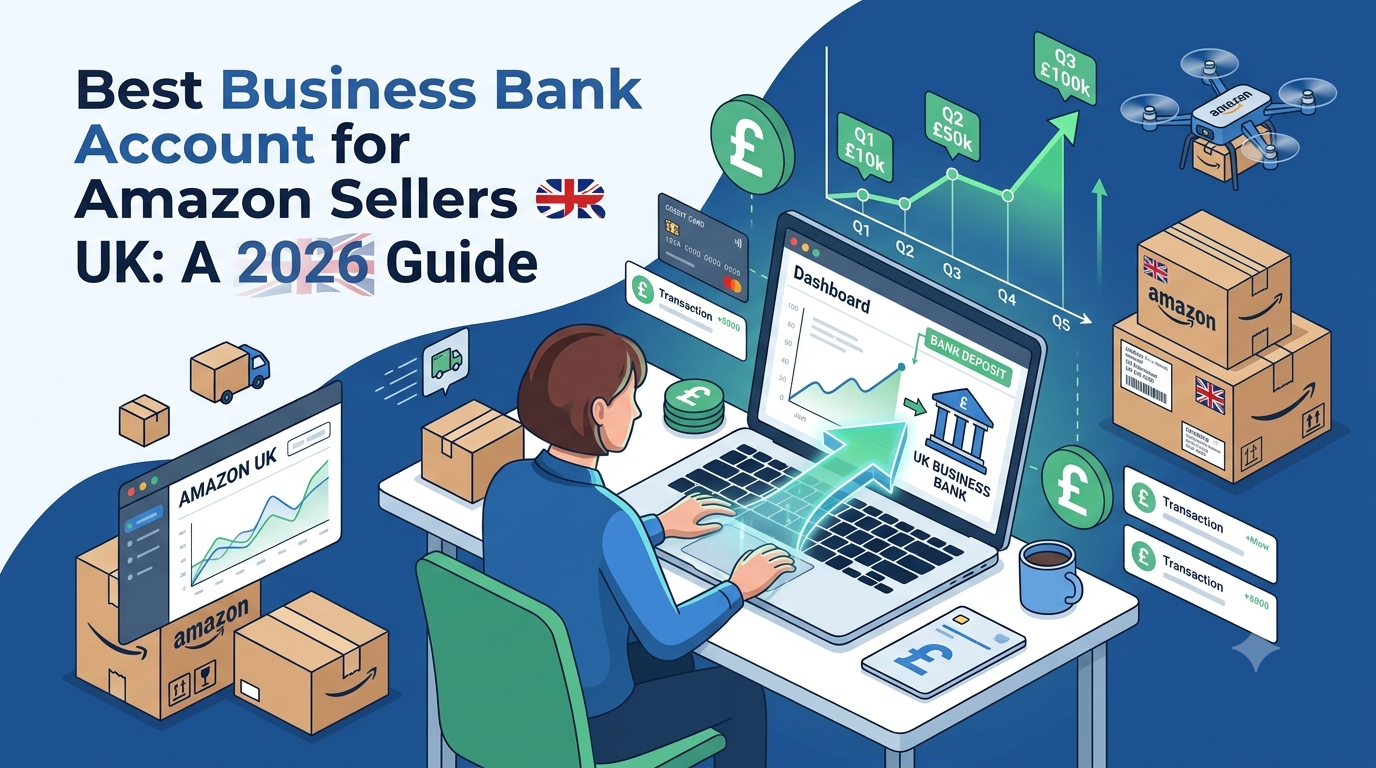
Things to Watch Out For as an Amazon Seller
A few Amazon-specific issues come up often:
- Business name matching. The name on your bank account must match your legal business name on your Amazon Seller Central profile exactly. Mismatches can trigger disbursement holds. If you’ve formed your UK company with a specific legal name, make sure your bank application uses the same.
- Amazon disbursement country. Amazon disbursements must go to a bank account in a supported country. UK Amazon.co.uk payouts to a UK-based account (including UK details provided by fintechs like Wise) generally work smoothly.
- Chargeback and reserve handling. Amazon may hold reserves against pending chargebacks and A-to-z claims. Your account needs to reflect these movements clearly for reconciliation.
- Category restrictions. Some fintechs restrict certain product categories under their acceptable use policies (adult goods, weapons, alcohol, tobacco, CBD, and others). Check the provider’s terms against what you sell before applying.
- Accounting connections. Tools like Link My Books, A2X, or Xero integrations save huge amounts of time on Amazon bookkeeping. Choosing an account that connects to your accounting stack is worth it.
What You’ll Need to Apply
Regardless of provider, Amazon sellers typically need:
- A properly registered UK limited company, with Certificate of Incorporation and company registration number (CRN)
- A UK registered office address, which we provide in our Non-Residents package
- Valid photo ID for directors and beneficial owners, such as a passport
- Proof of address, though whether UK or international is accepted varies by provider
- Details of your Amazon selling activity, expected disbursement volumes, and marketplaces
- A link to your Amazon storefront or online presence, which speeds up verification
Preparing all of this in advance is the single biggest factor in a fast, smooth approval.
How Form My Company Helps
We take the biggest hurdle out of the process. First, we form your UK limited company quickly and correctly, giving you the Certificate of Incorporation, company registration number, and registered office address you’ll need for any banking application (and for Amazon Seller Central verification). Second, we introduce you to banking partners suited to Amazon sellers, so you’re not searching alone. Final account approval always rests with the provider, but our support significantly smooths the path.
Set Up Your Amazon Business and Banking Today
The best business bank account for a UK Amazon seller isn’t a single provider, it’s the one that matches how you sell, which marketplaces you operate on, and how much protection you want on your capital. With Form My Company, getting your company formed and finding suitable banking is quick and fully supported. Get started today, and check current terms with any provider before applying to be sure it’s the right fit for your Amazon business.
Frequently Asked Questions
Which is the best business bank account for UK Amazon sellers?
There’s no single best account, as it depends on how you sell. Multi-marketplace sellers often prefer multi-currency-focused providers like Wise or Airwallex. UK-only sellers may prefer Tide or Starling. Many use two accounts to combine strengths.
Why do multi-currency accounts matter for Amazon sellers?
Because selling on Amazon.de, Amazon.fr, or Amazon.es generates EUR payouts, while your business is UK-based. A multi-currency account lets you receive EUR into a local EUR balance and pay EUR-denominated Amazon fees, VAT, and suppliers without forced conversion, protecting your margin.
Can non-resident Amazon sellers open a UK business account?
Yes, though not usually with a high street bank, which typically requires UK-resident directors. Digital providers like Wise, Revolut, Tide, and Airwallex accept non-resident Amazon sellers and offer fully remote onboarding.
Does my business bank name need to match my Amazon Seller Central profile?
Yes. The name on your bank account must match your legal business name on Seller Central exactly. Mismatches can trigger disbursement holds, so consistency between your UK company registration, Seller Central, and bank account is essential.
Are Wise and Revolut FSCS protected?
No. Both are FCA-authorised e-money institutions that safeguard customer funds, but balances sit outside FSCS deposit protection. Fully licensed banks (or fintechs like Tide via ClearBank) offer FSCS cover on eligible balances, which some sellers prefer for reserves.
Should I use more than one business account?
Many Amazon sellers do exactly that, running a multi-currency fintech for daily operations and marketplace payouts, plus a UK-focused FSCS-protected account for reserves and UK expenses like VAT. It’s a practical way to combine FX savings and deposit protection.
Do I need a UK company before opening an Amazon seller bank account?
Yes. To open a UK business account with virtually any provider, and to sell professionally on Amazon UK, you need a UK-registered company. We form your UK limited company and provide a compliant registered office address, giving you the credentials you need.