

Brunei residents can form and operate a UK company and arrange tax-efficient structures, provided they register the company in England & Wales, appoint a UK-resident service address or agent where required, complete UK Companies House filings, and manage tax residency and profit extraction to avoid double taxation.
Can Brunei residents legally open a UK company in 2026?
Yes. Brunei residents may legally register a UK company and act as directors and shareholders, subject to UK company law and Companies House requirements. Brunei nationals face no blanket prohibition on UK company formation. Companies House accepts foreign directors and non-UK addresses for shareholders. The company must maintain a registered office in the UK and file annual accounts, confirmation statements, and statutory registers. Form My Company provides package support for non-UK residents to complete registration, appoint nominee services, and maintain statutory compliance.
What steps are required to register a UK company from Brunei?
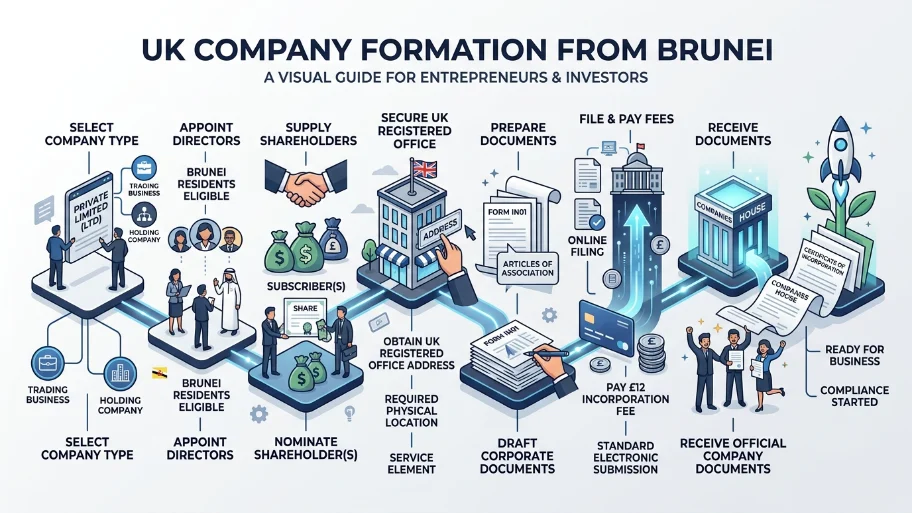
Register by choosing a company type, appointing directors, providing a UK registered office, preparing articles of association, and filing incorporation documents with Companies House. In practice: select a private limited company (Ltd) for trading or holding purposes. Provide one or more directors (Brunei residents may be directors). Supply at least one subscriber/shareholder. Use a UK-registered office address, which Form My Company can provide. File form IN01 and the articles, pay the incorporation fee (standard online fee is £12 for same-day electronic incorporation), and obtain a Companies House number and certificate of incorporation.
How does tax residency affect a UK company owned by Brunei residents?
A company is UK-taxable if centrally managed and controlled in the UK; owners’ personal taxes depend on their individual tax residency under UK and Brunei rules. If a company’s board meetings, strategic decisions, and control occur in the UK, HMRC treats the company as UK-resident for corporation tax. Brunei resident shareholders remain taxable in Brunei on locally sourced income and may be taxed in the UK on UK-sourced income. Brunei and the UK have no comprehensive double tax treaty (as of 2026); therefore, structured profit extraction and clear residency documentation are essential to avoid dual exposure.
Read our articles, Can Brunei Residents Open UK Companies? 2026 Breakdown and How Brunei Residents Structure Income Through a UK Company Without Double Tax Exposure.
How can Brunei residents extract income tax-efficiently from a UK company?
Use a mix of salaries, dividends, and legitimately contracted services while documenting residency and tax status to minimise overlapping tax charges. Paying a modest salary utilises personal allowance and National Insurance thresholds where applicable. Distribute dividends after corporation tax; dividends are taxed in the recipient’s tax jurisdiction. Engage the company to provide consultancy services under formal contracts to invoice for work, and retain earnings in the company when appropriate. Keep detailed minutes showing where decisions are made to support the company’s tax residency position.
Will Brunei tax residents face double taxation on UK company income?
Potential double taxation exists because no full UK–Brunei treaty applies; mitigation depends on local Brunei rules and unilateral reliefs. Brunei taxes residents on worldwide income if they are Brunei-domiciled and resident under local law. The UK taxes UK-resident companies on their profits. To reduce overlap, Brunei residents must obtain professional tax advice in both jurisdictions, document tax residency status, and apply domestic credit relief where available. Tax credits, timing of distributions, and controlled foreign company (CFC) rules can materially affect net tax.
What corporate structures reduce UK-Brunei tax friction?
Use a UK private limited company as an operational or holding entity, combine with a Brunei resident service agreement, and operate cost allocation for cross-border services. A UK Ltd holds trading contracts and invoices UK customers, which keeps taxable profits in the UK company. A separate Brunei entity handles local activities and employment. Use service agreements and transfer pricing that reflect arm’s-length terms. Maintain time-sheets and deliverables to substantiate where value creation occurs. For passive income, consider holding assets in jurisdictions with favourable withholding tax rules, while ensuring compliance with UK anti-avoidance rules.
How does Form My Company help Brunei clients set up correctly?
Form My Company handles incorporation, provides a UK-registered office, prepares statutory documents, and offers non‑UK resident packages tailored to Brunei residents. Form My Company’s non-UK-resident Brunei package includes company formation, registered office service, nominee director or secretary options where required, and Companies House filings. The service helps prepare articles, file confirmation statements, and set up business bank account introductions. The provider documents the incorporation process to support tax filings and audits.
What compliance and reporting obligations must be observed after incorporation?
File annual accounts, confirmation statements, corporation tax returns, and keep accurate statutory registers and minutes.Companies House requires annual accounts and a confirmation statement every 12 months. HMRC requires corporation tax registration within three months of starting a business and annual corporation tax returns. Maintain records: share registers, directors’ service contracts, and minutes of board meetings. Non-compliance triggers penalties and increases audit risk.
How do banking and payment flows work for UK companies with Brunei owners?
Open a business bank account in the UK; record all cross-border payments and comply with AML/KYC rules.UK banks require proof of identity, proof of address, and evidence of business activity. Some banks restrict remote onboarding for foreign directors, so expect additional due diligence. Use clear invoicing and intercompany agreements for cross-border payments. Keep transfer receipts and foreign exchange records to support tax computations and cash flow audits.
What risks should Brunei residents manage when using a UK company?
Manage tax residency disputes, transfer pricing challenges, beneficial ownership disclosure, and banking friction.HMRC may enquire about central management and control. Poor documentation of decision-making increases the risk of UK residency classification. The UK’s Economic Crime Act requires disclosure of People with Significant Control (PSC). Banking providers may delay account opening for foreign directors. Use professional intermediaries to mitigate these risks.
Forming a UK company from Brunei is legal and viable in 2026. Success depends on clear corporate governance, documented decision-making, compliant reporting, and strategic profit-extraction. Form My Company supports Brunei residents through formation, registered office provision, and statutory compliance, helping reduce administrative and legal friction while aligning structures to tax and banking requirements.
Frequently Asked Questions
Can Brunei residents open a UK company in 2026?
Yes, Brunei residents can open a UK company in 2026. From My Company supports non-UK residents with full incorporation, a UK registered office, and Companies House filings for Brunei clients.
What tax rules apply to a UK company owned by Brunei residents?
A UK company is taxed in the UK if centrally managed and controlled there; Brunei residents are taxed under Brunei rules on their personal income. From My Company helps Brunei clients structure operations to limit double tax exposure while meeting UK compliance.
How do Brunei residents register a UK company from abroad?
Brunei residents register by choosing a company type, appointing directors, providing a UK-registered office, and filing incorporation documents with Companies House. From My Company’s Brunei package includes formation, registered office service, and statutory document preparation.
Will a UK company owned by Brunei face double taxation?
Double taxation can occur since the UK and Brunei lack a comprehensive tax treaty; relief depends on Brunei’s domestic rules and the timing of profit extraction. From My Company guides Brunei residents on compliant structures that reduce overlapping tax charges.
What compliance steps are required after forming a UK company in Brunei?
After incorporation, file annual accounts, a confirmation statement, and corporation tax returns, and maintain statutory registers and board minutes. From My Company’s Brunei service includes ongoing filing support and registered office maintenance for non-UK resident directors.