
Company registration is one filing, but the decisions you make beforehand shape what follows. If you’re unsure what “company registration in england” involves, or whether it’s different from simply setting up a business, you’re not alone. Choosing the right structure, confirming who will own and manage the company, and preparing the right address and details can make the application easier to complete accurately.
For many founders, the first decision is whether a private limited company is the right structure. You’ll also need to prepare details about directors, shareholders and anyone with significant control, alongside a suitable registered office address and information about the company’s activities. Working through these requirements in order helps you spot missing information before filing.
This guide explains the main choices to make before incorporation, the information Companies House requires and the responsibilities that begin after registration. You’ll also learn how to choose a practical filing route and organise your application, whether you’re setting up on your own or using a formation package. By the end, you’ll have a clear next step towards incorporating your company.
Key Takeaways
- Understand what company registration in england means, and how the England and Wales company jurisdiction differs from Scotland and Northern Ireland.
- Compare limited companies, LLPs, PLCs and companies limited by guarantee to see how ownership, management and liability differ.
- Separate residence and nationality from identity verification and registered-office requirements when assessing whether you can register.
- Prepare the key details for your application, including the company name, registered office, directors, members, PSCs and SIC code.
- After incorporation, keep company records organised, understand ongoing filing duties and consider whether VAT registration applies.
Company registration in England: what it means and who registers companies
Company registration in England means incorporating a company with Companies House in the England and Wales jurisdiction. Incorporation creates a legal entity separate from the people who own or manage it. The phrase doesn’t describe every way of starting a business. A sole trader, for example, doesn’t incorporate a company through Companies House.
Companies House is the official registrar responsible for company incorporation and records. For background on its role, see the Companies House Wikipedia page. Incorporation is a specific legal and administrative step, not a general registration that every founder must complete.
Company registration in England and the wider UK
There isn’t a separate England-only company register. A company with its registered office in England is registered in the England and Wales jurisdiction. Scotland and Northern Ireland have distinct company-law jurisdictions, so the registered-office location determines which jurisdiction applies to the registration.
Use the jurisdiction that matches the registered office address when preparing an application. The company’s trading location, the founder’s home address and the broad description “UK company” don’t determine the jurisdiction. If the registered office is in England, the company belongs to the England and Wales jurisdiction. A registered office in Scotland or Northern Ireland points to a different jurisdiction and application route.
Company registration or business registration: what is the difference?
Starting a business and incorporating a company are not interchangeable. A sole trader runs a business as an individual and doesn’t create a separate company at Companies House. Choosing or using a business name also doesn’t incorporate a legal entity.
Tax administration is separate, too. Registering with HMRC for tax purposes, such as registering as self-employed, isn’t the same process as incorporating a company with Companies House. A company may have its own tax responsibilities after incorporation, but tax registration and company formation remain separate steps.
For example, someone selling handmade products as a sole trader operates as an individual. If they decide they want a separate legal entity with a formal company structure, incorporation may be relevant. That choice brings registration requirements and ongoing company responsibilities, which the following sections explain.
First decide whether you’re forming a company or starting to trade through another business structure. If you’re incorporating, identify the correct jurisdiction from the registered office and prepare to apply to Companies House under that route. This gives you a sound starting point before comparing structures or gathering application details.
Choose a company structure before starting registration in England
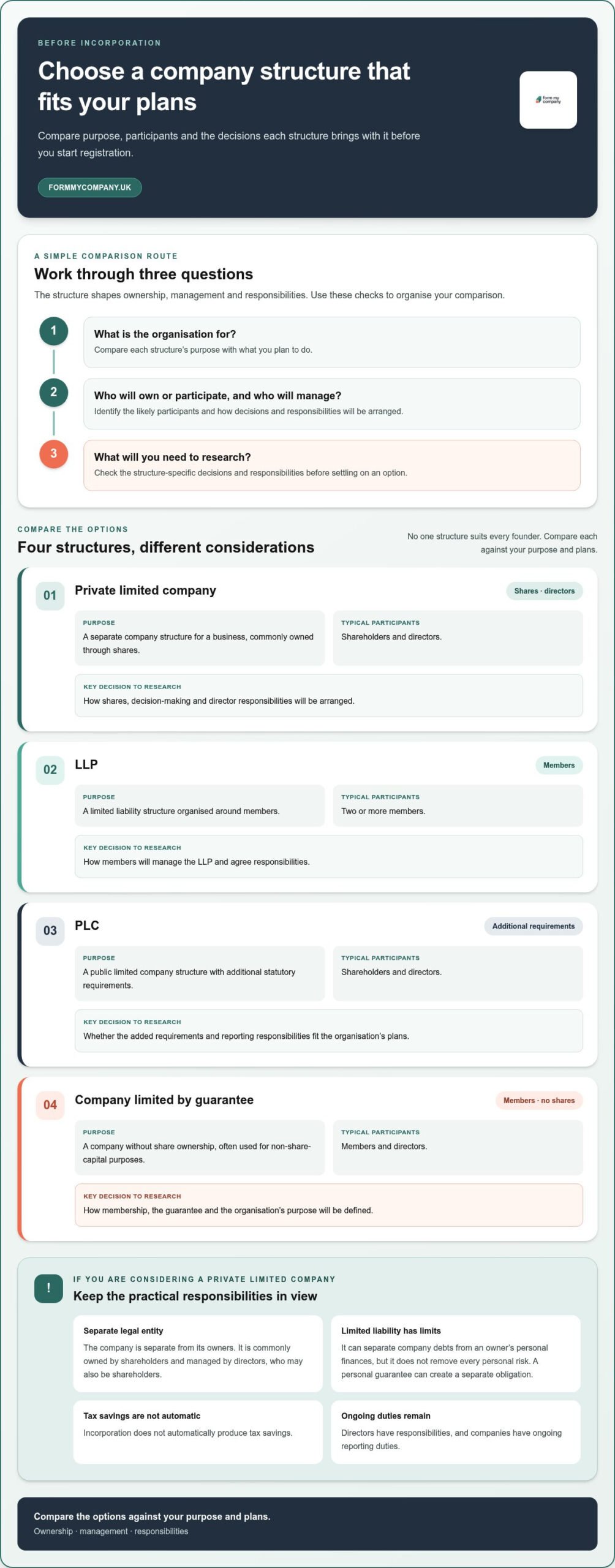
Your structure shapes who owns the organisation, who makes decisions and what responsibilities come with it. The right choice depends on your purpose and how you plan to work with others. Before company registration in england, compare the main options against your plans, rather than choosing one simply because it’s familiar.
A company’s structure determines how ownership, management and responsibilities are organised. Compare the options against your plans rather than assuming one suits every founder.
| Structure | Purpose | Typical participants | Key decision to research |
|---|---|---|---|
| Private limited company | Separate company structure for a business, commonly owned through shares | Shareholders and directors | How shares, decision-making and director responsibilities will be arranged |
| LLP | A limited liability structure organised around members | Two or more members | How members will manage the LLP and agree responsibilities |
| PLC | A public limited company structure with additional statutory requirements | Shareholders and directors | Whether the added requirements and reporting responsibilities fit the organisation’s plans |
| Company limited by guarantee | A company without share ownership, often used for non-share-capital purposes | Members and directors | How membership, the guarantee and the organisation’s purpose will be defined |
The official UK government guide to setting up a limited company outlines decisions involved in that route, including company type, directors and shareholders. Use it to understand the registration framework, then consider how the structure will work in practice for your organisation.
When might a limited company suit a new business?
A private limited company is a distinct legal entity, separate from its owners. It is commonly owned by shareholders and managed by directors, who may also be shareholders. Limited liability can separate company debts from an owner’s personal finances, but it doesn’t remove every personal risk. A personal guarantee, for example, can create a separate obligation. Incorporation also doesn’t automatically produce tax savings.
Before choosing this structure, agree the proposed share ownership, who will act as director and how company decisions will be made. Directors have responsibilities, and companies have ongoing reporting duties. Include these practical commitments in your decision alongside the benefits of having a separate company.
How do LLPs, PLCs and companies limited by guarantee differ?
An LLP is organised around members, who take part in running the business under arrangements that differ from a company’s shareholding and directorship model. A PLC has additional statutory requirements, so consider its compliance and reporting demands rather than treating it as a standard private company. A company limited by guarantee has members rather than shareholders, making it a possible fit for some organisations that don’t use share capital.
To compare these structures, map out who will participate, how decisions should be made and what ongoing responsibilities you can manage. Form My Company offers formation packages for limited companies, LLPs, PLCs and companies limited by guarantee. Compare the company formation package options based on the support and document format you want.
Do you need to live in England to register a company there?
No. Company directors and shareholders don’t have to live in England, or even in the UK, to register a company in the England and Wales jurisdiction. Residence, nationality, identity verification and the company’s registered office are separate considerations. Knowing what each means helps overseas founders prepare without assuming they need a personal home address in England.
For a company registered in England, distinguish between these requirements:
- Residence: a director doesn’t have to live in England or the UK.
- Nationality: nationality is separate from residence, and neither replaces the other registration requirements.
- Identity verification: Companies House requires directors and people with significant control (PSCs) to verify their identity.
- Registered office: the company needs an address in the correct jurisdiction, even if its founders live elsewhere.
Can an overseas founder register a company in England?
Companies House registration isn’t restricted to people who live in the UK. A non-UK resident can be a company director or shareholder, but must still meet the relevant filing requirements. Directors and PSCs must verify their identity with Companies House under the applicable rules. This is a compliance step, not a test of nationality or where you live.
Organise your preparation in two parts: gather the details needed for the company application, then make sure each relevant person completes identity verification as required. Form My Company provides formation support for overseas founders, including foreign nationals and Europeans, helping organise registration information and administrative steps.
What does the registered office address need to do?
A registered office is the company’s official address for correspondence. It’s different from a trading address, where the business operates, or a separate correspondence address for day-to-day contact. The registered office must be a physical address in the UK, cannot be a PO Box and must be in the jurisdiction where the company is registered. It needs to be able to receive official communications on the company’s behalf.
The registered office address appears on the public Companies House record, so consider the privacy implications before using a home address. An overseas founder still needs a suitable address in the relevant UK jurisdiction. Form My Company’s registered office address service provides an address for this official purpose, distinct from where the company’s owners live or trade.
Plan for the registered office and registered email address separately. Companies must provide a registered email address to Companies House, but it isn’t displayed publicly in the same way as the registered office. Confirm that both details have an appropriate destination for official communications, wherever the directors and founders are based.
What information and decisions prepare you to register a company?
A well-prepared application starts with decisions, not just data entry. Before company registration in england, agree who will own and manage the organisation, what it will do and which address will serve as its registered office. Accurate information about officers, ownership and address helps you prepare a complete application and avoid preventable corrections.
Work through the decisions in a sensible order:
- Choose a proposed company name. Check it against Companies House rules. A name may be unavailable because it is the same as, or too similar to, an existing name, or because it is restricted.
- Describe the company’s activity. Select the appropriate Standard Industrial Classification (SIC) code, which classifies the nature of the company’s business.
- Agree ownership and control. Decide who will hold shares, or be a member if the chosen structure doesn’t have shareholders, and identify anyone who may meet the definition of a person with significant control (PSC).
- Set the company’s internal framework. For a company limited by shares, agree the share structure and who will hold each share. Review the articles of association, which set out rules for how the company is run.
- Confirm the application details. Check the registered office, director information, shareholder or member details and PSC information for consistency before filing.
Agree the company name, activities and ownership details
A name search doesn’t guarantee that a name can be registered. Companies House applies naming rules, and some words or expressions are restricted or require approval. Choose a suitable alternative as well, so a name issue doesn’t hold up the rest of your application. Select a SIC code that accurately reflects the company’s intended activities, rather than choosing one simply because it sounds broad.
Agree ownership between founders before submitting an application. For example, if two people plan to own a company, decide how shares will be divided and who will take director roles. These roles aren’t the same: shareholders own shares, while directors manage the company. The articles of association also matter because they provide the company’s operating rules. Resolve these choices before filing to reduce the risk of disagreements later.
Gather director, shareholder and PSC information
Directors are responsible for managing the company. Shareholders own shares in a company limited by shares, while members participate in structures such as an LLP or a company limited by guarantee. A PSC is someone who meets one or more control conditions, such as holding significant ownership or influence. Record each person’s role accurately, as one person may hold more than one role.
Companies House identity-verification requirements apply to directors and PSCs, and personal-information requirements can change. Follow current official guidance and provide the relevant details in the application, while handling sensitive personal data carefully. Incorporation also brings continuing responsibilities, including keeping company information accurate as circumstances change. A formation service can help organise application details and administrative steps. Include director and PSC identity verification in your preparation.
Ready to organise your formation details and move towards incorporation? Explore company formation support for a practical route from preparation to application.
After registration: what happens next and how formation support helps
Successful incorporation is a milestone, not the end of the administrative work. Companies House issues a certificate of incorporation and a company number. The certificate confirms that the company has been incorporated, while the number identifies it on the Companies House register. Keep both with the company’s records so you can refer to its official details when needed.
Understand the incorporation outcome and continuing responsibilities
Once registered, a company must meet ongoing filing and record-keeping responsibilities. These include filing annual accounts and a confirmation statement with Companies House. The confirmation statement is used to check that information on the register is up to date. Note the company’s obligations early and keep its records current when details such as officers or ownership change.
VAT registration is separate from incorporation. A company doesn’t become VAT-registered simply because Companies House has accepted its application. Assess whether VAT registration applies to the company’s taxable turnover and circumstances. The current VAT registration threshold is £90,000 of VAT-taxable turnover in any rolling 12-month period. Form My Company’s VAT registration service can help with this separate step.
Choose formation support that fits your next steps
Before selecting formation support, consider what you want from the process and how you prefer to receive documents. Form My Company offers a Digital Package, a Digital & Print Package and a Fully Inclusive Package. Choose based on the formation support and document format that suit your preferences, rather than relying on a package name alone.
Formation support is available for limited companies, LLPs, PLCs and companies limited by guarantee, as well as for UK residents and overseas founders. If you’ve chosen a structure, focus on organising the correct information for that application. If you’re still deciding, compare the structures’ ownership and management arrangements before moving ahead.
Company registration in England gives your company its formal place on the register, but a confident start also means understanding what follows. Explore the available formation options, then keep the certificate, company number and filing responsibilities in view as the business begins operating.
Take your next step towards incorporation
Turn your plans into a practical decision: identify the structure you intend to form, agree who will be involved and decide what support would make the application easier to organise. For company registration in england, clarity on these choices gives you a stronger starting point for incorporation and the responsibilities that follow.
Form My Company supports several structures and overseas founders, with Digital, Digital & Print and Fully Inclusive formation package options. Registered office address and VAT registration services can also support relevant administrative steps. Choose the level of formation support and document format that fits how you want to proceed, then focus on building the business.
Ready to move from planning to action? Explore company formation options with Form My Company and take the next step with confidence.
Frequently Asked Questions
How much does company registration in England cost?
The total depends on the Companies House filing fee and whether you use a formation service. The government fee covers the filing itself, while a formation package has its own price. Allow separately for any post-incorporation costs that may apply to your company.
How long does it take to register a company in England?
Processing time depends on the filing method and Companies House workload, so allow flexibility if you have a deadline. Sending an application isn’t the same as receiving confirmation: the company is incorporated only once Companies House has processed and accepted the filing. Avoid making plans that rely on a particular registration date until the filing has been accepted.
Can Companies House reject a proposed company name?
Yes. Companies House may reject a name or require further review if it breaches naming rules, is too similar to an existing company name or contains restricted terms. Acceptance by Companies House doesn’t give you trade mark protection or settle whether another business has rights to a similar brand. Review the proposed name and relevant trade mark records, and consider alternatives before submitting your application.
Does registering a company automatically register it for VAT?
No. Incorporation and VAT registration are separate processes, so a company number doesn’t mean the business is VAT-registered. A company may need to register when the applicable rules require it, or may consider voluntary registration depending on its circumstances. Monitor taxable turnover and seek appropriate tax guidance if you’re unsure. Form My Company also offers VAT registration assistance for businesses taking this separate step.
Can a sole trader register a company with Companies House?
A sole trader doesn’t incorporate a company simply by starting to trade. If you later decide to form a separate company, you’ll need to choose a structure and complete its incorporation requirements. The company is a distinct legal entity from you. Moving from sole trading can affect tax treatment, contracts and how business assets are held. This article provides general information, not advice tailored to your circumstances.
What is a company registration number used for?
Companies House assigns a company number when incorporation succeeds. Use it to identify the legal entity in official records and correspondence, including when an organisation needs to distinguish the company from similarly named businesses. It isn’t the company’s name, a VAT registration number or an HMRC tax reference. The number generally remains with the company even if its name changes, so keep it with your core company records.