
A company registration number identifies a company, but it doesn’t tell you its tax status. If you’ve been asked for a company registration number and aren’t sure whether to provide your VAT number or another reference, it’s an easy mistake to make.
The distinction is straightforward: Companies House assigns a company registration number when a company is incorporated, and the number identifies that legal entity. HMRC issues tax references, including a Unique Taxpayer Reference and, where relevant, a VAT registration number. Each serves a different purpose, so using the wrong one can cause confusion when completing forms or checking a business.
This guide explains what the number identifies, where to find it in company records and how to check a company’s details on the free Companies House public register. It also covers what to do if your business hasn’t been registered yet, so you can choose the right reference and verify a company’s identity with confidence.
Key Takeaways
- A company registration number is the identifier Companies House assigns to a registered company, helping distinguish it from businesses with similar names.
- Search for the company by name on the Companies House register, then compare the number shown with the one on its official documents.
- A registration number is different from a UTR, VAT number and certificate of incorporation. Use the reference or document that the form specifically requests.
- Before proceeding with a business transaction, check that the registered name and number match the company’s public record.
- If your business isn’t registered yet, explore company formation. Companies House assigns the registration number after successful incorporation.
What is a company registration number, and what does it identify?
A company registration number (CRN) is the unique identifier Companies House assigns to a company when it incorporates and is added to the register. It distinguishes that company from other entities recorded there, even if their names are similar.
Companies House records are part of a wider system of public company registers. A company register records entities registered in a particular jurisdiction. In the UK, Companies House maintains the public register for companies and certain other organisations. A registration number provides a consistent reference for finding a company’s record, without relying on its name alone.
The number identifies the company as a legal entity. It doesn’t identify its directors or shareholders, and it isn’t a number for its products, trading name or tax account. The people connected with a business may change, and a company may trade under a name that differs from its registered name. Its registration number continues to point to the registered entity and remains separate from tax references issued by HMRC.
Which UK businesses have a company registration number?
Companies registered at Companies House, including private limited companies and public limited companies, receive a company number. Limited liability partnerships (LLPs) are also registered at Companies House and receive an LLP registration number. The structure matters: an LLP is not a company, so its identifier is more accurately called an LLP number, although it serves a similar purpose on the register.
Sole traders don’t incorporate a company at Companies House, so they don’t have a company registration number. A business or trading name doesn’t get its own number simply because it’s used publicly. Using a trading name doesn’t make a sole trader a registered company.
Why does a company registration number matter?
The number helps people identify the right entity in official and commercial records. Names can be similar, and a business may trade under a name that differs from its registered name. A registration number is a more precise reference when you need to identify the company behind a name.
Suppliers, customers and administrators may ask for the number when setting up an account, preparing paperwork or maintaining business records. Providing it can help match documents and correspondence to the correct registered entity. It’s a practical identifier, but it doesn’t prove by itself that a company is currently active or that a particular transaction is safe. Check the company’s public record and make any other checks relevant to your situation.
Where can you find a company registration number and check it?
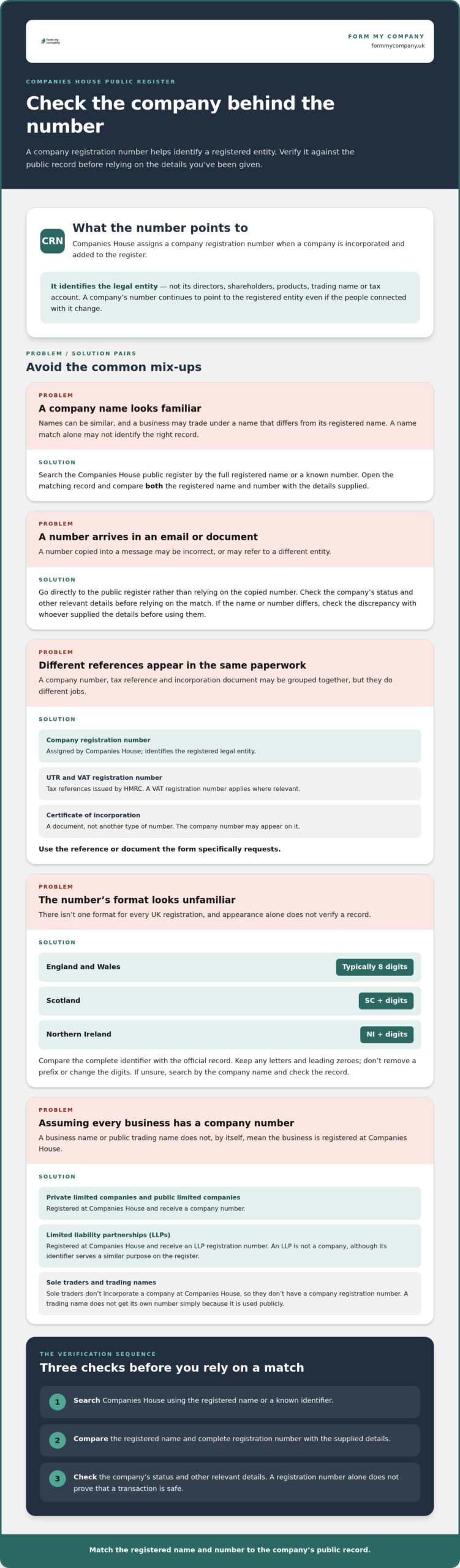
Start with the registered company name or a number you’ve already been given. Search the Companies House public register and open the record that matches. Compare the number shown there with the one on the document, form or message you’re checking. Going directly to the register is safer than relying on a number copied into an email.
- Search Companies House using the company’s registered name or a known identifier.
- Open the matching record and compare its registered name and registration number with the details supplied to you.
- Check the company’s status and other relevant details before relying on the match.
Company names can be similar, and a trading name may not exactly match the registered name. If a result looks close but the name or number differs, don’t assume it refers to the same entity. Check the discrepancy with the person or organisation that supplied the details before using them in a transaction or official paperwork.
How to look up a company on the public register
Search by the full registered name if you have it, or use the company number. On the record, check that both identifiers match the information you received. A name match alone may be inconclusive, particularly when businesses have similar names. The number helps pinpoint the record you mean.
The number may appear on the company’s certificate of incorporation and in correspondence from Companies House. If you’re organising formation paperwork, keeping documents together in a company document pack can make it easier to retrieve the relevant record when needed.
What do company registration number formats look like?
There isn’t one format for every UK registration. Companies registered in England and Wales typically have an eight-digit number, while Scottish company numbers commonly begin with “SC” and those for companies registered in Northern Ireland with “NI”, followed by digits. These are examples, not a way to verify a record by appearance alone.
Compare the complete identifier with the Companies House record, including any letters and leading zeroes. Don’t remove a prefix or change the digits when entering a number on a form. If the format looks unfamiliar, search by the company name and check the identifier on its official record.
If you’re preparing to incorporate a business rather than looking up an existing one, Companies House assigns the identifier as part of registration. You can explore company formation packages to get started.
Company registration number vs UTR, VAT number and incorporation certificate
These identifiers and documents may appear in the same set of business paperwork, but they don’t do the same job. Use the reference requested on the form: a company number won’t replace a tax reference, and a certificate isn’t another type of number.
| Item | What it identifies or evidences | Who issues it | When it’s used |
|---|---|---|---|
| Company registration number | Identifies a company on the Companies House register | Companies House | For company records and identification |
| Unique Taxpayer Reference (UTR) | Identifies a taxpayer for HMRC tax matters | HMRC | For relevant tax correspondence and processes |
| VAT registration number | Identifies a business registered for VAT | HMRC | For VAT-related records and transactions |
| Certificate of Incorporation | Provides evidence that a company has been incorporated | Companies House | As formal evidence of incorporation |
How is a company registration number different from a UTR?
A company number identifies the registered entity in Companies House records. A UTR, or Unique Taxpayer Reference, is a separate reference HMRC uses for tax administration. It’s generally a 10-digit number. The references come from different organisations and serve different purposes, so don’t enter a company number where a form asks for a UTR, or vice versa.
For example, a form asking you to identify a company on the Companies House register needs its company number. A tax form asking for the company’s UTR needs the HMRC reference. Check the field label before copying a number from a letter or saved record.
Is a company number the same as a VAT number or certificate?
No. HMRC issues a VAT registration number when a business is registered for VAT. It’s usually nine digits and may appear with a “GB” prefix. Not every company has one. A company number, by contrast, identifies the Companies House record, not the business’s VAT registration.
The Certificate of Incorporation is a document issued by Companies House when a company is incorporated. It provides evidence of incorporation and includes the company’s identifying details. The registration number is the identifier itself. A number identifies or references a record; a certificate is a document that provides evidence.
Keep these distinctions clear when organising records. If a form requests a VAT number, a UTR or proof of incorporation, the company number alone may not answer the question. Match the request to the right document or reference, and use the issuing body’s records to resolve any uncertainty.
How to use a company registration number and handle discrepancies
A company registration number is useful when a name alone doesn’t make clear which business you’re dealing with. Before signing an agreement, arranging payment or setting up a supplier account, compare the number and registered name with the Companies House record. This helps match the paperwork to the right legal entity, especially if the business trades under another name or a different company has a similar one.
Use the registered name and number together. A familiar trading name may appear on a website, invoice or email but differ from the name on the company’s official record. If the details don’t line up, pause and find out why before relying on them. A discrepancy is a reason to verify, not proof of wrongdoing.
What should you do if a company number does not match?
First, check for simple errors such as a typo, a missing digit or letter, or a number copied from another company’s paperwork. Then compare the details with the current Companies House record, including the registered name. Check the source document too: it may be out of date, refer to another legal entity or show a trading name rather than the registered one.
If the mismatch remains, ask the person or organisation that supplied the details to explain and provide corrected information or documentation. Recheck the record before proceeding. Don’t alter a number to make it appear to match, and don’t treat an email signature or invoice as a substitute for checking the official record.
Companies must include their registered name and number on certain business documents and communications, but the requirements depend on the document or communication. Don’t assume every message must display the number. If you’re responsible for company paperwork, check the current Companies House guidance for the specific document rather than relying on a blanket rule.
Can a company registration number change?
A company’s registered name can change, but a name change doesn’t ordinarily mean it receives a new company number. The number continues to identify that registered entity, even after its name is updated. Don’t assume an unfamiliar number belongs to the same company just because the name is recognisable.
To confirm the current identifier, check the company’s Companies House record and compare it with your latest documents. If the records appear to conflict, confirm you’re looking at the same legal entity and that the paperwork reflects current details. This is useful when updating supplier records, contracts or internal systems after a company name change.
If you’re forming a company and want support with registration, explore Form My Company’s Digital Package for company formation.
How to get a company registration number when forming a UK company
You don’t apply separately for a company registration number or request one from HMRC. Companies House assigns it when your company is successfully registered. To get started, choose a suitable structure, prepare the required details and submit an incorporation application. Your proposed company won’t have its own Companies House number until registration is complete.
At a high level, the process involves these steps:
- Choose a legal structure. Decide whether you’re forming a limited company or another registered structure, such as an LLP. The structure determines which registration process applies.
- Prepare the registration details. Gather the information required for the application, including the proposed company name and details about the people involved. Check that everything is accurate before submitting it.
- Submit the incorporation application. Companies House reviews the application. If the company is registered, it’s added to the register and assigned its company number.
What happens after a company is registered?
Once registration is successful, the Companies House record and incorporation documents contain the company’s identifying details, including its registration number. Keep the number with your core company records so it’s easy to find for forms, correspondence and routine administration.
Store the incorporation documents securely and keep the registered company name alongside the number. This helps ensure you use the right identifier for the right entity as you organise your records. The number is allocated through registration, not through a separate tax application.
What if you are still deciding how to form your company?
Start by considering how you plan to run the business and which legal structure suits those plans. A limited company and an LLP are different registered structures, each with its own formation process and type of registration identifier. If you’re comparing options, focus on the structure first rather than trying to obtain a number before incorporation. For founders exploring commercial opportunities internationally, such as entering the Middle East, corporate advisory firms like creatorsmajlis.qa offer specialised assistance with foreign market entry and regional company formation.
Form My Company supports formation for different structures, including limited companies and LLPs. Its Digital Package is one option for company formation. The registration number follows successful registration, so the next step is to prepare an application for the structure you’ve chosen.
If you’re ready to begin, explore company formation packages and choose a route towards incorporation.
Take the next step towards setting up your business
You don’t need to have every part of your future business mapped out before exploring formation. Form My Company offers a Digital Package and formation support for limited companies, LLPs and PLCs. Review the options and identify the details you’ll need for registration.
Ready to take the next step? Explore company formation with Form My Company and move forward with a clearer plan.
Frequently Asked Questions
Does a sole trader have a company registration number?
No. A sole trader isn’t a company incorporated at Companies House, so they don’t have a company registration number in that capacity. They may have separate tax or VAT identifiers, but these aren’t substitutes for a company number. If a form requests one, check whether it applies to your business structure. For example, a sole trader completing a supplier form can clarify that they trade as an individual rather than provide an unrelated tax reference.
Can I find a company registration number using a company name?
Yes. Search the name on the Companies House register, then check the full record rather than choosing a result based on the name alone. Trading names may differ from registered names, and similar names can belong to separate entities. If you’re unsure which result is relevant, compare other details you already have, such as the registered address or the company’s website and paperwork, before using the number on a business form.
Is a company registration number the same as a UTR?
No. A company registration number identifies a company in Companies House records, while a Unique Taxpayer Reference (UTR) is an HMRC tax identifier. If an HMRC tax form asks for a UTR, the Companies House number won’t answer that request. Read the field label and instructions carefully. Keep tax references in appropriate records, and don’t share them as if they were public company details.
Does a company registration number change when a company changes its name?
Usually, changing a company’s name doesn’t change its registration number, because the number refers to the registered entity. Check the current Companies House record, especially when updating a contract, payment record or supplier database. Make sure your paperwork reflects the current registered name and update your records to avoid using outdated details.
Can two UK companies have the same company registration number?
No. A registration number distinguishes a company on the relevant Companies House register. Don’t treat an identical-looking number as proof that two records refer to the same business. When comparing companies, retain any letters or leading zeroes and check each number against its official record. If a number appears to match across different records or jurisdictions, verify the complete details and relevant register before relying on it.
Do I need a company registration number before incorporating a company?
No. A new company won’t have a company registration number before its registration is complete. First choose the structure, prepare the application details and submit the incorporation application. After successful registration, record the assigned number with the company’s incorporation documents. Form My Company offers formation support for limited companies, LLPs and PLCs, including a Digital Package.