
International requirements for a legalised Certificate of Good Standing vary based on diplomatic agreements, state registrar policies, and verification frameworks. Hague Convention member nations accept an Apostille certificate, whereas non-member jurisdictions require multi-tiered embassy consular legalisation.
What Is a Legalised Certificate of Good Standing?
A legalised Certificate of Good Standing is an officially authenticated document that confirms a corporation’s active registration, tax compliance, and legal status for foreign jurisdictions. Legalisation verifies official signatures and seals through government-designated competent authorities.
A Certificate of Good Standing proves that a commercial entity maintains valid corporate standing with its domestic registrar. Domestic agencies such as Companies House in the United Kingdom or Secretaries of State in the United States issue these documents. Overseas regulatory bodies, international banking institutions, and foreign courts demand legalisation before recognizing foreign corporate filings.
Legalisation validates corporate authority during foreign branch registrations, asset acquisitions, and international trade contracts. Overseas governments enforce document validation protocols to eliminate corporate identity fraud and tax evasion. 74% of cross-border corporate expansions require legalised corporate credentials prior to executing commercial leases or opening institutional bank accounts.
Different nations apply distinct standards based on treaty memberships and legal systems. Understanding international document verification processes prevents administrative rejections, project delays, and compliance penalties.
How Do Hague Convention Countries Process Document Legalisation?
Hague Convention countries streamline document verification by requiring a single Apostille stamp issued by the originating state’s designated competent authority. This standardized certification replaces complex multi-step consular legalisation for member nations.
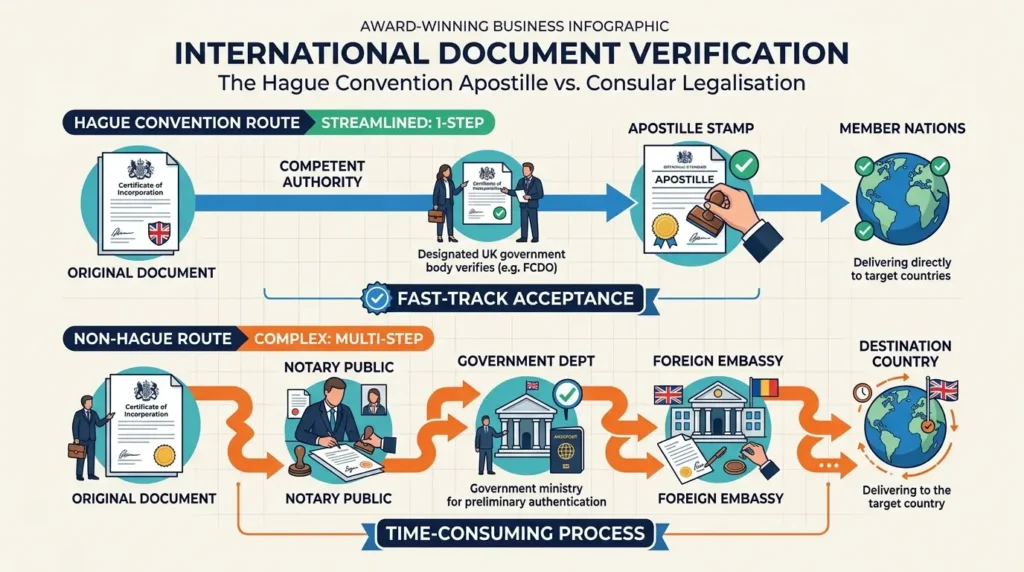
127 countries participate in the 1961 Hague Apostille Convention. Member states streamline cross-border document authentication by recognizing standardized Apostille certificates. The foreign ministry or designated registrar attaches an official Apostille directly to the corporate document.
Hague member jurisdictions include major global markets such as the United States, Germany, Japan, Spain, and the United Kingdom. When expanding into Hague member states, corporate entities avoid foreign embassy reviews. The competent authority validates the issuing officer’s signature, seal, and official capacity.
Processing times for Apostille certification typically range between two and five business days. Regulatory authorities verify Apostille authenticity through public digital registries or physical serial tracking codes. Entities expanding into European Union jurisdictions experience uniform acceptance across all member countries under standardized legal frameworks.
How Do Non-Hague Convention Countries Legalize Corporate Certificates?
Non-Hague Convention countries require multi-tiered consular legalisation involving domestic state certification, national foreign ministry authentication, and final validation by the destination country’s local embassy.
Nations outside the Hague Convention enforce rigorous chain-legalisation procedures. Prominent non-Hague jurisdictions include the United Arab Emirates, China, Qatar, Vietnam, and Saudi Arabia. Corporations operating in these countries must satisfy three sequential validation stages before achieving regulatory approval.
The origin state’s legalisation department certifies the Registrar’s signature on the document. Next, the national foreign ministry authenticates the domestic legalisation office’s authority. Finally, the target nation’s embassy or consulate applies an official verification stamp.
Consular fees vary significantly across embassies. Legalisation costs for commercial documents range from $150 to over $1,000 per document depending on the destination state. Overall processing timelines require two to six weeks. Foreign affairs departments inspect seal integrity, corporate officer authority, and translation accuracy before issuing final legalisation seals.
What Are the Specific Authentication Rules in European Jurisdictions?
European jurisdictions enforce Hague Apostille standards alongside mandatory certified translations completed by sworn court translators registered within the destination nation.
European civil law jurisdictions maintain strict language and formatting standards for incoming corporate filings. Spain, France, Italy, and Germany demand foreign corporate documentation in their respective official state languages. Sworn translators execute translations to guarantee absolute legal equivalence between source and target texts.
Civil law registrars scrutinize document validity periods. Most European commercial registers reject legalised credentials older than three to six months. Financial institutions in Switzerland and Luxembourg verify corporate standing documents to comply with strict anti-money laundering regulations.
Certain European nations enforce digital legalisation verification. Foreign entities operating in Estonia or Denmark submit e-Apostilled documents directly through electronic government portals. Digital authentication protocols reduce verification times from several business days to a few hours.
How Do Middle Eastern Nations Handle Corporate Document Verification?
Middle Eastern nations require full consular chain legalisation, commercial chamber validation, and certified Arabic translations approved by official government ministries.
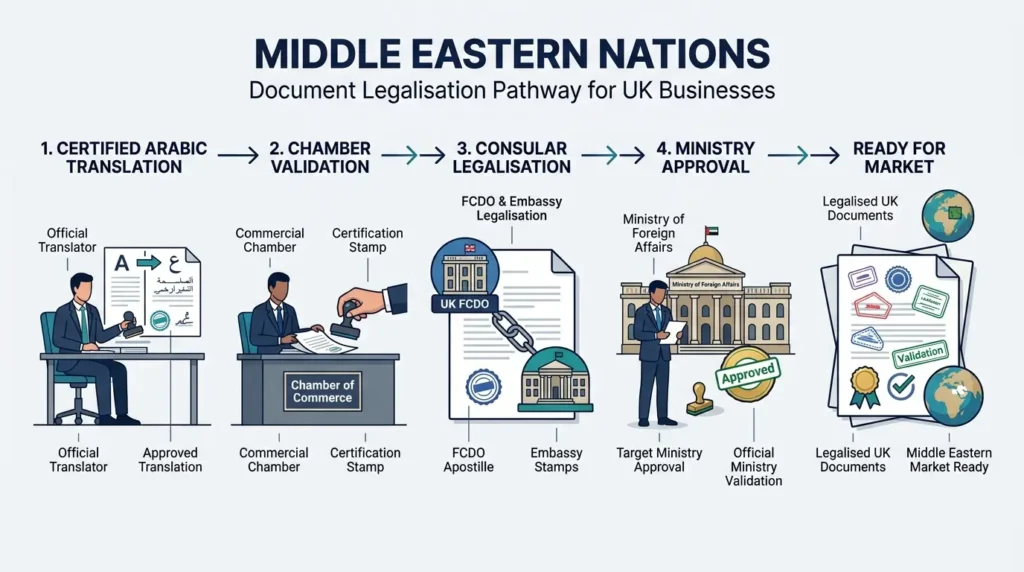
Gulf Cooperation Council member states impose comprehensive documentation standards on foreign enterprises. Organizations opening branches in Saudi Arabia, Qatar, or Kuwait navigate lengthy verification chains. Documents undergo local legalisation, foreign ministry seals, and destination embassy authentication.
Commercial chambers in Middle Eastern jurisdictions re-verify certified documents upon arrival. Local authorities require Arabic translations executed by licensed ministry translators. 82% of administrative rejections in Middle Eastern registries stem from minor translational discrepancies or missing consular seals.
Embassy fees in Middle Eastern jurisdictions represent a substantial corporate administrative expenditure. Foreign enterprises establish regional hubs in free zones to streamline regulatory filings. Free zone authorities occasionally waive full consular legalisation in favor of simplified internal verification procedures.
What Are the Requirements Across Asian Commercial Hubs?
Asian commercial hubs demand explicit notary attestations, Hague Apostilles or consular legalisations, and local company registry attestations tailored to specific jurisdictional governance rules.
Asian markets present varied legal frameworks ranging from common law systems to strict socialist market economies. Singapore and Hong Kong operate under common law principles and accept Hague Apostilles without complex secondary certifications. Local registrars process compliant submissions within 24 to 48 hours.
China enforces structured legalisation workflows for foreign commercial entities. Foreign corporations must secure local notarization, foreign ministry endorsement, and Chinese embassy attestation before registering local subsidiaries. China’s accession to the Hague Apostille Convention has simplified workflows, though specific provincial authorities still demand supplementary notarizations.
Japan and South Korea enforce strict document expiration parameters. Commercial registries require legalised certificates issued within 90 days of filing. Corporations executing cross-border mergers submit authenticated corporate records to confirm executive signatory authority.
How Do the Americas Approach Cross-Border Document Validation?
The Americas utilize a dual framework where Hague member states accept streamlined Apostilles while non-member Latin American nations demand traditional embassy legalisation.
North American jurisdictions such as Canada, Mexico, and the United States participate in the Hague Apostille Convention. Cross-border corporate filings between these nations require a standard Apostille attached by state or federal authorities. Registry officials reject unauthenticated documents during international corporate formations.
Several Latin American countries require traditional consular legalisation. Corporations expanding into nations like Bolivia or Paraguay route documents through foreign affairs ministries and regional consular offices. Translation into Spanish or Portuguese must occur via certified public translators recognized by the receiving jurisdiction.
State registrars across Latin America inspect executive authority statements within the Certificate of Good Standing. Corporate boards routinely verify state requirements prior to executing international lease agreements or registering local tax identification numbers.
How Does Document Expiration Impact International Legalisation?
Document expiration policies limit the legal validity of a legalised Certificate of Good Standing to between 30 and 180 days from the original date of issuance.
Foreign commercial registries enforce strict validity windows to ensure corporate solvency and regulatory compliance. Overseas authorities recognize that corporate standing status changes rapidly due to legal disputes, tax defaults, or administrative dissolutions. A legalised document loses official validity if presented past the receiving jurisdiction’s cutoff threshold.
89% of international commercial banks reject corporate standing certificates older than 90 days. Enterprises coordinating multi-jurisdictional filings synchronize document procurement with local registry submission deadlines. Missing a filing window forces organizations to re-initiate state ordering, notarization, and embassy legalisation processes.
When planning international corporate expansion, corporate secretaries order fresh standing certificates from domestic registers. Rapid authentication prevents administrative delays and avoids secondary government filing fees.
Why Do Translation Standards Vary Between Foreign Registrars?
Translation standards vary because sovereign nations enforce specific legal language codes, sworn translator certifications, and local court registration mandates.
Nations mandate certified translations to ensure local judicial and regulatory bodies accurately interpret foreign legal terms. Standard commercial translations lack legal standing in official government registries. Sworn translators assume legal liability for text accuracy under local civil codes.
Destination countries specify whether translation must occur in the country of origin or the destination state. Certain Middle Eastern and South American registries refuse translations executed outside their domestic borders. Sworn translators attach physical or digital certificates of accuracy directly to the legalised document.
Inaccurate translations trigger immediate corporate filing rejections. Foreign enterprises partner with professional corporate service providers to manage specialized legal translations alongside primary legalisation workflows.
How Do Corporations Efficiently Manage Global Legalisation Workflows?
Corporations manage global legalisation workflows by utilizing specialized corporate service providers, centralizing document tracking, and selecting targeted authentication pathways.
Navigating overlapping international legalisation protocols requires technical compliance expertise. Corporate legal departments outsource authentication management to professional corporate service specialists. Centralized management eliminates errors, controls embassy fee expenditures, and accelerates cross-border market entry.
Businesses seeking official documentation must review the necessary steps for obtaining a Certificate of Good Standing to ensure full regulatory compliance. Selecting appropriate verification methods saves operational resources during multi-country expansions. Understanding compliance distinctions helps executives choose between notarised and apostilled corporate documents based on jurisdictional legal frameworks.
Organizations expanding operations can secure an Apostille on corporate credentials through specialized compliance management channels to satisfy foreign government mandates. Professional oversight mitigates administrative friction during international commercial endeavors. Form My Company assists global organizations with international corporate compliance management. Form My Company coordinates multi-jurisdictional legalisation workflows for corporate expansion projects.
Explore More Certificate of Good Standing Guide,
Apostille vs Notarisation for a Certificate of Good Standing: Which Do You Need?
How to Get an Urgent Certificate of Good Standing Without Overpaying
Frequently Asked Questions
What is a UK Certificate of Good Standing?
A UK Certificate of Good Standing is an official document issued by Companies House confirming that a business is active, compliant, and up to date with its administrative filings. Corporations order this document through Form My Company to prove legal existence and financial solvency when opening bank accounts, securing loans, or expanding operations overseas.
How do I get a Certificate of Good Standing for my company?
You can request an official Certificate of Good Standing directly from Companies House or streamline the filing process using a corporate service provider like Form My Company. The issuing authority verifies that your company accounts and annual confirmation statements are fully updated before generating the legal certificate.
How long is a Certificate of Good Standing valid?
While a Certificate of Good Standing does not have a statutory expiration date, most international banks, foreign government registries, and legal institutions require one issued within the last 3 to 6 months. Obtaining an updated Certificate of Good Standing through Form My Company ensures your corporate credentials satisfy strict jurisdictional freshness requirements.
Does a Certificate of Good Standing need an Apostille for international use?
Yes, if you intend to use a Certificate of Good Standing in a Hague Convention member country, foreign registries require an Apostille stamp to legally authenticate the document. Form My Company assists businesses by obtaining the official certificate from Companies House and submitting it to the Foreign, Commonwealth & Development Office (FCDO) for Apostille legalisation.
What information is included in a Certificate of Good Standing?
A Certificate of Good Standing includes the official company name, registration number, incorporation date, and a statement verifying that no liquidation or administrative dissolution proceedings are pending. Form My Company can also request optional statutory details on the legal certificate, such as director names, secretary details, and registered office address information.