Imagine you’ve just secured a lucrative international contract, only for your bank to freeze the process because your paperwork is “out of date.” You reach for your original formation folder, confident that your documents are sufficient, but the compliance officer shakes their head. It’s a common, stressful scenario. This situation highlights the confusion surrounding Certificate of Good Standing vs Certificate of Incorporation: Which One Do You Need? whilst dealing with modern regulators and lenders.
We know that deciphering administrative jargon feels like a full-time job you didn’t sign up for. You’ve worked hard to build your business, and the last thing you need is a bureaucratic delay jeopardising your growth. This guide will clarify the roles of these essential UK documents so you can identify exactly what your bank or solicitor requires. We’ll examine why the Certificate of Incorporation is a permanent “birth certificate” whilst the Certificate of Good Standing, or Summary Statement, acts as a vital “clean bill of health” that usually expires every 90 days.
Key Takeaways
- Understand that your Certificate of Incorporation is a permanent “birth certificate” that proves your company was legally formed and remains valid for its entire existence.
- Recognise why a Certificate of Good Standing acts as a time-sensitive “clean bill of health” that banks and overseas registries typically require to be less than 90 days old.
- Use our comparison of Certificate of Good Standing vs Certificate of Incorporation: Which One Do You Need? to identify the exact paperwork required for banking, contracts, and international trade.
- Learn the essential compliance criteria, such as filing your Confirmation Statement and annual accounts, that must be met before you can successfully order a Summary Statement.
- Discover the most efficient ways to order official UK company certificates to avoid administrative delays and ensure your business remains compliant in 2026.
Understanding Your Company Identity: The Birth vs Health Metaphor
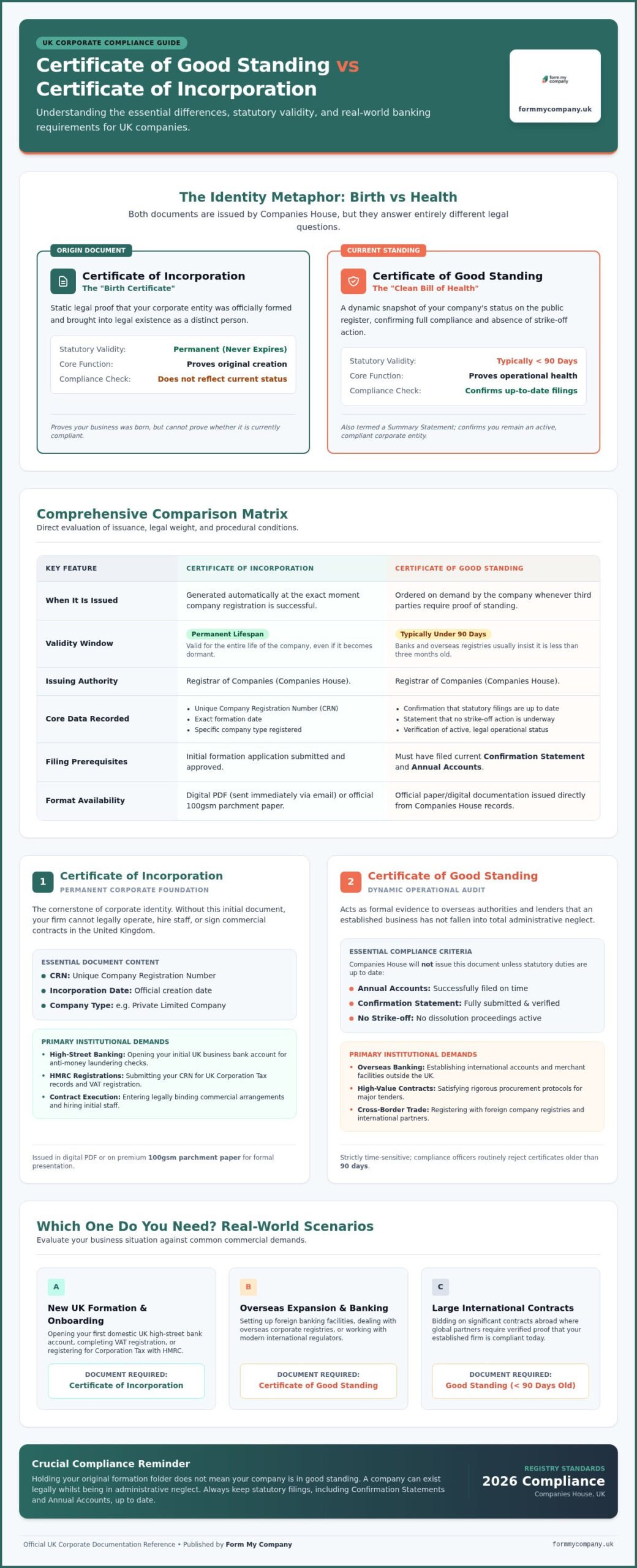
Think of your business as a legal person. Just like any individual, it needs official papers to navigate the world and prove its status. The Registrar of Companies, better known as Companies House, acts as the keeper of these records. When you’re trying to figure out the Certificate of Good Standing vs Certificate of Incorporation: Which One Do You Need?, it’s easiest to use a simple metaphor. One document proves you were born; the other proves you’re healthy and active today.
It’s a common mistake to assume that because you have your original formation papers, your business is automatically considered “in good standing.” This isn’t the case. A company can exist legally whilst being in a state of total administrative neglect. You might have your birth certificate in hand, but if you’ve missed your tax filings or failed to update your records, you won’t get a clean bill of health from the authorities. Both documents are issued by Companies House, but their value changes depending on the age of your business.
What is a Certificate of Incorporation?
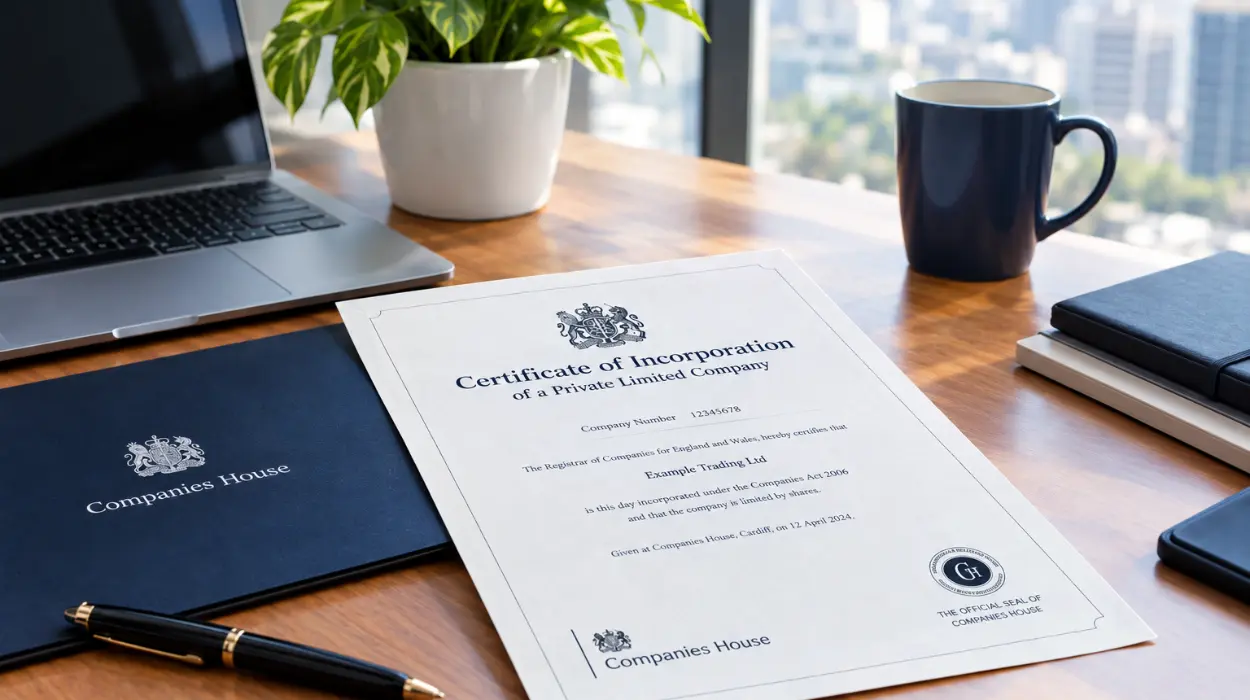
This is the very first document your business receives. It’s issued at the exact moment of registration to prove the company is a separate legal entity. This document contains your unique Company Registration Number (CRN), the date of formation, and the specific type of company you’ve created. This document acts as the static proof of a company’s origin that remains unchanged throughout its life.
Because it documents a historical event, it never expires. According to the foundational definition of a Certificate of Incorporation, it serves as the primary legal evidence that your corporate entity was officially formed. You’ll use it to open your first UK bank account or register for VAT, but it won’t tell a third party if you’re still compliant five years down the line.
What is a Certificate of Good Standing?
If incorporation is your birth certificate, the Certificate of Good Standing is your most recent fitness report. It provides a “snapshot” of your company’s current status on the public register. It confirms that your business is up to date with all statutory filings and, crucially, that no action is being taken to strike the company off the register.
This document is essential for proving current operational legitimacy to third parties, especially when dealing with international trade, high-value contracts, or overseas banking. It tells lenders and partners that you’re a reliable entity that follows the rules. Without it, your original incorporation papers only prove you existed once, not that you’re still a safe bet today.
The Certificate of Incorporation: Your Permanent Proof of Existence
Your Certificate of Incorporation is the definitive evidence that your company exists as a separate legal entity. It is the cornerstone of your corporate identity. When considering the Certificate of Good Standing vs Certificate of Incorporation: Which One Do You Need?, remember that the latter is your primary entry point into the business world. Without it, you cannot legally trade, hire employees, or enter into commercial contracts in the UK.
This document is permanent. It remains valid for the entire lifespan of your firm. Even if your company becomes dormant or changes its directors, the original certificate stands as proof of its creation. It’s the first thing a high-street bank will ask for when you open a business account, as it provides the verified Company Registration Number (CRN) required for credit checks and anti-money laundering protocols. Similarly, HMRC requires this CRN to process your VAT registration and Corporation Tax records.
When is it Issued?
Companies House generates this certificate automatically the moment your formation is successful. If you choose a Form My Company formation package, you will receive a digital PDF version of this document immediately via email. Whilst the digital version is sufficient for many online applications, certain traditional institutions and international partners often demand an official hard copy printed on 100gsm parchment paper. This physical proof adds a layer of prestige and security to your corporate records.
Key Details You Will Find on the Document
The certificate acts as a summary of your company’s “birth” details. It isn’t just a simple notice; it’s a legal instrument bearing the official seal of the Registrar of Companies. You will find several critical pieces of data on the face of the document:
- Company Name: The name of the business at the exact point of incorporation. Be aware that subsequent name changes require a separate Certificate of Name Change.
- CRN: Your unique eight-digit Company Registration Number.
- Jurisdiction: The legal territory where the company is registered, such as England and Wales or Scotland.
- Company Type: Whether it is a private limited company (Ltd) or a public limited company (PLC).
If you have lost your original documents, you can easily secure a replacement through our Digital & Print Package. This helps you settle the debate of Certificate of Good Standing vs Certificate of Incorporation: Which One Do You Need? by ensuring you have the foundational proof of your business’s legal existence. As noted in this SBA guide to registering your business, maintaining accurate formation records is the first step in ensuring your company remains compliant across different jurisdictions.
The Certificate of Good Standing: Proving Current Compliance
Whilst your incorporation papers prove you exist, the Certificate of Good Standing proves you are behaving. This distinction is the core of the debate: Certificate of Good Standing vs Certificate of Incorporation: Which One Do You Need? Most commercial lenders and international registries won’t accept a certificate older than three to six months. This “expiry” isn’t a legal limit, but a risk management standard. They want to know you haven’t fallen into administrative arrears since your last check-up.
Under the 2026 identity verification rules, obtaining this document has become more stringent. Companies House now acts as an active regulator rather than a passive registrar. If your directors haven’t completed their mandatory identity verification (IDV), you’ll likely find your request for a certificate rejected. This is particularly vital for businesses with foreign national directors, as compliance with these updated UK standards is now a prerequisite for proving operational legitimacy to third parties.
Criteria for a “Clean” Certificate
To secure this document, your company must be in a state of “good standing” on the public register. This means you have no overdue annual accounts or tax returns. You must also ensure your Confirmation Statements are filed and the associated fees are paid. According to the Companies House certified certificates and documents guidance, the Registrar won’t issue a certificate if the company is facing strike-off action or liquidation proceedings. A minimum number of directors must be appointed, and they must all be verified individuals to satisfy current regulatory audits.
International Use and Apostilled Documents
When expanding overseas, a standard UK certificate often isn’t enough. Foreign governments and banks usually require an Apostilled Certificate of Good Standing. This is a legalisation process where the Foreign, Commonwealth & Development Office (FCDO) attaches a certificate to the document, verifying the signature of the Companies House official. This is crucial for setting up a foreign branch or proving the authority of directors to sign international contracts. It provides the legal weight needed to trade across borders, ensuring your UK entity is recognised as a compliant, active participant in global trade.
Which One Do You Need? Real-World Business Scenarios
Deciding between these documents depends entirely on the intent of the person asking for them. If a third party needs to verify your company’s identity, they’ll ask for the Certificate of Incorporation. If they need to verify your company’s reliability, they’ll demand a Certificate of Good Standing. Understanding this distinction helps you settle the Certificate of Good Standing vs Certificate of Incorporation: Which One Do You Need? debate before you miss a critical deadline.
Consider three common scenarios. When opening a high-street bank account, a brand-new company usually only needs its incorporation papers. However, if you’re applying for a commercial lease, landlords often require a fresh health check for older firms to ensure you aren’t facing a strike-off. Finally, if you’re selling your business or seeking venture capital, providing a clean bill of health is a non-negotiable part of the due diligence process. It proves your administrative house is in order.
Banking and Finance Requirements
The age of your business dictates the bank’s expectations. For companies under 12 months old, the Certificate of Incorporation is usually sufficient proof of existence. Once you pass that first year, banks frequently demand a fresh Certificate of Good Standing to confirm you’ve filed your accounts on time. Maintaining a professional image during these checks is vital. Using a Business Address service ensures that the correspondence address on your certificates looks established and credible to compliance officers.
Contracts and Tenders
Government agencies and large corporate entities use these documents as a filter. When they evaluate Certificate of Good Standing vs Certificate of Incorporation: Which One Do You Need? for a specific bid, they are looking for proof that you are not in the process of liquidation. They often use these certificates to cross-reference your PSC Register details, ensuring they know exactly who controls the firm they are about to hire. This level of transparency is now a standard requirement for any high-value contract in 2026.
Don’t let missing paperwork stall your progress. You can order your official Certificate of Good Standing here to ensure your business remains ready for any opportunity.
How to Secure Your Official UK Company Certificates
Securing your official documents shouldn’t be a bureaucratic hurdle that stalls your business growth. Whilst you can navigate government portals alone, ordering through an agent ensures speed and precision. We act as a professional filter; we check your company’s current status on the register before submission to prevent the frustration of a rejected application. When you are caught between a Certificate of Good Standing vs Certificate of Incorporation: Which One Do You Need?, our team provides the clarity required to move forward without delay.
For new and growing firms, we recommend our combined Company Packs. These packages provide all your foundational documents in one place, ensuring you have both your birth certificate and your initial compliance records ready for any bank or landlord. Organise your statutory records today to ensure your future eligibility for a clean bill of health. It is much easier to maintain compliance than it is to fix a defaulted status during a high-stakes contract negotiation.
Ordering Your Certificate of Good Standing
Our streamlined Certificate of Good Standing service is designed for efficiency. You only need to provide your company name or registration number; we handle the technical communication with Companies House. In 2026, delivery timeframes remain strict. Standard dispatch typically takes up to 10 working days via Royal Mail. However, if you are facing a tight deadline, our express service ensures that orders submitted before 11:00 AM are dispatched the same working day. This fast-track option is essential for urgent international trade requirements or sudden compliance audits.
Maintaining Compliance for the Future
Your ability to secure these documents depends entirely on your filing history. There is a direct link between an up-to-date Confirmation Statement and your “Good Standing” status. If you miss this annual filing, the Registrar will refuse to issue a summary statement. To prevent this, many business owners utilise Virtual Office services to stay on top of official Companies House correspondence. This ensures that every legal notice and filing reminder reaches you instantly, protecting your company’s reputation and its ability to prove its legitimacy at a moment’s notice.
Don’t let administrative confusion hold your business back. Order your official Certificate of Good Standing now and gain the confidence of a fully compliant UK company.
Master Your Company Compliance Today
Navigating the administrative requirements of a UK business doesn’t have to be a source of anxiety. By understanding the roles of your permanent formation papers and your current status reports, you can prevent bureaucratic delays before they happen. When weighing up the Certificate of Good Standing vs Certificate of Incorporation: Which One Do You Need?, remember that your specific business goal dictates the choice. Your incorporation papers prove you exist; your good standing certificate proves you are a reliable, active entity ready for global trade.
As an official Companies House partner, we specialise in stripping away the complexity of corporate filings. Whether you’re a UK resident or a foreign national director, we provide the expert support needed to keep your venture moving. We offer fast digital delivery options to ensure you never miss a contract deadline due to missing paperwork. Take control of your statutory records and present a professional, compliant image to every bank, landlord, or investor you encounter.
Ready to prove your company’s health? Secure Your Certificate of Good Standing With Form My Company Now. We’re here to help your business reach its full potential with speed and accuracy.
Frequently Asked Questions
Can I get a Certificate of Good Standing for a newly incorporated company?
Yes, you can order a Certificate of Good Standing immediately after your company is formed. Whilst it might seem redundant alongside your incorporation papers, some international banks or partners require it to confirm that no strike-off action has been initiated in the days following registration. It serves as an official snapshot of the register at that specific moment, proving your business is active and compliant from day one.
What happens if my company is not in “Good Standing” at Companies House?
If your company is not in good standing, Companies House will refuse to issue a certificate until you rectify the defaults. This usually happens if you have overdue annual accounts or confirmation statements. Falling out of standing is a serious risk; it often triggers compulsory strike-off proceedings, which can lead to the freezing of your business bank accounts and the legal dissolution of your entity.
Do I need a Certificate of Incorporation to change my company name?
You don’t use your original Certificate of Incorporation to change your name; instead, you must file a special resolution with Companies House. Once they approve the change, they issue a “Certificate of Incorporation on Change of Name.” This new document is used alongside your original papers to prove the legal transition. When considering the Certificate of Good Standing vs Certificate of Incorporation: Which One Do You Need? for a name change, the new certificate becomes your permanent proof.
How long is a Certificate of Good Standing valid for in the UK?
Companies House certificates don’t have a formal expiry date, but most commercial institutions apply a strict validity window. Banks, solicitors, and overseas registries typically reject any Certificate of Good Standing that is older than three months, or 90 days. Because this document is a snapshot of your current compliance, third parties need to ensure that your filing status hasn’t changed since the certificate was issued. Always check the specific requirements of your requester.
Is a Certificate of Good Standing the same as a Tax Compliance Certificate from HMRC?
No, these are entirely different documents issued by different authorities. A Certificate of Good Standing comes from Companies House and confirms you’ve met your corporate filing obligations. A Tax Compliance Certificate is issued by HMRC and relates specifically to your tax affairs, such as Corporation Tax or VAT payments. If an overseas partner asks for proof of tax residency or payment, a Companies House certificate will not suffice for their requirements.
Can I use a digital copy of my Certificate of Incorporation for banking?
Many modern digital banks accept a PDF download of your Certificate of Incorporation, but traditional high-street banks and international lenders often demand a certified hard copy. These institutions require the physical assurance of an official document printed on specific parchment paper to prevent fraud. If you’re unsure, it’s safer to provide a certified copy from a professional agent to ensure your account application isn’t delayed by administrative queries.
What is an Apostilled Certificate and when would my business need one?
An Apostilled Certificate is a document that has been legally verified by the Foreign, Commonwealth & Development Office (FCDO) for use outside the UK. You’ll need this if you’re opening a foreign bank account, setting up an overseas branch, or signing high-value international contracts. The Apostille confirms that the signature or seal on your UK certificate is genuine, making it legally recognisable in countries that are members of the Hague Convention.
How do I check if my company is currently in good standing before I order a certificate?
You can check your company’s status for free by visiting the Companies House online register and searching for your company name or number. Look at the “Filing history” and “Overview” sections to ensure your accounts and confirmation statements are marked as up to date. If you see any warnings about overdue filings or active strike-off proposals, you must resolve these issues before attempting to order an official Certificate of Good Standing.