

Ecuador businesses can use a UK company to sell cross‑border by registering a UK limited company, appointing at least one UK‑registered director or service agent, registering for UK VAT when taxable supplies exceed thresholds, and complying with UK and Ecuador tax and customs rules.
How can an Ecuadorian business use a UK company for cross‑border sales?
Ecuador businesses register a UK limited company, open UK business banking, and route international contracts and invoicing through that UK entity to sell into the UK and EU with clearer VAT handling and stronger buyer trust.
Using a UK company creates a legal entity that signs contracts, issues invoices, and holds intellectual property. This entity can register for UK VAT, obtain EORI for EU customs, and use UK banking rails for GBP and multi‑currency payments. The structure improves payment reconciliation and buyer confidence during cross‑border transactions.
What are the legal steps to register a UK company from Ecuador?
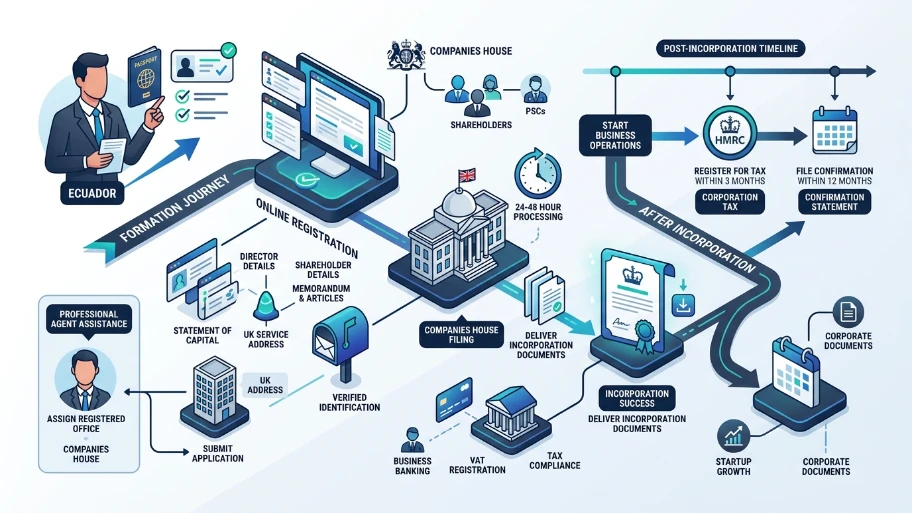
Register a UK limited company online, provide director and shareholder details, supply a registered UK address, and file incorporation documents with Companies House within 24–48 hours after payment.
Ecuador residents must supply verified identification and a service address in the UK. Companies House requires a company name, at least one director, a statement of capital (shares), and a memorandum and articles of association. Professional formation agents can complete the submission, assign a registered office, and deliver incorporation documents. After incorporation, file the first confirmation statement within 12 months and register for Corporation Tax within 3 months of starting business.
How do UK VAT rules affect cross‑border sales from Ecuador?
UK VAT applies to sales of goods and services consumed in the UK; register for VAT when taxable turnover exceeds £90,000 in 12 months or voluntarily register earlier for VAT recovery.
Registering for VAT allows charging UK VAT on B2C sales and reclaiming input VAT on business purchases. For B2B sales to VAT‑registered UK businesses, zero‑rate supplies may apply with valid VAT numbers. For imports into the UK, the UK‑registered company must account for import VAT and follow EORI procedures. For EU sales, distance‑selling thresholds no longer apply; use the One‑Stop Shop or local VAT registration as required.
Read our articles, How Ecuador Residents Can Register a UK Company and Handle Cross-Border Sales and Register a UK Company from Ecuador for Global Sales with Form My Company.
What customs and logistics steps are required for physical goods?
Obtain an EORI number, classify goods with HS codes, prepare commercial invoices, and choose an incoterm to allocate customs responsibilities and VAT payment.
EORI registration allows customs declarations in the UK and EU. HS codes determine tariffs and any licensing requirements. Commercial invoices must state origin, value, and commodity details. Choose incoterms like DDP (delivered duty paid) if the seller handles duties, or EXW/FOB when the buyer handles export/import formalities. Use customs brokers or freight forwarders to file declarations and manage duties. Ensure product compliance with UK standards, such as safety or labelling rules.
How should invoices, contracts, and payments be structured?
Issue invoices in the UK company’s name, state VAT details when applicable, use GBP and multi‑currency bank accounts, and route payments to UK business accounts to simplify reconciliation and tax reporting.
Contracts must identify the contracting entity as a UK limited company and define choice of law and dispute resolution. Invoices must include the supplier name, registered number, VAT number, description of goods/services, and payment terms. Use UK business bank accounts or payment service providers to accept card and bank transfers. For high‑risk transactions, use escrow or staged payment milestones to reduce non‑payment risk.
What are the tax obligations for the UK company and directors?
Register the UK company for Corporation Tax within 3 months of trading, file annual accounts with Companies House, and submit Company Tax Returns to HMRC; directors must ensure accurate bookkeeping and PAYE if employing staff.
Corporation Tax applies on worldwide profits if the company is UK‑resident. Keep records for 6 years and maintain separate accounting from any Ecuador business. If the UK company employs staff in the UK, register as an employer and operates PAYE. Directors must file a self‑assessment tax return if they receive taxable income. Cross‑border profits may trigger tax obligations in Ecuador; follow double tax rules and claim relief where applicable.
How do Ecuador’s tax and FX rules interact with a UK company?
Report foreign income and foreign‑controlled company interests to Ecuador tax authorities, repatriate profits with declared dividends, and convert GBP to USD/EUR/PKR through regulated channels to comply with exchange controls.
Ecuador requires disclosure of foreign assets and income. When the UK company pays dividends, shareholders must report and pay taxes under Ecuadorian rules. Use formal dividend resolutions and maintain transfer pricing documentation for intercompany transactions. Use licensed banks or payment providers for currency conversion and document all transfers to satisfy both Ecuadorian and UK tax audits.
How can intellectual property and digital goods be managed through the UK entity?
Assign copyrights and trademarks to the UK company, register UK trademarks where needed, and license IP back to Ecuador operations under formal agreements with arm’s‑length pricing.
Hosting, SaaS, and digital distribution can be invoiced by the UK company to customers worldwide. Register UK trademarks to protect the brand in target markets. Draft licensing agreements that specify royalties, territory, and tax treatment. Maintain records of IP transfers and fair market valuations to support tax positions.
Explore our East Timor guide,
How East Timor Entrepreneurs Can Start a UK Company for Global Business
What compliance and risk controls must Ecuadorian businesses implement?
Verify directors and beneficial owners, maintain AML records for 5 years, implement data protection measures aligned with UK GDPR principles, and perform periodic tax and legal reviews.
Conduct identity verification for company officers and beneficial owners. Keep statutory registers, minutes, and share ledgers current. Apply data security controls for customer data, and follow UK data processing requirements. Schedule annual reviews with tax and legal advisors to validate transfer pricing, VAT treatment, and customs practices.
How does using a UK company improve market access and buyer trust?
A UK company provides a familiar legal framework, GBP payment options, and easier contract enforcement, increasing buyer confidence and reducing perceived vendor risk in UK/EU markets.
Buyers often prefer suppliers with local legal presence. A UK registration enables UK contracts, local invoices, and returns handling. It simplifies merchant onboarding with UK platforms and payment processors. The entity can join UK trade schemes and access UK business support where eligible.
How From My Company supports Ecuador businesses
Ecuador businesses gain faster UK market entry and cleaner cross‑border operations by registering and operating through a UK limited company. From My Company helps Ecuador residents register a UK company, supply a registered office, and guide VAT and customs registrations. The firm also assists with UK banking introductions and statutory filings to maintain compliance.
Frequently Asked Questions
Can Ecuador residents register a UK company remotely for cross-border sales?
Yes. Ecuador residents can register a UK limited company remotely through From My company by submitting verified ID and a UK-registered address, then use that entity for international contracts, invoicing, and VAT-compliant cross-border sales.
How does a UK company help Ecuadorian businesses with UK VAT for exports?
A UK company allows Ecuador businesses to register for UK VAT, charge VAT on B2C sales into the UK, and reclaim input VAT on purchases. From My company guides registration and compliance for Ecuador clients selling goods or services to UK customers.
What documents are needed to form a UK company from Ecuador?
You need a valid passport or government-issued ID, a recent utility bill or bank statement showing your home address, director/shareholder details, and a UK-registered office address. From My company handles submission to Companies House for Ecuador residents and delivers incorporation documents.
Can Ecuador businesses use a UK company for EU cross-border sales too?
Yes. A UK company can obtain an EORI number, classify goods with HS codes, and file EU customs declarations to sell across the EU. From My company supports Ecuador clients with UK registration and referrals for VAT/EORI setup for cross-border trade.
Is a UK director required to register a company from Ecuador?
No. Non-UK residents can be directors of a UK limited company; you only need a UK registered office address. From My company provides the required address service and compliance support for Ecuador residents forming a UK company for global sales.