
A taxable disposal of shares triggers CGT when ownership transfers, and a chargeable gain exists after deducting acquisition cost, allowable costs, and Annual Exempt Amount.
A disposal occurs on the sale, gift, or exchange of shares, and on certain share-for-share reorganisations. Calculate the gain as proceeds minus acquisition cost, acquisition expenses, and improvement costs. Deduct the Annual Exempt Amount: £6,000 for 2024/25, reduced to £3,000 for 2025/26, and current amounts set by HMRC for 2026/27. Apply tax rates after reliefs and losses.
How are gains calculated on share sales?
Compute a gain as net proceeds less base cost, allowable costs, and indexation or reliefs; allocate joint ownership and pooling rules where required.
Use precise records: purchase price, purchase fees, sale price, and sale fees. For shares in public companies, use actual transaction figures. For closely held private companies, include valuation evidence. For multiple acquisitions, apply section 104 pooling for UK-listed shares and share identification rules for non-pooled holdings. Deduct allowable costs such as broker fees and solicitor costs. Offset allowable capital losses against gains in the same tax year, then subsequent years.
Read our articles, Capital Gains Tax on Shares: UK 2026 Guide and Capital Gains Tax Specialists for Share Sales | Form My Company.
What tax rates apply to share disposals by business owners?
Tax rates depend on the seller’s income band: 10% for basic-rate taxpayers and 20% for higher-rate taxpayers for most disposals; residential property has higher rates.
Calculate taxable income first, then add chargeable gains to determine the marginal rate. For most share disposals, basic-rate capital gains tax is 10%, higher-rate and additional-rate taxpayers pay 20%. For disposals that qualify as business assets under Business Asset Disposal Relief (BADR), a 10% rate may apply up to a lifetime limit. For residential property, rates are 18% and 28% respectively, not typically relevant to share sales.
When does Business Asset Disposal Relief (BADR) apply to share sales?
BADR applies when shares meet qualifying tests: a personal company status, a minimal shareholding threshold, and a two-year ownership and employment/director test.
Qualify as a personal company if the seller holds at least 5% of ordinary share capital and at least 5% of voting rights, and either 5% of distributable profits or 5% of assets on winding-up. The seller must be an officer or employee for at least two continuous years before disposal. BADR reduces the CGT rate to 10% on the first £1 million of qualifying lifetime gains (verify current lifetime limit with HMRC). Keep formal minutes, share registers, and payroll evidence to support entitlement.
How do reliefs and losses reduce CGT on share disposals?
Reliefs (BADR, holdover, entrepreneurs’ relief variants) and allowable losses reduce taxable gains; losses offset current-year gains, then carry forward.
Set allowable losses against the same tax year gains first. If losses exceed gains, carry them forward indefinitely with formal loss claims. Claim holdover relief for gift disposals and certain reorganisations to defer gains. Ensure relief claims are made within HMRC time limits—typically within nine months of the end of the month of disposal for reporting and payment on account. Maintain documentation: valuations, board minutes, and signed transfers.
How should business owners report and pay CGT on share sales?
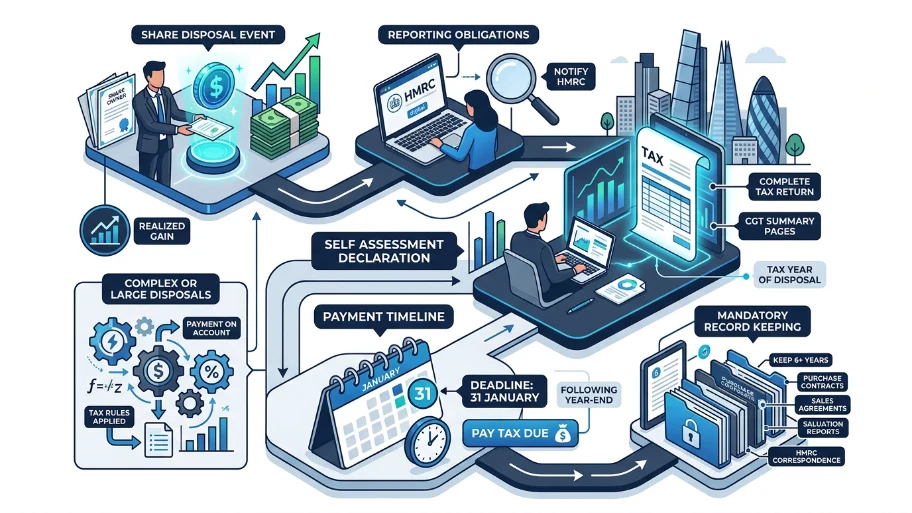
Report disposals to HMRC, declare gains on Self Assessment, and pay within 60 days for UK residential property or by Self Assessment deadlines for standard share disposals.
For most share disposals, include gains in the Self Assessment tax return for the tax year of disposal and pay any tax due by 31 January following year-end. Use the Capital Gains Tax summary pages on the return. For complex or large disposals, calculate the payment on account required under tax rules. Keep records for at least six years: purchase contracts, sales agreements, valuation reports, and correspondence with HMRC.
What valuation methods apply to private company share sales?
Valuate private company shares using market-based methods: comparable company, net asset valuation, discounted cash flow, or enterprise value multiples with supporting evidence.
Use a professional valuer for transactions where HMRC scrutiny is likely. Provide transaction comparables, audited accounts, and future cash flow forecasts. Apply appropriate discounts: minority discount when selling less than the controlling stake, and marketability discount for restricted shares. Document assumptions and calculations, and retain valuation reports to support the declared gain.
How do employment and director roles affect CGT for share disposals?
Director or employee status helps meet BADR and other relief conditions when ownership and role tests are satisfied for the qualifying period.
Confirm employment history through payroll, P60S, and board minutes. For directors, show appointment dates and minutes evidencing duties. If the seller received shares through share incentive plans, apply specific tax rules for plan disposals. Distinguish between income tax on employment-related securities and CGT on subsequent disposals; ensure correct relief and reporting route.
Explore our Company Services guide,
How Holidays Affect Payroll and Operations
What are common compliance pitfalls, and how can owners avoid them?
Common pitfalls include poor records, missing relief conditions, incorrect valuations, and late reporting; avoid them with early planning and professional advice.
Retain original purchase documents, share certificates, stock transfer forms, and valuation reports. Verify eligibility for BADR well before disposal. Use independent valuation for private-company shares. Prepare and submit Self Assessment returns on time. Make formal loss claims in the required format and timeframe. Document corporate actions—share issues, buybacks, company reorganisations to support tax positions.
Business owners pay CGT on share disposals when a chargeable gain arises. Calculate gains precisely, apply available reliefs such as BADR where qualifying criteria are met, and report gains to HMRC on Self Assessment. From My Company provides Company Services that assist with compliance, valuation coordination, and documenting relief eligibility to reduce CGT exposure and support robust reporting.
Frequently Asked Questions
What company services does From My Company offer for UK business setup?
From My Company provides Company Services that include company formation, director registration, and compliance support aligned with UK compliance frameworks. These services help businesses register correctly and maintain ongoing statutory requirements.
How quickly can I form a UK company using From My Company’s Company Services?
From My Company’s Company Services, we typically process UK company formation within 24 hours for standard applications submitted during business days. Processing speed depends on document accuracy and HMRC verification timelines.
What compliance support is included in From My Company’s Company Services?
Company Services from From My Company include annual confirmation statement filing, register updates, and HMRC notification support. Clients receive guidance on maintaining compliant records under UK company law.
Are From My Company’s Company Services suitable for foreign entrepreneurs setting up in the UK?
Yes, From My Company’s Company Services support foreign entrepreneurs with director registration, address services, and tax setup guidance. The team validates credentials using official UK compliance frameworks for international applicants.
What documents do I need to provide to use From My Company’s Company Services?
To use Company Services from From My Company, provide proof of identity, proof of address, and details of proposed company officers and share structure. Verified documents ensure successful registration and compliance with UK requirements.