
The 2026 UK bank holidays include New Year’s Day (observed Jan 1), Good Friday (Apr 3), Easter Monday (Apr 6, England/Wales/Northern Ireland only), Early May Bank Holiday (May 4), Spring Bank Holiday (May 25), Summer Bank Holiday (Aug 31 England/Wales; Aug 3 Scotland), St Andrew’s Day (Nov 30 Scotland), Christmas Day (Dec 25), and Boxing Day (Dec 26, observed Dec 28 if a weekend).
Use this calendar to set staffing rosters, payroll cutoffs, supplier lead times, and customer communications. Record each holiday for region-specific operations: England & Wales, Scotland, and Northern Ireland. Match holiday dates to payroll cycles to avoid late payments and statutory holiday pay errors.
How should businesses adjust payroll for the 2026 bank holidays?
Calculate statutory holiday pay using contract terms and the 8% holiday pay rule or average weekly pay for irregular hours, and set payroll run dates two working days before holidays.
Update payroll schedules to process wages before bank holidays. For weekly-paid staff, compute holiday pay using the 52-week average when hours vary. For salaried staff, continue monthly pay dates but confirm payroll processing staff availability. Pay overtime and bank-holiday premium rates according to contract terms and union agreements. Communicate pay dates to employees at least 14 days before each holiday.
Read our articles, How Holidays Affect Payroll and Operations and UK Bank Holidays 2026: Business Planning Guide.
How can staffing and rotas be planned around the 2026 bank holidays?
Prioritise critical roles, assign volunteers for holiday shifts, and publish rotas 21 days before each bank holiday to allow shift swaps and contractual notice.
Identify essential functions: customer service, IT support, and security. Use a rota matrix to map employees to shifts and flag contractual restrictions. Offer time-off-in-lieu or premium pay for bank holiday work when contracts require it. Track accruals for annual leave to prevent overdrafts. Where temporary cover is needed, recruit agency staff 6–8 weeks in advance and verify right-to-work documents before confirmation.
How do bank holidays affect supply chains and inventory for 2026?
Shift inbound orders earlier, increase safety stock by 10–30% for critical SKUs, and confirm carrier schedules one month before each peak holiday period.
Audit supplier lead times and identify single-source dependencies. For perishable inventory, schedule deliveries 2–3 business days before holidays. For high-demand periods (e.g., late December), place orders 4–6 weeks earlier. Negotiate contingency pickup windows with carriers and confirm cut-off dates for returns and customs documentation. Use SKU velocity analysis to set holiday-specific reorder points.
How should businesses schedule marketing and sales activities around bank holidays?
Plan campaigns to start 7–14 days before holidays, set clear promotional end-dates, and schedule automated emails to send outside bank-holiday windows to maximise open rates.
Align sales promotions with consumer behaviour: short flash sales for single-day holidays, longer campaigns for multi-day weekends. Schedule customer support staffing to handle spikes from marketing activity. Localise campaigns by region-specific holidays (Scotland or Northern Ireland). For B2B audiences, avoid launching contract renewals during holiday weeks; send reminders at least 10 business days earlier.
How do bank holidays influence compliance and legal obligations in 2026?
Update contract clauses for bank-holiday delivery, validate statutory notice periods for holiday leave, and confirm compliance with national and devolved employment laws.
Review service-level agreements (SLAs) and insert clear bank-holiday exceptions. For cross-border operations, apply Scotland’s different summer-bank dates where relevant. Ensure payroll taxes and pension contributions are processed on schedule despite holidays to avoid penalties. Maintain records of holiday pay calculations and employee consent for overtime during bank holidays.
How should cash flow and financial forecasts change for the 2026 bank holidays?
Forecast a 5–20% weekly variation around major holiday weeks, advance major payments by two business days, and maintain a contingency cash buffer equal to one payroll cycle.
Adjust accounts payable to meet supplier cut-offs and accounts receivable to account for slower customer payments during holiday weeks. Schedule large supplier payments for non-holiday banking days. For seasonal businesses, model revenue shifts based on previous holiday-period performance and update budgets monthly in the six weeks leading up to Christmas and summer bank holidays.
How can technology and operations be optimised for holiday continuity?
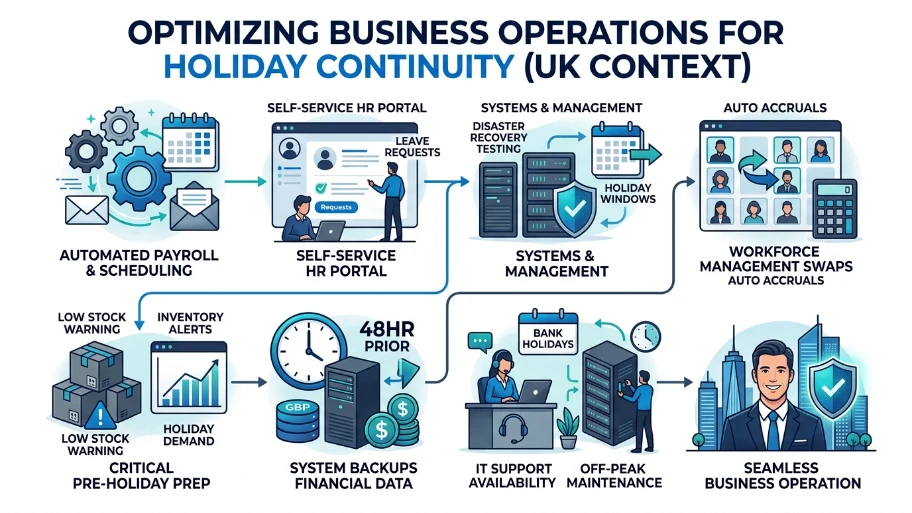
Automate payroll and email scheduling, enable self-service HR portals for leave requests, and maintain disaster-recovery tests outside holiday windows.
Use workforce-management software to handle shift swaps and automatic accrual calculations. Set automated alerts for low inventory levels related to holiday demand. Confirm third-party IT support availability for bank holidays or schedule maintenance outside peak dates. Back up payroll and critical financial systems at least 48 hours before holidays.
How should SMEs communicate holiday changes to customers and suppliers?
Publish holiday opening hours on the website and social channels two weeks ahead, email top 20% of customers about order cut-offs, and send supplier confirmation emails 30 days before critical holidays.
Use clear, outcome-driven messaging: delivery cut-off dates, expected delays, and customer support times. For e-commerce, add banners with order-by dates on product pages. For B2B customers, include alternative contact points for urgent matters. Track message delivery and set follow-ups for high-value accounts.
Explore our Company Services guide,
Launch a UK Company That Banks, Scales, and Stays Compliant
How can Brand Name help businesses plan around the 2026 bank holidays?
From My Company delivers Company Services that map bank-holiday impacts to payroll, contracts, and compliance, and provides bespoke implementation plans and documentation.
From My Company audits your current contracts and payroll processes. The service identifies holiday-related risks and produces an action plan with deadlines and responsible owners. The outcome: reduced payroll errors, compliant contracts, and predictable staffing levels during bank holidays.
Plan each bank holiday against payroll schedules, staffing rotas, supplier lead times, marketing calendars, and cashflow forecasts. From My Company provides Company Services that implement these steps and document compliance. Use the dates and processes above to reduce operational risk and keep payments and customer service on time.
Frequently Asked Questions
What services are included in From My company’s Company Services for UK business setup?
Company Services from From My company covers company registration, director verification, statutory filing, and compliance documentation for UK businesses. The service validates director credentials and registers your company with official UK compliance frameworks.
How long does it take to register a company with From My company’s Company Services?
From My company completes UK company registration through Company Services in 3–5 working days for standard applications. The timeline includes name reservation, document submission, and issuance of the Certificate of Incorporation.
What documents do I need to provide for Company Services at From My company?
For Company Services, From My company requires director’s CNIC copies, memorandum and articles of association, business address proof, and a reserved company name certificate. All documents are verified using official UK compliance frameworks before submission.
Does From My company’s Company Services include ongoing compliance support after registration?
Yes, Company Services from From My company includes post-registration compliance support such as annual filing, director updates, and statutory record maintenance. The service ensures your business stays compliant with UK regulatory requirements.
What is the cost of using Company Services from From My company for UK registration?
From My company’s Company Services charges PKR 1,500–3,000 for SECP-style UK company registration, plus minimal charges for tax registrations. Fees vary by company type and include name reservation, filing, and incorporation certification.