

If you are wondering how long does FCDO legalisation take, the answer depends on the type of apostille service you choose. According to current UK government guidance, standard paper-based apostille processing usually takes up to 25 working days, while an e-Apostille can take up to 2 working days. Registered businesses may also qualify for Next-Day or Restricted Urgent services, subject to the relevant conditions.
The total time can be longer when document preparation, solicitor certification, courier delivery or additional embassy legalisation is required. Understanding these stages helps individuals and businesses plan their international documentation requirements and avoid unnecessary delays.
This guide explains current FCDO processing times, the factors affecting document legalisation, faster submission options and how professional assistance can simplify the process.
How Long Does FCDO Legalisation Take?
FCDO legalisation processing times vary according to the service selected and the document submitted. Standard paper-based apostilles usually take up to 25 working days, while electronic apostilles take up to 2 working days. Registered businesses can access specific faster services where eligibility and pre-approval requirements are satisfied.
The following table summarises the published FCDO service times:
| Legalisation service | FCDO processing time | Important conditions |
|---|---|---|
| Standard paper-based apostille | Usually up to 25 working days | Additional return delivery time applies |
| Next-Day paper-based service | Next working day | Registered businesses only |
| e-Apostille | Up to 2 working days | Document must qualify for electronic legalisation |
| Restricted Urgent service | Same day | Registered businesses only and requires advance approval |
These are FCDO processing estimates, not guaranteed end-to-end delivery times. Applications requiring additional verification may take longer.
Businesses should check the live processing estimate on the official GOV.UK document legalisation service before submitting their documents.
What Does FCDO Legalisation Mean?
FCDO legalisation is the official process through which the UK Foreign, Commonwealth & Development Office verifies the authenticity of a signature, stamp or seal on a UK document. The Legalisation Office issues an Apostille certificate to confirm that the document has been signed or certified by an authorised person.
An apostille helps a UK-issued public document become acceptable for official use in another country where the Hague Apostille Convention applies.
The apostille does not verify the accuracy or truth of the document’s contents. It confirms the authenticity of the signature, capacity of the signatory and identity of the seal or stamp.
Apostille vs Full Document Legalisation
The terms apostille and legalisation are often used interchangeably, but they do not always describe the same process.
An apostille is generally sufficient when the destination country accepts documents under the Hague Apostille Convention. If the destination country requires additional authentication, the document may need further embassy or consular legalisation after the FCDO stage.
The required process depends on the destination country and the organisation receiving the document.
For a detailed explanation of international requirements, read our guide to countries covered by the Hague Apostille Convention.
Factors That Affect FCDO Legalisation Processing Time
Although the published processing times provide a useful starting point, several factors influence how long the complete process takes.
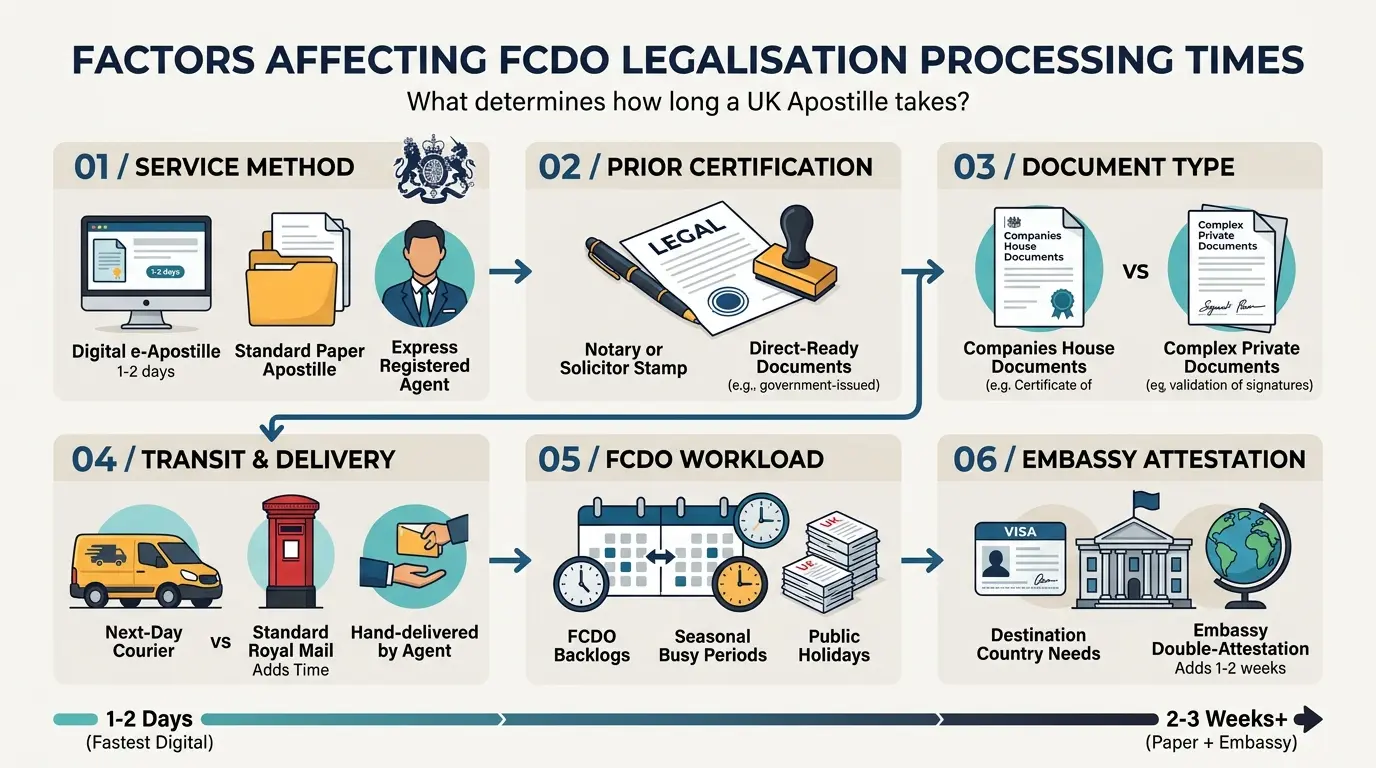
Type of Document
Different documents have different authentication requirements. Examples include:
Certificates of Incorporation
Certificates of Good Standing
Articles of Association
Memorandum of Association
Powers of attorney
Birth and marriage certificates
Academic qualifications
Commercial agreements
Some documents may qualify for direct submission, while others require prior certification by a solicitor or notary public.
Document Certification and Preparation
Documents must meet the relevant FCDO requirements before submission. If a document needs notarisation or certification, this preparation stage adds time.
Incorrect signatures, incomplete certification or unsuitable document formats can lead to delays or rejection.
Checking the requirements before submitting documents helps reduce unnecessary processing problems.
FCDO Service Selection
The service selected has a direct impact on processing time.
Standard paper-based applications generally have a longer processing window than electronic apostilles. Eligible registered businesses can access specific priority services, subject to the published conditions.
Applicants should not assume that every document qualifies for an urgent route.
Courier and Postal Delivery
Paper-based legalisation involves document transportation to and from the Legalisation Office. Courier arrangements, collection schedules and international delivery can increase the total turnaround time.
The published FCDO processing period should therefore be considered separately from delivery time.
Destination Country Requirements
The country where the document will be used determines whether an apostille alone is sufficient or whether additional embassy legalisation is necessary.
Some receiving authorities also require certified translations, specific document formats or additional supporting paperwork.
Confirming these requirements before starting the application can prevent repeat submissions.
Faster Routes for FCDO Legalisation
When documents are needed for urgent business transactions, international registrations or personal legal matters, choosing an appropriate legalisation route is important.
Standard Paper-Based Apostille
The standard paper-based service is suitable for applicants who do not have an urgent deadline. Current GOV.UK guidance states that processing usually takes up to 25 working days, excluding return delivery.
Applicants should allow additional time for document preparation and transportation.
Next-Day Apostille Service
The Next-Day paper-based service is available to registered businesses. Eligible applications are processed on the next working day.
Businesses should check the service conditions and confirm document eligibility before relying on this option.
e-Apostille Service
An e-Apostille is an electronic apostille issued digitally. GOV.UK currently publishes a processing time of up to 2 working days.
This option can reduce physical handling and delivery requirements, but the document must be suitable for electronic legalisation and accepted by the receiving authority.
Restricted Urgent Legalisation
The Restricted Urgent service provides same-day processing for eligible applications. It is available to registered businesses and requires advance approval from the FCDO Legalisation Office.
It should not be treated as a general walk-in or guaranteed same-day option.
How to Prepare Documents for Faster Legalisation
Good preparation can help avoid preventable delays, even when the FCDO processing time itself cannot be shortened.
Follow these steps before submitting your application:
1. Confirm the receiving country’s requirements
Check whether the receiving authority requires an apostille, further embassy legalisation or a certified translation.
2. Check the document format
Establish whether the original document, an official copy or a solicitor-certified copy is required.
3. Arrange notarisation where necessary
Certain documents, including some powers of attorney and private agreements, require notarisation or other authorised certification before apostille issuance.
4. Verify names and signatures
Check that names, signatures and supporting information are accurate and consistent.
5. Choose the appropriate FCDO service
Compare standard, electronic and eligible priority routes against your deadline and document requirements.
6. Arrange delivery and collection
Allow sufficient time for courier or postal transportation, particularly when documents must be returned internationally.
How Long Does Full Document Legalisation Take?
The complete legalisation process can take longer than the FCDO processing stage because some documents require additional preparation or authentication.
For example, a company preparing documents for an overseas registration may need to arrange solicitor certification, FCDO apostille processing and subsequent embassy legalisation.
The overall timeframe depends on the document type, the chosen FCDO service, the destination country and the relevant embassy’s requirements.
| Stage | What happens |
|---|---|
| Document preparation | Documents are checked and certified where required |
| FCDO processing | The apostille is issued |
| Embassy legalisation | Additional authentication is completed where necessary |
| Return delivery | Documents are collected or delivered to the applicant |
There is no single processing time that applies to every country or document. Applicants should obtain destination-specific guidance before committing to an international deadline.
Why Businesses Need Legalised Company Documents
UK businesses frequently need authenticated documents when operating internationally. Overseas banks, regulators, commercial partners and government authorities may request official company records before accepting applications or completing transactions.
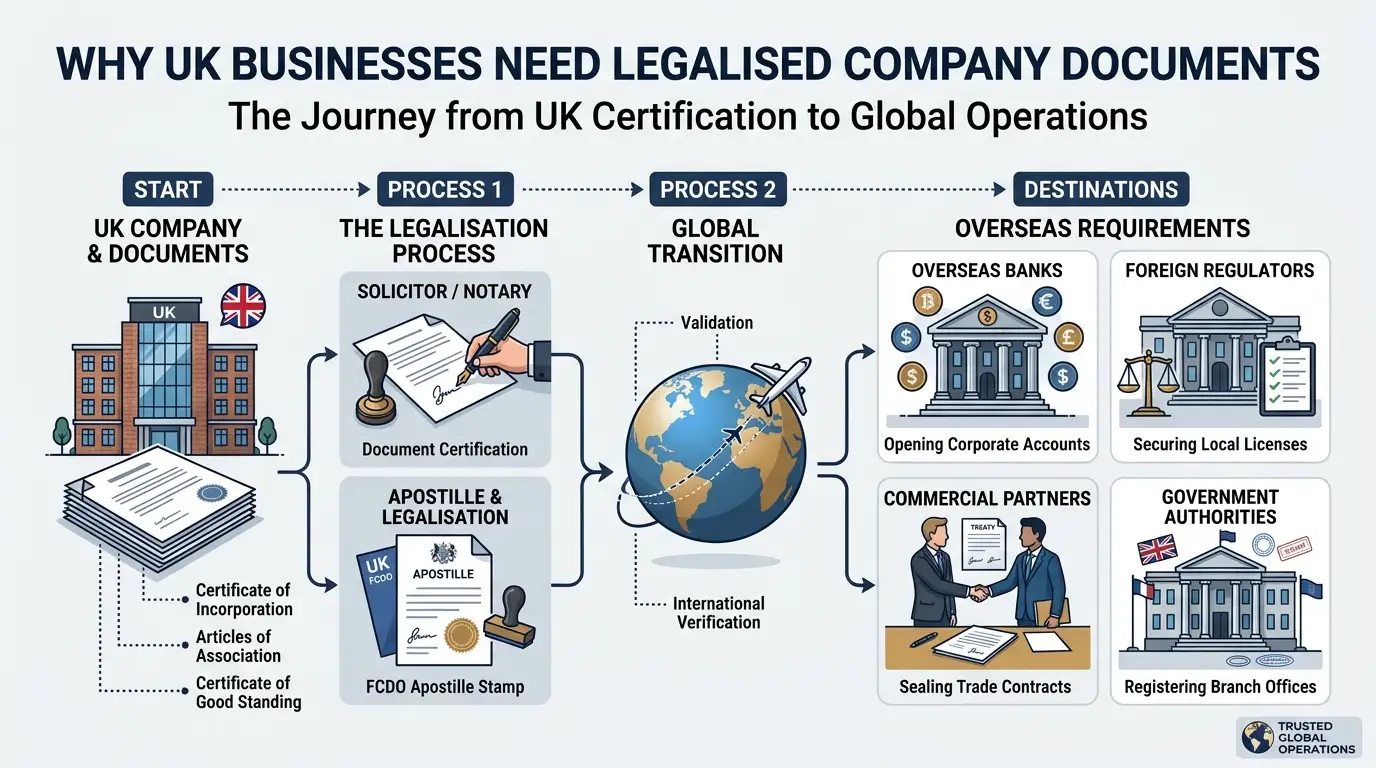
Common examples include:
International Company Registration
Businesses expanding overseas may need their Certificate of Incorporation, Articles of Association or other company records authenticated before registering a branch or subsidiary.
Overseas Banking Applications
International financial institutions may request verified company documents to confirm incorporation, company status and authorised representatives.
International Commercial Agreements
Certain overseas contracts and legal arrangements require authenticated documents to establish the identity and authority of the parties involved.
Corporate Due Diligence
A Certificate of Good Standing may be requested to demonstrate a company’s current status and compliance standing, depending on the receiving authority’s requirements.
If you need this document for an international transaction, explore our Certificate of Good Standing service.
For a fuller explanation of the document, its purpose and the information it provides, read What Is a Certificate of Good Standing for UK Companies?.
How Form My Company Helps with Apostilled Documents
Arranging document legalisation involves more than submitting paperwork to the FCDO. Applicants must identify the correct certification route, prepare supporting documents and understand the requirements of the destination country.
Form My Company helps individuals and businesses navigate the process by providing assistance with document preparation and legalisation requirements.
The service can help with:
Understanding document certification requirements.
Identifying whether notarisation is necessary.
Preparing documents for apostille submission.
Understanding additional embassy legalisation requirements.
Arranging suitable document handling and delivery.
Identifying the appropriate legalisation route for business documents.
Explore our UK apostilled documents service to learn more about the available assistance.
Common Reasons for FCDO Legalisation Delays
Even correctly prepared applications can experience delays. Understanding common problems helps applicants plan more effectively.
Incorrect certification: Documents submitted without the required solicitor or notarial certification may not qualify for legalisation.
Signature verification: The FCDO may need additional time to verify a signature or official seal.
Incomplete applications: Missing information or incorrect application details can interrupt processing.
Courier delays: Postal transportation and collection arrangements can extend the overall timeframe.
Additional embassy requirements: Some destinations require further authentication after the apostille has been issued.
Unclear destination requirements: Using the wrong document format or certification route can result in additional work.
Reviewing these requirements before submission is an effective way to reduce avoidable delays.
Frequently Asked Questions
How long does FCDO legalisation take?
Standard paper-based apostille processing usually takes up to 25 working days according to current GOV.UK guidance. An e-Apostille takes up to 2 working days, while eligible registered businesses can access Next-Day or Restricted Urgent services.
How long does an FCDO apostille take by post?
The standard paper-based apostille service usually takes up to 25 working days. Additional time is needed for postal delivery and document return.
Can I get an FCDO apostille in one day?
Same-day processing is available through the Restricted Urgent service for registered businesses, but applications require advance FCDO approval. The Next-Day service is another option for eligible registered businesses.
Is an e-Apostille faster than a paper apostille?
Yes. Current GOV.UK guidance states that an e-Apostille takes up to 2 working days, while standard paper-based processing usually takes up to 25 working days. The document must qualify for the electronic service.
Does FCDO processing time include courier delivery?
No. The published paper-based processing time does not include additional courier or postal transit. Applicants should allow extra time for document transportation and return.
Do all UK documents need notarisation before an apostille?
No. Not every document requires notarisation. Some official documents can be submitted directly, while certain private documents and agreements require certification by a solicitor or notary public.
Does every country accept a UK apostille?
No. The Hague Apostille Convention applies according to the relationship between the issuing and receiving countries. Some destinations require additional consular legalisation or have specific document requirements.
How can I check current FCDO legalisation times?
You can check the current processing estimates and service conditions through the official GOV.UK document legalisation service. Processing times can change, so check before submitting your documents.
Get Help with UK Document Legalisation
Understanding how long FCDO legalisation takes allows individuals and businesses to plan international transactions, company registrations and official applications more effectively.
The right legalisation route depends on your document, destination country and deadline. Standard paper-based processing, e-Apostille and priority services each have different eligibility requirements and turnaround times.
Form My Company helps clients understand document preparation and legalisation requirements, making it easier to navigate the process. Explore our apostilled documents service and get assistance with your UK documents today.