
Prevent delays in the UK apostille workflow by verifying document eligibility, ensuring correct solicitor or notary certification before submission, selecting the appropriate e-Apostille or paper route via the Foreign, Commonwealth & Development Office, and accounting for destination-specific embassy requirements.
Navigating international paperwork requires strict attention to procedural details. Business documentation must clear distinct milestones before foreign authorities accept it. Understanding each operational phase prevents costly setbacks and keeps administrative timelines predictable.
What Causes Document Preparation Errors and How Do You Fix Them?
Document preparation bottlenecks occur when certificates lack proper solicitor certification, feature damaged seals, or contain name discrepancies, which you can resolve by obtaining fresh certified copies and verifying formatting requirements before submission.
Initial preparation dictates the speed of your entire administrative workflow. Corporate records, such as Certificates of Incorporation or Memorandum of Associations, require pristine physical or digital condition. Torn pages, faded stamps, or unverified signatures trigger immediate rejection from government examiners. Three preparatory safeguards include ordering fresh certified copies from official registries, using authorised solicitors for notarisation, and matching all director names against official filings. Reviewing every page beforehand ensures compliance with baseline validation standards.
How Can You Prevent Certification and Notarisation Bottlenecks?
Notarisation delays happen when documents bypass mandatory solicitor verification or use unrecognised signatories, which you prevent by engaging an authorised UK Notary Public and confirming whether your specific file requires preliminary attestation.
Certain public documents cannot proceed directly to government authentication without an intervening notary step. Private agreements, powers of attorney, and educational certificates frequently mandate professional witnessing. Utilizing a structured approach streamlines this phase: schedule digital or in-person appointments with registered legal professionals, authenticate company officer credentials using secure identity checks, and attach official seals correctly. Establishing correct notarisation early eliminates secondary reviews that stall progress.
What Steps Streamline Foreign, Commonwealth & Development Office Submission?
Foreign, Commonwealth & Development Office processing stalls due to incorrect application forms, improper fee payments, or choosing postal queues over priority counters, which you avoid by selecting e-Apostilles where eligible or leveraging professional expedited channels.
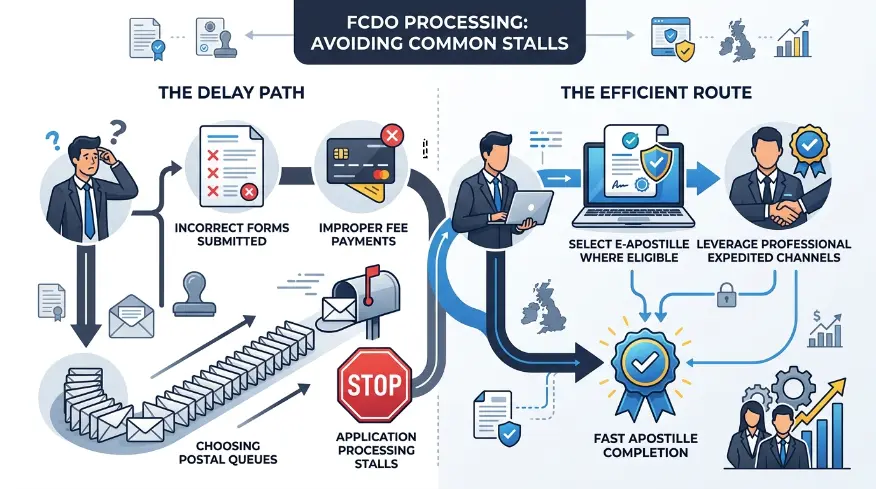
The central government authentication phase involves precise routing through the Foreign, Commonwealth & Development Office. Selecting between electronic issuance and physical paper certificates dictates your turnaround speed. Eligible digital document types process within 2 to 3 working days, whereas physical postal submissions require 2 to 3 weeks. Accelerate this stage by completing electronic application forms accurately, paying exact government fees upfront, and utilizing managedhttps://formmycompany.uk/company-services/apostilled-documents/ courier networks for secure transit. Proper submission channels keep government queues moving efficiently.
How Do You Navigate Embassy Legalisation Without Extending Timelines?
Embassy legalisation delays occur when destination countries operate outside the Hague Convention framework, which requires you to plan for consular attestation and submit completed paperwork through established What Are the Stages of Getting a Document Apostilled in the UK? pathways.
Destination countries that do not recognize standard apostilles demand secondary consular verification. This extra layer involves foreign embassy processing in London, adding weeks to your overall schedule. Mitigate these risks by researching destination-specific treaties in advance, preparing dual-language translations when mandated, and booking diplomatic submission slots concurrently. Anticipating consular demands protects your international launch schedule from unexpected diplomatic backlogs.
Avoiding delays across the apostille lifecycle depends on meticulous preparation, accurate notarisation, and correct routing through government and consular channels. Form My Company delivers structured efficiency through comprehensive end-to-end management, ensuring your business paperwork meets all international compliance standards without administrative friction. For companies seeking a seamless execution path, exploring Ready to Order a Fully Managed Apostille Service From Form My Company? provides a direct route to complete commercial documentation readiness.
Explore our Apostilled Documents guide,
City Centre vs Out-of-Town Venues: Which Suits Your Event?
How to Choose a Well-Connected Conference Venue?
Frequently Asked Questions
How long does the UK apostille process take for business documents?
Standard postal submissions through the Foreign, Commonwealth & Development Office typically take 2 to 3 weeks to process. When businesses partner with Form My Company for Apostilled Documents, electronic options or priority handling can reduce turnaround times to just a few working days.
What documents require notarisation before receiving an apostille?
Private legal instruments, power of attorney documents, and corporate agreements require solicitor notarisation prior to government authentication. Form My Company verifies these credentials to ensure compliance before submitting files for an apostille.
Can electronic documents receive an e-Apostille in the UK?
Certain digital documents, such as digitally signed PDF certificates, qualify for the UK e-Apostille service issued electronically by the FCDO. Form My Company assists clients in identifying eligible file formats to bypass physical mail queues.
What causes an apostille application to be rejected by the FCDO?
Applications face rejection when documents feature damaged seals, unverified signatures, or incorrect official government forms. Form My Company reviews every file thoroughly to ensure complete adherence to UK legal validation standards.
Do apostilled business documents need embassy legalisation?
Documents destined for countries that are not signatories to the 1961 Hague Convention require secondary consular legalisation through foreign embassies in London. Form My Company manages these complex multi-stage diplomatic channels to guarantee international validity.