
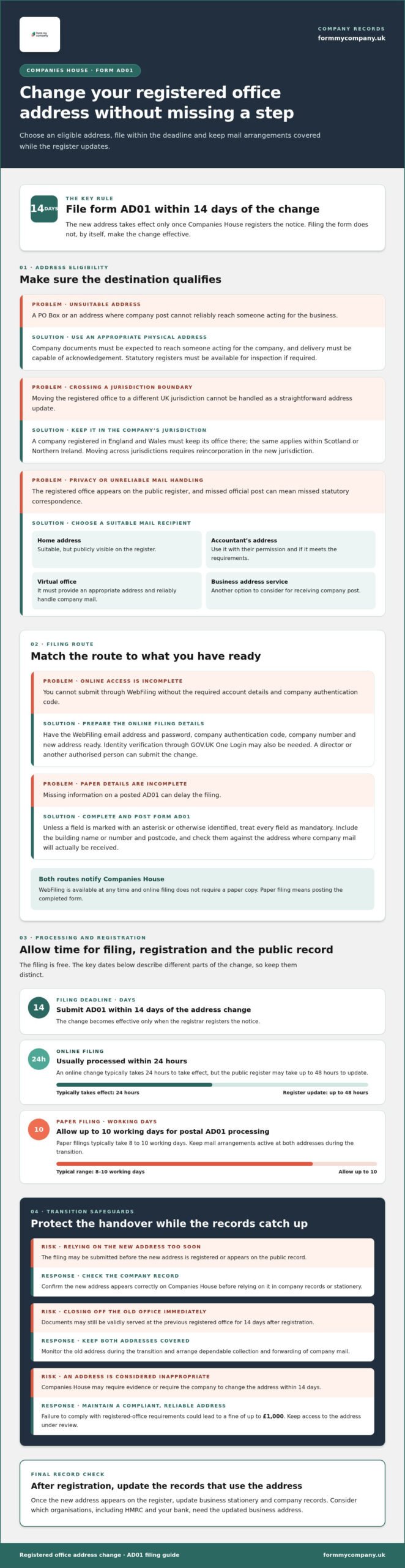
To change your registered office address with Companies House, file form AD01 online or by post and notify the registrar within 14 days of the change. Your new address must be an appropriate physical address in the same UK jurisdiction as your company. The change takes effect only when Companies House registers it.
Changing your registered office address with Companies House is more than an admin update: official correspondence is sent there, and the address appears on the public register. Whether you’re relocating, changing how company mail is handled or choosing an address that better suits your business, follow the filing requirements to avoid delays.
This guide explains how to choose an eligible address, submit form AD01 and understand when the change takes effect. You’ll also learn which organisations to notify afterwards, so you can complete the move with confidence and keep your business records up to date.
Key Takeaways
- Choose a physical address in the same UK jurisdiction as your company, where official correspondence can reach someone acting for the business.
- File form AD01 within 14 days of changing the address; the change takes effect once Companies House registers it.
- Use the online process or submit a paper form, and prepare the details and access information needed for your chosen route.
- After the registered office changes, consider which organisations, including HMRC and your bank, need your updated business address.
- Weigh privacy, reliable mail handling and your business’s circumstances when deciding whether a new registered office is the right move.
How do I change my company address with Companies House?
Choose an eligible address, then notify Companies House using form AD01. Follow these steps to meet the address rules and confirm the change is recorded.
Submit the registered office address change
Choose an address where someone acting for the company can receive official post. It must be a physical address, not a PO Box, and it must be in the same jurisdiction as the company’s registration.
- Check the address is appropriate. The UK Government says a registered office must be an address where company documents are expected to reach someone acting for the company and delivery can be acknowledged. Use an address where correspondence can be received and statutory registers can be inspected if required.
- Confirm the jurisdiction. A company registered in England and Wales must keep its registered office in England and Wales. The same rule applies within Scotland or Northern Ireland. Moving across jurisdictions requires reincorporation in the new jurisdiction, rather than simply changing the address.
- Choose who can receive mail. You can use your home address, which becomes publicly available on the Companies House register. An accountant’s address is also suitable if they give permission and it meets the requirements. A virtual office can be used if it provides an appropriate address and handles company mail reliably. A business address service is another option to consider.
- Prepare your filing access. For online filing, have the email address and password used for Companies House WebFiling, plus the company’s authentication code. You may also need to verify your identity through GOV.UK One Login. A director or another authorised person can submit the change; consider whether your company’s circumstances require a resolution.
Check the update and address handling
After filing, check the company record on Companies House and confirm the new address appears correctly. The change is effective only once the registrar registers the notice, so keep monitoring the old address meanwhile. For 14 days after registration, documents may still be validly served at the previous registered office.
If Companies House considers the address inappropriate, it may require the company to provide evidence or change the address within 14 days. Failure to comply with registered-office requirements could lead to a fine of up to £1,000. If mail is not received, the company risks missing statutory correspondence; arrange dependable collection and forwarding, and keep access to the address under review.
What guidelines apply when a registered office address has to be changed?
Choose an online or paper route, then submit the address change within 14 days. The filing is free, but processing and register updates take different amounts of time.
Choose an online or paper filing route
Decide whether to file through Companies House WebFiling or send a paper form AD01. Both routes notify Companies House of the change, but the online service is available 24/7 and paper filing involves posting the completed form. You can change your registered office address online without sending a paper copy.
- Use the online route for electronic filing. Sign in to the Companies House service and submit the address change. Keep the company number and new address details ready, and allow time for the filing to be processed before updating corporate records.
- Choose paper filing when needed. Complete form AD01 and post it to Companies House. Unless a field is marked with an asterisk or otherwise identified, treat every field as mandatory. Missing details can delay the filing.
Change the address using WebFiling
Sign in to Companies House WebFiling using the email address and password linked to your account. You’ll also need the company authentication code to submit the change. If you haven’t registered for WebFiling, Companies House sends the code by post to the company’s registered office.
- Enter the new address carefully. Include the building name or number and postcode. Check the details against the address where company mail will actually be received, rather than relying on a trading address or a forwarding label.
- Submit the online filing. Online changes are usually processed within 24 hours. Companies House WebFiling can be used at any time, so you can file as soon as the new address is ready and the company’s access details are available.
- Allow for the public register to refresh. An online filing typically takes 24 hours to take effect, while the public register may take up to 48 hours to update. Check the company record before relying on the new entry in corporate documents or stationery.
Postal AD01 submissions can take up to 10 working days to process; paper filings typically take 8 to 10 working days. Keep mail arrangements active at both addresses during the transition. For 14 days after registration, documents may still be validly served at the previous registered office. Once the new address appears on the register, update business stationery and company records to prevent conflicting details.
Changing a registered office using form AD01
Use form AD01 to notify Companies House of a registered office change. The Companies Act 2006 provides the filing basis, and the notice must be submitted within 14 days of the change.
Decide when to file a paper form
Use paper filing if the company has been moved to a Companies House default address or is in liquidation. An unregistered company must also file on paper. Check the company’s status first, as these circumstances affect which filing route you can use.
- Get the current form AD01. Use the form for a registered office address change, not a form intended for another company update. The filing notifies the Registrar under section 87 of the Companies Act 2006.
- Enter the company details. Add the registered company name and company number accurately, then provide the new address. Include the building name or number and postcode so Companies House can identify the location.
- Check every applicable field. Unless a field is marked with an asterisk or otherwise indicated, treat it as mandatory. Review the completed form for omissions and make sure the address matches the location where company correspondence can be received.
- Arrange valid authentication. Form AD01 may be authenticated by a director, secretary or authorised person. Other permitted signatories include a liquidator, administrator, administrative receiver, receiver, receiver manager, Charity Commission receiver and manager, CIC manager or judicial factor.
- Send the form to Companies House. Post the completed AD01 to Crown Way, Cardiff, CF14 3UZ. A company changing from a default address must use paper filing and send its form to this address.
- Keep a copy and track the filing. Retain a copy of the signed form and note when it was posted. The company should allow for postal processing before relying on the new address in its records or correspondence.
Send the AD01 form by post
Post the completed and authenticated form to Companies House at Crown Way, Cardiff, CF14 3UZ. Check that the postcode, company number and new address are legible, then keep a copy for the company’s records. File within 14 days, and maintain arrangements to receive correspondence at the existing office until Companies House registers the notice.
Once the Registrar registers the change, use the new address for future company records and correspondence. If you move between England and Wales, Scotland or Northern Ireland, make sure the new address remains within the company’s existing jurisdiction.
Organisations to notify after changing address
The new registered office address becomes effective when the registrar registers the notice. File the Companies House change within 14 days, then update other organisations that use your company address.
Identify organisations to notify
List the organisations that hold the old address and update their records after the change is registered. Notify HMRC if required, and update your bank details to keep its records current. Also review the contact details held by suppliers, insurers and customers so invoices, policy documents and business correspondence reach the right place.
- Notify HMRC where relevant. Review the company’s HMRC correspondence and tax records, then report the changed business address through the appropriate company account or correspondence process. Keep the company name and reference details together so HMRC can match the update to the correct business.
- Update your bank. Tell the company’s bank about the registered office change and ask for its business records to be updated. Check whether the bank also holds a separate trading or correspondence address, as changing one record may not update every contact field.
- Review other business records. Check supplier accounts, insurance policies, customer records, invoices and contracts for the old address. Update each record that uses it, and replace outdated templates before issuing new documents.
Meet the notification deadline
Submit the registered office change to Companies House within 14 days of changing the address. The filing deadline applies to the company’s notification; updates to HMRC, the bank and other organisations are separate practical follow-up tasks. Keep a record of when the address changed, when the filing was sent and which organisations received updated details.
- Track the registration date. The new address takes effect when the registrar registers the notice, not merely when you prepare or send it. Check the Companies House register after filing, then use the registered address shown there as the reference for your records.
- Keep mail arrangements running. For 14 days after registration, documents may still be validly served at the previous registered office. Arrange to receive post at both addresses during that period, and redirect or collect statutory correspondence so it is not missed.
- Separate the registered office from a home address. A home address used as the company’s registered office is publicly available on the Companies House register. Updating the registered office does not itself change a director’s residential address record; inform Companies House if a director’s residential address changes.
- Confirm each update. Save acknowledgements and correspondence from HMRC, the bank and other organisations. If an organisation maintains separate registered, trading and postal address fields, make sure the correct details are updated in each record.
Reasons to change a registered office address
Review your registered office when your circumstances change, such as when you relocate, adjust how mail is handled or want to keep your home address off the public company register.
- Move after relocating your business. If your company has moved, a registered office elsewhere may make statutory correspondence harder to manage. Choose an address where official letters can reach someone acting for the company, and make sure it remains within the company’s existing UK jurisdiction. Moving from England and Wales to Scotland, for example, cannot be handled as a simple address update.
- Separate your home from public company details. A home address used as a registered office is publicly visible on the Companies House register. A business owner may prefer a different appropriate address for privacy. Bear in mind that previous registered office addresses remain on the public register for the company’s lifetime and for 20 years after it has been dissolved.
- Improve statutory mail handling. Consider a change if official letters are being missed, delayed or delivered to a place without a reliable recipient. The registered office must allow company documents to reach someone acting for the business, with delivery capable of acknowledgement. If suppliers or staff currently handle post informally, set clear arrangements before changing the address.
- Replace an address that no longer suits the company. A former accountant’s premises, an old workplace or a closed office may no longer be appropriate. If the company uses an accountant’s address, confirm permission remains in place. For an agent or third-party address, ensure the service can receive company mail and send all correspondence to the business.
- Match the address to how the company operates. A growing company may want a stable official address while its working location changes. Keep the registered office distinct from the trading address where necessary, and check that the selected address meets the legal requirements. A virtual office address can be used as a registered office if it meets those requirements.
- Act when the current address becomes unsuitable. Don’t wait until statutory letters go astray. Choose the replacement address, check that it meets the requirements, then notify Companies House within 14 days of changing it. The new address takes effect once the registrar registers the notice, so plan mail handling around the transition.
If you need a suitable address for official company correspondence, explore registered office address options for your business.
Form My Company: Digital Package
Form My Company’s Digital Package is for people setting up a company. If you’re starting a business and choosing its registered office, the package can support the formation process. Digital & Print and Entrepreneurs Choice packages are also available, as is Limited Liability Partnership (LLP) Formation for those choosing that structure.
Choose a formation option that suits your needs, and ensure the registered office meets Companies House requirements and remains within the company’s jurisdiction. Explore the Digital Package and other formation options at formmycompany.uk, or contact Form My Company to discuss your company formation.
Make your next business move with confidence
Changing your registered office is a useful opportunity to review how your company will handle official correspondence as it grows. Choose an address arrangement that supports your privacy, reliable mail handling and the way you plan to run the business. If you’re also setting up a company, factor the address into your formation planning.
Form My Company offers a Digital Package, a Digital & Print Package and an Entrepreneurs Choice Package for company formation. These options give you a starting point for organising your new venture, while the right fit depends on what you need for formation. If you’re ready to explore your options, contact Form My Company and take the next step with clarity.
Frequently Asked Questions
What Is an ‘Appropriate Address’?
A suitable registered office is an address where company documents can reach someone acting for the business and delivery can be acknowledged. A staffed office with reliable post handling may meet this requirement. An address that cannot receive statutory correspondence is unsuitable, even if it appears on company stationery. Make sure the person handling mail can alert the company promptly when official documents arrive.
Can I use a virtual office as my new company address?
A virtual office address can be used if it meets the registered-office requirements. Consider how mail is actually handled, not just the address label: statutory post must reach someone acting for your company, and delivery must be capable of acknowledgement. Establish who receives official letters and how they will be passed on. An address outside your company’s jurisdiction is not suitable.
How Long Does the Whole Process Take?
The timing depends on the filing method and when you have the address and access details ready. Online registered-office changes are usually processed within 24 hours, while a paper submission can take up to 10 working days. An online filing typically takes 24 hours to take effect, and the public register may take up to 48 hours to update. Allow extra time to arrange mail handling and notify other organisations.
What documents are required to change address?
For a standard address change, prepare form AD01 if filing by post, or the equivalent details for the online filing. You’ll need the company’s name and number, the new address, and valid authentication by an eligible person. Online filing also requires the company authentication code. Keep a copy of the submitted form or filing confirmation with the company’s records for reference.
What happens if I forget to update my company address?
If you fail to notify Companies House within 14 days of changing the registered office, the company may breach its filing requirements. An inappropriate address can also leave statutory post unseen; failure to comply with address requirements could result in a fine of up to £1,000. For instance, missed official correspondence may require urgent attention. Keep mail collection active at the old address during the transition.
What is the AD01 form and when do I use it?
Form AD01 is the Companies House form used to notify a registered office address change. Use it for a paper filing, including when the company must submit a paper form, such as when it is in liquidation or has been moved to a default address. Complete the company details and new address, then ensure an eligible person authenticates the filing before posting it.
How do I change a company’s registered office address with Companies House?
To change your registered office address with Companies House, submit the change online or file form AD01 by post. Choose an address that meets the legal requirements and remains within the company’s jurisdiction. Check the company’s record after filing to ensure the new details appear correctly. Keep arrangements in place for post sent to the former address, including documents served during the transition period.
What information do I need to change a registered office address?
Have the company’s registered name and number, the complete new address, and the authentication details for your chosen filing method. The address must include a building name or number and postcode. Online filing requires the company authentication code; a postal AD01 needs authentication by an eligible person. Check spelling, postcode and jurisdiction before submitting, so the record matches the address used to receive official correspondence.