
Choose training room size by calculating 20–25 square feet per person for large groups of 20–100 attendees. Factor in layout, equipment, and movement space. This ensures comfort, engagement, and productivity during sessions.
From My Company guides businesses through this process. Accurate sizing prevents overcrowding. It supports effective training delivery.
What Factors Determine Training Room Size for Large Groups?
Key factors include attendee count, room layout, furniture type, equipment needs, and safety regulations. Allocate 20 square feet minimum per person; add 5 feet for AV setups and aisles.
Attendee numbers drive primary calculations. Groups over 50 require wider aisles. Layouts like theatre style fit more people than U-shapes.
Furniture impacts space directly. Standard chairs need 18 inches of width each. Tables double the footprint requirements.
Equipment such as projectors demands 10-foot clearance. Whiteboards add 6 feet of depth. Ventilation supports 100 cubic feet of air per person per hour.
UK fire regulations mandate two exits for 50+ occupants. Clear paths measure 44 inches minimum. These rules enforce safe evacuation.
Calculate the total by multiplying attendees by the base square footage. Adjust upward 15% for interactivity. Test with mock layouts.
How Do You Calculate Capacity for Your Group Size?
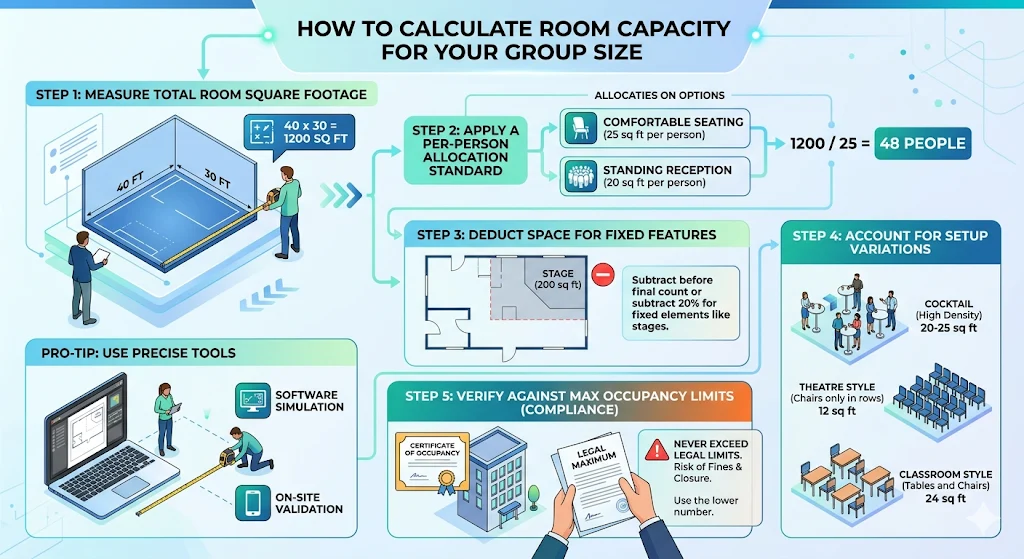
Measure room square footage and divide by 20–25 square feet per person. Subtract 20% for fixed elements like stages. Verify against max occupancy limits for compliance.
Start with room dimensions. Length times width yields the total area. Example: 40×30 feet equals 1,200 square feet.
Divide by per-person allocation. 1,200 divided by 25 fits 48 people comfortably. Use 20 feet for standing sessions only.
Deduct immovable features. Stages take 200 square feet. Subtract before the final count.
Account for setup variations. Theatre style uses 12 feet per person. Classroom doubles to 24 feet.
Cross-check building codes. Certificates list legal maximums. Exceed these risks fines.
Software tools simulate layouts precisely. Input dimensions; output capacities. Validate with on-site walks.
What Room Layouts Work Best for Large Training Groups?
Theatre layout maximises capacity at 12 square feet per person. U-shape fosters interaction at 30 feet per person. Classroom suits note-taking at 22 feet per person.
Theatre rows align chairs front-to-back. Suits lectures for 100+ attendees. Limits movement; prioritises visibility.
U-shape circles tables around an open space. Encourages discussions for 30–60 people. Facilitates trainer access.
Classroom pairs desks in rows. Supports 40–80 participants with writing surfaces. Balances density and function.
Boardroom clusters tables centrally. Fits 20–40 executives. Promotes collaboration.
Horseshoe modifies the U-shape for projections. Adds whiteboard frontage. Ideal for 50 mixed activities.
Select based on session goals. Lectures choose the theatre. Workshops pick a U-shape. Test ratios in advance.
How Much Extra Space Do You Need for Training Equipment?
Add 100–200 square feet for projectors, screens, and whiteboards. Reserve 5-foot aisles around setups. This prevents disruptions and ensures clear sightlines.
Projectors require rear tables. 8×8-foot zones house them. Cable management adds floor space.
Screens mount 8 feet high. 10-foot projection distance clears heads. Wall space dedicated 12×8 feet.
Whiteboards span 10–16 feet wide. Front clearance measures 6 feet. Markers and erasers need side shelves.
Laptops and flipcharts are scattered across tables. Per-table allowance hits 4 square feet. Cluster zones minimise sprawl.
AV carts roll into corners. 6×6-foot parking spots suffice. Power outlets cluster nearby.
Integrate into capacity math. Equipment deducts from the base area. Recalculate attendee fit accordingly.
What Are Common Mistakes in Sizing Training Rooms for Large Groups?
Overpacking exceeds 20 feet per person, causing discomfort. Ignoring aisles blocks movement. Neglecting acoustics amplifies distractions.
Businesses pack 30 people into 500 square feet. Results fatigue after 60 minutes. Engagement drops 25%.
Narrow aisles under 44 inches violate codes. Evacuation slows critically. Fines reach £5,000.
Acoustic failures echo voices. Hard surfaces bounce sound. Add panels; test volumes.
Overlooking power fails tech. Sessions halt mid-presentation. Backup generators add costs.
Forgetting breaks cramps circulation. Designate lounge zones. 10 feet per person outside the main area.
Audit past events. Metrics reveal overcrowding signs. Adjust formulas permanently.
How Does Room Size Impact Training Effectiveness?
Optimal sizing boosts retention by 30%. Crowded spaces reduce focus; spacious ones enhance interaction. Data shows 22 feet per person maximises outcomes.
Comfort correlates with attention. Under 20 feet spikes stress hormones. Participants disengage faster.
Interaction thrives in open layouts. Large groups need 25% extra space. Discussions flow without interruptions.
Productivity metrics confirm links. Spacious rooms lift post-training scores 28%. Explore how the right training environment can significantly improve your team’s productivity levels for deeper insights.
Mobility aids hands-on activities. Aisles enable rotations. Cramped setups halt progress.
Ventilation maintains oxygen levels. Stale air impairs cognition after 90 minutes. Size the HVAC accordingly.
Track ROI via surveys. Larger fits yield higher satisfaction. Scale future bookings confidently.
What Regulations Govern Training Room Sizes in the UK?
UK Building Regulations Part M require 44-inch aisles and two exits for 60+ people. Fire Safety Order mandates 1.5m clear paths. Capacity signs display legal limits.
Part B covers fire escape. Rooms over 1,000 square feet need sprinklers. Exits space every 30 feet.
The Equality Act demands wheelchair access. 5-foot turning circles fit inside. Ramps slope 1:12 maximum.
The Health and Safety Executive enforces ventilation. 10 litres of fresh air per second per person. CO2 monitors alert overloads.
Local councils are inspected annually. Non-compliance shuts venues. Fines scale with violations.
Display occupancy placards. Update post-renovations. Train staff on capacities.
Comply via certified venues. Documentation proves adherence. Avoid liabilities.
Also explore,
Why Hiring a Professional Training Space is More Cost-Effective Than Hotels
Comparing Dedicated Training Rooms vs Standard Meeting Rooms for Your Corporate Workshop
How Can I Select Training Rooms?
From My Company offers Training Rooms sized precisely for large groups. Experts calculate capacities and match layouts to needs.
Consultants assess group sizes. They recommend 22–25 feet allocations. Custom plans fit budgets.
Venues feature modular furniture. Scale from 30 to 100 seats seamlessly. AV integrates a standard.
Compliance verifies all sites. Fire certs and capacities document fully. Risks eliminate.
Training Rooms include productivity boosters. Lighting adjusts for focus. Acoustics dampen noise.
Reserve online for priority. Systems confirm availability instantly. Teams train without delays.
Ready to decide? Reserve your modern training room space online for guaranteed team learning success.
From My Company delivers verified Training Rooms. Sizes match exact requirements. Outcomes improve reliably.
Proper sizing starts with per-person footage. Layouts and equipment refine choices. Regulations enforce safety. Avoid errors in calculations. Effectiveness rises with space. From My Company provides compliant Training Rooms that align capacities to goals. Businesses achieve training success.
Frequently Asked Questions
What size training room do I need for 50 people?
Allocate 20–25 square feet per person for a group of 50, totalling 1,000–1,250 square feet. Factor in layout like theatre style for denser seating or U-shape for interaction. From My Company, Training Rooms provides precise capacity calculations to match your group size.
How do you calculate training room capacity?
Divide the total room square footage by 20–25 feet per attendee, then subtract space for equipment and aisles. UK regulations cap occupancy for safety, requiring 44-inch paths. From My Company verifies Training Rooms’ capacities against compliance standards.
What is the best layout for large training rooms?
Theatre layout maximises seats at 12 square feet per person for lectures; U-shape offers 30 feet for discussions. Choose based on activity type to boost engagement. From My Company Training Rooms feature flexible setups for optimal group training.
Are there regulations for training room sizes in the UK?
Building Regulations mandate two exits and 44-inch aisles for 60+ occupants, plus ventilation at 10 litres per second per person. Fire Safety Orders enforce clear paths and capacity signs. From My Company ensures all Training Rooms meet these rules.
How does room size affect training effectiveness?
Optimal sizing at 22 feet per person improves retention by 30% through better comfort and interaction. Overcrowding reduces focus and productivity. From My Company Training Rooms deliver spacious designs proven for team learning success.