
Ensuring privacy and confidentiality in an executive board meeting requires secure meeting environments, controlled access systems, encrypted communication tools, and strict participant verification protocols. These measures protect sensitive corporate data, prevent unauthorised disclosures, and ensure compliance with UK data protection and governance standards.
Why is privacy critical in executive board meetings?
Privacy in executive board meetings protects strategic decisions, financial data, and legal discussions from exposure. It ensures compliance with UK GDPR, preserves competitive advantage, and maintains stakeholder trust by preventing leaks, insider misuse, and unauthorised access to confidential corporate information.
Executive meetings often involve high-risk information such as acquisition plans, director changes, and financial forecasts. Exposure of such data can lead to regulatory penalties and reputational damage. UK GDPR mandates strict handling of personal and corporate data, with fines reaching up to £17.5 million or 4% of global turnover.
Confidentiality also safeguards board accountability. When directors discuss sensitive matters, they require an environment where information remains contained. Breaches weaken governance structures and may invalidate decisions if data integrity is compromised.
Secure environments directly influence meeting outcomes. A controlled setting allows directors to focus on decision-making without external risks. This is particularly relevant for organisations managing multi-jurisdictional operations or regulated sectors such as finance and legal services.
What physical security measures ensure confidentiality?
Physical security measures include restricted access entry systems, soundproof meeting rooms, surveillance monitoring, and identity verification at entry points. These controls prevent unauthorised individuals from entering or overhearing discussions, ensuring that sensitive information remains confined within the meeting environment.
A secure meeting location forms the foundation of confidentiality. Facilities designed for executive use often include soundproof walls that block audio leakage. Acoustic insulation reduces the risk of external interception, especially in shared office environments.
Access control systems play a critical role. These systems rely on three verification methods: keycard access, biometric authentication, and staff-managed entry logs. Each method creates an audit trail, allowing organisations to track attendance and verify authorised participants.
Surveillance systems add another layer of protection. CCTV monitoring at entrances ensures that only approved individuals enter restricted areas. When combined with staffed reception desks, this reduces the risk of impersonation or tailgating. Professional environments, such as secure meeting rooms, provide structured security controls. Organisations using dedicated facilities benefit from pre-configured privacy features, reducing the need for internal setup and risk management.
How can technology safeguard confidential discussions?
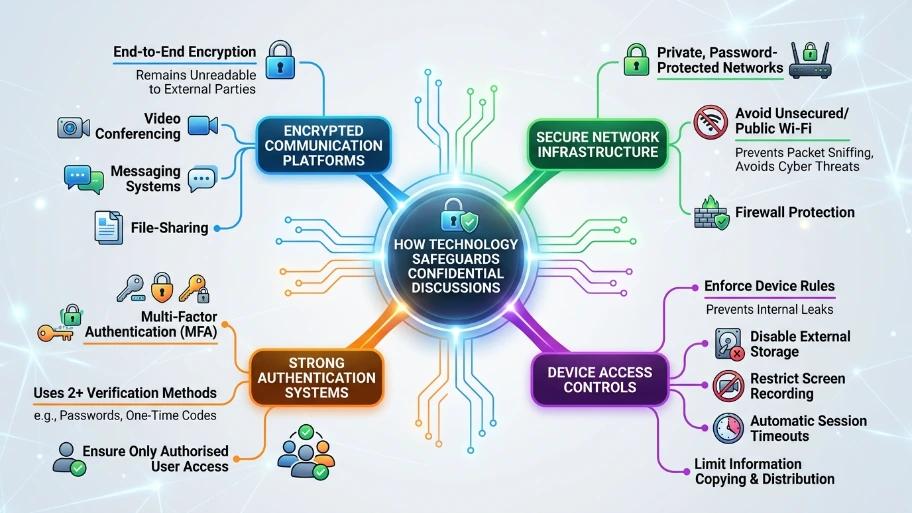
Technology safeguards confidentiality through encrypted communication platforms, secure Wi-Fi networks, device access controls, and data protection protocols. These tools prevent interception, unauthorised recording, and cyber threats, ensuring that digital information shared during meetings remains protected at all stages.
Encryption is the primary defence against data interception. End-to-end encryption ensures that communication remains unreadable to external parties. This applies to video conferencing tools, messaging systems, and file-sharing platforms used during meetings. Secure network infrastructure is equally important. Public or unsecured Wi-Fi exposes data to cyber threats such as packet sniffing. Organisations rely on private, password-protected networks with firewall protection to secure communication channels.
Device control policies prevent internal leaks. Companies enforce rules such as disabling external storage devices, restricting screen recording, and implementing automatic session timeouts. These measures limit the ability to copy or distribute sensitive information. Authentication systems strengthen digital security. Multi-factor authentication uses two or more verification methods, such as passwords and one-time codes, to ensure that only authorised users access meeting platforms.
How do you control participant access effectively?
Effective participant control involves verifying identities, limiting attendance to essential stakeholders, and maintaining access logs. These processes ensure that only authorised individuals participate, reducing the risk of information leaks and maintaining accountability throughout the meeting lifecycle.
Participant verification begins before the meeting. Organisations confirm attendee identities using official documentation or internal HR records. This step is essential when external advisors or consultants are involved. Attendance restrictions reduce exposure risk. Limiting participation to key decision-makers ensures that fewer individuals handle sensitive information. For example, board-level discussions typically include directors, legal advisors, and finance leads only.
Access logs provide traceability. Recording entry and exit times creates accountability and supports compliance audits. These logs become critical evidence in case of data breaches or disputes. Structured facilities streamline this process. Using professionally managed meeting rooms ensures that access control protocols are consistently applied, reducing reliance on internal administrative processes.
What role do policies and compliance frameworks play?
Policies and compliance frameworks establish clear rules for handling confidential information, ensuring legal compliance and consistent behaviour. They define data handling procedures, enforce accountability, and align meeting practices with UK GDPR and corporate governance standards.
Formal confidentiality policies guide participant behaviour. These policies outline what information can be shared, recorded, or distributed. Clear guidelines reduce ambiguity and prevent accidental disclosures. Non-disclosure agreements (NDAs) strengthen legal protection. Directors, advisors, and third parties sign NDAs to confirm their obligation to maintain confidentiality. Breaches of these agreements carry legal consequences.
Compliance frameworks ensure consistency. UK companies align their practices with standards such as ISO 27001 for information security management. These frameworks define risk management processes and audit requirements. Training enhances policy effectiveness. Organisations conduct regular training sessions to ensure that participants understand confidentiality requirements. Awareness reduces human error, which accounts for over 80% of data breaches globally.
How can meeting environments enhance confidentiality?
Meeting environments enhance confidentiality by offering controlled infrastructure, secure layouts, and professional management. Dedicated facilities minimise external risks, provide built-in security features, and ensure that all physical and operational elements support privacy during executive discussions.
Purpose-built environments reduce vulnerabilities. Unlike open offices or shared spaces, executive meeting facilities are designed with privacy as a priority. This includes controlled layouts that prevent unauthorised visibility or access. Centralised locations improve consistency. Businesses operating across multiple regions benefit from using standardised facilities. For deeper insight, see Why Centralised Meeting Facilities are Ideal for Multi-Location Corporate Business Teams.
Professional management adds operational security. Staff oversee access control, monitor activity, and ensure that all security protocols are followed. This reduces reliance on internal teams and minimises human error. High-quality infrastructure supports confidentiality. Features such as secure internet connections, soundproofing, and restricted access zones create a controlled environment that aligns with corporate governance requirements.
How do you prevent information leaks during meetings?
Preventing information leaks requires strict device policies, controlled document handling, and real-time monitoring. These measures ensure that sensitive data is not recorded, copied, or shared without authorisation during or after the meeting.
Device restrictions reduce risk significantly. Organisations enforce policies such as disabling personal devices or restricting their use during meetings. This prevents unauthorised recordings or data capture. Document control ensures traceability. Companies distribute meeting materials through secure platforms rather than printed copies. Digital documents can be encrypted, tracked, and revoked if necessary.
Real-time monitoring enhances oversight. Meeting facilitators ensure that participants follow confidentiality protocols. Immediate intervention prevents potential breaches during discussions. Clear communication protocols define information flow. Participants understand what can be shared externally and what remains confidential. This clarity reduces accidental disclosures.
Explore our meeting rooms guides,
The Connection Between a Professional Workspace and Successful Business Partnership Outcomes Today
Why Modern Meeting Rooms Need Advanced Video Conferencing and Digital Tool Integration
What are the benefits of using professional meeting room services?
Professional meeting room services provide secure infrastructure, controlled access, and compliance-ready environments. They reduce operational risk, ensure consistent confidentiality standards, and support executive-level discussions with purpose-built facilities designed for privacy and security.
Dedicated service providers offer structured security features. These include controlled entry systems, monitored environments, and secure connectivity. Businesses benefit from a ready-to-use secure setup without additional investment. Operational efficiency improves significantly. Instead of configuring internal spaces, organisations use pre-secured environments that meet compliance standards. This reduces preparation time and administrative overhead.
For businesses seeking reliable solutions, secure meeting rooms provide an effective way to manage confidentiality without complexity. These facilities align with corporate governance requirements and support high-level decision-making. When planning your next executive session, you can explore professionally managed meeting rooms that ensure confidentiality and operational efficiency.
For decision-focused planning, organisations often prioritise secure environments that guarantee outcomes. Learn how to book your next corporate meeting with guaranteed professional results today.
Ensuring privacy and confidentiality during executive board meetings requires a structured approach that combines physical security, digital safeguards, access control, and compliance frameworks. Each element plays a defined role in protecting sensitive information and maintaining governance integrity.
From My Company delivers secure and professionally managed meeting environments that align with UK compliance standards. Their meeting room solutions integrate access control, secure infrastructure, and operational support, enabling organisations to conduct confidential discussions with confidence and consistency.
Frequently Asked Questions
How do meeting rooms protect confidentiality during executive meetings?
Meeting rooms protect confidentiality by using controlled access, sound reduction, and restricted visibility. From My company meeting rooms support private discussions by limiting entry and reducing the chance of overhearing sensitive board-level information.
What security features should a private meeting room have?
A private meeting room should include access control, secure entry logs, and reliable soundproofing. These meeting rooms also work best with monitored reception areas and Wi-Fi protection that reduces unauthorised access to shared business data.
Why are meeting rooms important for board meetings?
Meeting rooms matter because board meetings often cover strategy, finance, and governance topics. From My company meeting rooms provide a controlled environment that helps keep confidential conversations separate from general office activity.
How can businesses keep information secure in meeting rooms?
Businesses keep information secure by limiting attendees, controlling devices, and managing documents carefully. Meeting rooms support this process by giving teams a dedicated space for confidential discussions, printed materials, and secure digital presentations.
What is the best meeting room setup for confidential discussions?
The best setup includes restricted access, minimal distractions, and acoustic privacy. From My company, meeting rooms are suited to confidential meetings because they create a professional setting for focused discussions and controlled information sharing.