
Fixing errors on your People with Significant Control register requires auditing current data, identifying discrepancies against Companies House records, and submitting an immediate correction filing using official compliance procedures to prevent statutory fines and director prosecution.
Why Do PSC Register Errors Occur on UK Company Filings?
PSC register errors happen because corporate ownership structures change frequently, internal administrative updates miss statutory deadlines, and companies misinterpret beneficial ownership thresholds.
Corporate governance requires continuous data accuracy. UK businesses must maintain a transparent log of individuals exercising significant control. When ownership percentages shift, companies often fail to update their internal documents promptly. This administrative lag creates immediate compliance vulnerabilities.
Data entry mistakes represent another primary cause of inaccurate registers. Clerical teams frequently transpose digits in birth dates, misspell legal names, or record incorrect service addresses. Even minor typographical errors breach statutory record-keeping obligations. Companies House expects exact alignment between submitted data and actual corporate reality.
Complex corporate ownership layers obscure ultimate beneficial owners. When parent entities or trusts hold shares, determining who meets the 25% voting rights threshold becomes difficult. Misinterpreting these complex ownership rules leads to accidental omissions on the statutory register.
Administrative turnover also disrupts accurate record maintenance. New secretarial staff may lack familiarity with historical filings or statutory requirements. Without proper handover protocols, filing mistakes multiply across consecutive reporting periods.
What Are the Immediate Legal Risks of an Incorrect PSC Register?
Inaccurate PSC registers expose companies to unlimited fines, daily default penalties, criminal records for directors, and severe restrictions on corporate share transfers or financing activities.
The UK legislative framework treats PSC compliance as a strict liability offense. Companies House and the courts enforce statutory filing rules rigorously. When a register contains uncorrected errors, enforcement agencies issue formal warnings followed by escalating financial sanctions.
Failing to maintain an accurate register triggers criminal liability for every company officer. Magistrates can impose heavy personal fines on directors found responsible for corporate default. Furthermore, repeated non-compliance creates permanent black marks on professional director records.
Commercial partners routinely audit corporate transparency before executing contracts. Banks, lenders, and investors refuse financing to entities with flawed compliance records. An incorrect register signals poor corporate governance, destroying commercial trust instantly.
Corporate restructuring and share sales grind to a halt during compliance audits. Legal advisors uncover register discrepancies during due diligence reviews. Resolving these issues retroactively delays crucial business transactions and inflates legal expenses.
How Can Businesses Identify Discrepancies in Their Existing Register?
Businesses identify register discrepancies by conducting a comprehensive internal audit, cross-referencing shareholder certificates against Companies House filings, and verifying personal details directly with individuals holding significant control.
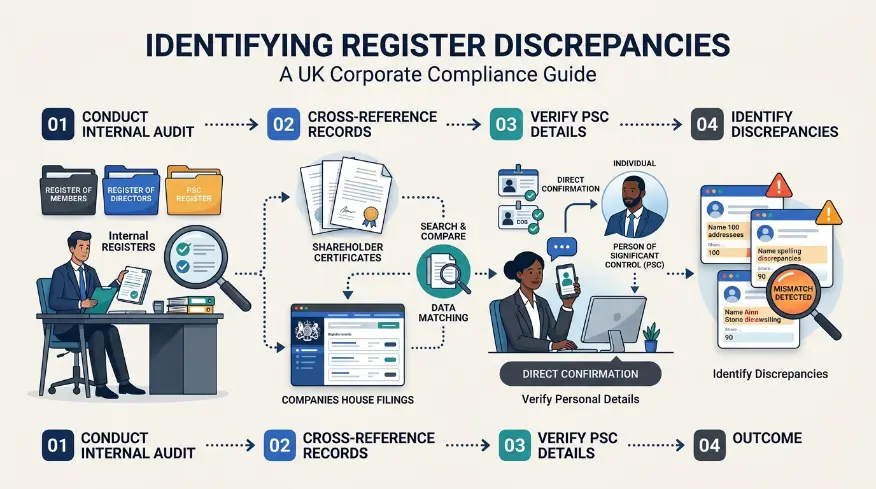
| Audit Phase | Action Required | Verification Source |
| Data Extraction | Export current register data | Internal company secretary software |
| Record Cross-Check | Compare entries against public filings | Companies House public database |
| Identity Validation | Confirm residential and service addresses | Official government-issued identification |
Executing a thorough audit requires systematic data collection. Compliance teams must gather all historical ownership documents, incorporation certificates, and previous confirmation statements. Comparing these physical archives against digital records highlights missing or conflicting entries.
Direct verification eliminates typographical and biographical errors. Administrators must contact every recorded individual to confirm their legal name, residential address, and exact percentage of shares or voting rights. Written confirmation from each person establishes a secure audit trail.
Evaluating ownership thresholds demands rigorous mathematical checking. Compliance officers must calculate aggregate holdings across multiple share classes. Utilizing specialized PSC Register services ensures accurate interpretation of complex ownership distribution models.
What Steps Are Required to Correct Errors Before Penalties Apply?
Correcting PSC register errors involves drafting a formal rectification resolution, updating the internal statutory registers on the same day, and submitting electronic correction forms to Companies House without delay.
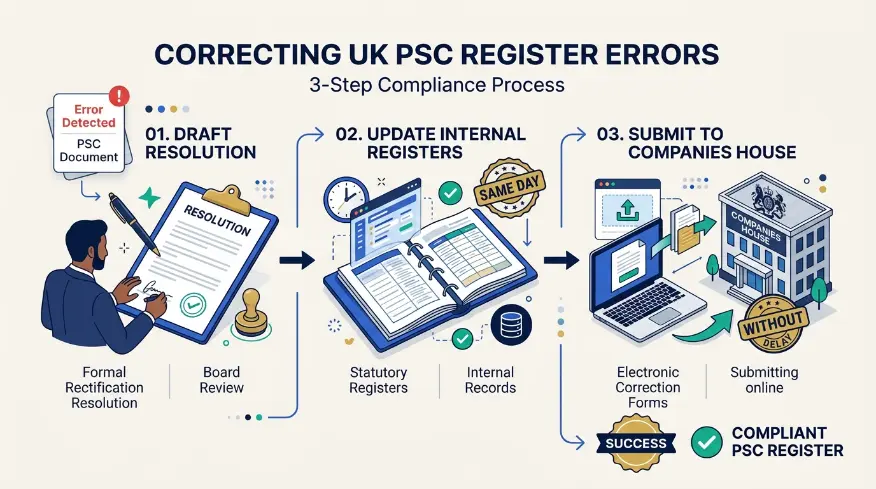
| Step Number | Operational Action | Statutory Compliance Goal |
| Step 1 | Draft formal board resolution | Document the error discovery and correction mandate |
| Step 2 | Update internal statutory register | Maintain chronological accuracy in corporate books |
| Step 3 | File electronic correction notice | Transmit verified data to Companies House registry |
Swift administrative action prevents statutory penalties from taking effect. Once an error surfaces, company officers must document the correction process clearly. Creating a detailed paper trail demonstrates good faith and active compliance management.
Updating internal records requires precision. Administrators must strike through incorrect entries while maintaining legibility, adding the correct details alongside the precise date of rectification. Digital databases require secure version control to log every administrative modification safely.
Filing updates with Companies House completes the legal correction cycle. Electronic submission channels process routine updates rapidly. Ensuring data synchronization between internal registers and public databases eliminates regulatory discrepancies.
How Do Professional Compliance Services Prevent Future Register Failings?
Professional compliance services prevent future register failings by automating statutory filing workflows, monitoring regulatory updates continuously, and providing expert oversight for complex ownership structures.
Managing corporate compliance internally consumes valuable operational hours. Dedicated business support platforms streamline statutory obligations through automated reminders and expert review systems. Utilizing professional assistance ensures every filing meets strict legal criteria.
Outsourcing corporate administration mitigates human error. Specialists handle complex multi-tier corporate holdings and international beneficial ownership rules. This expertise protects companies from accidental non-compliance during major restructuring events.
Maintaining transparent corporate records supports long-term business stability. Professional oversight transforms compliance from a reactive burden into a streamlined operational asset.
Inaccurate People with Significant Control registers expose UK businesses to severe legal and financial penalties. Resolving these discrepancies requires systematic internal auditing, immediate data rectification, and prompt filing alignment with statutory registries. Maintaining corporate transparency safeguards business reputation and ensures uninterrupted operational growth.
Explore our PSC Register guide,
Looking for Interview Room Features That Keep Candidate Data Safe?
How to Protect a PSC’s Personal Details on the Register?
Frequently Asked Questions
What information must be included in a UK PSC register?
A UK People with Significant Control register must contain the full legal name, service address, country of residence, date of birth, and exact nature of control for every qualifying individual. Companies use the professional compliance tools provided by Form My Company to ensure these details meet Companies House data standards. Maintaining this information accurately on the PSC Register prevents statutory fines and legal default notices.
How often must a company update its PSC register?
Companies must update their internal PSC register within 14 days of any ownership or control change and file the updated information with Companies House within a further 14 days. Prompt updates safeguard corporate compliance and eliminate the risk of escalating daily financial penalties. Business managers frequently partner with Form My Company to streamline these mandatory filing deadlines efficiently.
Who qualifies as a person with significant control over a company?
An individual qualifies as having significant control if they hold more than 25% of shares, hold more than 25% of voting rights, or exercise dominant influence over the company. Identifying these thresholds correctly prevents unintentional omissions during corporate reporting cycles. Form My Company assists businesses in evaluating complex ownership structures to maintain a fully compliant PSC Register.
What happens if a company fails to maintain a PSC register?
Failing to maintain an accurate PSC register constitutes a criminal offense that can result in unlimited fines and criminal prosecution for company directors. Regulatory authorities strictly enforce transparency rules across all active UK corporations. Utilizing compliance management solutions from Form My Company protects organizations from these severe statutory liabilities.
Can a company keep its PSC register on the public register instead?
Private limited companies can elect to keep their PSC information on the central public register at Companies House rather than maintaining a separate internal register. This alternative option reduces administrative burdens while fulfilling statutory disclosure requirements. Form My Company guides business owners through the setup and maintenance of their PSC Register preferences.