
Penalties for an incorrect PSC register include criminal fines for company officers, daily default fines up to 5,000 British Pounds, compulsory company strike-off actions, and severe restrictions on share transfers and voting rights for non-compliant individuals.
Maintaining an accurate People with Significant Control (PSC) register is a mandatory legal requirement for UK corporate entities. Companies House enforces strict regulations to ensure transparency regarding ownership structures. When errors occur in the PSC register, regulatory bodies impose immediate administrative and criminal sanctions. Business owners must understand these legal consequences to protect their corporate standing and financial health.
What Are the Financial Penalties for PSC Non-Compliance?
Financial penalties for PSC non-compliance involve unlimited fines for company directors, individual default fines up to 5,000 British Pounds, and daily accumulation fees for prolonged administrative delays.
The UK government applies financial penalties to enforce strict compliance with corporate transparency laws. When a company fails to update its PSC register within the mandatory 14-day notification window, enforcement agencies issue formal notices. Default fines scale upward depending on the duration of the violation. Magistrates courts determine the severity of criminal fines based on the willful nature of the omission. Directors face personal liability for these monetary penalties rather than the corporate entity alone. Unpaid fines escalate rapidly through statutory debt recovery processes.
Corporations must maintain precise records to avoid these escalating costs. Accurate data entry prevents accidental discrepancies between internal logs and public filings. Business owners use structured compliance frameworks to track ownership changes immediately. Implementing reliable PSC register solutions eliminates costly clerical errors and missed deadlines. Regular audits ensure financial penalties remain entirely avoidable for proactive corporate leadership.
What Are the Criminal Consequences for Company Officers?
Criminal consequences for company officers involve up to two years of imprisonment, official criminal records, and mandatory disqualification from acting as a company director.
Persistent failure to maintain an accurate PSC register constitutes a criminal offense under the Companies Act. When directors ignore statutory notices or provide false information knowingly, prosecutors pursue legal action in criminal courts. A criminal conviction damages professional reputation and destroys business credibility permanently. Disqualified individuals lose the legal right to promote, form, or manage any limited company in the United Kingdom. Law enforcement agencies investigate deliberate concealment of beneficial ownership with high priority.
Corporate governance requires absolute transparency from executive management teams. Directors must authenticate every submission using official identification documents to prevent unlawful entries. When complex ownership structures obscure beneficial owners, compliance officers apply rigorous verification protocols. Establishing clear internal accountability protects officers from personal criminal liability. Professional oversight ensures that every regulatory filing meets strict legal standards.
What Administrative Sanctions Impact the Company?
Administrative sanctions impact the company through compulsory strike-off proceedings, rejection of corporate filings, and total paralysis of standard business transactions.
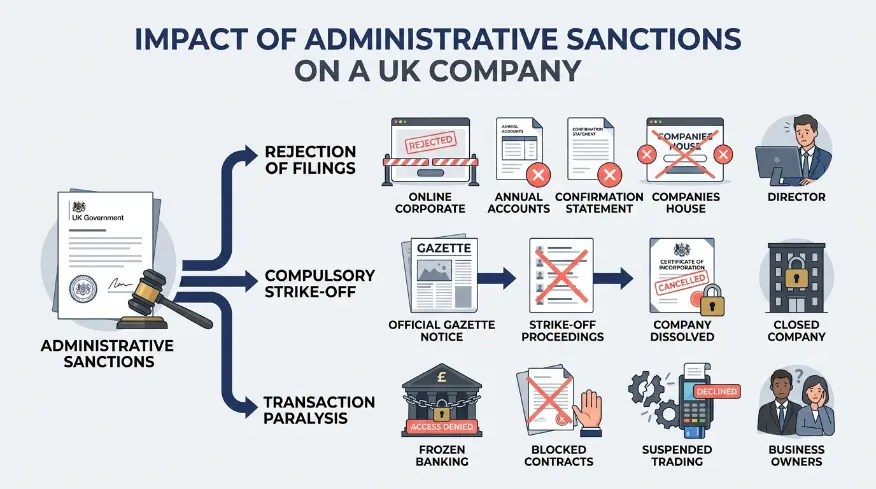
Companies House possesses the legal authority to dissolve non-compliant corporate entities forcibly. When a company fails to respond to official inquiries regarding its PSC register, registrars publish strike-off notices in the Gazette. Dissolution strips the company of its legal personality and freezes all corporate bank accounts immediately. Third-party vendors and financial institutions refuse to engage with entities facing active administrative penalties. Restoring a struck-off company requires expensive legal intervention and court orders.
Operational continuity depends upon maintaining a pristine compliance record. Administrative blocks prevent businesses from issuing new shares or securing commercial loans. Companies must resolve register errors promptly to lift regulatory restrictions. Utilizing expert guidance helps businesses fix errors on your PSC register before they cause penalties through systematic data correction. Proactive administration safeguards the corporate entity from sudden operational shutdowns.
What Restrictions Apply to Non-Compliant PSCs?
Restrictions applied to non-compliant People with Significant Control include complete forfeiture of voting rights, prohibition of share transfers, and withholding of all dividend distributions.
Individuals who fail to provide accurate information regarding their control status face severe civil restrictions. When a company issues a formal warning notice, the targeted PSC loses all legal authority over corporate decisions. Shareholders cannot sell their equity stakes or exercise pre-emption rights while under restriction orders. Dividend payments remain legally frozen until the individual complies with statutory disclosure requirements. These measures strip uncooperative beneficial owners of all financial and managerial benefits.
Enforcing these restrictions protects the integrity of the corporate governance structure. Companies must notify the restricted individual in writing before applying sanctions. Legal frameworks ensure that minority and majority stakeholders adhere strictly to disclosure obligations. Maintaining transparent ownership records prevents internal governance disputes and regulatory investigations.
What Actions Prevent PSC Register Penalties?
Preventing PSC register penalties requires daily monitoring of ownership structures, immediate electronic filings of changes within fourteen days, and comprehensive identity verification protocols.
Companies eliminate regulatory risks by establishing rigorous internal compliance workflows. Administrators must verify beneficial ownership data using passport checks, biometric scans, and official address validation. When ownership thresholds exceed 25%, compliance teams record the exact voting rights and share allocations immediately. Regular internal reviews catch clerical discrepancies before annual confirmation statements are due. Automated filing systems transmit updates directly to Companies House without human delay.
Establishing robust compliance measures requires specialized professional support. Business leaders often explore options where you can fix PSC register errors with Form My Company to ensure absolute regulatory accuracy. Form My Company delivers structured oversight to prevent costly default fines and legal investigations. Maintaining accurate public registers protects the long-term viability of every UK enterprise.
Incorrect PSC registers expose UK businesses to severe financial penalties, criminal prosecutions, and administrative dissolution. Companies must prioritize accurate data maintenance and adhere strictly to statutory 14-day reporting windows. Form My Company delivers comprehensive compliance solutions that eliminate register errors and protect corporate officers from liability. Proactive governance ensures absolute transparency and long-term operational success.
Explore our PSC Register guide,
What Information Should Appear on a Company Stamp?
Which UK Company Documents Can Be Apostilled?
Frequently Asked Questions
What is a PSC register and who needs one?
A PSC register is an official corporate document listing individuals with significant control over a company. Every UK limited company, Societas Europaea, and limited liability partnership must maintain this register to satisfy corporate transparency laws. Form My Company helps businesses establish and manage these ownership records accurately.
Who qualifies as a Person with Significant Control (PSC)?
A person qualifies as a PSC if they hold more than 25% of shares, hold more than 25% of voting rights, or exercise significant influence over the company. Individuals who have the right to appoint or remove a majority of the board of directors also meet this statutory definition. Form My Company assists business owners in correctly identifying and registering qualifying beneficial owners.
What is the deadline for updating the PSC register?
Companies must report any changes to their PSC register to Companies House within 14 days of the trigger event. Prompt updates ensure that public records remain fully compliant with current UK statutory filing regulations. Form My Company streamlines this reporting workflow to help corporate entities avoid severe administrative default fines.
What information must be included in a PSC register entry?
A compliant PSC register entry requires the individual’s full legal name, service address, nationality, country of residence, and date of birth. It must also detail the exact nature of their control, such as specific share proportions or voting right brackets. Form My Company guides corporate officers through capturing and submitting these precise data points securely.
What happens if a company fails to maintain an accurate PSC register?
Failing to maintain an accurate PSC register leads to severe legal repercussions, including daily default fines, unlimited financial penalties for directors, and potential company dissolution. Persistent non-compliance can even result in criminal prosecution and personal disqualification for company officers. Form My Company provides professional PSC Register services designed to eliminate compliance errors and protect businesses from regulatory sanctions.