

UK company formation with a nominee director is an arrangement in which an individual is appointed to act as a company’s director on behalf of another person, usually the beneficial owner. Although nominee director arrangements are not automatically unlawful in the UK, they involve significant legal responsibilities, transparency requirements and compliance considerations. The Economic Crime and Corporate Transparency Act 2023 has also introduced mandatory identity verification and stronger Companies House controls, changing how these arrangements operate.
For overseas entrepreneurs and business owners considering UK incorporation, understanding the legal position is essential before appointing a nominee. A nominee director does not simply act as a name on the public register. They assume the same statutory duties and responsibilities as other directors, regardless of any private agreement. At Form My Company, we help entrepreneurs understand UK company formation requirements, director responsibilities and compliant alternatives for establishing a UK business.
UK Company Formation With a Nominee Director: What You Need to Know
UK company formation with a nominee director involves incorporating a limited company and appointing an individual to serve as its registered director on behalf of the beneficial owner. The beneficial owner may hold shares, exercise significant control and retain an economic interest in the business.
However, the nominee is not simply a representative without legal responsibilities. Once appointed, the individual becomes a company director and must comply with the Companies Act 2006, Companies House requirements and applicable identity-verification rules.
A nominee agreement can document the commercial relationship and explain the parties’ arrangements, but it cannot remove the nominee’s statutory duties or override company law.
The beneficial owner must also be identified correctly where they meet the applicable Person with Significant Control criteria. Using a nominee director does not provide a lawful way to conceal ownership or avoid transparency requirements.
What Is a Nominee Director in the UK?
A nominee director is an individual appointed to a company’s board while acting in connection with an arrangement involving another person, usually the beneficial owner.
Historically, some overseas entrepreneurs used nominee directors to create a UK-based management presence or keep their personal details away from the public director register. However, this approach is frequently misunderstood.
A nominee director has genuine legal responsibilities. They must exercise independent judgment, act in the company’s interests and comply with their statutory duties. A private agreement cannot reduce these obligations to administrative tasks such as signing documents or submitting annual filings.
How a Nominee Director Arrangement Works
A typical arrangement involves several parties and responsibilities:
Beneficial owner: The individual who ultimately owns or controls the company.
Nominee director: The person formally appointed to the board and responsible for fulfilling director duties.
Shareholders: The individuals or entities holding shares and exercising the rights attached to them.
Person with Significant Control: An individual or relevant entity meeting the applicable ownership or control conditions.
Nominee agreement: A private document recording the commercial understanding and responsibilities between the parties.
The company must maintain accurate ownership and control information. The arrangement must also comply with identity verification and relevant reporting requirements.
How UK Company Formation With a Nominee Director Works
Setting up a company involving a nominee director requires careful preparation. The incorporation process must follow the normal Companies House requirements while accounting for the additional governance and compliance considerations associated with the arrangement.
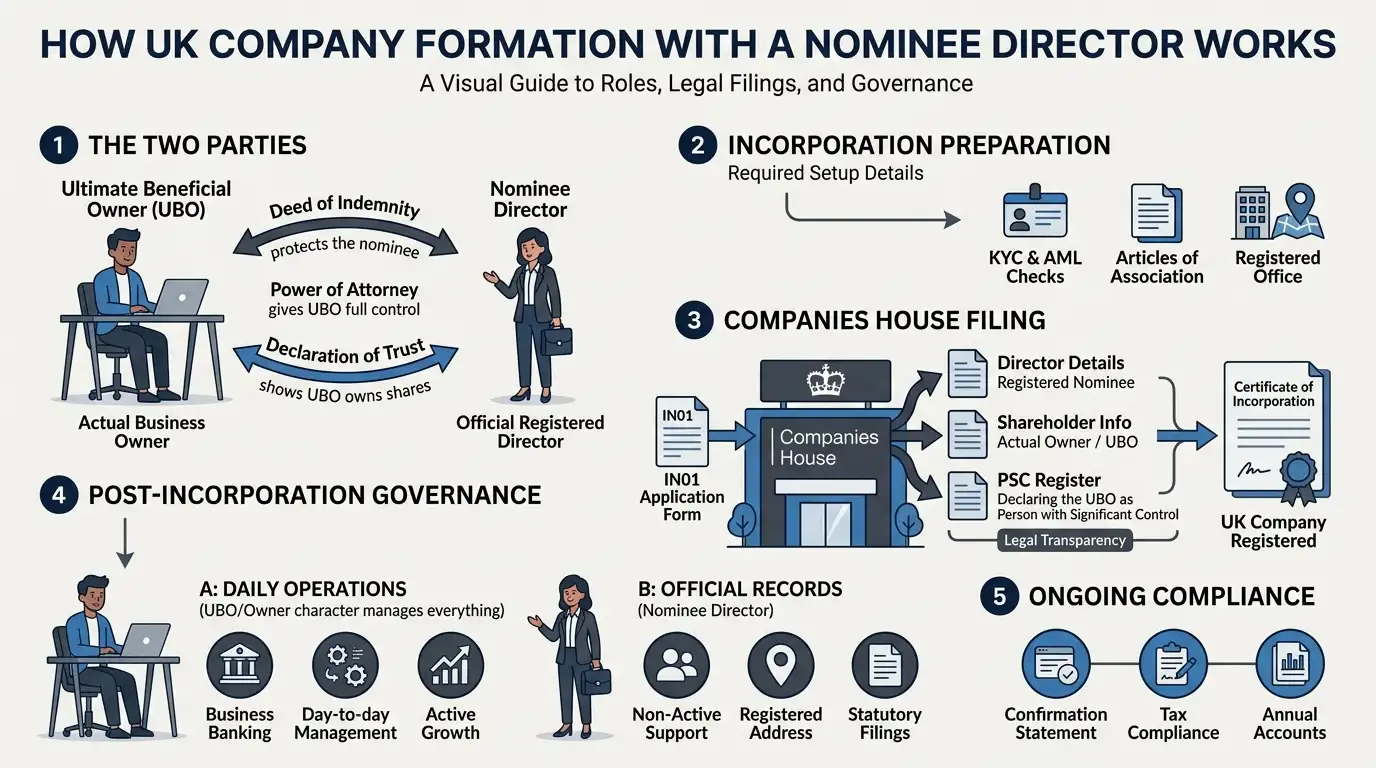
Step 1: Assess the Business Structure
Begin by deciding whether a private company limited by shares is appropriate for your business activities. Consider the ownership structure, proposed share allocation, management arrangements and responsibilities of each individual involved.
The company structure should reflect the actual commercial relationship between the parties. Do not appoint a nominee simply to create an appearance of UK residency or conceal the identity of the people controlling the business.
Step 2: Select and Assess the Proposed Director
Any proposed nominee director must meet the applicable eligibility requirements. The individual must generally be at least 16 years old and must not be disqualified from acting as a director.
Conduct appropriate due diligence before proceeding. Review the proposed director’s experience, availability, understanding of the business and ability to fulfil the responsibilities associated with the position.
A director appointment should never be treated as a purely administrative arrangement.
Step 3: Establish Ownership and Control
Identify the actual shareholders and beneficial owners before incorporation. Determine who holds shares, voting rights and other significant control rights.
A person generally qualifies as a PSC if they meet one or more of the statutory conditions, including holding more than 25% of the shares or voting rights, having the right to appoint or remove a majority of directors, or otherwise exercising significant influence or control.
Accurate PSC information is essential for Companies House transparency. A nominee arrangement does not eliminate the requirement to identify and report the real individuals who own or control the company.
Step 4: Prepare the Incorporation Documents
The company formation process requires accurate incorporation information, including:
Proposed company name.
Registered office address.
Details of the initial director.
Shareholder and share capital information.
Statement of capital.
SIC code describing the company’s business activities.
Articles of association.
PSC information where applicable.
The company must ensure that all information accurately reflects the intended business structure.
Step 5: Complete Identity Verification
Identity verification is now a mandatory requirement for company directors and PSCs under the current Companies House framework.
The proposed nominee director must complete the required verification process and obtain a Companies House personal code. Relevant PSCs must also meet their own identity-verification obligations.
The verification process can be completed through Companies House or an authorised route involving an Authorised Corporate Service Provider.
Step 6: Submit the Incorporation Application
Once the documents and verification requirements are ready, submit the incorporation application through the appropriate Companies House filing route.
The application must provide accurate information about the proposed director, shareholders, registered office and people with significant control.
Following successful incorporation, Companies House issues a certificate of incorporation and assigns the company a unique company number.
Step 7: Establish Ongoing Compliance Arrangements
After incorporation, the company must maintain its statutory records, prepare annual accounts, submit confirmation statements and meet its relevant HMRC obligations.
Any changes to directors, shareholders or PSC information must be reported within the applicable statutory deadlines.
Legal Responsibilities and Compliance Requirements
The legal position of nominee directors is one of the most important considerations when evaluating this arrangement. The Companies Act 2006 does not create a separate category of director with reduced responsibilities simply because someone acts as a nominee.
Companies Act 2006 and Directors’ Duties
Under the Companies Act 2006, directors have statutory responsibilities that apply regardless of their commercial arrangements with shareholders or beneficial owners.
These include:
Acting within the powers granted by the company’s constitution.
Promoting the success of the company.
Exercising independent judgment.
Exercising reasonable care, skill and diligence.
Avoiding conflicts of interest.
Not accepting benefits from third parties improperly.
Declaring interests in proposed or existing transactions.
A nominee director must consider these responsibilities when making decisions. Following instructions from a beneficial owner does not automatically provide protection if those instructions conflict with the director’s legal obligations.
Economic Crime and Corporate Transparency Act 2023
The Economic Crime and Corporate Transparency Act 2023 introduced significant changes to Companies House procedures and corporate transparency.
Mandatory identity verification became a central part of the updated framework from 18 November 2025. Directors and PSCs must complete the relevant verification requirements and provide the required personal code through the applicable filing process.
These requirements apply to nominee directors in the same way as other directors. Individuals who effectively direct a company’s formally appointed directors may also need to consider whether they fall within the legal definition of a shadow director.
Companies must maintain accurate records and avoid arrangements designed to conceal beneficial ownership.
PSC Disclosure and Beneficial Ownership
A company must identify individuals who meet the PSC conditions and report the relevant information to Companies House.
For nominee director arrangements, this means distinguishing between the person appointed as director and the individuals who actually own or control the business.
The nominee’s appointment does not automatically make them the beneficial owner. Equally, the beneficial owner cannot avoid disclosure simply by appointing another individual as the registered director.
Registered Office and Service Address
Every UK limited company must maintain an appropriate registered office address. Directors must also provide the required service address information for Companies House records.
A service address can help protect a director’s residential address from appearing publicly on the register. A professional registered office service can also provide a suitable address for official company correspondence.
These are legitimate privacy measures and should be distinguished from arrangements intended to conceal the identity of company owners.
Benefits and Potential Risks of Using a Nominee Director
Nominee arrangements may have legitimate commercial uses, but their benefits must be evaluated against the responsibilities and potential risks involved.
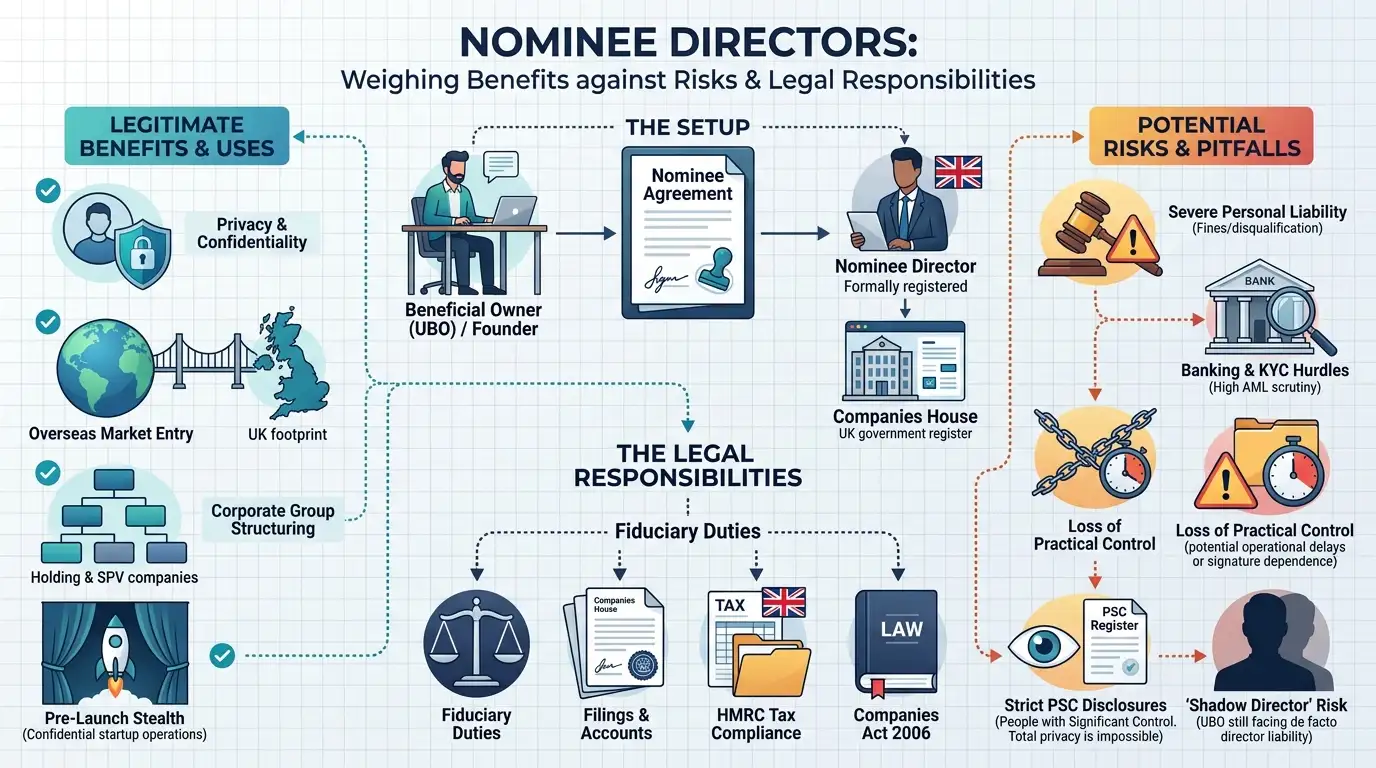
Potential Business Benefits
Defined management arrangements
A nominee arrangement can form part of a documented governance structure where the parties have clearly established responsibilities and legitimate commercial reasons for the appointment.
Support for specific business requirements
Certain corporate structures may involve professional directors with relevant management experience. However, the appointment must reflect genuine responsibilities rather than simply providing a name for registration.
Documented commercial relationships
A properly prepared agreement can explain the relationship between the parties, establish internal procedures and record expectations concerning communication and decision-making.
Professional governance
Where a director has the necessary experience and involvement, their contribution can support governance, oversight and business administration.
Risks and Limitations
Personal legal liability
A nominee director has the same statutory responsibilities as other directors. They cannot rely entirely on instructions from the beneficial owner or assume that an indemnity agreement removes their legal exposure.
Ownership transparency
Companies House requirements make it increasingly difficult to use nominee arrangements as a means of concealing beneficial ownership. Failure to disclose relevant information can result in enforcement action.
Banking and financial services restrictions
Banks and payment providers conduct their own customer due diligence. A nominee arrangement does not guarantee approval for a business bank account. Providers may request additional ownership documents, information about the business and details of its controlling individuals.
Loss of operational clarity
Poorly documented responsibilities can create disagreements between the nominee and beneficial owner. This can affect decision-making, contractual authority and the company’s ability to manage its obligations.
Termination and director replacement
Ending an arrangement requires proper corporate procedures. The company must ensure that director changes are authorised, recorded and notified to Companies House correctly.
Is a Nominee Director Necessary for Non-UK Residents?
In most cases, a non-UK resident does not need a nominee director to establish a UK limited company.
UK company law does not generally require directors to live in the United Kingdom or hold British nationality. An overseas entrepreneur can therefore act as the director of their own UK company, provided they satisfy the applicable eligibility and compliance requirements.
This is particularly important for international founders who consider nominee arrangements because they believe a UK-resident director is compulsory.
Instead, non-residents can consider a professional registered office address and director’s service address to establish an appropriate UK correspondence arrangement while maintaining legitimate privacy.
Form My Company’s Non-Residents package is relevant to overseas founders who want to establish a UK company without appointing an unnecessary nominee director.
Nominee Director vs Directorship by the Beneficial Owner
Understanding the difference between these approaches helps business owners select an appropriate company structure.
| Consideration | Nominee director arrangement | Beneficial owner as director |
|---|---|---|
| Registered director | Appointed nominee | Actual business owner |
| Ownership disclosure | PSC information remains necessary | PSC information remains necessary |
| Legal responsibilities | Full director duties | Full director duties |
| Identity verification | Required | Required |
| Management arrangements | Requires clear governance | Direct involvement in management |
| Privacy considerations | Does not conceal beneficial ownership | Service address can protect residential privacy |
| Suitability | Requires a genuine and compliant purpose | Often suitable for overseas founders |
For many international entrepreneurs, acting as their own director is a more straightforward option than introducing a nominee arrangement.
Common Mistakes to Avoid During Nominee Director Company Formation
Treating the Nominee as a Figurehead
A nominee director cannot simply sign documents without considering their responsibilities. Every director must understand and fulfil their statutory duties.
Failing to Disclose Beneficial Ownership
Not reporting the actual individuals who own or control the company creates serious compliance risks. PSC information must be accurate and maintained in accordance with Companies House requirements.
Assuming a Nominee Guarantees Banking Approval
Financial institutions conduct independent due diligence. A nominee director does not guarantee that a bank will accept an application or provide a business account.
Ignoring Identity Verification
Directors and relevant PSCs must complete mandatory identity verification. Failure to comply can result in offences and enforcement consequences.
Using Inadequate Agreements
A nominee agreement should accurately document the commercial arrangement. It cannot remove statutory duties or authorise conduct that conflicts with company law.
Neglecting Ongoing Company Compliance
Incorporation is only the beginning of a company’s legal responsibilities. Directors must maintain statutory records, submit required filings and ensure that relevant information remains accurate.
Practical Considerations Before Choosing a Nominee Director
Before entering into a nominee arrangement, assess whether the proposed structure serves a genuine commercial purpose and whether the parties understand their legal responsibilities.
Consider the following points:
Review the company’s intended ownership and management structure.
Confirm the legal eligibility of the proposed director.
Assess whether the nominee understands the responsibilities of the position.
Establish transparent beneficial ownership and PSC reporting.
Complete the relevant Companies House identity-verification requirements.
Obtain appropriate legal advice on the nominee agreement.
Review banking and payment provider eligibility independently.
Establish procedures for director changes and ongoing compliance.
A careful assessment helps prevent unnecessary complexity and reduces the risk of governance disputes or regulatory problems.
Frequently Asked Questions
Is UK company formation with a nominee director legal?
Nominee director arrangements are not automatically unlawful in the UK. However, the nominee must fulfil the same legal duties as any other director, complete mandatory identity verification and comply with Companies House requirements. Beneficial ownership must also be disclosed accurately.
Can a non-UK resident form a UK company with a nominee director?
Yes, but a non-UK resident does not generally need a nominee director to establish a UK limited company. Overseas individuals can usually act as directors themselves, subject to the applicable eligibility and verification requirements.
Does a nominee director have full legal responsibilities?
Yes. A nominee director has the same statutory duties and responsibilities as any other company director under the Companies Act 2006. A private agreement cannot remove these legal obligations.
Does appointing a nominee director hide the real company owner?
No. A nominee arrangement does not remove the obligation to identify and disclose people with significant control. Beneficial ownership and control information must be reported accurately where the relevant legal conditions are met.
Do banks accept UK companies with nominee directors?
Banking providers assess applications individually. They may request information about the nominee, beneficial owners, business activities and source of funds. Appointing a nominee director does not guarantee business banking approval.
What documents are required for nominee director company formation?
The requirements depend on the company’s circumstances. They generally include incorporation information, director and shareholder details, registered office information, relevant PSC details, identity verification and appropriate documentation recording the arrangement.
Can a nominee director be removed?
Yes. A director can leave office through the applicable company procedures and legal requirements. The company must record the change and notify Companies House within the relevant deadline.
What is the difference between a nominee director and a shadow director?
A nominee director is formally appointed to the company’s board. A shadow director is an individual whose directions or instructions the formally appointed directors are accustomed to follow, subject to the statutory definition and exceptions. Both arrangements involve important legal considerations.
Establish Your UK Company with Form My Company
UK company formation involving a nominee director requires careful consideration of ownership transparency, director responsibilities and Companies House compliance. Although nominee arrangements can have legitimate purposes, they are not a shortcut to hiding beneficial ownership or avoiding UK company regulations.
For many overseas founders, directorship combined with a professional registered office and director’s service address offers a more straightforward route to establishing a UK business.
Form My Company supports entrepreneurs with online company formation, registered office services, director’s service addresses, identity verification and ongoing compliance assistance. Explore the available services and choose a company formation approach that meets your business requirements while maintaining transparency and legal compliance.